Opening the book…
There is an order relation on the set of real numbers:
\(4< 9\) reads as \(4\) is less than \(9\),
\(-3\leq 2\) reads as \(-3\) is less than or equal to \(2\),
\(\dfrac{7}{6}> 1\) reads as \(\dfrac{7}{6}\) is greater than \(1\),
\(2\geq -3\) reads as \(2\) is greater than or equal to \(-3\).
We have \(2<3\), but \(-2>-3\), which can be seen on the number line above.
We have \(5\leq 5\) and \(5\geq 5\). However the same is not true when using the symbol \(<\). We write this as \(5\nless 5\).
The set of all real numbers \(x\) greater than or equal to some number \(a\) and/or less than or equal to some number \(b\) is denoted in different ways by the following chart:
| Inequality notation | Number line | Interval notation |
|---|---|---|
| \(a\leq x\leq b\) |  |
\([a,b]\) |
| \(a< x< b\) | 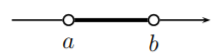 |
\((a,b)\) |
| \(a\leq x< b\) | 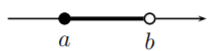 |
\([a,b)\) |
| \(a< x\leq b\) |  |
\((a,b]\) |
| \(a\leq x\) |  |
\([a,\infty)\) |
| \(a< x\) | 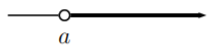 |
\((a,\infty)\) |
| \(x\leq b\) | 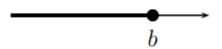 |
\((-\infty,b]\) |
| \(x< b\) |  |
\((-\infty,b)\) |
Formally, we define the interval \([a,b]\) to be the set of all real numbers \(x\) such that \(a\leq x \leq b\):
\[[a, b]=\{x \mid a \leq x \leq b\} \nonumber \]
There are similar definitions for the other intervals shown in the above table.
Be sure to write the smaller number \(a<b\) first when writing an interval \([a,b]\). For example, the interval \([5,3]=\left\{\begin{array}{l|l}
x \mid & 5 \leq x \leq 3\}
\end{array}\right.\) would be the empty set!
Graph the the inequality \(\pi<x\leq 5\) on the number line and write it in interval notation.
Solution
On the number line: 
Interval notation: \((\pi,5]\)
Write the following interval as an inequality and in interval notation: 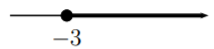
Solution
Inequality notation: \(-3\leq x\)
Interval notation: \([-3,\infty)\)
Write the following interval as an inequality and in interval notation: 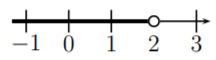
Solution
Inequality notation: & \(x<2\)
Interval notation: & \((-\infty,2)\)
In some texts round and square brackets are also used on the number line to depict an interval. For example the following displays the interval \([2,5)\).

This page titled 1.3: Inequalities and intervals was last modified on Mon, 02 May 2022 15:49:55 GMT and is shared under a CC BY-NC-SA 4.0 license and was authored, remixed, and/or curated by Thomas Tradler and Holly Carley (New York City College of Technology at CUNY Academic Works) via source content that was edited to the style and standards of the LibreTexts platform.
The book could not be loaded just now.