Opening the book…
Use the horizontal line test to determine if the function is one-to-one.
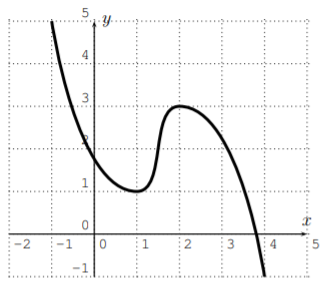
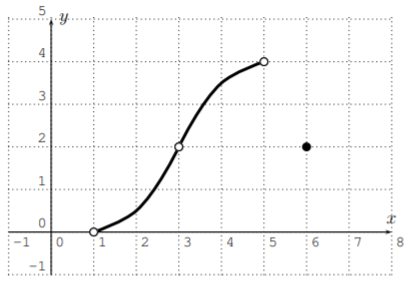
- \(f(x)=x^2+2x+5\)
- \(f(x)=x^2-14 x+29\)
- \(f(x)=x^3-5x^2\)
- \(f(x)=\dfrac{x^2}{x^2-3}\)
- \(f(x)=\sqrt{x+2}\)
- \(f(x)=\sqrt{|x+2|}\)
- Answer
-
- no (that is: the function is not one-to-one)
- yes
- no
- no
- no
- no
- yes
- no
Find the inverse of the function \(f\) and check your solution.
- \(f(x)=4x+9\)
- \(f(x)=-8x-3\)
- \(f(x)=\sqrt{x+8}\)
- \(f(x)=\sqrt{3x+7}\)
- \(f(x)=6\cdot \sqrt{-x-2}\)
- \(f(x)=x^3\)
- \(f(x)=(2x+5)^3\)
- \(f(x)=2\cdot x^3+5\)
- \(f(x)=\dfrac{1}{x}\)
- \(f(x)=\dfrac{1}{x-1}\)
- \(f(x)=\dfrac{1}{\sqrt{x-2}}\)
- \(f(x)=\dfrac{-5}{4-x}\)
- \(f(x)=\dfrac{x}{x+2}\)
- \(f(x)=\dfrac{3x}{x-6}\)
- \(f(x)=\dfrac{x+2}{x+3}\)
- \(f(x)=\dfrac{7-x}{x-5}\)
- \(f\) given by the table: \(\begin{array}{|c||c|c|c|c|c|c|}
\hline x & 2 & 4 & 6 & 8 & 10 & 12 \\
\hline \hline f(x) & 3 & 7 & 1 & 8 & 5 & 2 \\
\hline
\end{array} \)
- Answer
-
- \(f^{-1}(x)=\dfrac{x-9}{4}\)
- \(f^{-1}(x)=-\dfrac{x+3}{8}\)
- \(f^{-1}(x)=x^{2}-8\)
- \(f^{-1}(x)=\dfrac{x^{2}-7}{3}\)
- \(f^{-1}(x)=-\left(\dfrac{x}{6}\right)^{2}-2=\dfrac{-x^{2}-72}{36}\)
- \(f^{-1}(x)=\sqrt[3]{x}\)
- \(f^{-1}(x)=\dfrac{\sqrt[3]{x}-5}{2}\)
- \(f^{-1}(x)=\sqrt[3]{\dfrac{x-5}{2}}\)
- \(f^{-1}(x)=\dfrac{1}{x}+1=\dfrac{1+x}{x}\)
- \(f^{-1}(x)=\left(\dfrac{1}{x}\right)^{2}+2=\dfrac{1+2 x^{2}}{x^{2}}\)
- \(f^{-1}(x)=\dfrac{5}{y}+4=\dfrac{5+4 y}{y}\)
- \(f^{-1}(x)=\dfrac{5}{y}+4=\dfrac{5+4 y}{y}\)
- \(f^{-1}(x)=\dfrac{2 x}{1-x}\)
- \(f^{-1}(x)=\dfrac{6 x}{x-3}\)
- \(f^{-1}(x)=\dfrac{2-3 x}{x-1}\)
- \(f^{-1}(x)=\dfrac{5 x+7}{x+1}\)
- \(\begin{array}{|c||c|c|c|c|c|c|}
\hline x & 3 & 7 & 1 & 8 & 5 & 2 \\
\hline \hline f^{-1}(x) & 2 & 4 & 6 & 8 & 10 & 12 \\
\hline
\end{array}\)
Restrict the domain of the function \(f\) in such a way that \(f\) becomes a one-to-one function. Find the inverse of \(f\) with the restricted domain.
- \(f(x)=x^2\)
- \(f(x)=(x+5)^2+1\)
- \(f(x)=|x|\)
- \(f(x)=|x-4|-2\)
- \(f(x)=\dfrac{1}{x^2}\)
- \(f(x)=\dfrac{-3}{(x+7)^2}\)
- \(f(x)=x^4\)
- \(f(x)=\dfrac{(x-3)^4}{10}\)
- Answer
-
- restricting to the domain \(D=[0, \infty)\) gives the inverse \(f^{-1}(x)=\sqrt{x}\)
- restricting to the domain \(D=[-5, \infty)\) gives the inverse \(f^{-1}(x)=\sqrt{x-1}-5\)
- restricting to the domain \(D=[0, \infty)\) gives the inverse \(f^{-1}(x)=x\)
- restricting to the domain \(D=[4, \infty)\) gives the inverse \(f^{-1}(x)=x+6\)
- restricting to the domain \(D=[0, \infty)\) gives the inverse \(f^{-1}(x)=\sqrt{\dfrac{1}{x}}\)
- restricting to the domain \(D=[-7, \infty)\) gives the inverse \(f^{-1}(x)=\sqrt{-\dfrac{3}{x}}-7\)
- restricting to the domain \(D=[0, \infty)\) gives the inverse \(f^{-1}(x)=\sqrt[4]{x}\)
- restricting to the domain \(D=[3, \infty)\) gives the inverse \(f^{-1}(x)=3+\sqrt[4]{10 x}\)
Determine whether the following functions \(f\) and \(g\) are inverse to each other.
- \(f(x)=x+3, \quad g(x)=x-3\),
- \(f(x)=-x-4, \quad g(x)=4-x\),
- \(f(x)=2x+3, \quad g(x)=x-\dfrac{3}{2}\),
- \(f(x)=6x-1, \quad g(x)=\dfrac{x+1}{6}\),
- \(f(x)=x^3-5, \quad g(x)= 5+\sqrt[3]{x}\),
- \(f(x)=\dfrac{1}{x-2}, \quad g(x)=\dfrac{1}{x}+2\).
- Answer
-
- yes (that is: the functions f and g are inverses of each other)
- no
- no
- yes
- no
- yes
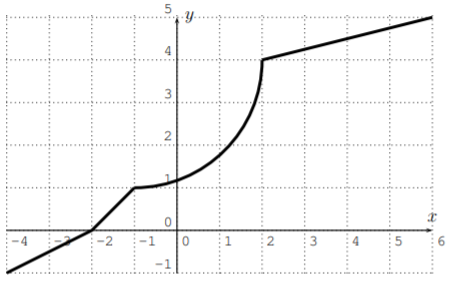
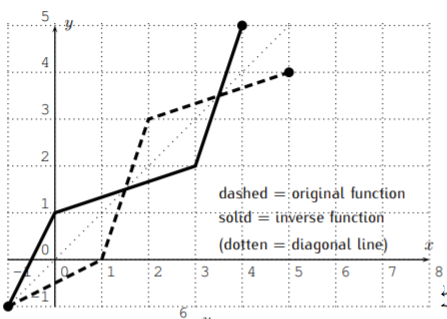
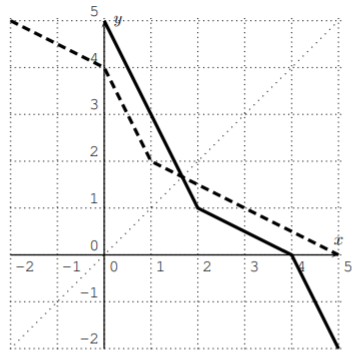
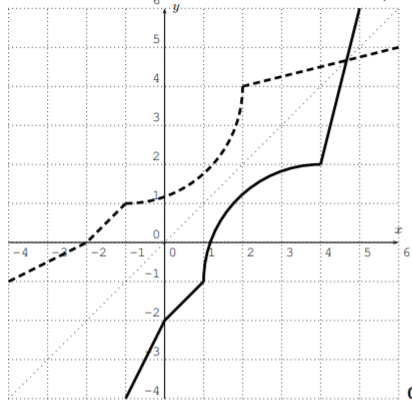
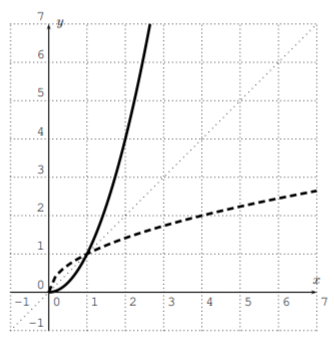
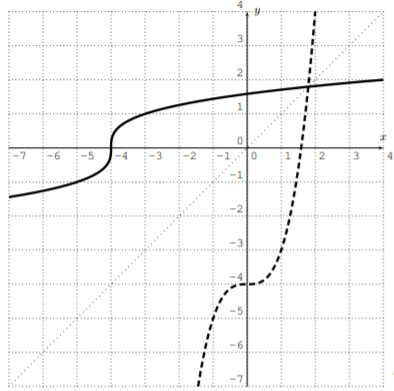
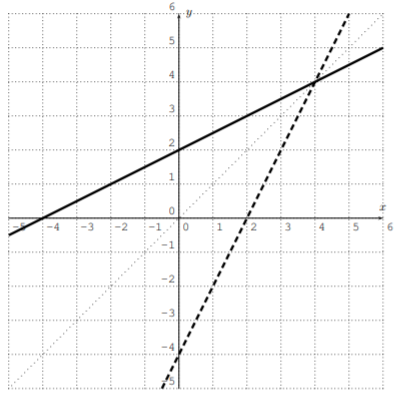
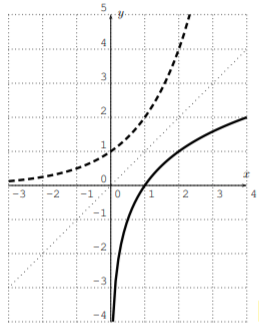
Draw the graph of the inverse of the function given below.
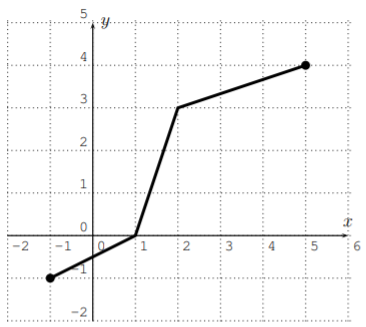
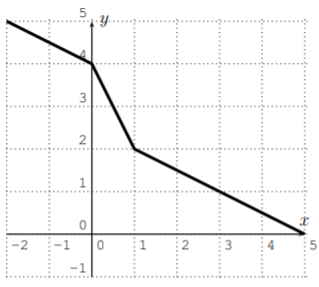
- \(f(x)=\sqrt{x}\)
- \(f(x)=x^3-4\)
- \(f(x)=2x-4\)
- \(f(x)=2^x\)
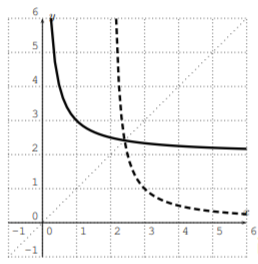
- \(f(x)=\dfrac{1}{x-2}\) for \(x>2\)
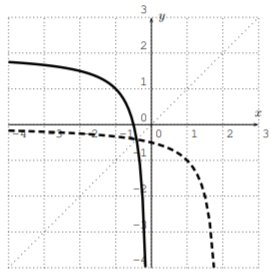
- \(f(x)=\dfrac{1}{x-2}\) for \(x<2\)
- Answer
-
This page titled 7.3: Exercises was last modified on Mon, 02 May 2022 15:49:55 GMT and is shared under a CC BY-NC-SA 4.0 license and was authored, remixed, and/or curated by Thomas Tradler and Holly Carley (New York City College of Technology at CUNY Academic Works) via source content that was edited to the style and standards of the LibreTexts platform.
The book could not be loaded just now.