Opening the book…
1. Partial answer: Jars: 3 singles, 3 @ \(x3, 2\) @ \(x6, 1\) @ \(x12. 3+9+12+12 = 36\)
3. \(113\)
5. \(3022\)
7. \(53\)
9. \(1100100\)
11. \(332\)
13. \(111100010\)
15. 7,1,10 base \(12=1030\) base 10
17. 6,4,2 base \(12=914\) base 10
19. 175 base \(10=1,2,7\) base \(12=\)
21. 10000 base \(10=5,9,5,4\) base \(12=\) 
23. \(135=6,15\) base \(20=\)
25. \(360=18,0\) base \(20=\)
27. \(10500=1,6,5,0\) base 20 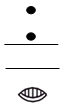
29. 1,2,12 base \(20=452\) base 10
31. 3,0,3 base \(20=1203\) base 10
33. \(32+11=1,12_{20}+11_{20}=1,23_{20}=2,3_{20}=43\)
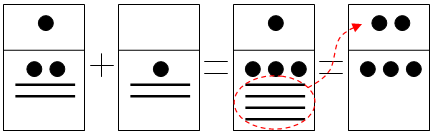
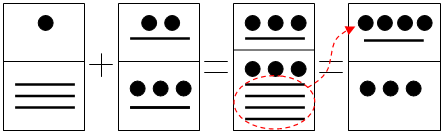
35. \(35+148=1,15_{20}+7,8_{20}=8,23_{20}=9,320=183\)
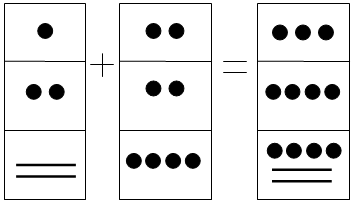
37. \(450+844=1,2,10_{20}+2,2,4_{20}=3,4,14_{20}=1294\)
This page titled 18.14: Historical Counting was last modified on Sat, 02 Jan 2021 09:26:47 GMT and is shared under a CC BY-SA 3.0 license and was authored, remixed, and/or curated by David Lippman (The OpenTextBookStore) via source content that was edited to the style and standards of the LibreTexts platform.
The book could not be loaded just now.