Opening the book…
In our discussion of similar triangles the idea of a proportion will play an important role. In this section we will review the important properties of proportions.
A proportion is an equation which states that two fractions are equal. For example, \(\dfrac{2}{6}=\dfrac{4}{12}\) is a proportion. We sometimes say "2 is to 6 as 4 is to \(12\)." This is also written \(2: 6 = 4:12\). The extremes of this proportion are the numbers 2 and 12 and the means are the numbers 6 and 4. Notice that the product of the means \(6 \times 4=24\) is the same as the product of the extremes \(2 \times 12=24\).
If \(\dfrac{a}{b} = \dfrac{c}{d}\) then \(a d= be\). Conversely, if \(ad = bc\) then \(\dfrac{a}{b} = \dfrac{c}{d}.\) (The product of the means is equal to the product of the extremes).
EXAMPLES:
- \(\dfrac{2}{6} = \dfrac{4}{12}\) and \(2 \times 12=6 \times 4\) are both true.
- \(\dfrac{2}{3} = \dfrac{6}{9}\) and \(2 \times 9=3 \times 6\) are both true.
- \(\dfrac{1}{4} = \dfrac{4}{12}\) and \(1 \times 12=4 \times 4\) are both false.
Proof of Theorem 1: If \(\dfrac{a}{b} = \dfrac{c}{d}\), multiply both sides of the equation by \(bd\):
\[\dfrac{a}{\cancel{b}} (\cancel{b} d) = \dfrac{c}{\cancel{d}} (b \cancel{d})\]
We obtain \(ad = bc\).
Conversely, if \(ad = bc\), divide both sides of the equation by \(bd\):
\[\dfrac{d\cancel{d}}{b\cancel{d}} = \dfrac{\cancel{b}c}{\cancel{b}d}\]
The result is \(\dfrac{a}{b} = \dfrac{c}{d}\).
The following theorem shows that we can interchange the means or the extremes or both of them simultaneously and still have a valid proportion:
If one of the following is true then they are all true:
- \(\dfrac{a}{b}=\dfrac{c}{d}\)
- \(\dfrac{a}{c}=\dfrac{b}{d}\)
- \(\dfrac{d}{b}=\dfrac{c}{a}\)
- \(\dfrac{d}{c}=\dfrac{b}{a}\)
- Proof
-
If any one of these proportions is true when \(ad = bc\) by Theorem \(\PageIndex{1}\). The remaining proportions can then be obtained from \(ad = bc\) by division, as in Theorem \(\PageIndex{1}\).
EXAMPLE: \(\dfrac{2}{6} = \dfrac{4}{12}, \dfrac{2}{4} = \dfrac{6}{12}, \dfrac{12}{6} = \dfrac{4}{2}, \dfrac{12}{4} = \dfrac{6}{2}\) are all true because \(2 \times 12=6 \times 4\).
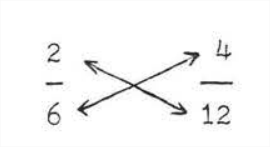
The process of converting a proportion \(\dfrac{2}{6} = \dfrac{4}{12}\) to the equivalent equation \(2 \times 12 = 6 \times 4\) is sometimes called cross multiplication. The idea is conveyed by the following notation:
Find \(x: \dfrac{3}{x} = \dfrac{4}{20}\)
Solution
By "cross multiplication,"
\[\begin{array} {rcl} {3(20)} & = & {x(4)} \\ {60} & = & {4x} \\ {15} & = & {x} \end{array}\]
Check:
\(\dfrac{3}{x} = \dfrac{3}{15} = \dfrac{1}{5}\). \(\dfrac{4}{20} = \dfrac{1}{5}\).
Answer: \(x = 15\).
Find \(x\): \(\dfrac{x - 1}{x - 3} = \dfrac{2x + 2}{x + 1}\)
Solution
\[\begin{array} {rcl} {(x - 1)(x + 1)} & = & {(x - 3)(2x + 2)} \\ {x^2 - 1} & = & {2x^2 - 4x - 6} \\ {0} & = & {x^2 - 4x - 5} \\ {0} & = & {(x - 5)(x + 1)} \\ {0} & = & {x - 5\ \ \ \ \ \ 0 = x + 1} \\ {5} & = & {x \ \ \ \ \ \ \ \ -1 = x} \end{array}\]
Check, \(x = 5\):
\(\dfrac{x - 1}{x - 3} = \dfrac{5 - 1}{5 - 3} = \dfrac{4}{2} = 2\). \(\dfrac{2x + 2}{x + 1} = \dfrac{2(5) + 2}{5 + 1} = \dfrac{12}{6} = 2\).
Check, \(x = -1\):
\(\dfrac{x - 1}{x - 3} = \dfrac{-1 -1}{-1 - 3} = \dfrac{-2}{-4} = \dfrac{1}{2}\). \(\dfrac{2x + 2}{x + 1} = \dfrac{2(-1) + 2}{-1 + 1} = \dfrac{-2 + 2}{0} = \dfrac{0}{0}\).
Since \(\dfrac{0}{0}\) is undefined, we reject this answer.
Answer: \(x = 5\).
Problems
1 - 12. Find \(x\):
1. \(\dfrac{6}{x} = \dfrac{18}{3}\)
2. \(\dfrac{4}{x} = \dfrac{2}{6}\)
3. \(\dfrac{7}{1} = \dfrac{x}{3}\)
4. \(\dfrac{x}{8} = \dfrac{9}{6}\)
5. \(\dfrac{7}{1} = \dfrac{x}{3}\)
6. \(\dfrac{10}{2} = \dfrac{25}{x}\)
7. \(\dfrac{x + 5}{x} = \dfrac{5}{4}\)
8. \(\dfrac{x - 6}{4} = \dfrac{5}{10}\)
9. \(\dfrac{3 + x}{x} = \dfrac{3}{2}\)
10. \(\dfrac{x}{x+3} = \dfrac{4}{x}\)
11. \(\dfrac{3x - 3}{2x + 6} = \dfrac{x - 1}{x}\)
12. \(\dfrac{3x - 6}{x - 2} = \dfrac{2x + 2}{x - 1}\)
This page titled 4.1: Proportions was last modified on Sun, 05 Sep 2021 05:47:01 GMT and is shared under a CC BY-NC-SA 4.0 license and was authored, remixed, and/or curated by Henry Africk (New York City College of Technology at CUNY Academic Works) via source content that was edited to the style and standards of the LibreTexts platform.
The book could not be loaded just now.