Opening the book…
- Determine derivatives and equations of tangents for parametric curves.
Now that we have introduced the concept of a parameterized curve, our next step is to learn how to work with this concept in the context of calculus. For example, if we know a parameterization of a given curve, is it possible to calculate the slope of a tangent line to the curve? How about the arc length of the curve? Or the area under the curve?
Another scenario: Suppose we would like to represent the location of a baseball after the ball leaves a pitcher’s hand. If the position of the baseball is represented by the plane curve \((x(t),y(t))\) then we should be able to use calculus to find the speed of the ball at any given time. Furthermore, we should be able to calculate just how far that ball has traveled as a function of time.
Derivatives of Parametric Equations
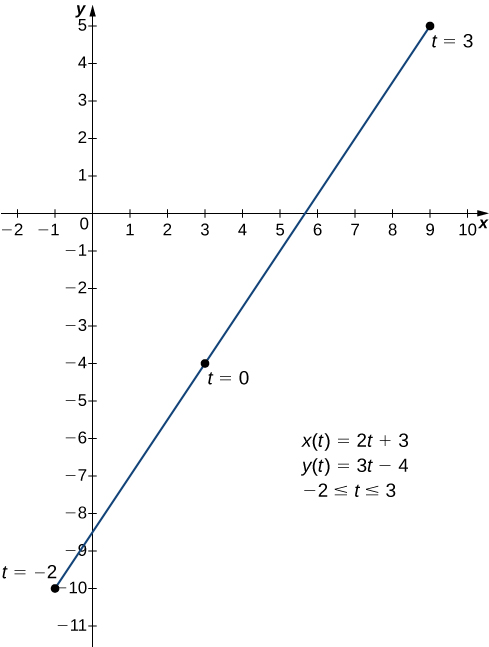
We start by asking how to calculate the slope of a line tangent to a parametric curve at a point. Consider the plane curve defined by the parametric equations
\[\begin{align} x(t) &=2t+3 \label{eq1} \\ y(t) &=3t−4 \label{eq2} \end{align}\]
within \(−2≤t≤3\).
The graph of this curve appears in Figure \(\PageIndex{1}\). It is a line segment starting at \((−1,−10)\) and ending at \((9,5).\)
We can eliminate the parameter by first solving Equation \ref{eq1} for \(t\):
\(x(t)=2t+3\)
\(x−3=2t\)
\(t=\dfrac{x−3}{2}\).
Substituting this into \(y(t)\) (Equation \ref{eq2}), we obtain
\(y(t)=3t−4\)
\(y=3\left(\dfrac{x−3}{2}\right)−4\)
\(y=\dfrac{3x}{2}−\dfrac{9}{2}−4\)
\(y=\dfrac{3x}{2}−\dfrac{17}{2}\).
The slope of this line is given by \(\dfrac{dy}{dx}=\dfrac{3}{2}\). Next we calculate \(x′(t)\) and \(y′(t)\). This gives \(x′(t)=2\) and \(y′(t)=3\). Notice that
\[\dfrac{dy}{dx}=\dfrac{dy/dt}{dx/dt}=\dfrac{3}{2}. \nonumber\]
This is no coincidence, as outlined in the following theorem.
Consider the plane curve defined by the parametric equations \(x=x(t)\) and \(y=y(t)\). Suppose that \(x′(t)\) and \(y′(t)\) exist, and assume that \(x′(t)≠0\). Then the derivative \(\dfrac{dy}{dx}\)is given by
\[\dfrac{dy}{dx}=\dfrac{dy/dt}{dx/dt}=\dfrac{y′(t)}{x′(t)}. \label{paraD}\]
This theorem can be proven using the Chain Rule. In particular, assume that the parameter \(t\) can be eliminated, yielding a differentiable function \(y=F(x)\). Then \(y(t)=F(x(t)).\) Differentiating both sides of this equation using the Chain Rule yields
\[y′(t)=F′\big(x(t)\big)x′(t), \nonumber\]
so
\[F′\big(x(t)\big)=\dfrac{y′(t)}{x′(t)}. \nonumber\]
But \(F′\big(x(t)\big)=\dfrac{dy}{dx}\), which proves the theorem.
□
Equation \ref{paraD} can be used to calculate derivatives of plane curves, as well as critical points. Recall that a critical point of a differentiable function \(y=f(x)\) is any point \(x=x_0\) such that either \(f′(x_0)=0\) or \(f′(x_0)\) does not exist. Equation \ref{paraD} gives a formula for the slope of a tangent line to a curve defined parametrically regardless of whether the curve can be described by a function \(y=f(x)\) or not.
Calculate the derivative \(\dfrac{dy}{dx}\) for each of the following parametrically defined plane curves, and locate any critical points on their respective graphs.
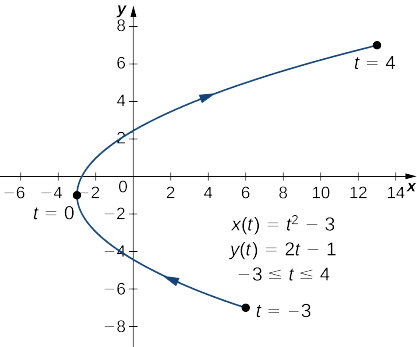
- \(x(t)=t^2−3, \quad y(t)=2t−1, \quad\text{for }−3≤t≤4\)
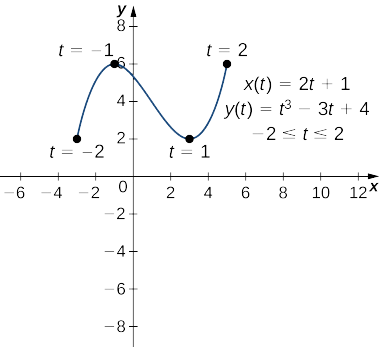
- \(x(t)=2t+1, \quad y(t)=t^3−3t+4, \quad\text{for }−2≤t≤2\)
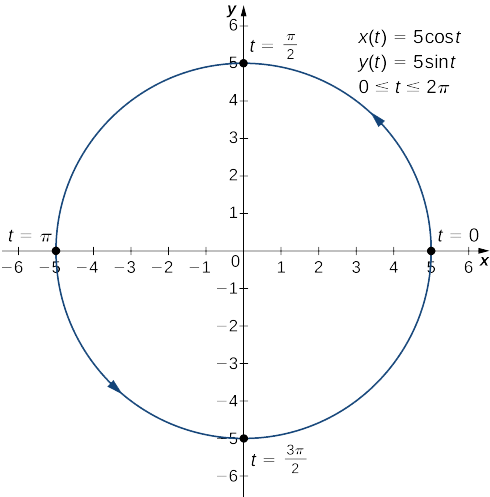
- \(x(t)=5\cos t, \quad y(t)=5\sin t, \quad\text{for }0≤t≤2π\)
Solution
a. To apply Equation \ref{paraD}, first calculate \(x′(t)\) and \(y′(t)\):
\(x′(t)=2t\)
\(y′(t)=2\).
Next substitute these into the equation:
\(\dfrac{dy}{dx}=\dfrac{dy/dt}{dx/dt}\)
\(\dfrac{dy}{dx}=\dfrac{2}{2t}\)
\(\dfrac{dy}{dx}=\dfrac{1}{t}\).
This derivative is undefined when \(t=0\). Calculating \(x(0)\) and \(y(0)\) gives \(x(0)=(0)^2−3=−3\) and \(y(0)=2(0)−1=−1\), which corresponds to the point \((−3,−1)\) on the graph. The graph of this curve is a parabola opening to the right, and the point \((−3,−1)\) is its vertex as shown.
b. To apply Equation \ref{paraD}, first calculate \(x′(t)\) and \(y′(t)\):
\(x′(t)=2\)
\(y′(t)=3t^2−3\).
Next substitute these into the equation:
\(\dfrac{dy}{dx}=\dfrac{dy/dt}{dx/dt}\)
\(\dfrac{dy}{dx}=\dfrac{3t^2−3}{2}\).
This derivative is zero when \(t=±1\). When \(t=−1\) we have
\(x(−1)=2(−1)+1=−1\) and \(y(−1)=(−1)^3−3(−1)+4=−1+3+4=6\),
which corresponds to the point \((−1,6)\) on the graph. When \(t=1\) we have
\(x(1)=2(1)+1=3\) and \(y(1)=(1)^3−3(1)+4=1−3+4=2,\)
which corresponds to the point \((3,2)\) on the graph. The point \((3,2)\) is a relative minimum and the point \((−1,6)\) is a relative maximum, as seen in the following graph.
c. To apply Equation \ref{paraD}, first calculate \(x′(t)\) and \(y′(t)\):
\(x′(t)=−5\sin t\)
\(y′(t)=5\cos t.\)
Next substitute these into the equation:
\(\dfrac{dy}{dx}=\dfrac{dy/dt}{dx/dt}\)
\(\dfrac{dy}{dx}=\dfrac{5\cos t}{−5\sin t}\)
\(\dfrac{dy}{dx}=−\cot t.\)
This derivative is zero when \(\cos t=0\) and is undefined when \(\sin t=0.\) This gives \(t=0,\dfrac{π}{2},π,\dfrac{3π}{2},\) and \(2π\) as critical points for t. Substituting each of these into \(x(t)\) and \(y(t)\), we obtain
| \(t\) | \(x(t)\) | \(y(t)\) |
|---|---|---|
| 0 | 5 | 0 |
| \(\dfrac{π}{2}\) | 0 | 5 |
| \(π\) | −5 | 0 |
| \(\dfrac{3π}{2}\) | 0 | −5 |
| \(2π\) | 5 | 0 |
These points correspond to the sides, top, and bottom of the circle that is represented by the parametric equations (Figure \(\PageIndex{4}\)). On the left and right edges of the circle, the derivative is undefined, and on the top and bottom, the derivative equals zero.
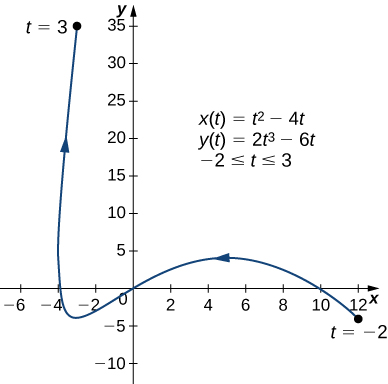
Calculate the derivative \(dy/dx\) for the plane curve defined by the equations
\[x(t)=t^2−4t, \quad y(t)=2t^3−6t, \quad\text{for }−2≤t≤3 \nonumber\]
and locate any critical points on its graph.
- Hint
-
Calculate \(x′(t)\) and \(y′(t)\) and use Equation \ref{paraD}.
- Answer
-
\(x′(t)=2t−4\) and \(y′(t)=6t^2−6\), so \(\dfrac{dy}{dx}=\dfrac{6t^2−6}{2t−4}=\dfrac{3t^2−3}{t−2}\).
This expression is undefined when \(t=2\) and equal to zero when \(t=±1\).
Find the equation of the tangent line to the curve defined by the equations
\[x(t)=t^2−3, \quad y(t)=2t−1, \quad\text{for }−3≤t≤4\]
when \(t=2\).
Solution
First find the slope of the tangent line using Equation \ref{paraD}, which means calculating \(x′(t)\) and \(y′(t)\):
\(x′(t)=2t\)
\(y′(t)=2\).
Next substitute these into the equation:
\(\dfrac{dy}{dx}=\dfrac{dy/dt}{dx/dt}\)
\(\dfrac{dy}{dx}=\dfrac{2}{2t}\)
\(\dfrac{dy}{dx}=\dfrac{1}{t}\).
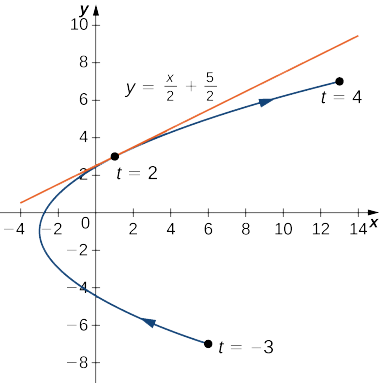
When \(t=2, \dfrac{dy}{dx}=\dfrac{1}{2}\), so this is the slope of the tangent line. Calculating \(x(2)\) and \(y(2)\) gives
\(x(2)=(2)^2−3=1\) and \(y(2)=2(2)−1=3\),
which corresponds to the point \((1,3)\) on the graph (Figure \(\PageIndex{5}\)). Now use the point-slope form of the equation of a line to find the equation of the tangent line:
\(y−y_0=m(x−x_0)\)
\(y−3=\dfrac{1}{2}(x−1)\)
\(y−3=\dfrac{1}{2}x−\dfrac{1}{2}\)
\(y=\dfrac{1}{2}x+\dfrac{5}{2}\).
Find the equation of the tangent line to the curve defined by the equations
\(x(t)=t^2−4t, \quad y(t)=2t^3−6t, \quad\text{for }−2≤t≤6\) when \(t=5\).
- Hint
-
Calculate \(x′(t)\) and \(y′(t)\) and use Equation \ref{paraD}.
- Answer
-
The equation of the tangent line is \(y=24x+100.\)
Second-Order Derivatives
Our next goal is to see how to take the second derivative of a function defined parametrically. The second derivative of a function \(y=f(x)\) is defined to be the derivative of the first derivative; that is,
\[\dfrac{d^2y}{dx^2}=\dfrac{d}{dx}\left[\dfrac{dy}{dx}\right]. \label{eqD2}\]
Since
\[\dfrac{dy}{dx}=\dfrac{dy/dt}{dx/dt}, \nonumber\]
we can replace the \(y\) on both sides of Equation \ref{eqD2} with \(\dfrac{dy}{dx}\). This gives us
\[\dfrac{d^2y}{dx^2}=\dfrac{d}{dx} \left(\dfrac{dy}{dx} \right)=\dfrac{(d/dt)(dy/dx)}{dx/dt}.\label{paraD2}\]
If we know \(dy/dx\) as a function of \(t\), then this formula is straightforward to apply
Calculate the second derivative \(d^2y/dx^2\) for the plane curve defined by the parametric equations \(x(t)=t^2−3, \quad y(t)=2t−1, \quad\text{for }−3≤t≤4.\)
Solution
From Example \(\PageIndex{1}\) we know that \(\dfrac{dy}{dx}=\dfrac{2}{2t}=\dfrac{1}{t}\). Using Equation \ref{paraD2}, we obtain
\(\dfrac{d^2y}{dx^2}=\dfrac{(d/dt)(dy/dx)}{dx/dt}=\dfrac{(d/dt)(1/t)}{2t}=\dfrac{−t^{−2}}{2t}=−\dfrac{1}{2t^3}\).
Calculate the second derivative \(d^2y/dx^2\) for the plane curve defined by the equations
\(x(t)=t^2−4t, \quad y(t)=2t^3−6t, \quad\text{for }−2≤t≤3\)
and locate any critical points on its graph.
- Hint
-
Start with the solution from the previous exercise, and use Equation \ref{paraD2}.
- Answer
-
\(\dfrac{d^2y}{dx^2}=\dfrac{3t^2−12t+3}{2(t−2)^3}\). Critical points \((5,4),\, (−3,−4)\),and \((−4,6).\)
Key Concepts
- The derivative of the parametrically defined curve \(x=x(t)\) and \(y=y(t)\) can be calculated using the formula \(\dfrac{dy}{dx}=\dfrac{y′(t)}{x′(t)}\). Using the derivative, we can find the equation of a tangent line to a parametric curve.
Key Equations
- Derivative of parametric equations
\[\dfrac{dy}{dx}=\dfrac{dy/dt}{dx/dt}=\dfrac{y′(t)}{x′(t)} \nonumber\]
- Second-order derivative of parametric equations
\[\dfrac{d^2y}{dx^2}=\dfrac{d}{dx}\left(\dfrac{dy}{dx}\right)=\dfrac{(d/dt)(dy/dx)}{dx/dt} \nonumber\]
Contributors and Attributions
Gilbert Strang (MIT) and Edwin “Jed” Herman (Harvey Mudd) with many contributing authors. This content by OpenStax is licensed with a CC-BY-SA-NC 4.0 license. Download for free at http://cnx.org.
- Modified by Jennifer Sinclair
This page titled 5.2: Slopes and Tangent Lines of Parametric Curves was last modified on Tue, 15 Sep 2026 20:36:49 GMT and is shared under a CC BY-NC-SA 4.0 license and was authored, remixed, and/or curated by Jennifer Sinclair via source content that was edited to the style and standards of the LibreTexts platform.
The book could not be loaded just now.