Opening the book…
1. Let \(f(x)=x^2\) and \(g(x)=3(x-1)^2+2\).
- What is the vertex of \(f(x)\) ?
- Since \(g(x)\) is a translation of \(f(x)\), use your knowledge of horizontal and vertical shifts to identify the vertex of \(g(x)\).
- What is the formula for the vertex form of a quadratic function?
- According to the formula, was the vertex you identified in part (b) correct? Why or why not?
2. Let \(g(x)=(x+3)^2-4\).
- What is the vertex of \(g(x)\) ?
- Graph \(g(x)\) using Desmos. What is the axis of symmetry of \(g(x)\) ?
- How can you find the axis of symmetry for any given quadratic function?
- Write the function \(g(x)\) in standard form.
- Explain how the vertical intercept can be found from the standard form.
- Find the zeros of \(g(x)\).
- Explain how the axis of symmetry of the parabola is related to the zeros.
3. Let \(f(x)=3 x^2-6 x+3\).
- What is the vertical intercept of \(f(x)\) ?
- Find the zeros of \(f(x)\).
- Write the function \(f(x)\) in vertex form.
- What is the vertex of \(f(x)\) ?
- What is the axis of symmetry of \(f(x)\) ?
4. Find a formula for the quadratic function based on the information given.
-
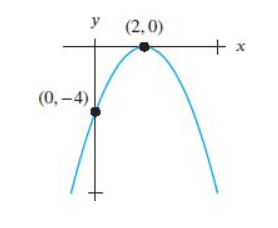
- Vertex at \((4,2)\) and \(y\)-intercept of \(y=6\).
- Vertex at \((4,2)\) and zeros at \(x=-3\) and \(x=11\).
5. Let \(m(n)=\frac{1}{2} n^2\). Write a formula in standard form for each of the transformations listed below. Graph the new function.
- \(g(n)=m(n)+1\)
- \(h(n)=m(n+1)\)
6. Let \(f(x)=2 x^2+4 x+4\) and \(g(x)=-2 x^2+4 x+4\).
- Does \(f(x)\) have an absolute maximum or an absolute minimum? How do you know? What is its coordinate?
- Does \(g(x)\) have an absolute maximum or an absolute minimum? How do you know? What is its coordinate?
7. If you have a string of length 50 cm ,what are the dimensions of the rectangle of maximum area that you can enclose with your string? Hint: let one side of your string rectangle have a length of \(x \mathrm{~cm}\). Then write an expression for the length of the other side, and use the area formula for a rectangle.
This page titled 5.2: Vertex of a parabola was last modified on Fri, 07 Aug 2026 01:49:57 GMT and is shared under a CC BY 4.0 license and was authored, remixed, and/or curated by Lynda Zenati.
The book could not be loaded just now.