Opening the book…
Let’s try to introduce the idea of an infinite series using a framework that we know and are (maybe) comfortable with: integrals!
With an integral, we have a nice way of evaluating integrals of nicely behaved functions with finite limits of integration (Fundamental Theorem of Calculus (Part 2)).
Then, when we talked about improper integrals, we built a nice way to think about evaluating integrals with unbounded limits of integration (Evaluating Improper Integrals (Infinite Width)). How will we use this to think about infinite series, a sum of the infinitely many terms from an infinite sequence?
Partial Sums
If we approach infinite series in a manner similar to improper integrals, then we will need to do a couple of things.
- Truncate the infinite series at some finite ending point. This is what we did with the integral, when we replaced the infinity with some real number variable t. We might use n for the series “ending index.”
- Find a formula for this truncated/finite version. For the integrals, we could use the Fundamental Theorem of Calculus (Part 2) for this! For series, we’ll need to do something else.
- Apply a limit as t (or n in the case of infinite series) goes off to infinity!
Let’s consider the following sequence:
\[\left\{\dfrac{9}{10^k}\right\}_{k=1}^{\infty} \nonumber \]
- Write out the first 5 terms of the sequence.
- What does this sequence converge to? Show this with a limit!
- Now we’ll construct a new sequence, this time by adding things up. We’re going to be working with the sequence \(\left\{S_n\right\}_{n=1}^{\infty}\) where\[S_n=\sum_{k=1}^{k=n}\left(\dfrac{9}{10^k}\right) \nonumber \]Write out the first five terms of this sequence: \(S_1, S_2, S_3, S_4, S_5\).
- Can you come up with an explicit formula for \(S_n\)?
- Does \(\left\{S_n\right\}\) converge or diverge? Use a limit to find what it converges to!
- What do you think this means for the infinite series \(\sum_{k=1}^{\infty}\left(\dfrac{9}{10^k}\right)\)? Does the infinite series converge or diverge?
This is hopefully a nice little introduction to how we’ll think about infinite series: we’ll consider, instead, the sequence of sums where we add up more and more terms. This is also a nice first example, because we really just showed that
0.999... = 1
since
\[\begin{aligned}
&\begin{aligned}
\sum_{k=1}^{\infty}\left(\dfrac{9}{10^k}\right) & =\dfrac{9}{10}+\dfrac{9}{100}+\dfrac{9}{1000}+\ldots \\
& =0.9+0.09+0.009+\ldots
\end{aligned}\\
&1 .
\end{aligned} \nonumber \]
But more importantly, we now have a good strategy for thinking about infinite series as sequences of partial sums.
For an infinite series \(\sum_{k=1}^{\infty} a_k\), we call \(S_n=\sum_{k=1}^n a_k\) the \(n\)th Partial Sum of the infinite series.
We say that the infinite series \(\sum_{k=1}^{\infty} a_k\) converges to the real number \(L\) if the sequence \(\left\{S_n\right\}_{n=1}^{\infty}\) converges to \(L\) (where \(\lim _{n \rightarrow \infty} S_n=L\)), where \(S_n=\sum_{k=1}^n a_k\) is the \(n\)th partial sum of the infinite series.
If the sequence of partial sums \(\left\{S_n\right\}_{n=1}^{\infty}\) diverges (the limit \(\lim _{n \rightarrow \infty} S_n\) does not exist), then we say that the infinite series \(\sum_{k=1}^{\infty} a_k\) diverges.
Visualizing the Sequence of Partial Sums
Since we’ll think about an infinite series \(\sum_{k=0}^{\infty} a_k\) as the sequence of its partial sums, \(\left\{\sum_{k=0}^n a_k\right\}_{n=0}^{\infty}\), then we can think about visualizing an infinite series as really the same thing as visualizing a sequence in general (Graphing Sequences).
Let’s consider, as a first (visual) example, the infinite series:
\[\sum_{k=0}^{\infty} \dfrac{3}{k+1} \nonumber \]
We can think about the two important sequences that we’ll consider:
\[\underbrace{\left\{\dfrac{3}{n+1}\right\}_{n=0}^{\infty}}_{\left\{a_n\right\} \text {, the sequence of terms }} \quad \text { and } \quad \underbrace{\left\{\sum_{k=0}^n \dfrac{3}{k+1}\right\}_{n=0}^{\infty}}_{\left\{S_n\right\}\text{, the sequence of partial sums }} \nonumber \]
We can plot the sequence of terms, \(\left\{\dfrac{3}{n+1}\right\}_{n=0}^{\infty}\), and visualize the limit \(\lim _{n \rightarrow \infty} a_n=0\). This sequence of terms converges to 0.

Figure 8.2.4 \(\left\{a_n\right\}\), the sequence of terms in the series.
Then, we can compare this with the plot of the partial sums, \(\left\{S_n\right\}\) where:
\[S_n=\sum_{k=0}^n \dfrac{3}{k+1} \nonumber \]

Figure 8.2.5 \(\left\{S_n\right\}\), the sequence of partial sums for the series.
This image is fine, but not very good at showing how the sequence of terms and the sequence of partial sums are related to each other. We should note that each point in Figure 8.2.5 is the accumulation of the heights of the preceding points in Figure 8.2.4. We can visualize this to make it easier by overlaying some information onto the plot of partial sums in Figure 8.2.5.
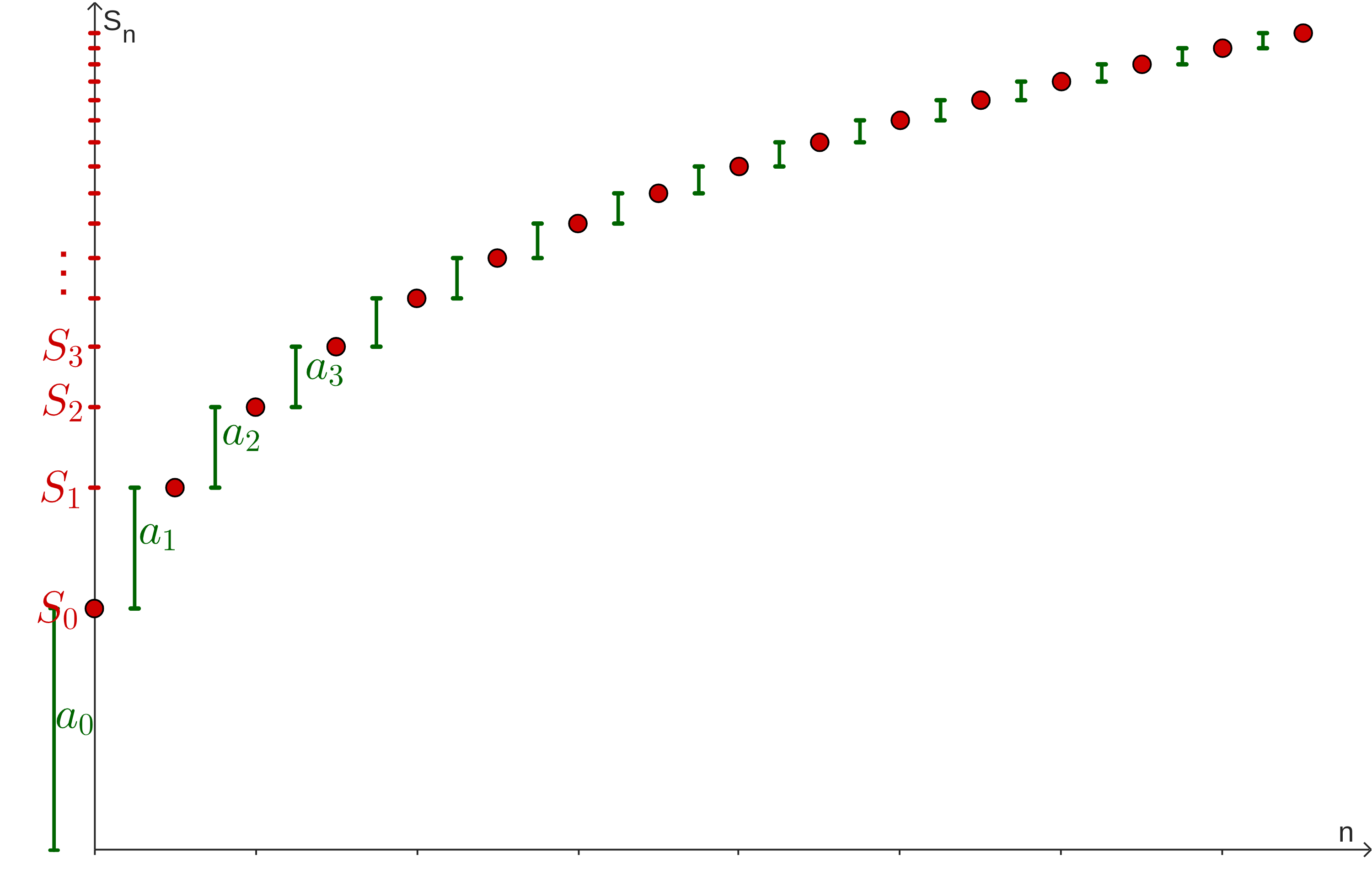
Figure 8.2.6 \(\left\{S_n\right\}\) and \(\left\{a_n\right\}\) visualized together.
Hopefully this does a good job of illustrating the connections between the two:
\[\begin{aligned}
S_0 & =a_0 \\
S_1 & =a_0+a_1 \\
& =S_0+a_1 \\
S_2 & =a_0+a_1+a_2 \\
& =S_1+a_2 \\
S_3 & =a_0+a_1+a_2+a_3 \\
& =S_2+a_3 \\
\vdots & \\
S_n & =a_0+a_1+\ldots+a_n \\
& =S_{n-1}+a_n
\end{aligned} \nonumber \]
In order to further examine the connection between sequences and partial sums, let’s look at an interactive example, where you can create the terms of a sequence (however you’d like) and examine the corresponding partial sums.

We had noted earlier (in Section 8.1) that it was hard to find explicit formulas (or recursion relations) for sequences where we had the first few terms.
This remains true when we think about finding formulas for the sequences of partial sums. Notice that it is easy to find the location of the horizontal asymptote in Figure 8.2.4 (by evaluating \(\lim _{n \rightarrow \infty} a_n\)), but that we did not attempt to find one to for the partial sums in Figure 8.2.5 or Figure 8.2.6.
If you’d like to try this, then we need to find a formula for \(S_n\). Try to find the first several partial sums by adding up terms in the series. Then try to find a formula to predict the next partial sum. This will definitely not be easy!
Ok, actually, this will be an impossible task. There is no closed-form formula for this. We cannot simply find \(\lim _{n \rightarrow \infty} S_n\) in the way that we’ve found the limit of the sequence of terms.
Special Series
Let’s look at three examples where we can think about partial sums and play with our new idea of series convergence.
For each of the following series, write out a few of the terms of the series. Then write out the corresponding partial sums. Use these to find a formula for \(S_n\), the \(n\)th partial sum. Then make a claim about whether or not the series converges and what it converges to.
- \(\sum_{k=0}^{\infty}\left(\dfrac{1}{2^k}\right)\)
- \(\sum_{k=2}^{\infty}\left(\dfrac{k}{\ln (k)}-\dfrac{k+1}{\ln (k+1)}\right)\)
- \(\sum_{k=2}^{\infty}\left(\dfrac{2}{k^2-1}\right)\) Hint. This one is tricky! It’s hard to notice anything unless we write out the series term formula a bit differently. Use Partial Fractions to rewrite \(\dfrac{2}{k^2-1} \text { as } \dfrac{1}{k-1}-\dfrac{1}{k+1}\)
Solution
- \[\begin{aligned}
S_0 & =1 \\
S_1 & =1+\dfrac{1}{2}=\dfrac{3}{2} \\
S_2 & =1+\dfrac{1}{2}+\dfrac{1}{4}=\dfrac{7}{4} \\
S_3 & =1+\dfrac{1}{2}+\dfrac{1}{4}+\dfrac{1}{8}=\dfrac{15}{8} \\
S_n & =1+\dfrac{1}{2}+\dfrac{1}{4}+\ldots+\dfrac{1}{2^n}=\dfrac{2^{n+1}-1}{2^n} \\
& =2-\dfrac{1}{2^n} \\
S_n & =\lim _{n \rightarrow \infty}\left(2-\dfrac{1}{2^n}\right) \\
& =2
\end{aligned} \nonumber \]The series converges to 2. - \[\begin{aligned}
S_2 & =\dfrac{2}{\ln (2)}-\dfrac{3}{\ln (3)} \\
S_3 & =\dfrac{2}{\ln (2)} \underbrace{-\dfrac{3}{\ln (3)}+\dfrac{3}{\ln (3)}}_0-\dfrac{4}{\ln (4)} \\
& =\dfrac{2}{\ln (2)}-\dfrac{4}{\ln (4)} \\
S_4 & =\dfrac{2}{\ln (2)} \underbrace{-\dfrac{3}{\ln (3)}+\dfrac{3}{\ln (3)}}_0 \underbrace{-\dfrac{4}{\ln (4)}+\dfrac{4}{\ln (4)}}_0-\dfrac{5}{\ln (5)} \\
& =\dfrac{2}{\ln (2)}-\dfrac{5}{\ln (5)} \\
S_5 & =\dfrac{2}{\ln (2)} \underbrace{-\dfrac{3}{\ln (3)}+\dfrac{3}{\ln (3)}}_0 \underbrace{-\dfrac{4}{\ln (4)}+\dfrac{4}{\ln (4)}}_0 \underbrace{-\dfrac{5}{\ln (5)}+\dfrac{6}{\ln (6)}}_0-\dfrac{6}{\ln (6)} \\
& =\dfrac{2}{\ln (2)}-\dfrac{6}{\ln (6)}
\end{aligned} \nonumber \]\[\begin{aligned}
S_n & =\dfrac{2}{\ln (2)} \underbrace{-\dfrac{3}{\ln (3)}+\dfrac{3}{\ln (3)}}_0 \underbrace{-\dfrac{4}{\ln (4)}+\dfrac{4}{\ln (4)}}_0 \underbrace{-\dfrac{5}{\ln (5)}+\ldots+\dfrac{n}{\ln (n)}}_0-\dfrac{n+1}{\ln (n+1)} \\
& =\dfrac{2}{\ln (2)}-\dfrac{n+1}{\ln (n+1)} \\
\lim _{n \rightarrow \infty} S_n & =\lim _{n \rightarrow \infty} \dfrac{2}{\ln (2)}-\dfrac{n+1}{\ln (n+1)} \\
& =-\infty
\end{aligned} \nonumber \]So the series \(\sum_{k=2}^{\infty}\left(\dfrac{k}{\ln (k)}-\dfrac{k+1}{\ln (k+1)}\right)\) diverges. - \[\sum_{k=2}^{\infty}\left(\dfrac{2}{k^2-1}\right)=\sum_{k=2}^{\infty}\left(\dfrac{1}{k-1}-\dfrac{1}{k+1}\right) \nonumber \]\[\begin{aligned}
S_2 & =1-\dfrac{1}{3} \\
S_3 & =1-\dfrac{1}{3}+\dfrac{1}{2}-\dfrac{1}{4} \\
S_4 & =1-\dfrac{1}{3}+\dfrac{1}{2}-\dfrac{1}{4}+\dfrac{1}{3}-\dfrac{1}{5} \\
& =1+\dfrac{1}{2}-\dfrac{1}{4}-\dfrac{1}{5} \\
S_5 & =1-\dfrac{1}{3}+\dfrac{1}{2}-\dfrac{1}{4}+\dfrac{1}{3}-\dfrac{1}{5}+\dfrac{1}{4}-\dfrac{1}{6} \\
& =1+\dfrac{1}{2}-\dfrac{1}{5}-\dfrac{1}{6} \\
S_n & =1-\dfrac{1}{3}+\dfrac{1}{2}-\dfrac{1}{4}+\dfrac{1}{3}-\dfrac{1}{5}+\dfrac{1}{4}-\dfrac{1}{6}+\ldots+\underbrace{\dfrac{1}{n-2}-\dfrac{1}{n}}_{a_{n-1}}+\underbrace{\dfrac{1}{n-1}-\dfrac{1}{n+1}}_{a_n} \\
1 & +\dfrac{1}{2}-\dfrac{1}{n}-\dfrac{1}{n+2} \\
S_n & =\lim _{n \rightarrow \infty}\left(1+\dfrac{1}{2}-\dfrac{1}{n}-\dfrac{1}{n+2}\right) \\
& =\dfrac{3}{2}
\end{aligned} \nonumber \]
These examples are a bit misleading: we often won’t be able to do this kind of thing! For most infinite series, we will struggle to find an explicit formula for the \(n\)th partial sum. In these examples, though, we took advantage of some specific structure.
In this first example (as well as the example in Activity 8.2.1), we noticed that because of the exponential function defining the terms, we were able to find some nice patterns in the partial sums. We’ll explore this a bit more later in Section 8.6.
Then in these other two examples, we noticed that once we could write each term as a difference of two fractions that have a really similar structure, we got these “repeat” values from term to term where the opposite signs made things add up to 0. These are called “telescoping series,” and they’re mostly fun examples to think about partial sum formulas. We’ll see some pop up later though, and Partial Fraction Decomposition is a nice trick to keep in mind for these kinds of things.
Practice Problems
What does it mean for an infinite series \(\sum_{k=1}^{\infty} a_k\) to converge? What does it mean for this series to diverge?
What is a partial sum, \(S_n\), of the infinite series \(\sum_{k=1}^{\infty} a_k\)? Why do we care about this?
For some infinite series \(\sum_{k=1}^{\infty} b_k\), we consider the partial sum
\[S_n=\sum_{k=1}^n b_k \nonumber \]
For each of the following descriptions of \(S_n\), explain what conclusions we can make about the infinite series. Be specific, and justify your answers.
- \(S_n=\dfrac{3 n^2}{2 n^2+1}\)
- \(\left\{S_n\right\}\) is increasing and bounded.
- \(0 \leq S_n \leq 1\) for all \(n \geq 1\).
- \(4-\dfrac{1}{n} \leq S_n \leq 4+\dfrac{1}{n}\) for all \(n \geq 1\)
Consider the infinite series \(\sum_{k=1}^{\infty} c_k=0.6+0.06+0.006+0.0006+\ldots \).
- Write out an explicit formula for the sequence of terms \(\left\{c_k\right\}=\{0.6,0.06,0.006,0.0006, \ldots\}\).
- Write out the partial sums \(S_1, S_2, S_3\), and \(S_4\).
- Write out an explicit formula for the \(n\)th partial sum, \(S_n\).
- Does the sequence \(\left\{S_n\right\}\) converge or diverge? Explain. If it converges, what does it converge to?
- Does the series \(\sum_{k=1}^{\infty} c_k\) converge or diverge? Explain. If it converges, what does it converge to.
Consider the infinite series \(\sum_{k=1}^{\infty} \dfrac{1}{k(k+1)}\).
- Use Partial Fraction Decomposition to rewrite this series.
- Write out the first five terms, and the partial sum \(S_5\).
- Write out the explicit formula for the \(n\)th partial sum, \(S_n\).
- Does the sequence \(\left\{S_n\right\}\) converge or diverge? Explain. If it converges, what does it converge to?
- Does the series \(\sum_{k=1}^{\infty} \dfrac{1}{k(k+1)}\) converge or diverge? Explain. If it converges, what does it converge to?
This page titled 8.2: Introduction to Infinite Series was last modified on Wed, 07 Oct 2026 01:39:20 GMT and is shared under a CC BY 4.0 license and was authored, remixed, and/or curated by Peter Keep.
The book could not be loaded just now.