Opening the book…
For the following exercises, use the figure to determine whether the sequence of vertices in the given graph is a Hamilton cycle, an Euler circuit, both, or neither.
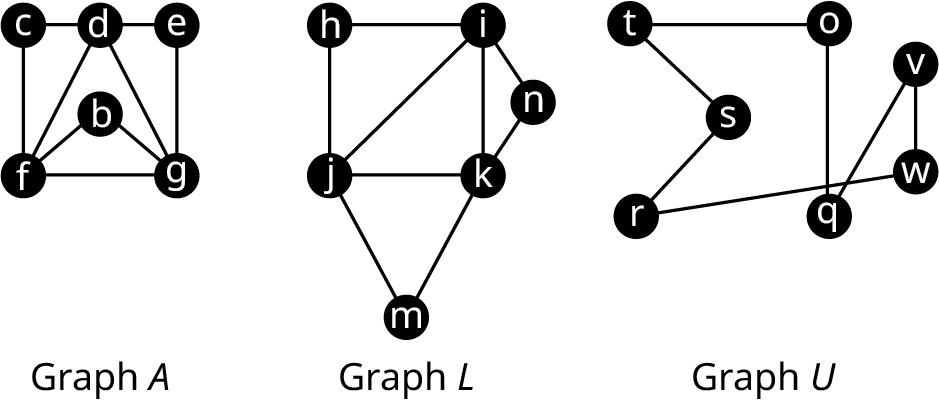
Graph A: f → b → g → e → d → c → f
Graph A: g → b → f → c → d → e → g
Graph A: d → e → g → d → f → b → g → f → c → d
Graph L: h → i → k → n → j → h
Graph L: n → i → h → j → m → k → n
Graph L: j → i → n → k → i → j → k → m → j
Graph U: v → w → r → s → t → o → q → v
Graph U: w → q → r → s → t → o → v → w
For the following exercises, use the figure to find a circuit that fits the description.
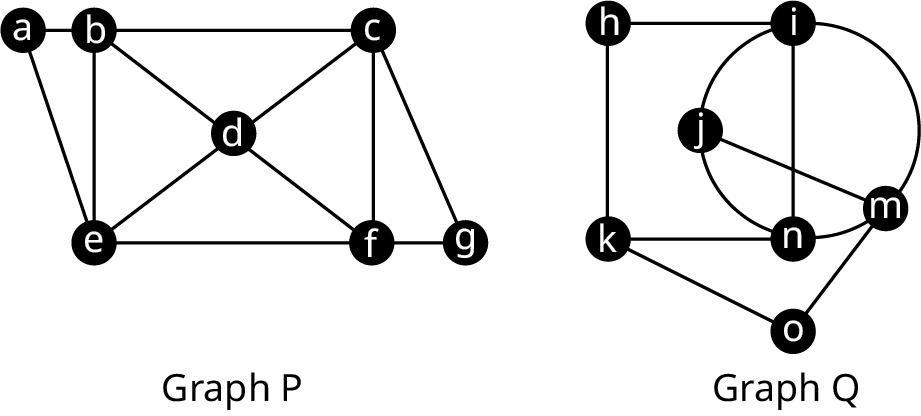
A Hamilton cycle in Graph P that begins at vertex c.
An Euler circuit in Graph P that begins at vertex c.
A directed cycle in Graph P that is NOT a Hamilton cycle, and explain why it is not a Hamilton cycle.
A directed circuit in Graph P that is NOT an Euler circuit, and explain why it is not an Euler circuit.
A Hamilton cycle in Graph Q that begins at vertex n.
An Euler circuit in Graph Q that begins at vertex n.
A directed cycle in Graph Q that is NOT a Hamilton cycle, and explain why it is not a Hamilton cycle.
A directed circuit in Graph Q that is NOT an Euler circuit, and explain why it is not an Euler circuit.
Use the results of Exercises 9–16 to make an observation about which tends to involve a longer sequence of vertices, Hamilton cycles or Euler circuits. Explain why you think this is.
For the following exercises, evaluate the factorial expression for the given value of \(n\).
\(n!,\,{n} = 10\)
\(n!,\,{n} = 11\)
\(\left( {n - 1} \right)!,\,{n} = 10\)
\(\left( {n - 1} \right)!,\,{n} = 11\)
For the following exercises, find the number of arrangements letters in the given word.
have
teamwork
anime
making
For the following exercises, find the number of Hamilton cycles in a complete graph with the given number of vertices.
12 vertices
13 vertices
9 vertices
8 vertices
\(x\) vertices
For the following exercises, given the number of Hamilton cycles in a complete graph, determine the number of vertices.
\(5! = 120\) Hamilton cycles
\(6! = 720\) Hamilton cycles
\(7! = 5040\) Hamilton cycles
\(x!\) Hamilton cycles
For the following exercises, all the distinct Hamilton cycles for a complete graph are given. Indicate which pairs of Hamilton cycles (directed cycles) lie on the same cycle (undirected cycle) in the graph.
- b → a → c → d → b
- b → a → d → c → b
- b → c → a → d → b
- b → c → d → a → b
- b → d → a → c → b
- b → d → c → a → b
- i → f → g → h → e → i
- i → f → g → e → h → i
- i → f → h → g → e → i
- i → f → h → e → g → i
- i → f → e → g → h → i
- i → f → e → h → g → i
- i → g → f → h → e → i
- i → g → f → e → h → i
- i → g → h → f → e → i
- i → g → h → e → f → i
- i → g → e → f → h → i
- i → g → e → h → f → i
- i → h → g → f → e → i
- i → h → g → e → f → i
- i → h → f → g → e → i
- i → h → f → e → g → i
- i → h → e → g → f → i
- i → h → e → f → g → i
- i → e → g → h → f → i
- i → e → g → f → h → i
- i → e → h → g → f → i
- i → e → h → f → g → i
- i → e → f → g → h → i
- i → e → f → h → g → i
For the following exercises, use the figure to find the weight of the given Hamilton cycle.

q → r → s → v → y → x → w → t → u → q
u → y → x → w → t → q → r → s → v → u
y → v → s → r → u → q → t → w → x → y
u → v → s → r → q → t → w → x → y → u
The neighborhood of Pines West has three cul-de-sacs that meet at an intersection as shown. A postal delivery person starts at the intersection and visits each house in a cul-de-sac once, returns to the intersection, visits each house in the next cul-de-sac, and so on, returning to the intersection when finished. Describe how the route can be represented as a graph. If there is no backtracking, in other words, the person never reverses direction, is the route followed by the postal delivery person best described as a trail, an Euler circuit, a Hamilton cycle, or neither? Explain your reasoning.

In chess, a knight can move in any direction, but it must move two spaces then turn and move one more space. The 8 possible moves a knight can make from a given space are shown in the figure.

A graph in which each vertex represents a space on a five-by-six game board and each edge represents a move a knight could make is shown in the figure.

A knight’s tour is a sequence of moves by a knight on a chessboard (of any size) such that the knight visits every square exactly once. If the knight’s tour brings the knight back to its starting position on the board, it is called a closed knight’s tour. Otherwise, it is called an open knight’s tour.

Determine if the closed knight’s tour in Figure 12.239 is most accurately described as an Euler circuit or a Hamilton cycle, or both, of the graph of all possible knight moves. Explain your reasoning.
3.8.1: Exercises is shared under a not declared license and was authored, remixed, and/or curated by LibreTexts.
The book could not be loaded just now.