Opening the book…
When you turn on an automobile or a light bulb or a computer, many things happen. Some of them are uniquely part of the start-up process of the system. These “transient” things occur only during start up, and then the system settles down to its steady-state operation. This start-up behavior can be very important, but sometimes we want to investigate the steady-state — or long-term — behavior: how does the system behave “after a long time?” In this section we investigate and describe the long-term behavior of functions and the systems they model: how does a function behave “when \(x\) (or \(-x\)) is arbitrarily large?”
Limits as \(x\) Becomes Arbitrarily Large (“Approaches Infinity”)
The same type of questions we considered about a function \(f\) as \(x\) approached a finite number can also be asked about \(f\) as \(x\) “becomes arbitrarily large” (or “increases without bound”) — that is, eventually becomes larger than any fixed number.
What happens to the values of \(\displaystyle f(x) = \frac{5x}{2x + 3}\) and \(\displaystyle g(x) = \frac{\sin(7x + 1)}{3x}\) as \(x\) becomes arbitrarily large (increases without bound)?
Solution
One approach is numerical: evaluate \(f(x)\) and \(g(x)\) for some “large” values of \(x\) and see if there is a pattern to the values of \(f(x)\) and \(g(x)\). The table below:
| \(x\) | \(\frac{5x}{2x+3}\) | \(\frac{\sin(7x+1)}{3x}\) |
|---|---|---|
| \(10\) | \(2.17\) | \(0.031702\) |
| \(100\) | \(2.463\) | \(-0.001374\) |
| \(1000\) | \(2.4962\) | \(0.000333\) |
| \(10,000\) | \(2.4996\) | \(0.000001\) |
values of \(g(x)\) are close to \(0\). In fact, we can guarantee that the values of \(f(x)\) are as close to \(\frac52\) as someone wants by taking \(x\) to be “big enough.” The values of \(\displaystyle f(x) = \frac{5x}{2x + 3}\) may or may not ever equal \(\frac52\) (they never do), but if \(x\) is “large,” then \(f(x)\) is “very close to” \(\frac52\). Similarly, we can guarantee that the values of \(g(x)\) are as close to \(0\) as someone wants by taking \(x\) to be “big enough.” The graphs of \(f\) and \(g\) for “large” values of \(x\) appear below:

What happens to the values of \(\displaystyle f(x) = \frac{3x + 4}{x - 2}\) and \(\displaystyle g(x) = \frac{\cos(5x)}{2x + 7}\) as \(x\) becomes arbitrarily large?
- Answer
-
As \(x\) becomes arbitrarily large, the values of \(f(x)\) approach \(3\) and the values of \(g(x)\) approach \(0\).
We can express the answers to Example 1 using limits. “As \(x\) becomes arbitrarily large, the values of \(\displaystyle \frac{5x}{2x + 3}\) approach \(\frac52\)” can be written:\[\lim_{x \to \infty} \, \frac{5x}{2x + 3} = \frac52\nonumber\]and “the values of \(\displaystyle \frac{\sin(7x + 1)}{3x}\) approach \(0\)” can be written:\[\lim_{x\to \infty} \, \frac{\sin(7x +1)}{3x} = 0\nonumber\]We read \(\displaystyle \lim_{x\to\infty}\) as “the limit as \(x\) approaches infinity,” meaning “the limit as \(x\) becomes arbitrarily large” or “as \(x\) increases without bound.”
During this discussion — and throughout this book — we do not treat “infinity” or “\(\infty\)” as a number, but only as a useful notation. “Infinity” is not part of the real number system, and we use the common notation “\(x \rightarrow \infty\)” and the phrase “\(x\) approaches infinity” only to mean that “\(x\) becomes arbitrarily large.”
The notation “\(x \rightarrow -\infty\),” read as “\(x\) approaches negative infinity,” means that the values of \(-x\) become arbitrarily large.
Rewrite your answers to Practice \(\PageIndex{1}\) using limit notation.
- Answer
-
\(\displaystyle \lim_{x\to\infty} \,\frac{3x+4}{x-2} = 3\) and \(\displaystyle \lim_{x\to\infty} \, \frac{\cos(5x)}{2x+7} = 0\)
The expression \(\displaystyle \lim_{x\to\infty} \, f(x)\) asks about the behavior of \(f(x)\) as the values of \(x\) get larger and larger without any bound. One way to determine this behavior is to look at the values of \(f(x)\) for some values of \(x\) that are very “large.” If the values of the function get arbitrarily close to a single number as \(x\) gets larger and larger, then we will say that number is the limit of the function as \(x\) approaches infinity. (A more formal definition of the limit as “\(x\rightarrow\infty\)” appears at the end of this section.)
Fill in the table for \(\displaystyle f(x) = \frac{6x + 7}{3 - 2x}\) and \(\displaystyle g(x) = \frac{\sin(3x)}{x}\) and use those values to estimate \(\displaystyle \lim_{x\to\infty}\, f(x)\) and \(\displaystyle \lim_{x\to\infty}\, g(x)\).
| \(x\) | \(\frac{6x+7}{3-2x}\) | \(\frac{\sin(3x)}{x}\) |
|---|---|---|
| \(10\) | ||
| \(200\) | ||
| \(500\) | ||
| \(20,000\) |
- Answer
-
\(x\) \(\frac{6x+7}{3-2x}\) \(\frac{\sin(3x)}{x}\) \(10\) \(-3.94117647\) \(-0.09880311\) \(200\) \(-3.04030227\) \(0.00220912\) \(500\) \(-3.00160048\) \(0.00017869\) \(20,000\) \(-3.00040003\) \(0.00004787\) \(\downarrow\) \(\downarrow\) \(-3\) \(0\)
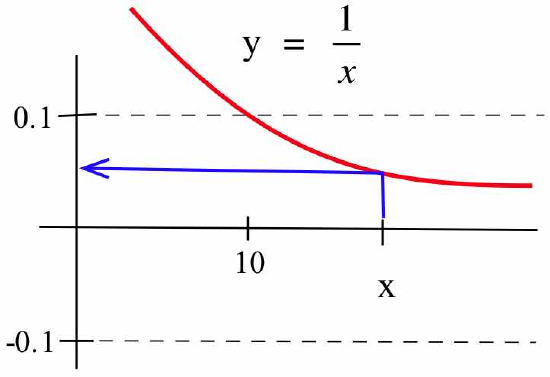
How large must \(x\) be to guarantee that \(\displaystyle f(x) = \frac{1}{x} < 0.1\)? That \(f(x) < 0.001\)? That \(f(x) < E\) (with \(E>0\))?
Solution
If \(x > 10\), then \(\displaystyle \frac{1}{x} < \frac{1}{10} = 0.1\). If \(x > 1000\), then \(\displaystyle \frac{1}{x} < \frac{1}{1000} = 0.001\). In general, if \(E\) is any positive number, then we can guarantee that \(\left| f(x) \right| < E\) by picking only values of \(\displaystyle x > \frac{1}{E} > 0\): if \(\displaystyle x > \frac{1}{E}\), then \(\displaystyle \frac{1}{x} < E\). From this we can conclude that \(\displaystyle \lim_{x\to\infty}\, \frac{1}{x} = 0\).
How large must \(x\) be to guarantee that \(\displaystyle f(x) = \frac{1}{x^2} < 0.1\)? That \(f(x) < 0.001\)? That \(f(x) < E\) (with \(E>0\))? Evaluate \(\displaystyle \lim_{x\to\infty}\,\frac{1}{x^2}\).
- Answer
-
If \(x > \sqrt{10} \approx 3.162\) then \(\displaystyle f(x) = \frac{1}{x^2} < 0.1\).
If \(x > \sqrt{1000} \approx 31.62\) then \(\displaystyle f(x) = \frac{1}{x^2} < 0.001\).
If \(\displaystyle x > \sqrt{\frac{1}{E}} = \frac{1}{\sqrt{E}}\) then \(\displaystyle f(x) = \frac{1}{x^2} < E\).
The Main Limit Theorem (Section 1.2) about limits of combinations of functions still holds true if the limits as “\(x\rightarrow a\)” are replaced with limits as “\(x\rightarrow \infty\)” but we will not prove those results.
Polynomials arise regularly in applications, and we often need the limit, as “\(x\rightarrow \infty\),” of ratios of polynomials or functions containing powers of \(x\). In these situations the following technique is often helpful:
- factor the highest power of \(x\) in the denominator from both the numerator and the denominator
- cancel the common factor from the numerator and denominator
The limit of the new denominator is a constant, so the limit of the resulting ratio is easier to determine.
Determine \(\displaystyle \lim_{x\to \infty} \, \frac{7x^2 + 3x - 4}{3x^2 - 5}\) and \(\displaystyle \lim_{x \to \infty} \, \frac{9x +2}{3x^2 - 5x + 1}\).
Solution
Factoring \(x^2\) out of the numerator and the denominator of the first rational function results in:\[\lim_{x\to \infty} \, \frac{7x^2 + 3x - 4}{3x^2 - 5} = \lim_{x\to \infty} \, \frac{x^2(7 + \frac{3}{x} - \frac{4}{x^2})}{x^2(3 - \frac{5}{x^2})} = \lim_{x\to \infty} \, \frac{7 + \frac{3}{x} - \frac{4}{x^2}}{3 - \frac{5}{x^2}} = \frac73\nonumber\]where we used the facts that \(\frac{3}{x} \rightarrow 0\), \(\frac{4}{x^2} \rightarrow 0\) and \(\frac{5}{x^2} \rightarrow 0\) as \(x \rightarrow \infty\). Similarly:\[\lim_{x\to\infty}\, \frac{9x +2}{3x^2 - 5x + 1} = \lim_{x\to\infty}\, \frac{x^2(\frac{9}{x} + \frac{2}{x^2})}{x^2(3 - \frac{5}{x} + \frac{1}{x^2})} = \lim_{x\to\infty}\, \frac{\frac{9}{x} + \frac{2}{x^2}}{3 - \frac{5}{x} + \frac{1}{x^2}} = \frac{0}{3} = 0\nonumber\]because \(\frac{k}{x} \rightarrow 0\) and \(\frac{c}{x^2} \rightarrow 0\) as \(x \rightarrow \infty\) for any constants \(k\) and \(c\).
If we need to evaluate a more difficult limit as \(x \rightarrow \infty\), it is often useful to algebraically manipulate the function into the form of a ratio and then use the previous technique.
If the values of the function oscillate and do not approach a single number as \(x\) becomes arbitrarily large, then the function does not have a limit as \(x\) approaches \(\infty\): the limit does not exist.
Evaluate \(\displaystyle \lim_{x \to \infty} \, \sin(x)\) and \(\displaystyle \lim_{x \to \infty} \, x - \lfloor x \rfloor\).
Solution
As \(x \rightarrow \infty\), \(f(x) = \sin(x)\) and \(g(x) = x - \lfloor x \rfloor\) do not have limits. As \(x\) grows without bound, the values of \(f(x) = \sin(x)\) oscillate between \(-1\) and \(+1\):

and these values do not approach a single number. Similarly, \(g(x) = x - \lfloor x \rfloor\) continues to take on all values between \(0\) and \(1\), and these values never approach a single number.
Using Calculators to Help Find Limits as “\(x \rightarrow \infty\)” or “\(x \rightarrow -\infty\)”
Calculators only store a limited number of digits for each quantity. This becomes a severe limitation when we deal with extremely large quantities.
The value of \(f(x) = (x + 1) - x\) is clearly equal to \(1\) for all values of \(x\), and your calculator will give the right answer if you use it to evaluate \(f(4)\) or \(f(5)\). Now use it to evaluate \(f\) for a big value of \(x\), say \(x = 10^{40}\): \(f(10^{40}) = (10^{40} + 1) - 10^{40} = 1\), but most calculators do not store 40 digits of a number, and they will respond that \(f(10^{40}) = 0\), which is wrong. In this example the calculator’s error is obvious, but similar errors can occur in less obvious ways when using calculators for computations involving very large numbers.
You should be careful with — and somewhat suspicious of — the answers your calculator gives you.
Calculators can still be helpful for examining limits as \(x \rightarrow \infty\) and \(x \rightarrow -\infty\) as long as we don't place too much faith in their responses.
Even if you have forgotten some of the properties of the natural logarithm function \(\ln(x)\) and the cube root function \(\sqrt[3]{x}\), a little experimentation on your calculator can help convince you that \(\displaystyle \lim_{x \to \infty} \, \frac{\ln(x)}{\sqrt[3]{x}}= 0\).
Limit Is Infinite
The function \(\displaystyle f(x) = \frac{1}{x^2}\) is undefined at \(x = 0\), but we can still ask about the behavior of \(f(x)\) for values of \(x\) “close to” \(0\). The figure below:

indicates that if \(x\) is very small (close to \(0\)) then \(f(x)\) is very large. As the values of \(x\) get closer to \(0\), the values of \(f(x)\) grow larger and can be made as large as we want by picking \(x\) to be close enough to \(0\). Even though the values of \(f\) are not approaching any one number, we use the “infinity” notation to indicate that the values of \(f\) are growing without bound, and write: \(\displaystyle \lim_{x\to 0} \, \frac{1}{x^2} = \infty\).
The values of \(\displaystyle \frac{1}{x^2}\) do not equal “infinity”: the notation \(\displaystyle \lim_{x\to 0} \, \frac{1}{x^2} = \infty\) means that the values of \(\displaystyle \frac{1}{x^2}\) can be made arbitrarily large by picking values of \(x\) very close to \(0\).
The limit, as \(x \rightarrow 0\), of \(\displaystyle \frac{1}{x}\) is slightly more complicated. If \(x\) is close to \(0\), then the value of \(\displaystyle f(x) = \frac{1}{x}\) can be a large positive number or a large negative number, depending on the sign of \(x\). The function \(\displaystyle f(x) = \frac{1}{x}\) does not have a (two-sided) limit as \(x\) approaches \(0\), but we can still investigate one-sided limits:\[\lim_{x\to 0^{+}} \, \frac{1}{x} = \infty \quad \mbox{and} \quad \lim_{x\to 0^{-}} \, \frac{1}{x} = -\infty\nonumber\]
Determine \(\displaystyle \lim_{x\to 3^{+}} \, \frac{x-5}{x-3}\) and \(\displaystyle \lim_{x\to 3^{-}} \, \frac{x-5}{x-3}\).
Solution
As \(x \rightarrow 3^{+}\), \(x - 5 \rightarrow -2\) and \(x - 3 \rightarrow 0\). Because the denominator is approaching \(0\), we cannot use the Main Limit Theorem, and we need to examine the function more carefully. When \(x \rightarrow 3^{+}\), we know that \(x > 3\) so \(x - 3 > 0\). So if \(x\) is close to \(3\) and slightly larger than \(3\), then the ratio of \(x - 5\) to \(x - 3\) is:\[\frac{\mbox{a number close to }-2}{\mbox{small positive number}} = \mbox{large negative number}\nonumber\]As \(x > 3\) gets closer to \(3\):\[\frac{x - 5}{x - 3} = \frac{\mbox{a number closer to }-2}{\mbox{positive and closer to }0} = \mbox{larger negative number}\nonumber\]By taking \(x > 3\) even closer to \(3\), the denominator gets closer to \(0\) but remains positive, so the ratio gets arbitrarily large and negative: \(\displaystyle \lim_{x\to 3^{+}} \, \frac{x-5}{x-3} = -\infty\).
As \(x \rightarrow 3^{-}\), \(x - 5 \rightarrow -2\) and \(x - 3 \rightarrow 0\) as before, but now we know that \(x < 3\) so \(x - 3 < 0\). So if \(x\) is close to \(3\) and slightly smaller than \(3\), then the ratio of \(x - 5\) to \(x - 3\) is:\[\frac{\mbox{a number close to }-2}{\mbox{small negative number}} = \mbox{large positive number}\nonumber\]so \(\displaystyle \lim_{x\to 3^{-}} \, \frac{x-5}{x-3} = \infty\).
Find:
- \(\displaystyle \lim_{x\to 2^{+}} \, \frac{7}{2-x}\)
- \(\displaystyle \lim_{x\to 2^{+}} \, \frac{3x}{2x-4}\)
- \(\displaystyle \lim_{x\to 2^{+}} \, \frac{3x^2-6x}{x-2}\).
- Answer
-
- As \(x \rightarrow 2^{+}\), \(2 - x \rightarrow 0\), and \(x > 2\) so \(2 - x < 0\): \(2 - x\) takes on small negative values.\[\frac{7}{2 - x} = \frac{7}{\mbox{small negative number}} = \mbox{large negative number}\nonumber\]so we represent the limit as: \(\displaystyle \lim_{x\to2^{+}} \, \frac{7}{2-x} = -\infty\).
- As \(x \rightarrow 2^{+}\), \(2x - 4 \rightarrow 0\), and \(x > 2\) so \(2x - 4 > 0\): \(2x - 4\) takes on small positive values. And as \(x \rightarrow 2^{+}\), \(3x \rightarrow 6\) so:\[\frac{3x}{2x-4} = \frac{\mbox{number near }6}{\mbox{small positive number}} = \mbox{large positive number}\nonumber\]so we represent the limit as: \(\displaystyle \lim_{x\to2^{+}} \, \frac{3x}{2x-4} = +\infty\).
- As \(x \rightarrow 2^{+}\), \(3x^2 - 6x \rightarrow 0\) and \(x-2 \rightarrow 0\) so we need to do more work. Factoring the numerator as \(3x^2-6x = 3x(x-2)\):\[\lim_{x\to2^{+}} \, \frac{3x^2-6x}{x-2} = \lim_{x\to2^{+}} \, \frac{3x(x-2)}{x-2} = \lim_{x\to2^{+}} \, 3x = 6\nonumber\]where we were able to cancel the \(x-2\) factor because the limit involves values of \(x\) close to (but not equal to) \(2\).
Horizontal Asymptotes
The limits of \(f\), as “\(x \rightarrow \infty\)” and “\(x \rightarrow -\infty\),” provide information about horizontal asymptotes of \(f\).
The line \(y = K\) is a horizontal asymptote of \(f\) if:\[\lim_{x\to \infty} \, f(x) = K \quad \mbox{or} \quad \lim_{x\to -\infty} \, f(x) = K\nonumber\]
Find any horizontal asymptotes of \(\displaystyle f(x) = \frac{2x + \sin(x)}{x}\).
Solution
Computing the limit as \(x\rightarrow\infty\): \begin{align*} \lim_{x\to\infty} \, \frac{2x +\sin(x)}{x} &= \lim_{x\to\infty} \, \left[\frac{2x}{x} +\frac{\sin(x)}{x}\right] = \lim_{x\to\infty} \, \left[2 +\frac{\sin(x)}{x}\right]\\ &= 2 + \lim_{x\to\infty} \, \frac{\sin(x)}{x} = 2+0 = 2 \end{align*} so the line \(y = 2\) is a horizontal asymptote of \(f\). The limit, as “\(x \rightarrow -\infty\),” is also \(2\) so \(y = 2\) is the only horizontal asymptote of \(f\). The graphs of \(f\) and \(y = 2\) appear below:

A function may or may not cross its asymptote.
You likely explored horizontal asymptotes in a previous course using terms like “end behavior” and investigating only rational functions. The tools of calculus allow us to make the the notion of “end behavior” more precise and investigate a wider variety of functions.
Vertical Asymptotes
As with horizontal asymptotes, you have likely studied vertical asymptotes before (at least for rational functions). We can now define vertical asymptotes using infinite limits.
The vertical line \(x = a\) is a vertical asymptote of the graph of \(f\) if either or both of the one-sided limits of \(f\), as \(x \rightarrow a^{-}\) or \(x \rightarrow a^{+}\), is infinite.
If our function \(f\) is the ratio of a polynomial \(P(x)\) and a polynomial \(Q(x)\), \(\displaystyle f(x) = \frac{P(x)}{Q(x)}\), then the only candidates for vertical asymptotes are the values of \(x\) where \(Q(x) = 0\). However, the fact that \(Q(a) = 0\) is not enough to guarantee that the line \(x = a\) is a vertical asymptote of \(f\); we also need to evaluate \(P(a)\).
If \(Q(a) = 0\) and \(P(a) \neq 0\), then the line \(x = a\) must be a vertical asymptote of \(f\). If \(Q(a) = 0\) and \(P(a) = 0\), then the line \(x = a\) may or may not be a vertical asymptote.
Find the vertical asymptotes of \(\displaystyle f(x) = \frac{x^2-x-6}{x^2-x}\) and \(\displaystyle g(x) = \frac{x^2-3x}{x^2-x}\).
Solution
Factoring the numerator and denominator of \(f(x)\) yields \(\displaystyle f(x) = \frac{(x - 3)(x + 2)}{x(x - 1)}\) so the only values of \(x\) that make the denominator \(0\) are \(x = 0\) and \(x = 1\), and these are the only candidates to be vertical asymptotes. Because \(\displaystyle \lim_{x\to 0^{+}} \, f(x) = +\infty\) and \(\displaystyle \lim_{x\to 1^{+}} \, f(x) = -\infty\), both \(x = 0\) and \(x = 1\) are vertical asymptotes of \(f\).
Factoring the numerator and denominator of \(g(x)\) yields \(\displaystyle \frac{x(x-3)}{x(x-1)}\) so the only candidate to be vertical asymptotes are \(x = 0\) and \(x = 1\). Because \(\displaystyle \lim_{x \to 1^{+}} \, g(x) = \lim_{x \to 1^{+}} \, \frac{x(x-3)}{x(x-1)} = \lim_{x \to 1^{+}} \, \frac{x-3}{x-1} = -\infty\) the line \(x=1\) must be a vertical asymptote of \(g\). But \(\displaystyle \lim_{x \to 0} \, g(x) = \lim_{x \to 0} \, \frac{x-3}{x-1} = 3 \neq \pm\infty\) so \(x=0\) is not a vertical asymptote of \(g\).
Find the vertical asymptotes of \(\displaystyle f(x) = \frac{x^2+x}{x^2+x-2}\) and \(\displaystyle g(x) = \frac{x^2-1}{x-1}\).
- Answer
-
- \(\displaystyle f(x) = \frac{x^2+x}{x^2+x-2} = \frac{x(x+1)}{(x-1)(x+2)}\) so \(f\) has vertical asymptotes at \(x = 1\) and \(x = -2\).
- \(\displaystyle g(x) = \frac{x^2-1}{x-1} = \frac{(x+1)(x-1)}{x-1}\) so the value \(x = 1\) is not in the domain of \(g\). If \(x \neq 1\), then \(g(x) = x + 1\): \(g\) has a “hole” when \(x = 1\) and no vertical asymptotes.
Other Asymptotes as “\(x \rightarrow \infty\)” and “\(x \rightarrow -\infty\)”
If the limit of \(f(x)\), as \(x \rightarrow \infty\) or \(x \rightarrow -\infty\), is a constant \(K\), then the graph of \(f\) gets arbitrarily close to the horizontal line \(y = K\), in which case we call \(y = K\) a horizontal asymptote of \(f\). Some functions, however, approach lines that are not horizontal.
Find all asymptotes of \(\displaystyle f(x) = \frac{x^2+2x+1}{x} = x + 2 + \frac{1}{x}\).
Solution
If \(x\) is a large positive (or negative) number, then \(\displaystyle \frac{1}{x}\) is very close to \(0\), and the graph of \(f(x)\) is very close to the line \(y = x + 2\):

The line \(y = x + 2\) is an asymptote of the graph of \(f\).
If \(x\) is a large positive number, then \(\displaystyle \frac{1}{x}\) is positive, and the graph of \(f\) is slightly above the graph of \(y = x + 2\). If \(x\) is a large negative number, then \(\displaystyle \frac{1}{x}\) is negative, and the graph of \(f\) will be slightly below the graph of \(y = x + 2\). The \(\displaystyle \frac{1}{x}\) piece of \(f\) never equals \(0\), so the graph of \(f\) never crosses or touches the graph of the asymptote \(y = x + 2\).
The graph of \(f\) also has a vertical asymptote at \(x = 0\) because \(\displaystyle \lim_{x\to 0^{+}} \, f(x) = \infty\) and \(\displaystyle \lim_{x\to 0^{-}} \, f(x) = -\infty\).
Find all asymptotes of \(\displaystyle g(x) = \frac{2x^2- x - 1}{x + 1} = 2x - 3 + \frac{2}{x + 1}\).
- Answer
-
\(\displaystyle g(x) = 2x - 3 + \frac{2}{x + 1}\) has a vertical asymptote at \(x = -1\) and no horizontal asymptotes, but \(\displaystyle \lim_{x\to \infty} \, \frac{2}{x+1} = 0\) so \(g\) has the linear asymptote \(y = 2x - 3\).
Some functions even have nonlinear asymptotes: asymptotes that are not straight lines. The graphs of these functions approach some nonlinear function when the values of \(x\) become arbitrarily large.
Find all asymptotes of \(\displaystyle f(x) = \frac{x^4+3x^3+x^2+4x+5}{x^2+1} = x^2 + 3x + \frac{x + 5}{x^2 + 1}\).
Solution
When \(x\) is very large, positive or negative, then \(\displaystyle \frac{x + 5}{x^2+1}\) is very close to \(0\) and the graph of \(f\) is very close to the graph of \(g(x) = x^2 + 3x\). The function \(g(x) = x^2 + 3x\) is a nonlinear asymptote of \(f\). The denominator of \(f\) is never \(0\) and \(f\) has no vertical asymptotes.
Find all asymptotes of \(\displaystyle f(x) = \frac{x^3 + 2\sin(x)}{x} = x^2 + \frac{2\sin(x)}{x}\).
- Answer
-
\(\displaystyle f(x) = x^2 + \frac{2\sin(x)}{x}\) is not defined at \(x = 0\), so \(f\) has a vertical asymptote or a “hole” there; \(\displaystyle \lim_{x\to 0} \, x^2 + \frac{2\sin(x)}{x} = 0+2 = 2\) so \(f\) has a “hole” when \(x = 0\). Because \(\displaystyle \lim_{x\to \infty} \, \frac{2\sin(x)}{x} = 0\), \(f\) has the nonlinear asymptote \(y = x^2\) (but no horizontal asymptotes).
If we can write \(f(x)\) as a sum of two functions, \(f(x) = g(x) + r(x)\), with \(\displaystyle \lim_{x\to\pm\infty} \, r(x) = 0\), then the graph of \(f\) is asymptotic to the graph of \(g\), and \(g\) is an asymptote of \(f\). In this situation:
- if \(g(x) = K\), then \(f\) has a horizontal asymptote \(y = K\)
- if \(g(x) = ax + b\), then \(f\) has a linear asymptote \(y = ax + b\)
- otherwise \(f\) has a nonlinear asymptote \(y = g(x)\)
Formal Definition of \(\displaystyle \lim_{x\to\infty} \, f(x) = K\)
The following definition states precisely what we mean by the phrase “we can guarantee that the values of \(f(x)\) are arbitrarily close to \(K\) by restricting the values of \(x\) to be sufficiently large.”
\(\displaystyle \lim_{x\to\infty} \, f(x) = K\) means that, for every given \(\epsilon > 0\), there is a number \(N\) so that:
if: \(x\) is larger than \(N\)
then: \(f(x)\) is within \(\epsilon\) units of \(K\).
Equivalently: \(\left| f(x) - K \right| < \epsilon\) whenever \(x > N\).
Show that \(\displaystyle \lim_{x\to\infty} \, \frac{x}{2x+1} = \frac12\).
Solution
Typically, we need to do two things. First we need to find a value of \(N\), often depending on \(\epsilon\). Then we need to show that the value of \(N\) we found satisfies the conditions of the definition.
Assume that \(\left| f(x) - K \right|\) is less than \(\epsilon\) and solve for \(x > 0\):
\begin{align*}\epsilon &> \left|\frac{x}{2x+1}\right| = \left|\frac{2x-(2x+1)}{2(2x+1)}\right| = \left|\frac{-1}{4x+2}\right| = \frac{1}{4x+2}\\
&\Rightarrow 4x+2 > \frac{1}{\epsilon} \Rightarrow x > \frac14 \left(\frac{1}{\epsilon} - 2\right)\end{align*}
So, given any \(\epsilon > 0\), take \(\displaystyle N = \frac14 \left(\frac{1}{\epsilon} - 2\right)\).
Now we can just reverse the order of the steps above to show that this \(N\) satisfies the limit definition. If \(x > 0\) and \(\displaystyle x > \frac14 \left(\frac{1}{\epsilon} - 2\right)\) then:\[4x + 2 > \frac{1}{\epsilon} \Rightarrow \epsilon > \frac{1}{4x + 2} = \left|\frac{x}{2x + 1} -\frac12\right| = \left| f(x) - K \right|\nonumber\]We have shown that “for every given \(\epsilon\), there is an \(N\)” that satisfies the definition.
Problems
- The figure below shows \(f(x)\) and \(g(x)\) for \(0 \leq x \leq 5\).
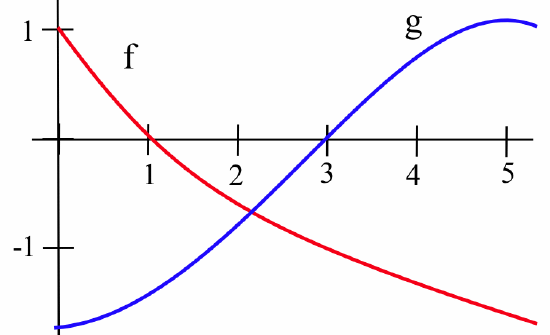
Define a new function \(\displaystyle h(x) = \frac{f(x)}{g(x)}\).- At what value of \(x\) does \(h(x)\) have a root?
- Determine the limits of \(h(x)\) as \(x\rightarrow 1^{+}\), \(x\rightarrow 1^{-}\), \(x\rightarrow 3^{+}\) and \(x\rightarrow 3^{-}\).
- Where does \(h(x)\) have a vertical asymptote?
- The figure below shows \(f(x)\) and \(g(x)\) on the interval \(0 \leq x \leq 5\).
![A red curve labeled f and a blue curve labeled g on a [0,5.3]X[-1.2,2.2] grid: f starts concave up at (0,1), and descends through (1,0) to a low point near (2.6,-0.5] before rising through (4,0) toward (5,2); g begins concave up at (0,2), reaches a low point near (1.2,0.7), transitions to concave down near (1.7,0.8), reaches a peak at (2,1), transitions to concave up at (3,0) and descends to a low point near (4.8,-1).](https://math.libretexts.org/@api/deki/files/140513/fig306_10.png?revision=1&size=bestfit&width=363&height=250)
Let \(\displaystyle h(x) = \frac{f(x)}{g(x)}\).- At what value(s) of \(x\) does \(h(x)\) have a root?
- Where does \(h(x)\) have vertical asymptotes?
- The figure below shows \(f(x)\) and \(g(x)\) for \(0 \leq x \leq 5\).

Let \(\displaystyle h(x) = \frac{f(x)}{g(x)}\). Determine the limits of \(h(x)\) as \(x\rightarrow 2^{+}\), \(x\rightarrow 2^{-}\), \(x\rightarrow 4^{+}\) and \(x\rightarrow 4^{-}\).
For Problems 4–24, calculate the limit of each expression as “\(x\rightarrow \infty\).”
- \(\displaystyle \frac{6}{x+2}\)
- \(\displaystyle \frac{28}{3x-5}\)
- \(\displaystyle \frac{7x+12}{3x-2}\)
- \(\displaystyle \frac{4-3x}{x+8}\)
- \(\displaystyle \frac{5\sin(2x)}{2x}\)
- \(\displaystyle \frac{\cos(3x)}{5x-1}\)
- \(\displaystyle \frac{2x-3\sin(x)}{5x-1}\)
- \(\displaystyle \frac{4+x\cdot\sin(x)}{2x-4}\)
- \(\displaystyle \frac{x^2-5x+2}{x^2+8x-4}\)
- \(\displaystyle \frac{2x^2-9}{3x^2+10x}\)
- \(\displaystyle \frac{\sqrt{x+5}}{\sqrt{4x-2}}\)
- \(\displaystyle \frac{5x^2-7x+2}{2x^3+4x}\)
- \(\displaystyle \frac{x+\sin(x)}{x-\sin(x)}\)
- \(\displaystyle \frac{7x^2 + x\cdot \sin(x)}{3-x^2+\sin(7x^2)}\)
- \(\displaystyle \frac{7x^{143}+734x-2}{x^{150}-99x^{83}+25}\)
- \(\displaystyle \frac{\sqrt{9x^2+16}}{2+\sqrt{x^2+1}}\)
- \(\displaystyle \sin\left(\frac{3x+5}{2x-1}\right)\)
- \(\displaystyle \cos\left(\frac{7x+4}{x^2+x+1}\right)\)
- \(\displaystyle \ln\left(\frac{3x^2+5x}{x^2-4}\right)\)
- \(\displaystyle \ln(x+8)-\ln(x-5)\)
- \(\displaystyle \ln(3x+8)-\ln(2x+5)\)
- Salt water with a concentration of 0.2 pounds of salt per gallon flows into a large tank that initially contains 50 gallons of pure water.
- If the flow rate of salt water into the tank is 4 gallons per minute, what is the volume \(V(t)\) of water and the amount \(A(t)\) of salt in the tank \(t\) minutes after the flow begins?
- Show that the salt concentration \(C(t)\) at time \(t\) is \(\displaystyle C(t) = \frac{0.8t}{4t + 50}\).
- What happens to the concentration \(C(t)\) after a “long” time?
- Redo parts (a)–(c) for a large tank that initially contains 200 gallons of pure water.
- Under certain laboratory conditions, an agar plate contains \(\displaystyle B(t) = 100\left(2 - e^{-t}\right)\) bacteria \(t\) hours after the start of the experiment.
- How many bacteria are on the plate at the start of the experiment (\(t = 0\))?
- Show that the population is always increasing. (Show \(B'(t) > 0\) for all \(t > 0\).)
- What happens to the population \(B(t)\) after a “long” time?
- Redo parts (a)–(c) for \(B(t) = A(2 - e^{-t})\).
For Problems 27–41 , calculate the limits.
- \(\displaystyle \lim_{x\to 0} \, \frac{x+5}{x^2}\)
- \(\displaystyle \lim_{x\to 3} \, \frac{x-1}{(x-3)^2}\)
- \(\displaystyle \lim_{x\to 5} \, \frac{x-7}{(x-5)^2}\)
- \(\displaystyle \lim_{x\to 2^{+}} \, \frac{x-1}{x-2}\)
- \(\displaystyle \lim_{x\to 2^{-}} \, \frac{x-1}{x-2}\)
- \(\displaystyle \lim_{x\to 3^{+}} \, \frac{x-1}{x-2}\)
- \(\displaystyle \lim_{x\to 4^{+}} \, \frac{x+3}{4-x}\)
- \(\displaystyle \lim_{x\to 1^{-}} \, \frac{x^2+5}{1-x}\)
- \(\displaystyle \lim_{x\to 3^{+}} \, \frac{x^2-4}{x^2-2x-3}\)
- \(\displaystyle \lim_{x\to 2} \, \frac{x^2-x-2}{x^2-4}\)
- \(\displaystyle \lim_{x\to 0} \, \frac{x-2}{1-\cos(x)}\)
- \(\displaystyle \lim_{x\to \infty} \, \frac{x^3+7x-4}{x^2+11x}\)
- \(\displaystyle \lim_{x\to 5} \, \frac{\sin(x-5)}{(x-5)}\)
- \(\displaystyle \lim_{x\to 0} \, \frac{x+1}{\sin^2(x)}\)
- \(\displaystyle \lim_{x\to 0^{+}} \, \frac{1+\cos(x)}{1-e^x}\)
In Problems 42–59, write an equation of each asymptote for each function and state whether it is a vertical, horizontal or slant asymptote.
- \(\displaystyle f(x) = \frac{x+2}{x-1}\)
- \(\displaystyle f(x) = \frac{x-3}{x^2}\)
- \(\displaystyle f(x) = \frac{x-1}{x^2-x}\)
- \(\displaystyle f(x) = \frac{x+5}{x^2-4x+3}\)
- \(\displaystyle f(x) = \frac{x+\sin(x)}{3x-3}\)
- \(\displaystyle f(x) = \frac{x^2-4}{x+1}\)
- \(\displaystyle f(x) = \frac{\cos(x)}{x^2}\)
- \(\displaystyle f(x) = 2+ \frac{3-x}{x-1}\)
- \(\displaystyle f(x) = \frac{x\cdot\sin(x)}{x^2-x}\)
- \(\displaystyle f(x) = \frac{2x^2+x+5}{x}\)
- \(\displaystyle f(x) = \frac{x^2+x}{x+1}\)
- \(\displaystyle f(x) = \frac{1}{x-2} + \sin(x)\)
- \(\displaystyle f(x) = x+\frac{x}{x^2+1}\)
- \(\displaystyle f(x) = x^2+\frac{x}{x^2+1}\)
- \(\displaystyle f(x) = x^2+\frac{x}{x+1}\)
- \(\displaystyle f(x) = \frac{x\cdot\cos(x)}{x-3}\)
- \(\displaystyle f(x) = \frac{x^3-x^2+2x-1}{x-1}\)
- \(\displaystyle f(x) = \sqrt{\frac{x^2+3x+2}{x+3}}\)
This page titled 3.6: Asymptotic Behavior of Functions was last modified on Wed, 28 Jan 2026 21:01:15 GMT and is shared under a CC BY-NC-SA 4.0 license and was authored, remixed, and/or curated by Dale Hoffman, edited and updated by Jeff Eldridge.
The book could not be loaded just now.