Opening the book…
For exercises 1 - 10, find the slope of the secant line between the values \(x_1\) and \(x_2\) for each function \(y=f(x)\).
1) \(f(x)=4x+7; \quad x_1=2, \quad x_2=5\)
- Answer
- \(m_{\text{sec}}=4\)
2) \(f(x)=8x−3;\quad x_1=−1,\quad x_2=3\)
- Answer
- \(m_{\text{sec}}=8\)
3) \(f(x)=x^2+2x+1;\quad x_1=3,\quad x_2=3.5\)
- Answer
- \(m_{\text{sec}}=-1\)
4) \(f(x)=−x^2+x+2;\quad x_1=0.5,\quad x_2=1.5\)
- Answer
- \(m_{\text{sec}}=4\)
5) \(f(x)=\dfrac{4}{3x−1};\quad x_1=1,\quad x_2=3\)
- Answer
- \(m_{\text{sec}}=−\frac{3}{4}\)
6) \(f(x)=\dfrac{x−7}{2x+1};\quad x_1=−2,\quad x_2=0\)
- Answer
- \(m_{\text{sec}}=-5\)
7) \(f(x)=\sqrt{x};\quad x_1=1,\quad x_2=16\)
- Answer
- \(m_{\text{sec}}=0.2\)
8) \(f(x)=\sqrt{x−9};\quad x_1=10,\quad x_2=13\)
- Answer
- \(m_{\text{sec}}={1}{3}\)
9) \(f(x)=x^{1/3}+1;\quad x_1=0,\quad x_2=8\)
- Answer
- \(m_{\text{sec}}=0.25\)
10) \(f(x)=6x^{2/3}+2x^{1/3};\quad x_1=1,\quad x_2=27\)
- Answer
- \(m_{\text{sec}}=2\)
For the functions in exercises 11 - 20,
a. find the slope of the tangent line at \(x=a\)
b. find the equation of the tangent line to \(f\) at \(x=a\).
11) \(f(x)=3−4x, \quad a=2\)
- Answer
- a. \(m_{\text{tan}}=−4\)
b. \(y=−4x+3\)
12) \(f(x)=\dfrac{x}{5}+6, \quad a=−1\)
- Answer
- a. \(m_{\text{tan}}={1}{5}\)
b. \(y={x}{5}+6\)
13) \(f(x)=x^2+x, \quad a=1\)
- Answer
- a. \(m_{\text{tan}}=3\)
b. \(y=3x−1\)
14) \(f(x)=1−x−x^2, \quad a=0\)
- Answer
- a. \(m_{\text{tan}}=-1\)
b. \(y=-x+1\)
15) \(f(x)=\dfrac{7}{x}, \quad a=3\)
- Answer
- a. \(m_{\text{tan}}=\frac{−7}{9}\)
b. \(y=\frac{−7}{9}x+\frac{14}{3}\)
16) \(f(x)=\sqrt{x+8}, \quad a=1\)
- Answer
- a. \(m_{\text{tan}}={1}{6}\)
b. \(y={1}{6}x+{17}{6}\)
17) \(f(x)=2−3x^2, \quad a=−2\)
- Answer
- a. \(m_{\text{tan}}=12\)
b. \(y=12x+14\)
18) \(f(x)=\dfrac{−3}{x−1}, \quad a=4\)
- Answer
- a. \(m_{\text{tan}}={1}{5}\)
b. \(y={1}{5}x+6\)
19) \(f(x)=\dfrac{2}{x+3}, \quad a=−4\)
- Answer
- a. \(m_{\text{tan}}=−2\)
b. \(y=−2x−10\)
20) \(f(x)=\dfrac{3}{x^2}, \quad a=3\)
- Answer
- a. \(m_{\text{tan}}={-2}{9}\)
b. \(y=−{2}{9}x+1\)
For the functions \(y=f(x)\) in exercises 21 - 30, find f′(a).
21) \(f(x)=\dfrac{3}{5}x+1, \quad a=-5\)
- Answer
- \(f'(-1) = \dfrac{3}{5}\)
22) \(f(x)=−7x+1, \quad a=3\)
- Answer
- \(f'(-1) = -7\)
23) \(f(x)=x^2+9x, \quad a=2\)
- Answer
- \(f'(2) = 13\)
24) \(f(x)=3x^2−x+2, \quad a=1\)
- Answer
- \(f'(1) = 5\)
25) \(f(x)=\sqrt{x}, \quad a=4\)
- Answer
- \(f'(4) = \frac{1}{4}\)
26) \(f(x)=\sqrt{x−2}, \quad a=6\)
- Answer
- \(f'(6) = 1\)
27) \(f(x)=\dfrac{1}{x}, \quad a=2\)
- Answer
- \(f'(2) = −\frac{1}{4}\)
28) \(f(x)=\dfrac{1}{x−3}, \quad a=−1\)
- Answer
- \(f'(-1) = \dfrac{-1}{16}\)
29) \(f(x)=\dfrac{1}{x^3}, \quad a=1\)
- Answer
- \(f'(1) = -3\)
30) \(f(x)=\dfrac{1}{\sqrt{x}}, \quad a=4\)
- Answer
- \(f'(4) = \dfrac{-1}{16}\)
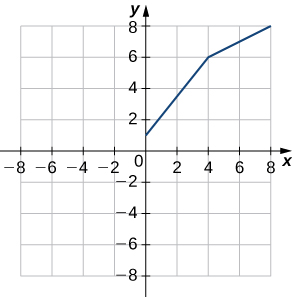
31) Use the following graph to evaluate a. \(f′(1)\) and b. \(f′(6).\)
- Answer
- a. \(1.25\); b. \(0.5\)
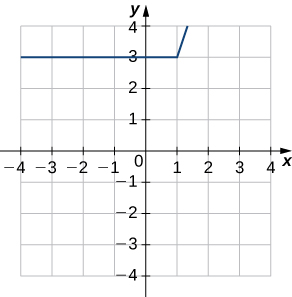
32) Use the following graph to evaluate a. \(f′(−3)\) and b. \(f′(1.5)\).
For the following exercises, use the limit definition of derivative to show that the derivative does not exist at \(x=a\) for each of the given functions.
33) \(f(x)=x^{1/3}, \quad x=0\)
- Answer
- \(\displaystyle \lim_{x→0^−}\frac{x^{1/3}−0}{x−0}=\lim_{x→0^−}\frac{1}{x^{2/3}}=∞\)
34) \(f(x)=x^{2/3}, \quad x=0\)
35) \(f(x)=\begin{cases}1, & \text{if } x<1\\x, & \text{if } x≥1\end{cases}, \quad x=1\)
- Answer
- \(\displaystyle \lim_{x→1^−}\frac{1−1}{x−1}=0≠1=\lim_{x→1^+}\frac{x−1}{x−1}\)
36) \(f(x)=\dfrac{|x|}{x}, \quad x=0\)
This page titled 2.7E: Exercises for Section 2.7 was last modified on Wed, 12 Aug 2026 19:25:31 GMT and is shared under a CC BY-NC-SA 4.0 license and was authored, remixed, and/or curated by Leonard Lamp, Kenn Huber, and Mohamad Youssef.
The book could not be loaded just now.