Opening the book…
In exercises 1 - 4, use the limit laws to evaluate each limit. Justify each step by indicating the appropriate limit law(s).
1) \(\displaystyle \lim_{x→0}(4x^2−2x+3)\)
- Answer
-
Use constant multiple law, sum law, root law, and difference law:
\(\displaystyle \lim_{x→0}(4x^2−2x+3)=4\lim_{x→0}x^2−2\lim_{x→0}x+\lim_{x→0}3=0 + 0 + 3=3\)
2) \(\displaystyle \lim_{x→1}\frac{x^3+3x^2+5}{4−7x}\)
3) \(\displaystyle \lim_{x→−2}\sqrt{x^2−6x+3}\)
- Answer
- Use root law: \(\displaystyle \lim_{x→−2}\sqrt{x^2−6x+3}=\sqrt{\lim_{x→−2}(x^2−6x+3)}=\sqrt{19}\)
4) \(\displaystyle \lim_{x→−1}(9x+1)^2\)
In exercises 5 - 10, use direct substitution to evaluate the limit of each continuous function.
5) \(\displaystyle \lim_{x→7}x^2\)
- Answer
- \(\displaystyle \lim_{x→7}x^2\;=\;49\)
6) \(\displaystyle \lim_{x→−2}(4x^2−1)\)
7) \(\displaystyle \lim_{x→0}\frac{1}{1+\sin x}\)
- Answer
- \(\displaystyle \lim_{x→0}\frac{1}{1+\sin x}\;=\;1\)
8) \(\displaystyle \lim_{x→2}e^{2x−x^2}\)
9) \(\displaystyle \lim_{x→1}\frac{2−7x}{x+6}\)
- Answer
- \(\displaystyle \lim_{x→1}\frac{2−7x}{x+6}\;=\;−\frac{5}{7}\)
10) \(\displaystyle \lim_{x→3}\ln e^{3x}\)
In exercises 11 - 20, use direct substitution to show that each limit leads to the indeterminate form \(0/0\). Then, evaluate the limit analytically.
11) \(\displaystyle \lim_{x→4}\frac{x^2−16}{x−4}\)
- Answer
- \(\displaystyle \text{When }x = 4, \quad\frac{x^2−16}{x−4}=\frac{16−16}{4−4}=\frac{0}{0};\)
then, \(\displaystyle \lim_{x→4}\frac{x^2−16}{x−4}= \lim_{x→4}\frac{(x+4)(x−4)}{x−4}=\lim_{x→4}(x+4) = 4+4 =8\)
12) \(\displaystyle \lim_{x→2}\frac{x−2}{x^2−2x}\)
13) \(\displaystyle \lim_{x→6}\frac{3x−18}{2x−12}\)
- Answer
- \(\displaystyle \text{When }x = 6, \quad\frac{3x−18}{2x−12}=\frac{18−18}{12−12}=\frac{0}{0};\)
then, \(\displaystyle \lim_{x→6}\frac{3x−18}{2x− 12}=\lim_{x→6}\frac{3(x−6)}{2(x−6)}=\lim_{x→6}\frac{3}{2}=\frac{3}{2}\)
14) \(\displaystyle \lim_{h→0}\frac{(1+h)^2−1}{h}\)
15) \(\displaystyle \lim_{t→9}\frac{t−9}{\sqrt{t}−3}\)
- Answer
- \(\displaystyle \text{When }t = 9, \quad\frac{t−9}{\sqrt{t}−3}=\frac{9−9}{3−3}=\frac{0}{0};\)
then, \(\displaystyle \lim_{t→9}\frac{t−9}{\sqrt{t}−3} =\lim_{t→9}\frac{t−9}{\sqrt{t}−3}\frac{\sqrt{t}+3}{\sqrt{t}+3}=\lim_{t→9}\frac{(t−9)(\sqrt{t}+3)}{t - 9}=\lim_{t→9}(\sqrt{t}+3)=\sqrt{9}+3=6\)
16) \(\displaystyle \lim_{h→0}\frac{\dfrac{1}{a+h}−\dfrac{1}{a}}{h}\), where \(a\) is a real-valued constant and \(a\) is not zero.
17) \(\displaystyle \lim_{θ→π}\frac{\sin θ}{\tan θ}\)
- Answer
- \(\displaystyle \text{When }θ = π, \quad\frac{\sin θ}{\tan θ}=\frac{\sin π}{\tan π}=\frac{0}{0};\)
then, \(\displaystyle \lim_{θ→π}\frac{\sin θ}{\tan θ}=\lim_{θ→ π}\frac{\sin θ}{\frac{\sin θ}{\cos θ}}=\lim_{θ→π}\cos θ=\cos π=−1\)
18) \(\displaystyle \lim_{x→1}\frac{x^3−1}{x^2−1}\)
19) \(\displaystyle \lim_{x→1/2}\frac{2x^2+3x−2}{2x−1}\)
- Answer
- \(\displaystyle \text{When }x=1/2, \quad\frac{2x^2+3x−2}{2x−1}=\frac{\frac{1}{2}+\frac{3}{2}−2}{1−1}=\frac{0}{0};\)
then, \(\displaystyle \lim_{x→ 1/2}\frac{2x^2+3x−2}{2x−1}=\lim_{x→1/2}\frac{(2x−1)(x+2)}{2x−1}=\lim_{x→1/2}(x+2)=\frac{1}{2}+2=\frac{5}{2}\)
20) \(\displaystyle \lim_{x→−3}\frac{\sqrt{x+4}−1}{x+3}\)
In exercises 21 - 24, use direct substitution to obtain an undefined expression. Then, use the method used in Example 9 of this section to simplify the function and determine the limit.
21) \(\displaystyle \lim_{x→−2^−}\frac{2x^2+7x−4}{x^2+x−2}\)
- Answer
- \(−∞\)
22) \(\displaystyle \lim_{x→−2^+}\frac{2x^2+7x−4}{x^2+x−2}\)
23) \(\displaystyle \lim_{x→1^−}\frac{2x^2+7x−4}{x^2+x−2}\)
- Answer
- \(−∞\)
24) \(\displaystyle \lim_{x→1^+}\frac{2x^2+7x−4}{x^2+x−2}\)
In exercises 25 - 32, assume that \(\displaystyle \lim_{x→6}f(x)=4,\quad \lim_{x→6}g(x)=9\), and \(\displaystyle \lim_{x→6}h(x)=6\). Use these three facts and the limit laws to evaluate each limit.
25) \(\displaystyle \lim_{x→6}2f(x)g(x)\)
- Answer
- \(\displaystyle \lim_{x→6}2f(x)g(x)=2\left(\lim_{x→6}f(x)\right)\left(\lim_{x→6}g(x)\right)=2 (4)(9)=72\)
26) \(\displaystyle \lim_{x→6}\frac{g(x)−1}{f(x)}\)
27) \(\displaystyle \lim_{x→6}\left(f(x)+\frac{1}{3}g(x)\right)\)
- Answer
- \(\displaystyle \lim_{x→6}\left(f(x)+\frac{1}{3}g(x)\right)=\lim_{x→6}f(x)+\frac{1}{3}\lim_{x→6}g(x)=4+\frac{1}{3}(9)=7\)
28) \(\displaystyle \lim_{x→6}\frac{\big(h(x)\big)^3}{2}\)
29) \(\displaystyle \lim_{x→6}\sqrt{g(x)−f(x)}\)
- Answer
- \(\displaystyle \lim_{x→6}\sqrt{g(x)−f(x)}=\sqrt{\lim_{x→6}g(x)−\lim_{x→6}f(x)}=\sqrt{9-4}=\sqrt{5}\)
30) \(\displaystyle \lim_{x→6}x⋅h(x)\)
31) \(\displaystyle \lim_{x→6}[(x+1)⋅f(x)]\)
- Answer
- \(\displaystyle \lim_{x→6}[(x+1)f(x)]=\left(\lim_{x→6}(x+1)\right)\left(\lim_{x→6}f(x)\right)=7(4)=28\)
32) \(\displaystyle \lim_{x→6}(f(x)⋅g(x)−h(x))\)
In exercises 33 - 35, Graph of each piecewise-defined function and study the graph to evaluate the given limits.
33) \(f(x)=\begin{cases}x^2, & x≤3\\ x+4, & x>3\end{cases}\)
a. \(\displaystyle \lim_{x→3^−}f(x)\)
b. \(\displaystyle \lim_{x→3^+}f(x)\)
- Answer
-

a. \(9\); b.\( 7\)
34) \(g(x)=\begin{cases}x^3−1, & x≤0\\1, & x>0\end{cases}\)
a. \(\displaystyle \lim_{x→0^−}g(x)\)
b. \(\displaystyle \lim_{x→0^+}g(x)\)
35) \(h(x)=\begin{cases}x^2−2x+1, & x<2\\3−x, & x≥2\end{cases}\)
a. \(\displaystyle \lim_{x→2^−}h(x)\)
b. \(\displaystyle \lim_{x→2^+}h(x)\)
In exercises 36 - 43, use the following graphs and the limit laws to evaluate each limit.
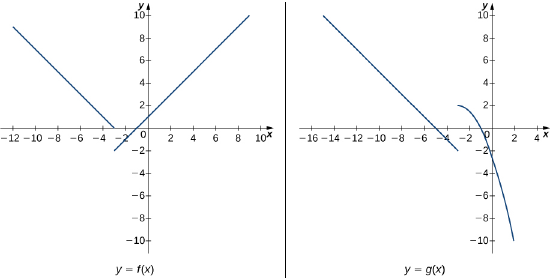
36) \(\displaystyle \lim_{x→−3^+}(f(x)+g(x))\)
37) \(\displaystyle \lim_{x→−3^−}(f(x)−3g(x))\)
- Answer
- \(\displaystyle \lim_{x→−3^−}(f(x)−3g(x))=\lim_{x→−3^−}f(x)−3\lim_{x→−3^−}g(x)=0+6=6\)
38) \(\displaystyle \lim_{x→0}\frac{f(x)g(x)}{3}\)
39) \(\displaystyle \lim_{x→−5}\frac{2+g(x)}{f(x)}\)
- Answer
- \(\displaystyle \lim_{x→−5}\frac{2+g(x)}{f(x)}=\frac{2+\left(\displaystyle \lim_{x→−5}g(x)\right)}{\displaystyle \lim_{x→−5}f(x)}=\frac{2+0}{2}=1\)
40) \(\displaystyle \lim_{x→1}(f(x))^2\)
41) \(\displaystyle \lim_{x→1}\sqrt[3]{f(x)−g(x)}\)
- Answer
- \(\displaystyle \lim_{x→1}\sqrt[3]{f(x)−g(x)}=\sqrt[3]{\lim_{x→1}f(x)−\lim_{x→1}g(x)}=\sqrt[3]{2+5}=\sqrt[3]{7}\)
42) \(\displaystyle \lim_{x→−7}(x⋅g(x))\)
43) \(\displaystyle \lim_{x→−9}[x⋅f(x)+2⋅g(x)]\)
- Answer
- \(\displaystyle \lim_{x→−9}(xf(x)+2g(x))=\left(\lim_{x→−9}x\right)\left(\lim_{x→−9}f(x)\right)+2\lim_{x→−9}g(x)=(−9)(6)+2(4)=−46\)
For exercises 44 - 46, evaluate the limit using the squeeze theorem.
44) [T] True or False? If \(2x−1≤g(x)≤x^2−2x+3\), then \(\displaystyle \lim_{x→2}g(x)=0\).
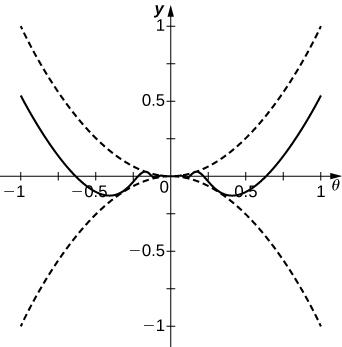
45) [T] \(\displaystyle \lim_{θ→0}θ^2\cos\left(\frac{1}{θ}\right)\)
- Answer
-
The limit is zero.
46) \(\displaystyle \lim_{x→0}f(x)\), where \(f(x)=\begin{cases}0, & x\text{ rational}\\ x^2, & x\text{ irrrational}\end{cases}\)
Contributors and Attributions
Gilbert Strang (MIT) and Edwin “Jed” Herman (Harvey Mudd) with many contributing authors. This content by OpenStax is licensed with a CC-BY-SA-NC 4.0 license. Download for free at http://cnx.org.
This page titled 2.3E: Exercises for Section 2.3 was last modified on Mon, 17 Aug 2026 01:11:54 GMT and is shared under a CC BY-NC-SA 4.0 license and was authored, remixed, and/or curated by Leonard Lamp, Kenn Huber, and Mohamad Youssef via source content that was edited to the style and standards of the LibreTexts platform.
The book could not be loaded just now.