Opening the book…
Perimeter and Area
Introduction
Perimeter and area are two fundamental mathematical concepts. They help you to quantify physical space and also provide a foundation for more advanced mathematics found in algebra, trigonometry, and calculus. Perimeter is the distance around a shape, and area is the amount of surface the shape covers.
Knowledge of area and perimeter is applied in practice by people such as architects, engineers, and graphic designers, and is a skill that is very much needed by people in general. Understanding how much space you have and learning how to fit shapes together exactly will help you when you paint a room, buy a home, remodel a kitchen, or build a deck.

Perimeter
The perimeter of a two-dimensional shape is the distance around the shape. You can think of wrapping a string around a triangle. The length of this string would be the perimeter of the triangle. Or, walking around the outside of a park, you walk the distance of the park’s perimeter. Some people find it useful to think “peRIMeter” because the edge of an object is its rim and peRIMeter has the word “rim” in it.
If the shape is a polygon, then you can add up all the lengths of the sides to find the perimeter. Be sure to measure all lengths in the same units. You measure perimeter in linear units, which is a one-dimensional measurement. Examples of units of measure for length are inches, centimeters, or feet.
| Name | Figure | Area (\(A)\) and Perimeter \((P)\) |
| Rectangle/Square |
 |
\(A=l \cdot w \) \(P =2(l+w)\) \(l\) is a length and \(w\) is width. |
| Triangle |  |
\(A =\frac{1}{2}\cdot b \cdot h\) \(P =a+b+c\) \(b\) is a base and \(h\) is a height. |
|
Parallelogram |
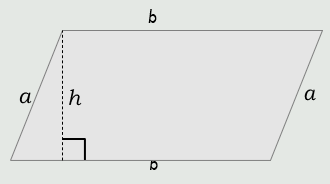 |
\(A= b \cdot h\) \(P=2(b+a)\) |
| Trapezoid |  |
\(A = \dfrac{1}{2}\cdot (b_1+b_2)\cdot h\) \(P=b_1+b_2+a_1+a_2\) \(b_1\) and \(b_2\) are length of parallel bases. |
| Circle |  |
\(A = \pi r^2\) \(C=2\pi r\) \(r\) is a radius and \(C\) is Cirumference (Perimeter) |
Remember that all cubes are rectangular prisms, so the formula for finding the volume of a cube is the area of the base of the cube times the height.
Example \(\PageIndex{2}\): Find the Perimeter
Find the perimeter of the given figure. All measurements indicated are in ft.

- Answer
-
Since all the sides are measured in inches, just add the lengths of all six sides to get the perimeter.
\[P = 5 + 3 + 7 + 4+ 6\nonumber\]
Remember to include units.
\(P = 25 \text{ ft}\). This means that a tightly wrapped string running the entire distance around the polygon would measure \(25\) feet long.
Example \(\PageIndex{3}\):Sides are Given as Algebraic Expression
Find the perimeter of a triangle with sides. Write your answer in terms of \(x\).

- Answer
-
\(\text{Perimeter} = 16x^2+5x+9x^2+20x+(16x^2-9x^2)+(20x-5x)=16x^2+5x+9x^2+20x+7x^2+14x=32x^2+40x\)
Sometimes, you need to use what you know about a polygon in order to find the perimeter. Let’s look at the rectangle in the next example.
Example \(\PageIndex{4}\): Perimeter of Rectangle
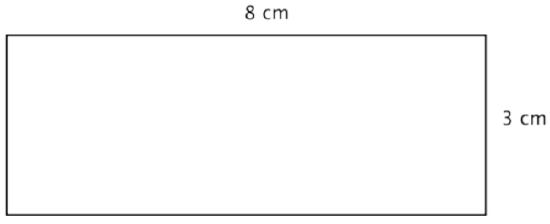
A rectangle has a length of \(8\) centimeters and a width of \(3\) centimeters. Find the perimeter.
- Answer
-
Since this is a rectangle, the opposite sides have the same lengths, \(3\) cm. and \(8\) cm. Add up the lengths of all four sides to find the perimeter.
\(P = 3 + 3 + 8 + 8= 22 \text{ cm}\)
Notice that the perimeter of a rectangle always has two pairs of equal-length sides.
The formula for the perimeter of a rectangle is often written as \(P = 2l + 2w\), where \(l\) is the length of the rectangle and \(w\) is the width of the rectangle.
So you could have also written \[P = 2(3) + 2(8) = 6 + 16 = 22 \text{ cm}\nonumber\].
Example \(\PageIndex{5}\): Find Missing Length
Find the length of the rectangle pictured above, if the perimeter is \(96\).

- Answer
-
Two opposite sides of a rectangle have equal length. So the two opposite sides have a total length of \(18+18=36\). The remaining two sides must total \(60 \). So unknown side must be \(\frac{60}{2}=30\).
Another way
\[\begin{aligned}
96&=2l+2\times18\\
96&=2l+36\\
96-36&=2l\\
60&=2l\\
l&=30
\end{aligned} \nonumber \]
Triangles
Triangles are the strongest geometric shape. Roof trusses, bridges, and towers use triangular frames to distribute weight evenly. Ladders, bicycle frames, tents, and cranes use triangular supports. Foldable stands and racks often use triangular shapes for stability. The following example shows how to find the area and perimeter of a triangle.
Example \(\PageIndex{6}\): Area and Perimeter of a Triangle
Find the perimeter and area of the figure below.

- Answer
-
First, change centimeters (cm) and decimeters (dm) to meters (m).
\[\begin{array}{l}
21\mathrm{ ~cm}&=0.21 \mathrm{ ~ m}\\
3.5\mathrm{ ~dm}&=0.35\mathrm{ ~m}\\
\end{array} \nonumber \]The base measures \(0.28\) m and the height measures \(0.21\) m . Using the formula, we can calculate the area:
\[A=\frac{1}{2}(0.28)(0.21)=0.0294\mathrm{~m}^2 \nonumber \]
The perimeter is
\[\P=0.21+0.28+0.35=0.84\mathrm{~m}\nonumber \]
Example \(\PageIndex{7}\): Finding Area of a Triangle
Find the area of this triangle that has a base of \(4\) cm and a height of \(6\) cm Figure \(\PageIndex{6}\).
- Answer
The base measures \(4\) cm and the height measures \(6\) cm. Using the formula, we can calculate the area:
\[A=\frac{1}{2}(4)(6)=12\mathrm{~cm}^2 \nonumber \]
Quadrilaterals
A quadrilateral is a four-sided polygon with four vertices. Some quadrilaterals have either one or two sets of parallel sides. The set of quadrilaterals include the square, the rectangle, the parallelogram, the trapezoid, and the rhombus. The most common quadrilaterals are the square and the rectangle.
Square and Rectangle
Many everyday applications require the use of the perimeter and area formulas. Suppose you are remodeling your home and you want to replace all the flooring. You need to know how to calculate the area of the floor to purchase the correct amount of tile, hardwood, or carpet. If you want to paint the rooms, you need to calculate the area of the walls and the ceiling to know how much paint to buy, and the list goes on. Can you think of other situations where you might need to calculate area?
Example \(\PageIndex{8}\): Finding Area of a Rectangle
You have a garden with an area of \(196\) square feet. How wide can the garden be if the length is \(28\) feet?
- Answer
-
The area of a rectangular region is \(A=lw \). Letting the width equal \(w\) :
\[\begin{aligned}
A&=lw\\
196&=28w\\
\frac{196}{28}&=w\\
7&=w\\
\end{aligned} \nonumber \]
Parallelogram
The area of a parallelogram can be found using the formula for the area of a triangle. If we cut a diagonal across the parallelogram from one vertex to the opposite vertex, we have two triangles. If we multiply the area of a triangle by \(2 \) , we have the area of a parallelogram:
Example \(\PageIndex{9}\): Finding the Area of a Parallelogram
Use the diagram of the parallelogram in the following figure to answer the questions.

- Answer
-
Note that the base is \(4\) feet and the height is \(6\) feet. Using the formula \(A=b\times h\), we have
\[A=6\mathrm{~ft}\times4\mathrm{~ft}=24 \mathrm{~ft}^2\nonumber\]
Trapezoid
Another quadrilateral is the trapezoid. A trapezoid has one set of parallel sides or bases. An example is provided below. Notice that the height of a trapezoid will always be perpendicular to the bases (just like when you find the height of a parallelogram).
Example \(\PageIndex{10}\): Finding the Area of a Trapezoid
The given figure is a regular trapezoid. Find the exact perimeter and then find the area.
- Answer
-
The perimeter is the measure of the boundary of a shape, so we simply add up the lengths of its sides. We have
\[\text{Perimeter} =31 + 13.5+11 + 13.5 = 69 \text{ ~in}\nonumber\]
Then, the area of the trapezoid using the formula is
\[A=\frac{1}{2}(11+31)\cdot 10=210 \text{~in}^2\nonumber\]
Circles
Introduction
Circles are a common shape. You see them all over—wheels on a car, Frisbees passing through the air, compact discs delivering data. These are all circles.
A circle is a two-dimensional figure, just like polygons and quadrilaterals. However, circles are measured differently from these other shapes—you even have to use some different terms to describe them. Let’s take a look at this interesting shape.
Properties of Circles
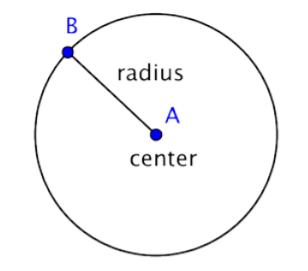
A circle represents a set of points, all of which are the same distance away from a fixed, middle point. This fixed point is called the center. The distance from the center of the circle to any point on the circle is called the radius.
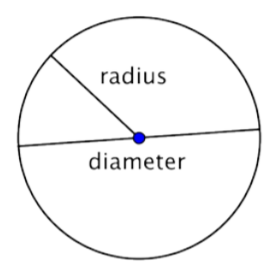
When two radii (the plural of radius) are put together to form a line segment across the circle, you have a diameter. The diameter of a circle passes through the center of the circle and has its endpoints on the circle itself.
The diameter of any circle is two times the length of that circle’s radius. It can be represented by the expression \(2r\), or “two times the radius.” So, if you know a circle’s radius, you can multiply it by \(2\) to find the diameter; this also means that if you know a circle’s diameter, you can divide by \(2\) to find the radius.
Circumference
The distance around a circle is called the circumference. (Recall, the distance around a polygon is the perimeter.)
One interesting property about circles is that the ratio of a circle’s circumference and its diameter is the same for all circles. No matter the size of the circle, the ratio of the circumference to the diameter will be the same.
Some actual measurements of different items are provided below. The measurements are accurate to the nearest millimeter or quarter-inch (depending on the unit of measurement used). Look at the ratio of the circumference to the diameter for each one—although the items are different, the ratio for each is approximately the same.
| Item | Circumference (\(C\)) (rounded to nearest hundredth) | Diameter (\(d\)) | Ratio \(\dfrac{C}{d}\) |
| Cup | \(253\) mm | \(79\) mm | \(\dfrac{253}{79} = 3.2025...\) |
| Quarter | \(84\) mm | \(79\) mm | \(\dfrac{84}{27} = 3.1111...\) |
| Bowl | \(37.25\) in | \(11.5\) in | \(\dfrac{37.25}{11.75} = 3.1702...\) |
The circumference and the diameter are approximate measurements since there is no precise way to measure these dimensions exactly. If you were able to measure them more precisely, however, you would find that the ratio \(\dfrac{C}{d}\) would move towards \(3.14\) for each of the items given. The mathematical name for the ratio \(\dfrac{C}{d}\) is pi and is represented by the Greek letter \(\pi\).
\(\pi\) is a non-terminating, non-repeating decimal, so it is impossible to write it out completely? The first 10 digits of \(\pi\) are \(3.141592653\); it is often rounded to \(3.14\) or estimated as the fraction \(\dfrac{22}{7}\). Note that both \(3.14\) and \(\dfrac{22}{7}\) are approximations of \(\pi\), and are used in calculations where it is not important to be precise.
When we calculate the area and circumference of a circle, there are two ways to write the answers. If we write the answer in terms of \(\pi\), the answer is called an exact answer. If we substitute \(\pi=3.14\) and simplify the given decimal places, the answer is called an approximate answer.
Example \(\PageIndex{11}\): Circumference of a Circle
Find the circumference of a circle with a radius of \(2.5\) yards. Write the answer in terms of pi (exact answer) and use \(\pi =3.14\) to find an approximate answer and round your answer to two decimal places.
- Answer
-
To calculate the circumference of a circle given a radius of \(2.5\) yards, use the formula \(C = 2 \pi r\).
\(C = 2 \pi r\)
\(C = 2 \pi \cdot 2.5\)
\(C = 5\pi \)
So the exact answer is \(C =5 \pi\;\text{ ~yd} \). Use \(3.14\) as an approximation for \(\pi\).
\(C ≈ 3.14 \cdot 5\)
\(C ≈ 15.7 \;\text{~yd}\)
Example \(\PageIndex{12}\): Tire Circumference
A \(22\)-inch wheel rim has a diameter of \(22\) inches. When a tire is mounted and fully inflated, the wheel will expand another \(2\) inches from the rim.

What is the circumference of the inflated tire?
- Answer
-
For an inflated tire, the radius is \(r=11+2=13\;\text{~in}\).
To calculate the circumference of an inflated tire with a radius of \(12\) in, use the formula \(C=2\pi r\).
\(C = 2 \pi r\)
\(C = 2 \pi \cdot 13\)
\(C = 26\pi\)
So the exact answer is \(C =26 \pi\;\text{ in} \). Use \(3.14\) as an approximation for \(\pi\).
\(C ≈ 26\cdot 3.14\)
\(C ≈ 81.64 \;\text{ ~in}\)
Area of Circle
Pi, \(\pi\), is an important number in geometry. You have already used it to calculate the circumference of a circle. You use \(\pi\) when you are figuring out the area of a circle, too.
Example \(\PageIndex{13}\): Area of a Circle
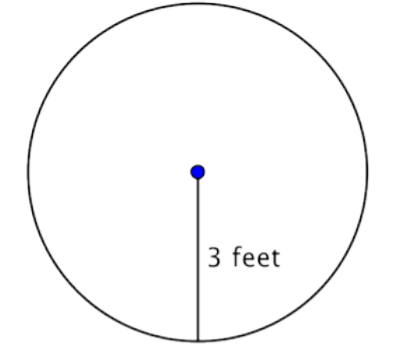
Find the area of the circle.
- Answer
-
To find the area of this circle, use the formula \(A = \pi r^2\). Remember to write the answer in terms of square units, since you are finding the area.
\(A = \pi r^2\)
\(A = \pi \cdot 3^2\)
\(A = \pi \cdot 9\)
\(A = 3.14 \cdot 9\)
\(A = 28.26\)
Answer The area is \(9\pi\) or approximately \(28.26 \text{ ~feet}^2\).
Example \(\PageIndex{14}\): Area of a Pizza
The diameter of a pizza is \(14\) inches. If the pizza is cut into \(10\) slices, what is the area of one slice of pizza? If a whole pizza costs $\(14.50\), what is the price of one square inch? Round your answer to the nearest hundredth.
- Answer
-
To find the area of this circle, use the formula \(A = \pi r^2\). Remember to write the answer in terms of square units, since you are finding the area.
\(A = \pi r^2\)
\(A = \pi \cdot 7^2\)
\(A = \pi \cdot 49\)
\(A = 3.14 \cdot 49\)
\(A = 153.86\;\text{in}^2\)
The area of one slice of pizza is approximately \(\frac{153.86}{10}=15.39\; \text{in}^2\).
Price for \(1\;\text{in}^2\) slice of pizza is \(\frac{\$14.50}{15.39}=$0.94\).
Working More with Perimeter and Area (Composite Figures)
Often, you need to find the area or perimeter of a shape that is not a standard polygon. Artists and architects, for instance, often work with complex shapes. However, even complex shapes can be thought of as composed of smaller, less complicated shapes, such as rectangles, trapezoids, and triangles.
To find the perimeter of non-standard shapes, you still find the distance around the shape by adding together the length of each side.
Finding the area of non-standard shapes is a bit different. You need to create regions within the shape for which you can find the area and add these areas together. Have a look at how this is done below.
You can also use what you know about perimeter and area to help solve problems about situations like buying fencing or paint, or determining how big a rug is needed in the living room. Here’s a fencing example.
Example \(\PageIndex{15}\): Area of Composite Figure
Find the area of the shaded region. (Object is not drawn to scale.)

- Answer
-
This shape is a combination of two simpler shapes: a rectangle and a trapezoid. Find the area of each.
Find the area of the rectangle.
\(A = l \cdot w\)
\(A = 9 \cdot 20\)
\(A = 180 \text{~cm}^2\)
Find the area of the white triangle.
\(A = \dfrac{b\dot h}{2}\)
\(A = \dfrac{(20-5)\times 9}{2}\)
\(A = \dfrac{135}{2} \)
\(A =67.5 \text{ ~ft}^2\)
The shaded area is
\(180 \text{~cm}^2 - 67.5 \text{ cm}^2 = 112.5 \text{ ~cm}^2\)
Example \(\PageIndex{16}\): Area of Composite Figure
Find the area of the shaded region.

- Answer
-
Area of a rectangle, which is the length times the width.
\(A = l \times w\)
Substitute \(55\) ft for the length and \(47\) ft for the width.
\(A = 55 \times 47 = 2,585\;\text{~ ft}^2\).
Area of a right rectangle, which is again the length times the width.
Substitute \(110\) ft for the length and \(45\) ft for the width.
\(A =110 \times 45 = 4,950\;\text{~ ft}^2\)
So the area of the figure is.
\(\text{Total area}=2,585\;\text{~ft}^2+4,950\;\text{~ft}^2=7,535\;\text{~ft}^2 \)
You know how to calculate the circumference and area of a circle, you can use this knowledge to find the perimeter and area of composite figures. The trick to figuring out these types of problems is to identify shapes (and parts of shapes) within the composite figure, calculate their individual dimensions, and then add them together.
Example \(\PageIndex{17}\): Area and Perimeter of Composite Figure
You decide to make a trim for the window in the figure. How many feet of trim do you need to buy? What is the area of the window?
- Answer
-
The trim will cover the \(6\) feet along the bottom and the two \(12\)-ft sides plus the half circle on top. The circumference of a semicircle is ½ the circumference of a circle. The diameter of the semicircle is \(6\) ft. So its radius is \(3 \) ft. Then, the circumference of the semicircle would be
\(C =\frac{1}{2}\times 2 \pi r\)
\(C = \frac{1}{2} \pi \times 2\pi\cdot 3\)
\(C = 9.4\)
So the circumference of the top semicircle is
\(C ≈ 9.4 \;\text{~ft}\)
Therefore, the total perimeter of the window is \( 6 + 12 +12 +9.4 = 39.4\text{~ft}\).
The area of a rectangle is calculated by multiplying the length by the width.
\(A = l \times w\)
Substitute \(6\) in for the length and \(12\) in for the width.
\(A = 6 \cdot 12 = 72\;\text{~ft}^2\).
Area of semicircles of \(r=3\) is
\begin{align*}
A &= \frac{1}{2}\pi r^2\\
&= \frac{1}{2}\pi\times 3^2\\
&=\frac{1}{2}\pi\times 9\\
&=4.5\pi\text{~ft}^2\\
\end{align*}\[\text{Total area of window} =72 + 4.5 \pi \text{~ft}^2\nonumber\]
The above is exact answer. The approximate answer would be
\[\text{Total area of window} =72 + 4.5 \times 3.14 = 86.13\text{~ft}^2\nonumber\]
Example \(\PageIndex{18}\): Area and Circumference of Composite Figure
Find the perimeter and area of the composite figure, which is made up of two semicircles, one square, and one rectangle. Write exact answer (in terms of pi) and round your answer to two decimal places with \(\pi=3.14\).

- Answer
-
Identify smaller shapes within the composite figure. This figure contains a rectangle, a square, and two semicircles.
Area of a rectangle, which is the length times the width.
\(A = l \cdot w\)
Substitute \(17\) in for the length and \(6\) in for the width.
\(A = 17 \cdot 6 = 102\;\text{ in}^2\)
Area of a square, which is the length times the width.
\(A = l \cdot w\)
Substitute \(4\) in for the length and \(4\) in for the width.
\(A = 4 \cdot 4 = 16\;\text{ in}^2\).
Note that two semicircles combine to make one circle with a diameter of \(4\), hence a radius of \(r=2\).
\(A = \pi r^2\)
\(A = \pi 2^2\)
\(A = 4\pi\)
\(\text{Total area of figure } =102 + 16 + 4 \pi = 118\pi\text{ in}^2\)
For approximate answer put \(\pi=3.14\)
\[\text{Total area of figure } = 118\times 3.14=370.52\text{ in}^2\nonumber\]
For the perimeter, let's find the circumference of two circles. Note that two semicircles combine to make one circle with a diameter of \(4\), hence a radius of \(r=2\).
\[\begin{aligned}
C &=2 \pi r\\
&= 2 \pi \times 2\\
&= 4\pi \text{~inches}\\
\end{aligned} \nonumber \]
Figure \(\PageIndex{1}\): Showing Perimeter of the Figure Therefore, the total perimeter of the window is \(13+6 + 17 +6 +4+4\pi = (46+4\pi)\text{~ft}\). Substitute \(pi=3.14\) to find an approximate answer.
Example \(\PageIndex{19}\): Area and Perimeter of Composite Figure
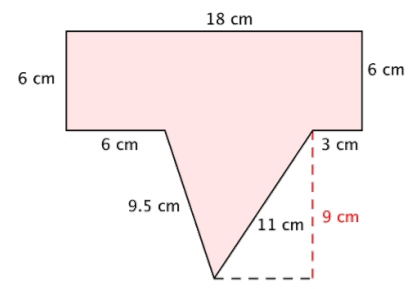
Find the area and perimeter of the polygon.
- Answer
-
To find the perimeter, add together the lengths of the sides. Start at the top and work clockwise around the shape.
\(P = 18 + 6 + 3 + 11 + 9.5 + 6 + 6\)
\(P = 59.5 \text{ cm}\)
To find the area, divide the polygon into two separate, simpler regions. The area of the entire polygon will equal the sum of the areas of the two regions.
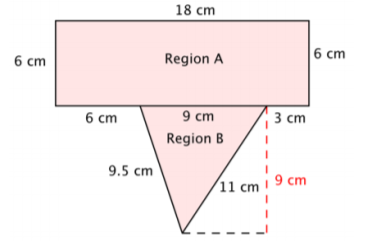
\(\text{Area of Polygon } = (\text{Area of A}) + (\text{Area of B})\)
Region A is a rectangle. To find the area, multiply the length \(18\) by the width \(6\).
\[\begin{aligned}
\text{Area of Region: }A &= l\times w\\
&= 18 \times 6\\
&= 108\\
\end{aligned} \nonumber \]The area of Region A is \(108 \text{ cm}^2\).
Region B is a triangle. To find the area, use the formula \(\dfrac{1}{2}bh\), where the base is \(9\) and the height is \(9\).
\[\begin{aligned}
\text{Area of Region }:B &= \dfrac{1}{2}b \times h\\
&= \dfrac{1}{2}\times 9 \times 9\\
&= \dfrac{1}{2} \times 81\\
&= 40.5\\
\end{aligned} \nonumber \]The area of Region B is \(40.5 \text{~cm}^2\).
Add the regions together.
\(108 \text{~cm}^2\) + \(40.5 \text{~cm}^2\) = \(148.5 \text{~cm}^2\).
Perimeter = \(59.5 \text{~cm}\)
Area = \(148.5 \text{~cm}^2\)
4.2: Perimeter, Circumference, and Area is shared under a not declared license and was authored, remixed, and/or curated by LibreTexts.
The book could not be loaded just now.