Opening the book…
Sketch the level curves for \(z=0,1,2,3\) and draw function \(z= \sqrt{(x-y)^2}\) on the domain \(D=\left\{(x,y)\, : \, 0\le x\le 4, \, 0\le y\le 4\right\} \)
- Answer
-
Simplifying with each provided value of \(z\) we get:
\(0=\sqrt{(x-y)^2} \longleftrightarrow y=x\)
\(1=\sqrt{(x-y)^2} \longleftrightarrow y=x\pm 1\)
\(2=\sqrt{(x-y)^2} \longleftrightarrow y=x\pm 2\)
\(3=\sqrt{(x-y)^2} \longleftrightarrow y=x\pm 3\)
The level curves are therefore:

The surface \(z=\sqrt{(x-y)^2}\) looks like:

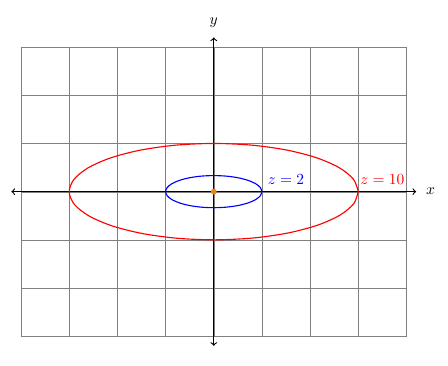
Sketch the level curves for \(z=1,2,10\) and draw the function \(z=x^2+9y^2+1\)
- Answer
-
Simplifying with each provided value of \(z\) we get:
\(1=x^2+9y^2+1 \longleftrightarrow x^2+9y^2=0\)
\(2=x^2+9y^2+1 \longleftrightarrow x^2+\dfrac{y^2}{\frac{1}{9}}=1\)
\(10=x^2+9y^2+1 \longleftrightarrow \dfrac{x^2}{9}+y^2=1\)
The level curves are therefore:
The surface \(z=x^2+9y^2+1\) looks like:

Sketch the level curves for \(z=-2,-1,0,1,2\) and draw the function \(z=\dfrac{2y}{x^2+y^2}\)
- Answer
-
Simplifying with each provided value of \(z\) we get:
\(-2=\dfrac{2y}{x^2+y^2} \longleftrightarrow x^2+\left(y+\dfrac{1}{2}\right)^2=\dfrac{1}{4}\)
\(-1=\dfrac{2y}{x^2+y^2} \longleftrightarrow x^2+(y+1)^2=1\)
\(0=\dfrac{2y}{x^2+y^2} \longleftrightarrow y=0\)
\(1=\dfrac{2y}{x^2+y^2} \longleftrightarrow x^2+(y-1)^2=1\)
\(2=\dfrac{2y}{x^2+y^2} \longleftrightarrow x^2+\left(y-\dfrac{1}{2}\right)^2=\dfrac{1}{4}\)
The level curves are therefore:

The surface \(z=\dfrac{2y}{x^2+y^2}\) looks like:

Sketch the level curves for \(z=\dfrac{1}{2},1,2\) and draw the function \(z=\dfrac{1}{\sqrt[3]{x^2-y^2}}\)
- Answer
-
Simplifying with each provided value of \(z\) we get:
\(\dfrac{1}{2}=\dfrac{1}{\sqrt[3]{x^2-y^2}} \longleftrightarrow \dfrac{x^2}{8}-\dfrac{y^2}{8}=1\)
\(1=\dfrac{1}{\sqrt[3]{x^2-y^2}} \longleftrightarrow x^2-y^2=1\)
\(2=\dfrac{1}{\sqrt[3]{x^2-y^2}} \longleftrightarrow \dfrac{x^2}{\frac{1}{8}}-\dfrac{y^2}{\frac{1}{8}}=1\)
The level curves are therefore:

The surface \(z=\dfrac{1}{\sqrt[3]{x^2-y^2}}\) looks like:

Find the domain and range of the function \(f(x,y)=\dfrac{1}{x^2+y^2+1} \)
- Answer
-
We can see that the denominator of \(f(x,y)\) can never equal zero, so the domain is all of \(\mathbb{R}^2\).
Considering that \(t=x^2+y^2\ge 0\), the range of \(f(x,y)\) is the same as that of the function \(g(t)=\dfrac{1}{t+1}\) for \(t\ge 0\):

This function has its maximum at \(t=0\), where \(g(0)=1\) and achieves all values down to (but not including) zero. Therefore the range of \(f(x,y)\) is the interval \((0,1]\).
Find the domain and range of the function \(f(x,y)= \sin^{-1}\left( 3x^2+y^2-2\right)\)
- Answer
-
We know the domain of \(\sin^{-1}(t)\) is \([-1,1]\), therefore the domain of \(f(x,y)\) is \(D=\left\{ (x,y)\, : \, -1\le 3x^2+y^2-2 \le 1\right\}\).
These edge cases can be re-written as:
\( -1=3x^2+y^2-2 \longleftrightarrow 3x^2+y^2=1 \quad \text{ and } \quad 1=3x^2+y^2-2 \longleftrightarrow x^2+\dfrac{y^2}{3}=1\)
Therefore the domain is the subset of \(\mathbb{R}^2\) below:

Considering that \(t=3x^2+y^2-2\) ranges entirely between \(-1\) and \(1\) in this domain, we see that \(sin^{-1}(t)\) reaches its every value in its range, which is the interval \(\left[ -\dfrac{\pi}{2},\dfrac{\pi}{2}\right]\).
Find the domain and range of the function \(f(x,y,z)=\dfrac{\sqrt{x^2+y^2+z^2}}{x^2+y^2+z^2-1} \)
- Answer
-
Since the value of \(t=x^2+y^2+z^2\) is always greater than or equal to zero, there is no domain issue with the square root in \(f(x,y,z)\).
To ensure that the denominator is not zero, we simply ensure that \(t\ne 1\), therefore the domain of \(f\) is \(D=\left\{(x,y,z)\,: \, x^2+y^2+z^2\ne 1\right\}\)
The range of \(f(x,y,z)\) will match that of the single variable function \(g(t)=\dfrac{\sqrt{t}}{t-1}\):

We can clearly see this range is all of \(\mathbb{R}\), so the range of \(f(x,y,z)\) is also all of \(\mathbb{R}\).
Sketch the surface parameterized by \(\vecs{r}(u,v)=\left\langle u\sin(v), 2, 3u\cos(v)\right\rangle \) with parametric domain \(D=\left\{ (u,v)\, : \, 0\le u\le 1,\, 0\le v\le 2\pi \right\}\)
- Answer
-
We can rewrite \(x=u\sin(v) \longleftrightarrow \dfrac{x}{u}=\sin(v)\) and \(z=3u\cos(v) \longleftrightarrow \dfrac{z}{3u}=\cos(v)\)
Therefore since \(\sin^2(v)+\cos^2(v)=1\) we know that \(\dfrac{x^2}{u^2}+\dfrac{z^2}{9u^2}=1 \longleftrightarrow x^2+\dfrac{z^2}{9}=u^2\)
Since \(y=2\) is a constant, it does not relate to \(x\) and \(z\). Instead, we have \(0\le u \le 1\), so:
\(0\le x^2+\dfrac{z^2}{9}\le 1\) is the interior of an ellipse in the plane \(y=2\). Since \(0\le v\le 2\pi\) we have the full ellipse.
Therefore we have a flat elliptical disc in the plane \(y=2\) as pictured below:

Sketch the surface parameterized by \(\vecs{r}(u,v)\left\langle \sin(u), \cos(u), v \right\rangle \) with parametric domain \(D=\left\{ (u,v)\, : \, 0\le u \le \dfrac{\pi}{2}, \, 1\le v\le 2 \right\}\)
- Answer
-
We can see that \(x=\sin(u)\) and \(y=\cos(u)\), and thus \(\sin^2(u)+\cos^2(u)=1\longleftrightarrow x^2+y^2=1\)
This is the surface of a cylinder with unit circle cross sections along the \(z\)-axis. Since \(0\le u\le \dfrac{\pi}{2}\), we must have \(x\ge 0\) and \(y\ge 0\).
Because \(z=v\) and \(1\le v\le 2\), we must have \(1\le z\le 2\).
Thus we have a quarter cylinder as pictured below:

Sketch the surface parameterized by \(\vecs{r}(u,v)\left\langle u-v, 2u+v, -u+3v \right\rangle \) with parametric domain \(D=\left\{ (u,v)\, : \, 0\le u\le 1, \, 0\le v\le 1\right\}\)
- Answer
-
This surface is bounded by four straight line segments:
\(u=0:\quad \vecs{r}(0,v)=\langle -v,v,3v\rangle\) for \(0\le v\le 1\)
\(u=1:\quad \vecs{r}(1,v)=\langle 1-v,2+v,-1+3v\rangle\) for \(0\le v\le 1\)
\(v=0:\quad \vecs{r}(u,0)=\langle u,2u,-u\rangle\) for \(0\le u\le 1\)
\(v=1:\quad \vecs{r}(u,1)=\langle u-1,2u+1,-u+3\rangle\) for \(0\le u\le 1\)
These must make a quadrilateral with vertices at \(\vecs{r}(0,0)=(0,0,0), \, \vecs{r}(0,1)=(-1,1,3), \, \vecs{r}(1,0)=(1,2,-1), \, \vecs{r}(1,1)=(0,3,2)\)
Therefore the surface is a parallelogram as pictured below:

Sketch the surface parameterized by \(\vecs{r}(u,v)\left\langle -\sqrt{8-u^2-v^2},u,v\right\rangle \) with parametric domain \(D=\left\{ (u,v)\, : \, -1\le u\le 1,\, -2\le v\le 2\right\}\)
- Answer
-
This surface is defined as a function \(x=-\sqrt{8-y^2-z^2}\), which is part of the sphere \(x^2+y^2+z^2=8\) where \(x\) is negative.
Since \(y=u\) and \(z=v\), the parametrization tells us we only want the part where \(-1\le y\le 1\) and \( -2\le z\le 2 \).
This gives the picture below:

Match each parameterization to the surface it describes (choices: plane, cylinder, sphere, cone, paraboloid, hyperbolic paraboloid). Then state the parametric domain used.
(a) \(\vecs{r}(u,v) = \langle u\cos (v), u\sin (v), u^2 \rangle\)
(b) \(\vecs{r}(u,v) = \langle u, v, 2u - 3v + 1 \rangle\)
(c) \(\vecs{r}(u,v) = \langle 2\cos (u), 2\sin (u), v \rangle\)
(d) \(\vecs{r}(u,v) = \langle \sin (u )\cos (v), \sin (u) \sin (v), \cos (u) \rangle\)
- Answer
-
(a) Cone — since \(\sqrt{x^2 + y^2} = |u|\) and \(z = u^2\), so \(z = (x^2 + y^2)\).
Parametric domain: \(u \in \mathbb{R}, v \in [0, 2\pi]\) for full cone, or restricted as needed.
(b) Plane — linear in \(u\) and \(v\), so the surface is flat.
Parametric domain: \(u, v \in \mathbb{R}\) for entire plane.
(c) Cylinder — \(x^2 + y^2 = 4\), constant cross-section, \(z\) free.
Parametric domain: \(u \in [0, 2\pi], v \in \mathbb{R}\) for infinite cylinder.
(d) Sphere — \(x^2 + y^2 + z^2 = 1\) (standard spherical coordinates with radius 1).
Parametric domain: \(u \in [0, \pi], v \in [0, 2\pi]\) for full sphere.
Find a parameterization \(\vecs{r}(u,v)\) for each surface, including an appropriate parametric domain.
(a) The plane through \((1,0,-2)\) with normal vector \(\langle 2, -3, 1 \rangle\)
(b) The elliptic paraboloid \(z = x^2 + 4y^2\) for \(0 \le z \le 4\)
(c) The part of the sphere \(x^2 + y^2 + z^2 = 9\) with \(x \ge 0\) and \(y \le 0\)
(d) The cylinder \(x^2 + z^2 = 1\) for \(0 \le y \le 3\)
- Answer
-
(a) We know the point \((1,0,-2)\) must satisfy \(2x-3y+z=D\), so we get: \(2\cdot 1-3\cdot 0+(-2)=0=D\)
Choose two independent direction vectors in the plane. One easy method: let \(u = x\), \(v = y\), then solve for \(z\) from plane equation:
\(2(x-1) -3(y-0) + 1(z+2) = 0 \longrightarrow 2x - 2 - 3y + z + 2 = 0 \longrightarrow z = -2x + 3y\)
So \(\vecs{r}(u,v) = \left\langle u, v, -2u + 3v \right\rangle\) with \(u,v \in \mathbb{R}\)
(b) Let \(x = u\), \(y = v\), then \(z = u^2 + 4v^2\)
The condition \(0 \le z \le 4\) means \(0 \le u^2 + 4v^2 \le 4\), which is an elliptical disk.
So \(\vecs{r}(u,v) = \langle u, v, u^2 + 4v^2 \rangle\) with domain \(D = \{ (u,v) \,:\, u^2 + 4v^2 \le 4 \}\)
(c) Use spherical coordinates: \(x = 3\sin(\phi)\cos(\theta)\), \(y = 3\sin(\phi)\sin(\theta)\), \(z = 3\cos(\phi)\)
Constraints: \(x \ge 0 \Rightarrow \cos(\theta) \ge 0\), \(y \le 0 \Rightarrow \sin(\theta) \le 0\).
Thus \(\theta\) is in the fourth quadrant \(\dfrac{3\pi}{2} \le \theta \le 2\pi\), and \(0\le \phi \le \pi\)Letting \(u=\phi, v=\theta\), we get: \(\vecs{r}(u,v) = \langle 3\sin(u)\cos(v), 3\sin(u)\sin(v), 3\cos(u) \rangle\) with \(\phi \in [0,\pi]\), \(\theta \in \left[\dfrac{3\pi}{2}, 2\pi\right]\)
(d) Parametrize the circle in the \(xz\)-plane: \(x = \cos (u)\), \(z = \sin (u)\), and let \(y = v\).
Then \(\vecs{r}(u,v) = \langle \cos (u), v, \sin (u) \rangle\) with \(u \in [0, 2\pi]\), \(v \in [0, 3]\)
Find and describe the domain of each function. Then find the range.
(a) \(f(x,y) = 2\sqrt{2 - x^2 - y^2} + \ln(x^2 + y^2)\)
(b) \(f(x,y) = \dfrac{1}{\sqrt{x^2 - y^2}}\)
(c) \(f(x,y,z) = \sqrt{9 - (x-2)^2 - (y-2)^2 - (z-1)^2} - \sqrt{(x-2)^2 + (y-2)^2 + (z-1)^2 - 1}\)
- Answer
-
(a) Let \(t = x^2 + y^2\). The square root requires \(2 - t \ge 0 \longrightarrow t\le 2\). The logarithm requires \(t > 0\).
Thus, the domain is \(0 < t\le 2\), or \(\left\{(x,y)\, : \, 0<x^2 + y^2 \le 2\right\}\) (the closed disk of radius \(\sqrt{2}\) centered at the origin, excluding the origin).

For the range, define \(g(t) = 2\sqrt{2 - t} + \ln (t)\) for \(0 < t \le 2\)
As \(t \to 0^+\), we have \(g(t) \to -\infty\)
At \(t = 2\), we have \(g(2) = 0 + \ln(2) = \ln (2)\)The derivative \(g'(t) = \dfrac{-1}{\sqrt{2 - t}} + \dfrac{1}{t}\)
Setting \(g'(t) = 0\) gives:
\[ \begin{align*} \frac{1}{t} &= \frac{1}{\sqrt{2 - t}} \\[4pt] \sqrt{2 - t}& = t \\[4pt] 2 - t &= t^2 \\[4pt] t^2 + t - 2 &= 0 \\[4pt] (t+2)(t-1)&=0 \end{align*} \]
Thus \(t=1\) is the only critical point. Note: \(g(1) = 2\sqrt{1} + 2\ln (1) = 2(1) + 0 = 2\)
Comparing with endpoint value \(\ln (2) \approx 0.693\), the maximum is \(2\) at \(t=1\). Therefore, the range is \((-\infty, 2]\)
(b) The denominator requires \(x^2 - y^2 > 0 \longrightarrow x^2>y^2\longrightarrow |x| > |y|\)
This is the union of two opposite wedges (above and below the lines \(y = \pm x\))
Thus, the domain is : \(\{ (x,y) \,:\, |x| > |y| \}\)

Let \(t=\sqrt{x^2-y^2}\ge 0\) so our function looks like \(g(t)=\dfrac{1}{t}\), which is restricted to \(t>0\).

As \(t \to 0^+\), we have \(g(t) \to +\infty\)
As \(t \to \infty\), we have \(g(t) \to 0^+\)
The function is always positive, so range is \((0, \infty)\)
(c) Let \(t = (x-2)^2 + (y-2)^2 + (z-1)^2\). The first square root requires \(9 - t \ge 0 \longrightarrow t \le 9\). The second square root requires \(t - 1 \ge 0 \longrightarrow t \ge 1\). Thus \(1 \le t\le 9\).
Thus, the domain is the spherical shell centered at \((2,2,1)\) with inner radius \(1\) and outer radius \(3\), including both spherical surfaces.
Define \(g(t) = \sqrt{9 - t} - \sqrt{t - 1}\) for \(t \in [1, 9]\)
At \(t=1\), we have \(g(1) = \sqrt{8} - \sqrt{0} = 2\sqrt{2}\)
At \(t=9\), \(g(9) = \sqrt{0} - \sqrt{8} = -2\sqrt{2}\)The derivative \(g'(t) = -\dfrac{1}{2\sqrt{9-t}} - \dfrac{1}{2\sqrt{t-1}} < 0\) for all \(t \in (1,9)\), so \(g\) is strictly decreasing.
Therefore the range is \([-2\sqrt{2}, 2\sqrt{2}]\)
This page titled 2.1: Practice Set was last modified on Sat, 16 May 2026 13:02:54 GMT and is shared under a CC BY-NC 4.0 license and was authored, remixed, and/or curated by Kenn Huber.
The book could not be loaded just now.