Opening the book…
Evaluate \(\displaystyle{ \int_1^3 \int_{-1}^2\int_0^2 (x+y-2z) \, dy \, dx \, dz}\)
- Answer
-
\[ \begin{align*} \int_1^3 \int_{-1}^2\int_0^2 (x+y-2z )\, dy \, dx \, dz & = \int_1^3 \int_{-1}^2 \left[ xy+\dfrac{1}{2}y^2-2yz \right]\Bigg|_0^2 \, dx \, dz
\\[4pt] &= \int_1^3 \int_{-1}^2 \left( 2x+2-4z \right) \, dx \, dz
\\[4pt] &= \int_1^3 \left[ x^2+2x-4xz \right] \Big|_{-1}^2 \, dz
\\[4pt] &= \int_1^3 \left( 9-12z \right) \, dz
\\[4pt] &= \left[ 9z-6z^2 \right] \Big|_1^3
\\[4pt] &= -30 \end{align*} \]
Evaluate \(\displaystyle{ \int_0^3 \int_0^2 \int_0^5 8xyz \, dx \, dz \, dy}\)
- Answer
-
\[ \begin{align*} \int_0^3 \int_0^2 \int_0^5 8xyz \, dx \, dz \, dy & = \int_0^3 \int_0^2 4x^2yz \Big|_0^5 \, dz \, dy
\\[4pt] &= \int_0^3 \int_0^2 100yz \, dz \, dy
\\[4pt] &= \int_0^3 50yz^2 \Big|_0^2 \, dy
\\[4pt] &= \int_0^3 200y \, dy
\\[4pt] &= 100y^2 \Big|_0^3
\\[4pt] &= 900 \end{align*} \]
Evaluate \(\displaystyle{ \int_0^2 \int_0^2 \int_0^{5-x-2y} 2z \, dz \, dx \, dy}\)
- Answer
-
\[ \begin{align*} \int_0^2 \int_0^2 \int_0^{5-x-2y} 2z \, dz \, dx \, dy & = \int_0^2 \int_0^2 z^2 \Big|_0^{5-x-2y} \, dx \, dy
\\[4pt] &= \int_0^2 \int_0^2 (5-x-2y)^2 \, dx \, dy
\\[4pt] &= \int_0^2 -\dfrac{1}{3}(5-x-2y)^3 \Big|_0^2 \, dy
\\[4pt] &= -\dfrac{1}{3} \int_0^2 \left( (3-2y)^3-(5-2y)^3\right) \, dy
\\[4pt] &= -\dfrac{1}{3}\left[ -\dfrac{1}{8}(3-2y)^4+\dfrac{1}{8}(5-2y)^4 \right]\Bigg|_0^2
\\[4pt] &= \dfrac{1}{24}\left( (-1)^4-1^4-3^4+5^4\right)
\\[4pt] &= \dfrac{68}{3} \end{align*} \]
Evaluate \(\displaystyle{ \int_0^1 \int_{x^2}^x \int_{x^2+y^2}^2 x \, dz \, dy \, dx}\)
- Answer
-
\[ \begin{align*} \int_0^1 \int_{x^2}^x \int_{x^2+y^2}^2 x \, dz \, dy \, dx & = \int_0^1 \int_{x^2}^x xz \Big|_{x^2+y^2}^2 \, dy \, dx
\\[4pt] &= \int_0^1 \int_{x^2}^x (2x-x^3-xy^2) \, dy \, dx
\\[4pt] &= \int_0^1 \left[2xy-x^3y-\dfrac{1}{3}xy^3 \right]\Bigg|_{x^2}^x \, dx
\\[4pt] &= \int_0^1 \left( 2x^2-2x^3-\dfrac{4}{3}x^4+x^5+\dfrac{1}{3}x^7 \right) \, dx
\\[4pt] &= \left[ \dfrac{2}{3}x^3-\dfrac{1}{2}x^4-\dfrac{4}{15}x^5+\dfrac{1}{6}x^6+\dfrac{1}{24}x^8 \right]\Bigg|_0^1
\\[4pt] &= \dfrac{2}{3} -\dfrac{1}{2} -\dfrac{4}{15} +\dfrac{1}{6} +\dfrac{1}{24}
\\[4pt] &= \dfrac{13}{120} \end{align*} \]
Evaluate \(\displaystyle{ \int_0^1 \int_{-z}^z \int_{y+z}^{2z} x \, dx \, dy \, dz}\)
- Answer
-
\[ \begin{align*} \int_0^1 \int_{-z}^z \int_{y+z}^{2z} x \, dx \, dy \, dz & = \int_0^1 \int_{-z}^z \dfrac{1}{2}x^2\Bigg|_{y+z}^{2z} \, dy \, dz
\\[4pt] &= \int_0^1 \int_{-z}^z \left( 2z^2-\dfrac{1}{2}(y+z)^2\right) \, dy \, dz
\\[4pt] &= \int_0^1 \left[ 2yz^2-\dfrac{1}{6}(y+z)^3\right]\Bigg|_{-z}^z \, dz
\\[4pt] &= \int_0^1 \dfrac{8}{3}z^3 \, dz
\\[4pt] &= \dfrac{2}{3}z^4 \Bigg|_0^1
\\[4pt] &= \dfrac{2}{3} \end{align*} \]
Evaluate \(\displaystyle{ \int_0^3 \int_0^x \int_0^y xze^{-z} \, dz \, dy \, dx}\)
- Answer
-
\[ \begin{align*} \int_0^3 \int_0^x \int_0^y xze^{-z} \, dz \, dy \, dx & = \int_0^3 \int_0^x x(-z-1)e^{-z} \Big|_0^y \, dy \, dx
\\[4pt] &= \int_0^3 \int_0^x x\left(1- (y+1)e^{-y}\right) \, dy \, dx
\\[4pt] &= \int_0^3 x\left(y+ (y+2)e^{-y}\right) \Big|_0^x \, dx
\\[4pt] &= \int_0^3 \left(x^2+ (x^2+2x)e^{-x} -2x \right)\, dx
\\[4pt] &= \left[ \dfrac{1}{3}x^3-x^2-( x^2+4x+4 )e^{-x} \right]\Bigg|_0^3
\\[4pt] &= 4-25e^{-3} \end{align*} \]
Evaluate \(\displaystyle{ \iiint_D (y^2-z^2)\cos(x) \, dV}\) where \(D=\{(x,y,z) \, : \, 0\le x \le \pi,\, \sin(x)\le y \le 1, \, 0\le z\le \sin(x) \}\)
- Answer
-
\[ \begin{align*} \iiint_D (y^2-z^2)\cos(x) \, dV & = \int_0^\pi \int_{\sin(x)}^1 \int_0^{\sin(x)} (y^2-z^2)\cos(x) \,dz \, dy \, dx
\\[4pt] &= \int_0^\pi \int_{\sin(x)}^1 \left[ \left(y^2z-\dfrac{1}{3}z^3\right)\cos(x) \right]\Bigg|_0^{\sin(x)} \, dy \, dx
\\[4pt] &= \int_0^\pi \int_{\sin(x)}^1 \left(y^2\sin(x)\cos(x)-\dfrac{1}{3}\sin^3(x)\cos(x) \right) \, dy \, dx
\\[4pt] &= \int_0^\pi \left[ \dfrac{1}{3}y^3\sin(x)\cos(x)-\dfrac{1}{3}\sin^3(x)\cos(x)y \right]\Bigg|_{\sin(x)}^1 \, dx
\\[4pt] &= \int_0^\pi \dfrac{1}{3} \left( \sin(x)- \sin^3(x) \right)\cos(x) \, dx
\\[4pt] &= \dfrac{1}{3} \left[ \dfrac{1}{2}\sin^2(x)-\dfrac{1}{4}\sin^4(x) \right]\Bigg|_0^\pi
\\[4pt] &= 0 \end{align*} \]
Evaluate \(\displaystyle{ \iiint_E yz^2 \, dV}\) where \(E=\{(x,y,z)\, : \, 1\le z\le 2,\, 0\le x\le yz,\, z\le y \le 2z \}\)
- Answer
-
Since \(x\) is bounded by functions of \(y\) and \(z\) it must be integrated first!
\[ \begin{align*} \iiint_E yz^2 \, dV & = \int_1^2 \int_z^{2z} \int_0^{yz} yz^2 \,dx \, dy \, dz
\\[4pt] &= \int_1^2 \int_z^{2z} xyz^2 \Big|_0^{yz} \, dy \, dz
\\[4pt] &= \int_1^2 \int_z^{2z} y^2z^3 \, dy \, dz
\\[4pt] &= \int_1^2 \dfrac{1}{3}y^3z^3 \Bigg|_z^{2z} \, dz
\\[4pt] &= \int_1^2 \dfrac{7}{3}z^6 \, dz
\\[4pt] &= \dfrac{1}{3}z^7 \Bigg|_1^2
\\[4pt] &= \dfrac{127}{3} \end{align*} \]
Evaluate \(\displaystyle{ \iiint_F ye^x \, dV}\) where \(F=\{ (x,y,z)\,:\, 0\le z \le 25-x^2-y^2 \}\)
- Answer
-
Since \(z\) is bounded by functions of \(x\) and \(y\) it must be integrated first.
We have \(25-x^2-y^2\ge 0 \longleftrightarrow x^2+y^2\le 25\), which means that \(F\) can really be written as:
\(F=\left\{ (x,y,z)\,: \,-5\le x\le 5, \, -\sqrt{25-x^2}\le y\le \sqrt{25-x^2}, \, 0\le z \le 25-x^2-y^2 \right\}\)
\[ \begin{align*} \iiint_F ye^x \, dV & = \int_{-5}^5 \int_{-\sqrt{25-x^2}}^{\sqrt{25-x^2}} \int_0^{ 25-x^2-y^2} ye^x \,dz \, dy \, dx
\\[4pt] &= \int_{-5}^5 \int_{-\sqrt{25-x^2}}^{\sqrt{25-x^2}} yze^x \Big|_0^{25-x^2-y^2} \, dy \, dx
\\[4pt] &= \int_{-5}^5 \int_{-\sqrt{25-x^2}}^{\sqrt{25-x^2}} ye^x(25-x^2-y^2) \, dy \, dx
\\[4pt] &= \int_{-5}^5 -\dfrac{1}{4}(25-x^2-y^2)^{2}e^x \Bigg|_{-\sqrt{25-x^2}}^{\sqrt{25-x^2}} \, dx
\\[4pt] &= \int_{-5}^5 0 \, dx
\\[4pt] &= 0 \end{align*} \]This problem could also have been put into polar form after the z integration is complete:
The double integral \(\displaystyle \int_{-5}^5 \int_{-\sqrt{25-x^2}}^{\sqrt{25-x^2}} ye^x(25-x^2-y^2) \, dy \, dx =\int_0^5 \int_0^{2\pi} r\sin(\theta) e^{r\cos(\theta)} (25-r^2)\cdot r \, d\theta \, dr\) is also easily shown to be zero.
Evaluate \(\displaystyle{ \iiint_G \dfrac{xz}{3-x-\frac{3}{4}y} \, dV}\) where \(G\) is the region under \(4x+3y+z=12\) with \(x,y\ge 0\)
- Answer
-
First we sketch the region under the plane \(4x+3y+z=12\) in the first quadrant:
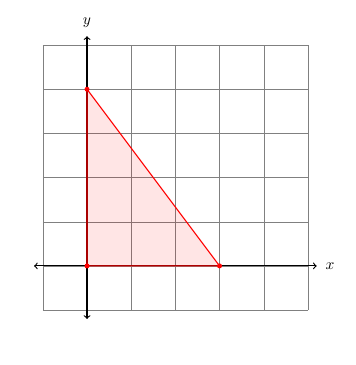
Since the intercepts are \((3,0,0)\) and \((0,4,0)\) we see the hypotenuse of this triangle is the line \(y=4-\dfrac{4}{3}x\)
Therefore \(G=\left\{ (x,y,z)\, : \, 0\le x\le 3\, 0\le y \le 4-\dfrac{4}{3}x, \, 0\le z\le 12-4x-3y\right\}\), and our integral is
\[ \begin{align*} \iiint_G \dfrac{xz}{3-x-\frac{3}{4}y} \, dV & = \int_0^3 \int_0^{4-\frac{4}{3}x} \int_0^{12-4x-3y} \dfrac{xz}{3-x-\frac{3}{4}y} \,dz \, dy \, dx
\\[4pt] &= \int_0^3 \int_0^{4-\frac{4}{3}x} \dfrac{xz^2}{2(3-x-\frac{3}{4}y)} \Bigg|_0^{12-4x-3y} \, dy \, dx
\\[4pt] &= \int_0^3 \int_0^{4-\frac{4}{3}x} \dfrac{x(12-4x-3y)^2}{6-2x-\frac{3}{2}y} \, dy \, dx
\\[4pt] &= \int_0^3 \int_0^{4-\frac{4}{3}x} 2x(12-4x-3y) \, dy \, dx
\\[4pt] &= \int_0^3 -\dfrac{1}{3}x(12-4x-3y)^2 \Bigg|_0^{4-\frac{4}{3}x} \, dx
\\[4pt] &= \dfrac{1}{3}\int_0^3 x(12-4x)^2 \, dx
\\[4pt] &= \dfrac{1}{3}\int_0^3 \left(144x-96x^2+16x^3 \right) \, dx
\\[4pt] &= \dfrac{1}{3} \left[ 72x^2-32x^3+4x^4 \right] \Big|_0^3
\\[4pt] &= \dfrac{1}{3} \left( 72\cdot 9-32\cdot 27+4\cdot 81\right)
\\[4pt] &= 36 \end{align*} \]
Evaluate \(\displaystyle{\int_0^1 \int_0^{\sqrt{1-x^2}} \dfrac{4}{1+x^2+y^2} \, dy \, dx }\)
- Answer
-
The domain \(D=\left\{ (x,y)\, : \, 0\le x\le 1,\, 0\le y\le \sqrt{1-x^2}\right\}\) is a quarter circle.

This can be written in polar form as \(D=\left\{ (r\cos(\theta), r\sin(\theta))\, : \, 0\le r\le 1,\, 0\le \theta\le \dfrac{\pi}{2}\right\}\)
Therefore the integral is:
\[ \begin{align*} \int_0^1 \int_0^{\sqrt{1-x^2}} \dfrac{4}{1+x^2+y^2} \, dy \, dx & = \int_0^1 \int_0^{\frac{\pi}{2}} \dfrac{4}{1+r^2}\cdot r \, d\theta \, dr
\\[4pt] &= \left( \int_0^1 \dfrac{4r}{1+r^2} \, dr \right) \left( \int_0^{\frac{\pi}{2}}\, d\theta \right)
\\[4pt] &= \left( 2\ln\left|1+r^2\right| \Big|_0^1\right) \cdot \left( \theta \Big|_0^{\frac{\pi}{2}}\right)
\\[4pt] &= \left(2\ln(2)-2\ln(1)\right)\cdot \dfrac{\pi}{2}
\\[4pt] &= \pi \ln(2) \end{align*} \]
Evaluate \(\displaystyle{\int_{-1}^2 \int_{\max(-x\sqrt{3},0)}^{\sqrt{4-x^2}} y \, dy \, dx }\)
- Answer
-
The domain \(D=\left\{ (x,y)\, : \, -1\le x\le 2,\, \max(-x\sqrt{3},0)\le y\le \sqrt{4-x^2}\right\}\) is a sector.

This can be written in polar form as \(D=\left\{ (r\cos(\theta), r\sin(\theta))\, : \, 0\le r\le 2,\, 0\le \theta\le \dfrac{2\pi}{3}\right\}\)
Therefore the integral is:
\[ \begin{align*} \int_{-1}^2 \int_{\max(-x\sqrt{3},0)}^{\sqrt{4-x^2}} y \, dy \, dx & = \int_0^2 \int_0^{\frac{2\pi}{3}}r\sin(\theta) \cdot r \, d\theta \, dr
\\[4pt] &= \left( \int_0^2 r^2 \, dr \right) \left( \int_0^{\frac{2\pi}{3}} \sin(\theta) \,d\theta \right)
\\[4pt] &= \left(\dfrac{1}{3}r^3 \Bigg|_0^2\right) \cdot \left( -\cos(\theta) \Big|_0^{\frac{2\pi}{3}}\right)
\\[4pt] &= \dfrac{8}{3}\cdot \left(\dfrac{1}{2}+1\right)
\\[4pt] &= 4 \end{align*} \]
Evaluate \(\displaystyle{\iint_D \dfrac{x-y}{\sqrt{x+y}} \, dA }\) for \(D=\{ (x,y)\,: \,1\le x^2+y^2\le 81,\, x\ge 0,\, y\ge 0 \}\)
- Answer
-
The domain \(D=\left\{ (x,y)\, : \,1\le x^2+y^2\le 81,\, x\ge 0,\, y\ge 0 \right\}\) is part of an annulus in the first quadrant.

This can be written in polar form as \(D=\left\{ (r\cos(\theta), r\sin(\theta))\, : \, 1\le r\le 9,\, 0\le \theta\le \dfrac{\pi}{2}\right\}\)
Therefore the integral is:
\[ \begin{align*} \iint_D \dfrac{x-y}{\sqrt{x+y}} \, dA & = \int_1^9 \int_0^{\frac{\pi}{2}} \dfrac{r\cos(\theta)-r\sin(\theta)}{\sqrt{r\cos(\theta)+r\sin(\theta)}} \cdot r \, d\theta \, dr
\\[4pt] &= \left( \int_1^9 r^{\frac{3}{2}} \, dr \right) \left( \int_0^{\frac{\pi}{2}} \dfrac{\cos(\theta)-\sin(\theta)}{\sqrt{\cos(\theta)+\sin(\theta)}} \,d\theta \right)
\\[4pt] &= \left( \dfrac{2}{5}r^{\frac{5}{2}} \Bigg|_1^9\right) \cdot \left( 2\sqrt{\cos(\theta)+\sin(\theta)} \Big|_0^{\frac{\pi}{2}}\right)
\\[4pt] &= \dfrac{2}{5}\left( 9^{\frac{5}{2}}-1^{\frac{5}{2}}\right)\cdot \left(2\sqrt{1}-2\sqrt{1}\right)
\\[4pt] &= 0 \end{align*} \]
Evaluate \(\displaystyle{\iint_E xy \, dA }\) for \(E=\{ (x,y)\,:\, 9\le x^2+y^2\le 25,\, y\le |x| \}\)
- Answer
-
The domain \(E=\left\{ (x,y)\, : \, 9\le x^2+y^2\le 25,\, y\le |x| \right\}\) is part of an annulus.

This can be written in polar form as \(E=\left\{ (r\cos(\theta), r\sin(\theta))\, : \, 3\le r\le 5,\, \dfrac{3\pi}{4} \le \theta\le \dfrac{9\pi}{4}\right\}\)
Therefore the integral is:
\[ \begin{align*} \iint_E xy \, dA & = \int_3^5 \int_{\frac{3\pi}{4}}^{\frac{9\pi}{4}} r\cos(\theta)\cdot r\sin(\theta) \cdot r \, d\theta \, dr
\\[4pt] &= \left( \int_3^5 r^3 \, dr \right) \left( \int_{\frac{3\pi}{4}}^{\frac{9\pi}{4}} \sin(\theta)\cos(\theta) \,d\theta \right)
\\[4pt] &= \left( \dfrac{1}{4}r^4 \Bigg|_3^5 \right) \cdot \left( \dfrac{1}{2}\sin^2(\theta) \Bigg|_{\frac{3\pi}{4}}^{\frac{9\pi}{4}}\right)
\\[4pt] &= \dfrac{1}{4}\left( 5^4-3^4\right)\cdot \dfrac{1}{2}\left( \left(\dfrac{1}{\sqrt{2}}\right)^2-\left(\dfrac{1}{\sqrt{2}}\right)^2\right)
\\[4pt] &= 0 \end{align*} \]
Evaluate \(\displaystyle{\int_0^{\frac{\pi}{4}} \int_0^{\sqrt{2}} \dfrac{r^2 \cos(\theta)}{1-r^2\sin^2(\theta)}e^{r\sin(\theta)} \, dr \, d\theta }\)
- Answer
-
This integral is already in polar form, but is not separable or easy to evaluate.
We sketch the domain \(D=\left\{ (r\cos(\theta),r\sin(\theta))\,: \, 0\le r\le \sqrt{2}, \, 0\le \theta \le \dfrac{\pi}{4}\right\}\) below:

This can be written as a Type 2 region instead: \(D=\left\{ (x,y)\, : \, 0\le y\le 1, \, y\le x\le \sqrt{2-y^2}\right\}\), so the integral becomes:
\[ \begin{align*} \int_0^{\frac{\pi}{4}} \int_0^{\sqrt{2}} \dfrac{r^2 \cos(\theta)}{1-r^2\sin^2(\theta)}e^{r\sin(\theta)} \, dr \, d\theta & = \int_0^{\frac{\pi}{4}} \int_0^{\sqrt{2}} \dfrac{r \cos(\theta)}{1-(r\sin(\theta))^2}e^{r\sin(\theta)} \cdot r \, dr \, d\theta
\\[4pt] &= \iint_D \dfrac{x}{1-y^2}e^{y}\, dA
\\[4pt] &= \int_0^1 \int_y^{\sqrt{2-y^2}} \dfrac{x}{1-y^2}e^{y}\, dx \,dy
\\[4pt] &= \int_0^1 \dfrac{x^2}{2(1-y^2)}e^{y}\Bigg|_y^{\sqrt{2-y^2}} \,dy
\\[4pt] &= \int_0^1 \dfrac{2-2y^2}{2(1-y^2)}e^{y} \,dy
\\[4pt] &= \int_0^1 e^{y} \,dy
\\[4pt] &= e^y \Big|_0^1
\\[4pt] &= e-1 \end{align*} \]
Evaluate \(\displaystyle{\iint_E \dfrac{16}{\sqrt[3]{x^2+y^2}} \, dA }\) for \(E=\{ (x,y)\, : \,1\le x^2+y^2\le 64,\, x\le y,\, y\le -x\sqrt{3} \}\)
- Answer
-
The domain \(E=\left\{ (x,y)\, : \, 1\le x^2+y^2\le 64,\, x\le y,\, y\le -x\sqrt{3} \right\}\) is part of an annulus.

This can be written in polar form as \(E=\left\{ (r\cos(\theta), r\sin(\theta))\, : \, 1\le r\le 8,\, \dfrac{2\pi}{3} \le \theta\le \dfrac{5\pi}{4}\right\}\)
Therefore the integral is:
\[ \begin{align*} \iint_E \dfrac{16}{\sqrt[3]{x^2+y^2}} \, dA & = \int_1^8 \int_{\frac{2\pi}{3}}^{\frac{5\pi}{4}} \dfrac{16}{\sqrt[3]{r^2}} \cdot r \, d\theta \, dr
\\[4pt] &= \left( \int_1^8 16r^{\frac{1}{3}} \, dr \right) \left( \int_{\frac{2\pi}{3}}^{\frac{5\pi}{4}} \,d\theta \right)
\\[4pt] &= \left( 12r^{\frac{4}{3}} \Big|_1^8\right) \cdot \left( \theta \Big|_{\frac{2\pi}{3}}^{\frac{5\pi}{4}}\right)
\\[4pt] &= 12\left( 8^{\frac{4}{3}}-1^{\frac{4}{3}}\right)\cdot \dfrac{7\pi}{12}
\\[4pt] &= 105\pi \end{align*} \]
Find the volume of \(A=\{ (x,y,z)\, : \, x^2+y^2\le 16,\, -2\le z\le 2 \}\)
- Answer
-
The region defined by \(A\) is a cylinder:

We can write it as \(A=\{ (x,y,z)\, : \, -4\le x\le 4, \, -\sqrt{16-x^2}\le y\le \sqrt{16-x^2},\, -2\le z\le 2 \}\)
The volume is given by the triple integral:
\[ \begin{align*} \text{Volume}(A)&= \iiint_A 1\, dV
\\[4pt] &= \int_{-4}^4 \int_{-\sqrt{16-x^2}}^{\sqrt{16-x^2}} \int_{-2}^2 1\, dz\, dy\,dx
\\[4pt] &= \int_{-4}^4 \int_{-\sqrt{16-x^2}}^{\sqrt{16-x^2}} z \Big|_{-2}^2 dy\,dx
\\[4pt] &= \int_{-4}^4 \int_{-\sqrt{16-x^2}}^{\sqrt{16-x^2}} 4\, dy\,dx
\\[4pt] &= 4\cdot \text{Area}( x^2+y^2\le 16 )
\\[4pt] &= 4\cdot ( \pi \cdot 4^2)
\\[4pt] &= 64\pi \end{align*} \]
Find the volume of \(B=\{(x,y,z)\, : \, 0\le x\le y\le z\le 2\}\)
- Answer
-
The region \(B\) can most easily be written as \(B=\{(x,y,z)\,: \, 0\le z\le 2,\, 0\le y\le z, \, 0\le x\le y\}\)

The volume is given by the triple integral:
\[ \begin{align*} \text{Volume}(B)&= \iiint_B 1\, dV
\\[4pt] &= \int_0^2 \int_0^z \int_0^y 1\, dx\, dy\,dz
\\[4pt] &= \int_0^2 \int_0^z x \Big|_0^y \, dy\,dz
\\[4pt] &= \int_0^2 \int_0^z y \, dy\,dz
\\[4pt] &= \int_0^2 \dfrac{1}{2}y^2\Bigg|_0^z \,dz
\\[4pt] &= \int_0^2 \dfrac{1}{2}z^2 \,dz
\\[4pt] &= \dfrac{1}{6}z^3 \Bigg|_0^2
\\[4pt] &= \dfrac{4}{3} \end{align*} \]
Find the volume of \(C=\{ (x,y,z)\,:\, -1\le z \le 3-x^2-y^2 \}\)
- Answer
-
The boundary of \(x\) and \(y\) for \(C\) occurs when \(-1=3-x^2-y^2\longleftrightarrow x^2+y^2=4\)
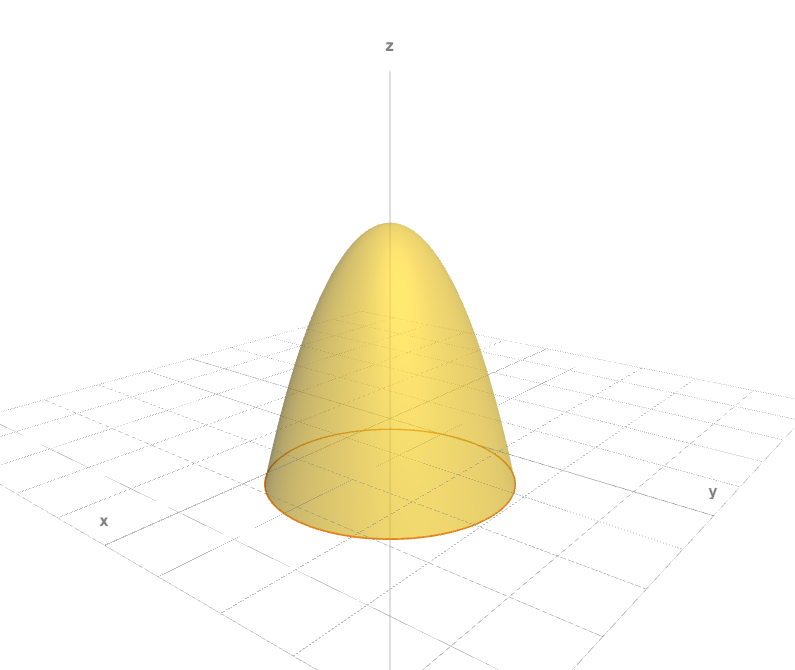
Therefore we write it as \(C=\left\{ (x,y,z)\,:\, -2\le x\le 2,\, -\sqrt{4-x^2}\le y\le \sqrt{4-x^2}, \,-1\le z \le 3-x^2-y^2 \right\}\)
The volume is given by the triple integral:
\[ \begin{align*} \text{Volume}(C)&= \iiint_C 1\, dV
\\[4pt] &= \int_{-2}^2 \int_{-\sqrt{4-x^2}}^{\sqrt{4-x^2}} \int_{-1}^{3-x^2-y^2} 1\, dz\, dy\,dx
\\[4pt] &= \int_{-2}^2 \int_{-\sqrt{4-x^2}}^{\sqrt{4-x^2}} z \Big|_{-1}^{3-x^2-y^2} \, dy\,dx
\\[4pt] &= \int_{-2}^2 \int_{-\sqrt{4-x^2}}^{\sqrt{4-x^2}} ( 4-x^2-y^2) \, dy\,dx \end{align*} \]This double integral is easier to evaluate in polar form:
\(\left\{(x,y)\, :\, -2\le x\le 2,\, -\sqrt{4-x^2}\le y\le \sqrt{4-x^2} \right\}=\left\{ (r\cos(\theta),r\sin(\theta))\, : \, 0\le r \le 2, \, 0\le \theta\le 2\pi \right\} \)
Therefore our integral becomes:
\[ \begin{align*} \text{Volume}(C) &=\int_0^2 \int_0^{2\pi} (4-r^2)\cdot r\, d\theta\, dr
\\[4pt] &= \left( \int_0^2 (4r-r^3)\, dr \right)\left( \int_0^{2\pi} \, d\theta\right)
\\[4pt] &= \left[ 2r^2-\dfrac{1}{4}r^4 \right]\Bigg|_0^2\cdot \left( \theta \Big|_0^{2\pi}\right)
\\[4pt] &= 4\cdot 2\pi
\\[4pt] &= 8\pi \end{align*} \]
Find the volume of the intersection of \(x^2+y^2\le 1\) and \(x^2+z^2\le 1\)
- Answer
-
This region \(D\) is the intersection of two cylinders:

Since both \(y\) and \(z\) can be bounded by functions of \(x\), we write:
\(D=\left\{(x,y,z)\, : \, -1\le x\le 1, \, -\sqrt{1-x^2}\le y\le \sqrt{1-x^2}, \, -\sqrt{1-x^2}\le z \le \sqrt{1-x^2} \right\}\)
Therefore, the volume is given by the triple integral:
\[ \begin{align*} \text{Volume}(D)&= \iiint_D 1\, dV
\\[4pt] &= \int_{-1}^1 \int_{-\sqrt{1-x^2}}^{\sqrt{1-x^2}} \int_{-\sqrt{1-x^2}}^{\sqrt{1-x^2}} 1\, dz\, dy\,dx
\\[4pt] &= \int_{-1}^1 \int_{-\sqrt{1-x^2}}^{\sqrt{1-x^2}} z \Big|_{-\sqrt{1-x^2}}^{\sqrt{1-x^2}} \, dy\,dx
\\[4pt] &= \int_{-1}^1 \int_{-\sqrt{1-x^2}}^{\sqrt{1-x^2}} 2\sqrt{1-x^2} \, dy\,dx
\\[4pt] &= \int_{-1}^1 2y\sqrt{1-x^2} \Big|_{-\sqrt{1-x^2}}^{\sqrt{1-x^2}} \,dx
\\[4pt] &= \int_{-1}^1 4(1-x^2) \,dx
\\[4pt] &= 4\left[ x-\dfrac{1}{3}x^3\right]\Bigg|_{-1}^1
\\[4pt] &= 4\cdot \dfrac{4}{3}
\\[4pt] &= \dfrac{16}{3} \end{align*} \]
Find the volume of \(E=\left\{(x,y,z) \, : \, 1\le x^2+y^2\le 2,\, 0\le z \le e^{2-x^2-y^2} \right\}\)
- Answer
-
The region \(E\) is under \(z=e^{2-x^2-y^2}\) above the annulus \(\hat{E}=\left\{(x,y) \, : \, 1\le x^2+y^2\le 2 \right\}\):
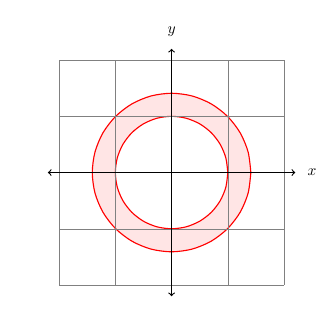
Therefore we write it as \(E=\left\{ (x,y,z)\,:\, (x,y)\in \hat{E}, \, 0\le z \le e^{2-x^2-y^2} \right\}\)

The volume is given by the triple integral:
\[ \begin{align*} \text{Volume}(E)&= \iiint_E 1\, dV
\\[4pt] &= \iint_{\hat{E}} \int_0^{e^{2-x^2-y^2}} 1\, dz\, dA
\\[4pt] &= \iint_{\hat{E}} z \Big|_0^{e^{2-x^2-y^2}} \, dA
\\[4pt] &= \iint_{\hat{E}} e^{2-x^2-y^2} \,dA \end{align*} \]This double integral is easier to evaluate in polar form:
\(\hat{E}=\left\{ (r\cos(\theta),r\sin(\theta))\, :\, 1\le r \le \sqrt{2}, \, 0\le \theta\le 2\pi \right\} \)
Therefore our integral becomes:
\[ \begin{align*} \text{Volume}(E) &=\int_1^{\sqrt{2}} \int_0^{2\pi} e^{2-r^2} \cdot r\, d\theta\, dr
\\[4pt] &= \left( \int_1^{\sqrt{2}} re^{2-r^2}\, dr \right)\left( \int_0^{2\pi} \, d\theta\right)
\\[4pt] &= \left( -\dfrac{1}{2}e^{2-r^2} \Bigg|_1^{\sqrt{2}}\right) \cdot \left( \theta \Big|_0^{2\pi}\right)
\\[4pt] &= \left( -\dfrac{1}{2}+\dfrac{1}{2}e\right) \cdot 2\pi
\\[4pt] &= (e-1)\pi \end{align*} \]
Find the volume of \(F=\left\{(x,y,z)\, : \, 9\le x^2+y^2\le 25, \, 0\le y \le x, \, 0\le z \le x^2+y^2 \right\}\)
- Answer
-
The region \(F\) is under \(z=x^2+y^2\) above the annulus \(\hat{F}=\left\{(x,y) \, : \, 9\le x^2+y^2\le 25,\, 0\le y\le x \right\}\):

Therefore we write it as \(F=\left\{ (x,y,z)\,: \, (x,y)\in \hat{F}, \, 0\le z \le x^2+y^2 \right\}\)

The volume is given by the triple integral:
\[ \begin{align*} \text{Volume}(F)&= \iiint_F 1\, dV
\\[4pt] &= \iint_{\hat{F}} \int_0^{x^2+y^2} 1\, dz\, dA
\\[4pt] &= \iint_{\hat{F}} z \Big|_0^{ x^2+y^2} \, dA
\\[4pt] &= \iint_{\hat{F}} (x^2+y^2) \,dA \end{align*} \]This double integral is easier to evaluate in polar form:
\(\hat{F}=\left\{ (r\cos(\theta),r\sin(\theta))\, : \, 3\le r \le 5, \, 0\le \theta\le \dfrac{\pi}{4} \right\} \)
Therefore our integral becomes:
\[ \begin{align*} \text{Volume}(F) &=\int_3^5 \int_0^{\frac{\pi}{4}} r^2 \cdot r\, d\theta\, dr
\\[4pt] &= \left( \int_3^5 r^3\, dr \right)\left( \int_0^{\frac{\pi}{4}} \, d\theta\right)
\\[4pt] &= \left( \dfrac{1}{4} r^4 \Bigg|_3^5\right) \cdot \left( \theta \Big|_0^{\frac{\pi}{4}} \right)
\\[4pt] &= \dfrac{1}{4} \left( 5^4-3^4\right) \cdot \dfrac{\pi}{4}
\\[4pt] &= 34\pi \end{align*} \]
Find the volume of \(E=\left\{ (x,y,z) \, : \, x^2+y^2+z^2 \le R^2,\, x,y,z\ge 0 \right\}\)
- Answer
-
The region \(E\) described is the part of a sphere in the first octant:

This can be written \(E=\left\{ (x,y,z)\, : \, 0\le x\le R, \, 0\le y\le \sqrt{R^2-x^2}, \, 0\le z\le \sqrt{R^2-x^2-y^2} \right\}\)
Therefore the volume of \(E\) is given by the integral:
\[ \begin{align*} \text{Volume}(E)&= \iiint_E 1\, dV
\\[4pt] &= \int_0^R \int_0^{\sqrt{R^2-x^2}} \int_0^{\sqrt{R^2-x^2-y^2}} 1\, dz\, dy\, dx
\\[4pt] &= \int_0^R \int_0^{\sqrt{R^2-x^2}} z \Big|_0^{\sqrt{R^2-x^2-y^2}} \, dy\, dx
\\[4pt] &= \int_0^R \int_0^{\sqrt{R^2-x^2}} \sqrt{R^2-x^2-y^2} \, dy\, dx \end{align*} \]This double integral is easier to evaluate in polar form:
\(\left\{ (x,y)\, : \, 0\le x\le R, \, 0\le y\le \sqrt{R^2-x^2} \right\}=\left\{ (r\cos(\theta),r\sin(\theta))\, : \, 0\le r \le R, \, 0\le \theta\le \dfrac{\pi}{2} \right\} \)
Therefore our integral becomes:
\[ \begin{align*} \text{Volume}(E) &=\int_0^R \int_0^{\frac{\pi}{2}} \sqrt{R^2-r^2} \cdot r\, d\theta\, dr
\\[4pt] &= \left( \int_0^R r\sqrt{R^2-r^2}\, dr \right)\left( \int_0^{\frac{\pi}{2}} \, d\theta\right)
\\[4pt] &= \left( -\dfrac{1}{3} (R^2-r^2)^{\frac{3}{2}} \Bigg|_0^R\right) \cdot \left( \theta \Big|_0^{\frac{\pi}{2}}\right)
\\[4pt] &= \dfrac{1}{3} R^3 \cdot \dfrac{\pi}{2}
\\[4pt] &= \dfrac{\pi R^3}{6} \end{align*} \]Notice this matches with one eighth of the known volume of a sphere formula: \(\dfrac{1}{8}\cdot \dfrac{4\pi}{3}R^3=\dfrac{\pi R^3}{6}\)
Find the volume of \(F=\left\{(x,y,z) \, : \, \dfrac{x^2}{a^2}+\dfrac{y^2}{a^2}+\dfrac{z^2}{b^2}\le 1 \right\}\)
- Answer
-
The region \(F\) in this question is a full ellipsoid with \(x\) and \(y\) radius \(a>0\) and \(z\) radius \(b>0\):

This can be written \(F=\left\{ (x,y,z)\, : \, -a\le x\le a, \, -\sqrt{a^2-x^2}\le y\le \sqrt{a^2-x^2}, \, -\dfrac{b}{a}\sqrt{a^2-x^2-y^2}\le z\le \dfrac{b}{a}\sqrt{a^2-x^2-y^2} \right\}\)
Therefore the volume of \(F\) is given by the integral:
\[ \begin{align*} \text{Volume}(F)&= \iiint_F 1\, dV
\\[4pt] &= \int_{-a}^a \int_{-\sqrt{a^2-x^2}}^{\sqrt{a^2-x^2}} \int_{-\frac{b}{a}\sqrt{a^2-x^2-y^2}}^{\frac{b}{a}\sqrt{a^2-x^2-y^2}} 1\, dz\, dy\, dx
\\[4pt] &= \int_{-a}^a \int_{-\sqrt{a^2-x^2}}^{\sqrt{a^2-x^2}} z \Big|_{-\frac{b}{a}\sqrt{a^2-x^2-y^2}}^{\frac{b}{a}\sqrt{a^2-x^2-y^2}} \, dy\, dx
\\[4pt] &= \int_{-a}^a \int_{-\sqrt{a^2-x^2}}^{\sqrt{a^2-x^2}} \dfrac{2b}{a}\sqrt{a^2-x^2-y^2} \, dy\, dx \end{align*} \]This double integral is easier to evaluate in polar form:
\(\left\{ (x,y)\, : \, -a\le x\le a, \, -\sqrt{a^2-x^2}\le y\le \sqrt{a^2-x^2} \right\}=\left\{ (r\cos(\theta),r\sin(\theta))\,: \, 0\le r \le a, \, 0\le \theta\le 2\pi \right\} \)
Therefore our integral becomes:
\[ \begin{align*} \text{Volume}(F) &=\int_0^a \int_0^{2\pi} \dfrac{2b}{a}\sqrt{a^2-r^2} \cdot r\, d\theta\, dr
\\[4pt] &= \left( \int_0^a \dfrac{2b}{a}r\sqrt{a^2-r^2}\, dr \right)\left( \int_0^{2\pi} \, d\theta\right)
\\[4pt] &= \left( -\dfrac{2b}{3a} (a^2-r^2)^{\frac{3}{2}} \Bigg|_0^a\right) \cdot \left( \theta \Big|_0^{2\pi}\right)
\\[4pt] &= \dfrac{2b}{3a} a^3 \cdot 2\pi
\\[4pt] &= \dfrac{4\pi a^2 b}{3} \end{align*} \]
This page titled 3.2: Practice Set was last modified on Thu, 16 Apr 2026 01:10:36 GMT and is shared under a CC BY-NC 4.0 license and was authored, remixed, and/or curated by Kenn Huber.
The book could not be loaded just now.