Opening the book…
Triple integrals can often be more readily evaluated by using cylindrical coordinates instead of rectangular coordinates. Some common equations of surfaces in rectangular coordinates along with corresponding equations in cylindrical coordinates are listed in the table below. These equations will become handy as we proceed with solving problems using triple integrals.
| Circular cylinder | Circular cone | Sphere | Paraboloid | |
|---|---|---|---|---|
| Rectangular | \(x^2 + y^2 = c^2\) | \(z^2 = c^2 (x^2 + y^2)\) | \(x^2 + y^2 + z^2 = c^2\) | \(z = c(x^2 + y^2)\) |
| Cylindrical | \(r = c\) | \(z = cr\) | \(r^2 + z^2 = c^2\) | \(z = cr^2\) |
Suppose that \(f(x,y,z)\) is continuous on a region \(B\) which when described in cylindrical coordinates looks like \(B = \{(r\cos(\theta),r\sin(\theta),z) \, :\, a \leq r \leq b, \, \alpha \leq \theta \leq \beta, \, c \leq z \leq d\}\). Then
\[\iiint_B f(x,y,z)\, dV = \int_c^d \int_{\alpha}^{\beta} \int_a^b f(r \cos (\theta), r \sin (\theta),z) \,r \, dr \, d\theta \, dz \nonumber \]
The iterated integral may be replaced equivalently by any one of the other five iterated integrals obtained by integrating with respect to the three variables in other orders.
Cylindrical coordinate systems work well for solids that are symmetric around an axis, such as cylinders and cones. Let us look at some examples before we define the triple integral in cylindrical coordinates on general cylindrical regions.
Evaluate the triple integral
\[\int_0^2 \int_0^{\sqrt{4-x^2}} \int_0^4 zy \, dz \, dy\, dx \nonumber \]
Solution
The domain of this triple integral is nicer in cylindrical coordinates: \(B = \left\{(r,\theta,z) \, : \, 0 \leq r \leq 2, \, 0 \leq \theta \leq \dfrac{\pi}{2}, \, 0 \leq z \leq 4\right\}\)
Therefore we can rewrite the triple integral as the iterated integral
\[\int_0^2 \int_0^{\sqrt{4-x^2}} \int_0^4 zy \, dz \, dy\, dx= \int_{0}^{\frac{\pi}{2} } \int_{0}^{2} \int_{0}^{4} zr \, \sin ( \theta) \, r \, dz \, dr \, d\theta \nonumber \]
Since each variable factors out and their limits of integration do not interact, this is equivalent to the product of their separate integrals:
\[\begin{align*} & = \left(\int_0^{\frac{\pi}{2}} \sin (\theta) \, d\theta \right) \left( \int_0^2 r^2 \, dr \right) \left( \int_0^4 z \, dz\right) \\[4pt] &= \left( -\cos (\theta) \Big|_0^{\frac{\pi}{2}}\right) \cdot \left( \dfrac{r^3}{3} \Bigg|_0^2\right) \cdot \left( \frac{z^2}{2} \Bigg|_0^4\right) \\[4pt] &=1\cdot \dfrac{8}{3}\cdot 8 = \boxed{ \dfrac{64}{3}} \end{align*}\]
When we have to integrate over a more general solid, we look at the projections onto the coordinate planes. If that region in cylindrical coordinates looks like \(E = \{(r, \theta, z)\,:\,(r, \theta) \in D, u_1 (r, \theta) \leq z \leq u_2 (r, \theta)\}\) in \(\mathbb{R}^3\) where \(D\) is the projection of \(E\) onto the \(r\theta\)-plane, then
\[\iiint_E f(x, y, z) \, dV = \iint_D \left[\int_{u_1(r,\theta)}^{u_2(r,\theta)} f(r\cos(\theta), r\sin(\theta), z) dz \right] r \, dr \, d\theta \nonumber \]
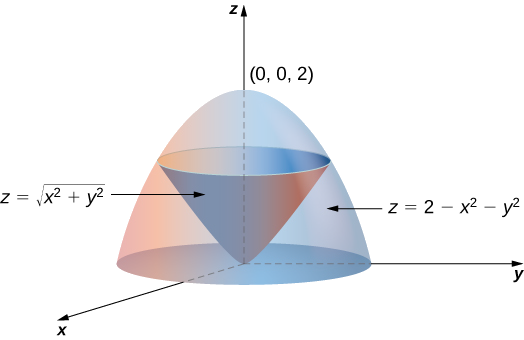
Find the volume of the region bounded below by the cone \(z = \sqrt{x^2 + y^2}\) and above by the paraboloid \(z = 2 - x^2 - y^2\)
Solution
In cylindrical form, the cone \(z=\sqrt{x^2+y^2}\) is \(z=r\) and the paraboloid \(z=2-x^2-y^2\) is \(z=2-r^2\). These intersect when \(2 - r^2 = r\). Solving, we have \(r^2 + r - 2 = (r + 2)(r - 1) = 0\). Since \(r \geq 0\), we have \(r = 1\). Therefore \(z = 1\). So the intersection of these two surfaces is a circle of radius \(1\) in the plane \(z = 1\). The cone is the lower bound for \(z\) and the paraboloid is the upper bound. The projection of the region onto the \(xy\)-plane is the circle of radius \(1\) centered at the origin.
Thus, we can describe the region as \(E = \{\left(r\cos(\theta),r\sin( \theta), z\right) \, : \, 0 \leq \theta \leq 2\pi, \, 0 \leq r \leq 1, \, r \leq z \leq 2 - r^2 \}\).
Hence the volume is given by the triple integral:
\[\begin{align*} V &= \int_{0}^{2\pi} \int_{0}^{1} \int_{r}^{2-r^2} r \, dz \, dr \, d\theta \\
&= \int_{0}^{2\pi} \int_{0}^{1} rz \Big|_r^{2-r^2} \, dr \, d\theta \\
&= \int_{0}^{2\pi} \int_{0}^{1} (2r-r^3-r^2) \, dr \, d\theta \\
&= \int_{0}^{2\pi} \left[ r^2-\dfrac{1}{4}r^4-\dfrac{1}{3}r^3 \right]\Bigg|_0^1 \, d\theta \\
&= \int_{0}^{2\pi} \dfrac{5}{12} \, d\theta \\
&= \dfrac{5}{12} \theta \Bigg|_{0}^{2\pi} \\
& =\boxed{\dfrac{5\pi}{6}} \end{align*} \]
Consider the region \(R\) inside the right circular cylinder with equation \(x^2+(y-1)^2 = 1\), bounded below by the \(x\,y\)-plane and bounded above by the sphere \(x^2+y^2+z^2=16\). Evaluate the integral \(\displaystyle \iint_R 4z \, dV\)
Solution
First, identify that the equation for the sphere is \(r^2 + z^2 = 16\) and for the cylinder is \(r=2\sin(\theta)\) for \(0\le \theta \le \pi\). We can see that the limits for \(z\) are from \(0\) to \(z = \sqrt{16 - r^2}\). Hence we can write \(R\) in cylindrical coordinates as the set \(E = \{(r,\theta, z)\, :\, 0 \leq \theta \leq \pi, \, 0 \leq r \leq 2 \, \sin (\theta), \, 0 \leq z \leq \sqrt{16 - r^2} \}\)

Therefore, the triple integral becomes:
\[\begin{align*} \iint_R 4z \, dV &= \iiint_E 1\, 4rz \, dz \, dr \, d\theta \\[4pt]
&= \int_{0}^{\pi} \int_{0}^{2\sin(\theta)} \int_{ 0}^{ \sqrt{16-r^2}} 4rz \, dz \, dr \, d\theta \\[4pt]
&= \int_{0}^{\pi} \int_{0}^{2\sin(\theta)} 2 rz^2 \Big|_{ 0}^{ \sqrt{16-r^2}} \, dr \, d\theta \\[4pt]
&= \int_{0}^{\pi} \int_{0}^{2\sin(\theta)} \left(32r-2r^3\right) \, dr \, d\theta \\[4pt]
&= \int_{0}^{\pi} \left[16r^2-\dfrac{1}{2}r^4\right]\Bigg|_{0}^{2\sin(\theta)} \, d\theta \\[4pt]
&= \int_{0}^{\pi} \left( 64\sin^2(\theta)-8\sin^4(\theta) \right) \, d\theta \\[4pt]
&= \int_{0}^{\pi} \left( 29-28\cos(2\theta)-\cos(4\theta) \right) \, d\theta \\[4pt]
&= \left[ 29-14\sin(2\theta) -\dfrac{1}{4}\sin(4\theta) \right]\Bigg|_0^\pi \\[4pt]
& =\boxed{29\pi} \end{align*} \]
Some circular triple integrals are easier using spherical coordinates instead of rectangular or cylindrical coordinates. Most commonly, this is when the boundary of the domain is made of spheres \(\rho=c\), vertical planes \(\theta=c\), and cones \(\phi=c\).
Suppose that \(f(x,y,z)\) is continuous on a region \(B\) which when described in spherical coordinates looks like \(B = \{\left(\rho \sin(\phi)\cos(\theta),\rho \sin(\phi)\sin(\theta), \rho \cos(\phi)\right) \, : \, a \leq \rho \leq b, \, \alpha \leq \theta \leq \beta, \, c \leq \phi \leq d\}\). Then,
\[\iiint_B f(x,y,z)\, dV = \int_c^d \int_{\alpha}^{\beta} \int_a^b f(\rho \sin(\phi)\cos(\theta),\rho \sin(\phi)\sin(\theta), \rho \cos(\phi)) \rho^2 \sin(\phi) \, d\rho \, d\theta \, d\phi \nonumber \]
As stated before, spherical coordinate systems work well for solids that are symmetric around a point, such as spheres and cones. Let us look at some examples before we consider triple integrals in spherical coordinates on general spherical regions.
Find the volume of the region bounded by the cone \(z = \sqrt{3(x^2 + y^2)}\) and the hemisphere \(z = \sqrt{4 - x^2 - y^2}\).

Solution
In spherical form, the hemisphere\(z=\sqrt{4-x^2-y^2}\) is \(\rho=2\) and since we start from the origin, we know \(0\le \rho \le 2\). The cone \(z=\sqrt{3}\sqrt{x^2+y^2}\) is \(\phi=\cot^{-1}(\sqrt{3})=\dfrac{\pi}{6} \), and since we want the region above this cone, we start at \(\phi=0\). We do not need to find the radius of the circular projection of the region onto the \(xy\)-plane, but since it is a full circle we know \(0\le \theta \le 2\pi \).
Thus, we can describe the region as \(E = \left\{(\rho \sin(\phi)\cos(\theta),\rho \sin(\phi)\sin(\theta), \rho \cos(\phi)) \, : \,0 \leq \theta \leq 2\pi, \, 0 \leq \rho \leq 2, \, 0 \leq \phi \leq \dfrac{\pi}{6}\right\}\)
Hence the volume is given by the triple integral:
\[\begin{align*} V &= \int_{0}^{2\pi} \int_{0}^{2} \int_{0}^{\frac{\pi}{6} } \rho^2\sin(\phi) \, d\phi \, d\rho \, d\theta \\[4pt]
&= \left( \int_{0}^{2\pi} d\theta \right) \left( \int_{0}^{2} \rho^2 d\rho \right) \left( \int_{0}^{\frac{\pi}{6} } \sin(\phi) \, d\phi \right) \\[4pt]
&= \left( \theta \Big|_{0}^{2\pi}\right) \cdot \left( \dfrac{1}{3}\rho^3\Bigg|_0^2\right) \cdot \left( -\cos(\phi) \Big|_0^{\frac{\pi}{6}}\right) \\[4pt]
&= 2\pi \cdot \dfrac{8}{3}\cdot \left( 1-\dfrac{\sqrt{3}}{2}\right) \\[4pt] &=\boxed{\dfrac{8\pi(2-\sqrt{3})}{3}} \end{align*} \]
Evaluate the triple integral below by transforming to spherical coordinates:
\[\int_{-1}^{1} \int_{0}^{\sqrt{1-y^2}} \int_{-\sqrt{2-x^2-y^2}}^{-\sqrt{x^2+y^2}} xyz \, dz \, dx \, dy. \nonumber \]
Solution
This triple integral is over the region \(R=\{ (x,y,z) \, : \, -1\le y\le 1, \, 0\le x \le \sqrt{1-y^2}, \, -\sqrt{1-y^2}\le z \le -\sqrt{2-x^2-y^2} \} \)
The first two inequalities describe the right half of a circle of radius \(1\). Therefore, the range for \(\theta\) is \(-\dfrac{\pi}{2}\le \theta \le \dfrac{\pi}{2}\). The cone \(z=-\sqrt{x^2+y^2}\) is represented by the spherical equation \(\phi=\cot^{-1}(-1)=\dfrac{3\pi}{4}\). Since our region is below this cone, we know that the other endpoint for \(\phi\) is the negative \(z\)-axis, which is \(\phi=\pi\). Lastly, we can see the spherical radius goes from the origin (\(\rho=0\)) to \(\rho=\sqrt{2}\). The radius of the projected circle here is \(r\) in cylindrical coordinates, but this is not \(\rho\) (it is instead the projection of the intersection of the sphere and cone in this question).
Thus we can describe the region as \(E = \left\{(\rho \sin(\phi)\cos(\theta),\rho \sin(\phi)\sin(\theta), \rho \cos(\phi) \, : \, -\dfrac{\pi}{2} \leq \theta \leq \dfrac{\pi}{2}, \, 0 \leq \rho \leq \sqrt{2}, \, \dfrac{3\pi}{4} \leq \phi \leq \pi \right\}\).
Therefore our triple integral becomes:
\[\begin{align*} \int_{-1}^{1} \int_{0}^{\sqrt{1-y^2}} \int_{-\sqrt{2-x^2-y^2}}^{-\sqrt{x^2+y^2}} xyz \, dz \, dx \, dy &= \int_{-\frac{\pi}{2}}^{\frac{\pi}{2}} \int_0^{\sqrt{2}} \int_{\frac{3\pi}{4}}^\pi \left(\rho \sin(\phi)\cos(\theta)\right) \left(\rho \sin(\phi)\sin(\theta)\right) \left( \rho \cos(\phi)\right) \rho^2\sin(\phi) d\phi \, d\rho \, d\theta \\
&= \left( \int_{-\frac{\pi}{2}}^{\frac{\pi}{2}} \sin(\theta)\cos(\theta)d\theta \right) \left( \int_0^{\sqrt{2}} \rho^5 d\rho \right) \left( \int_{\frac{3\pi}{4}}^\pi \sin^3(\phi) \cos(\phi) d\phi \right) \\
&= \left( \dfrac{1}{2}\sin^2(\theta) \Bigg|_{-\frac{\pi}{2}}^{\frac{\pi}{2}}\right) \cdot \left( \dfrac{1}{6}\rho^6 \Bigg|_0^{\sqrt{2}}\right) \cdot \left( \dfrac{1}{4} \sin^4(\phi) \Bigg|_{\frac{3\pi}{4}}^\pi\right) \\
&= 0 \cdot \dfrac{4}{3} \cdot \left( -\dfrac{1}{16}\right)=\boxed{0} \end{align*} \]
Sometimes things are not perfectly cylindrical or spherical, but are a simple substitution away from being so. The most common example of this are elliptic cylinders (which stretch into circular cylinders and thus cylindrical coordinates), and ellipsoids (which stretch into spheres and thus spherical coordinates).
Let \(R=\left\{ (x,y,z) \, : \, x^2+4y^2+9z^2\le 1,\, x\ge 2y,\, z\ge 0 \right\}\)
We will evaluate \(\displaystyle \iiint_R \sin\left( \pi (x^2+4y^2+9z^2)^{\frac{3}{2}}\right)\, dV \)
The original domain \(R\) is clearly a partial ellipsoid, but in terms of \(u=x, v=2y,\) and \(w=3z\) it would look like:
\[ S=\left\{ (u,v,w) \, : \, u^2+v^2+w^2\le 1, \, u\ge v,\, w\ge 0 \right\} \nonumber\]
This is easily solved as \(x=u, y=\dfrac{v}{2}, z=\dfrac{w}{3}\), so the Jacobian of this transformation is:
\[J(u,v,w) = \begin{vmatrix} \dfrac{\partial x}{\partial u} & \dfrac{\partial x}{\partial v} & \dfrac{\partial x}{\partial w} \\ \dfrac{\partial y}{\partial u} & \dfrac{\partial y}{\partial v} & \dfrac{\partial y}{\partial w} \\ \dfrac{\partial z}{\partial u} & \dfrac{\partial z}{\partial v} & \dfrac{\partial z}{\partial w} \end{vmatrix} = \begin{vmatrix} 1 & 0 & 0 \\ 0 & \dfrac{1}{2} & 0 \\ 0 & 0 & \dfrac{1}{3} \end{vmatrix} = \dfrac{1}{6} \nonumber \]
Now we can turn our original integral into:
\[ \iiint_E \sin\left( \pi (x^2+4y^2+9z^2)^{\frac{3}{2}}\right)\, dV =\iiint_S \sin \left( \pi (u^2+v^2+w^2)^{\frac{3}{2}}\right) \cdot \dfrac{1}{6} \, dV \nonumber \]
This new domain is easily put into spherical coordinates:
Since \(u^2+v^2+w^2\le 1\), we have \(0\le \rho \le 1\).
Since \(u\ge v\) we think of the angles which make \(x\ge y\) on the unit circle, which are \( -\dfrac{3\pi}{4}\le \theta \le \dfrac{\pi}{4}\)
Since \(w\ge 0\) is the top half of the sphere, we have \( 0\le \phi \le \dfrac{\pi}{2}\).
Therefore our second transformation (into spherical coordinates) turns this into:
\[ \begin{align*} \iiint_S \dfrac{1}{6} \sin \left( \pi (u^2+v^2+w^2)^{\frac{3}{2}}\right) \, dV &= \int_0^1 \int_{-\frac{3\pi}{4}}^{\frac{\pi}{4}} \int_0^{\frac{\pi}{2}} \dfrac{1}{6} \sin\left( \pi \rho^3\right) \rho^2\sin(\phi) \, d\phi \, d\theta \, d\rho \\[4pt]
&= \left( \int_0^1 \rho^2 \sin\left( \pi \rho^3\right) d\rho \right) \left( \int_{-\frac{3\pi}{4}}^{\frac{\pi}{4}} \dfrac{1}{6}d\theta \right) \left( \int_0^{\frac{\pi}{2}} \sin(\phi) d\phi \right) \\[4pt]
&= \left( -\dfrac{1}{3\pi} \cos\left(\pi \rho^3\right) \Bigg|_0^1\right) \cdot \left( \dfrac{1}{6} \theta \Bigg|_{-\frac{3\pi}{4}}^{\frac{\pi}{4}}\right) \cdot \left( -\cos(\phi) \Big|_0^{\frac{\pi}{2}}\right) \\[4pt]
&= \dfrac{2}{3\pi} \cdot \dfrac{\pi}{6} \cdot 1=\dfrac{1}{9} \end{align*} \]
This page titled 3.4: Triple Integrals in Cylindrical and Spherical Coordinates was last modified on Thu, 16 Apr 2026 02:59:57 GMT and is shared under a CC BY-NC 4.0 license and was authored, remixed, and/or curated by Kenn Huber via source content that was edited to the style and standards of the LibreTexts platform.
The book could not be loaded just now.