Opening the book…
Reading Questions
- What is the difference between an arc and an arc length?
- What defines a central angle?
- How is the radian measure of an angle defined based on a fraction of a revolution?
- How many radians are in one full revolution (360°)?
- What is the formula for arc length, \(s\), if the central angle \(\theta\) is measured in radians and the radius is \(r\)?
- What is the most important requirement for the angle \(\theta\) when using the arc length formula \(s = r\theta\)?
- What is the conversion factor used to convert an angle from degrees to radians?
- What is the conversion factor used to convert an angle from radians to degrees?
- In which quadrant does an angle of 5 radians terminate?
- What is the reference angle for \(\theta = \frac{5\pi}{3}\)?
Skills Refresher
Review the following skills you will need for this section.
For the following exercises, use the appropriate conversion factor to convert units.
-
\(\dfrac{1 \text{ mile}}{1.609 \text{ kilometers}} = 1\)
-
10 miles = ______ km
-
50 km = ______ miles
-
-
\(\dfrac{1 \text{ acre}}{0.405 \text{ hectare}} = 1\)
-
40 acres = ______ hectares
-
5 hectares = ______ acres
-
-
\(\dfrac{1 \text{ horsepower}}{746 \text{ watts}} = 1\)
-
250 horsepower = ______ watts
-
1000 watts = ______ horsepower
-
-
\(\dfrac{ 1 \text{ troy ounce}}{480 \text{ grains}} = 1\)
-
0.5 troy oz = ______ grains
-
100 grains = ______ troy oz
-
For the following exercises, determine how many degrees are in each fraction of one complete revolution.
-
\(\dfrac{1}{4}\)
-
\(\dfrac{1}{5}\)
-
\(\dfrac{1}{6}\)
-
\(\dfrac{1}{8}\)
- Answers
-
-
-
16.09 km
-
31.08 mi
-
-
-
16.2 hectares
-
12.35 acres
-
-
-
186,500 watts
-
1.34 horsepower
-
-
-
240 grains
-
0.21 troy oz
-
-
\(90^{\circ}\)
-
\(72^{\circ}\)
-
\(60^{\circ}\)
-
\(45^{\circ}\)
-
Homework
Vocabulary Check
-
Unlike degree measure, radian measure is a ___ measure (i.e., radian measure does not require a measurement symbol).
-
An angle with vertex at the center of the circle is called a(n) ___.
-
A central angle whose sides meet the endpoints of an arc is said to ___ the arc. Another way to say this is the angle ___ the arc.
-
The ___ length is the distance along the edge of a circle subtended by a central angle \( \theta \).
-
The product of \( 2 \pi \) and the fraction of one revolution cut out by the angle \( \theta \) is named the ___ measure of the angle.
Concept Check
-
The length of a circular arc depends on what two variables?
-
Define the radian measure of an angle.
-
What is the conversion factor from radians to degrees?
-
On a unit circle, the length of an arc is equal to what other quantity?
True or False? For the following exercises, determine if the statement is true or false. If true, cite the definition or theorem stated in the text supporting your claim. If false, explain why it is false and, if possible, correct the statement.
-
The distance we travel around a circle of diameter \( d \) is proportional to the angle of displacement. In fact,\[\text{arc length } = \text{(fraction of one revolution)} \cdot (\pi d)\nonumber \]
-
We measure angles in radians when we work with arc length.
-
An arc length equal to one radius determines a central angle of one degree.
-
An angle given in radian measure must be written as \( k \pi \), where \( k \) is a real number.
-
\( \dfrac{180^{\circ}}{\pi \text{ radians}} = 1 \)
-
On a circle of radius \(r\), the length \(s\) of an arc spanned by an angle \(\theta\) is \(s = r \theta\).
Basic Skills
-
Radians 0 \(\dfrac{\pi}{4}\) \(\dfrac{\pi}{2}\) \(\dfrac{3\pi}{4}\) \(\pi\) \(\dfrac{5\pi}{4}\) \(\dfrac{3\pi}{2}\) \(\dfrac{7\pi}{4}\) \(2\pi\) Degrees -
Convert each angle to degrees.
-
Sketch each angle on a circle like this, and label in radians.
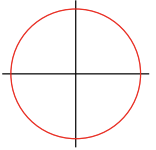
-
-
Radians 0 \(\dfrac{\pi}{6}\) \(\dfrac{\pi}{3}\) \(\dfrac{\pi}{2}\) \(\dfrac{2\pi}{3}\) \(\dfrac{5\pi}{6}\) \(\pi\) \(\dfrac{7\pi}{6}\) \(\dfrac{4\pi}{3}\) \(\dfrac{3\pi}{2}\) \(\dfrac{5\pi}{3}\) \(\dfrac{11\pi}{6}\) \(2\pi\) Degrees -
Convert each angle to degrees.
-
Sketch each angle on a circle like this, and label in radians.
-
For the following exercises, express each fraction of one complete rotation in degrees and radians.
-

-
\(\dfrac{1}{3}\)
-
\(\dfrac{2}{3}\)
-
\(\dfrac{4}{3}\)
-
\(\dfrac{5}{3}\)
-
-

-
\(\dfrac{1}{5}\)
-
\(\dfrac{2}{5}\)
-
\(\dfrac{3}{5}\)
-
\(\dfrac{4}{5}\)
-
-
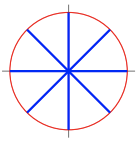
-
\(\dfrac{1}{8}\)
-
\(\dfrac{3}{8}\)
-
\(\dfrac{5}{8}\)
-
\(\dfrac{7}{8}\)
-
-
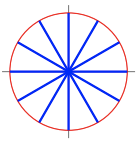
-
\(\dfrac{1}{12}\)
-
\(\dfrac{1}{6}\)
-
\(\dfrac{5}{12}\)
-
\(\dfrac{5}{6}\)
-
For the following exercises, label each angle in standard position with radian measure (assume the angles shown are special angles).
-
Rotate counter-clockwise from 0.

-
Rotate clockwise from 0.
For the following exercises, give a decimal approximation to hundredths for each angle in radians.
-
-
\(\dfrac{\pi}{6}\)
-
\(\dfrac{5 \pi}{6}\)
-
\(\dfrac{7 \pi}{6}\)
-
\(\dfrac{11 \pi}{6}\)
-
-
-
\(\dfrac{\pi}{4}\)
-
\(\dfrac{\pi}{4}\)
-
\(\dfrac{5 \pi}{4}\)
-
\(\dfrac{7 \pi}{4}\)
-
-
Locate and label each angle from Problem 24 on the unit circle below. (The circle is marked off in tenths of a radian.)

-
Locate and label each angle from Problem 25 on the unit circle below. (The circle is marked off in tenths of a radian.)

For the following exercises, choose the best decimal approximation for each angle in radians from the list below. Do not use a calculator; use the fact that \(\pi\) is a little greater than 3.\[0.52, 0.79, 2.09, 2.36, 2.62, 3.67, 5.24, 5.50\nonumber \]
-
\(\dfrac{2 \pi}{3}\)
-
\(\dfrac{\pi}{4}\)
-
\(\dfrac{5 \pi}{6}\)
-
\(\dfrac{5 \pi}{3}\)
-
\(\dfrac{\pi}{6}\)
-
\(\dfrac{7 \pi}{4}\)
-
\(\dfrac{3 \pi}{4}\)
-
\(\dfrac{7 \pi}{6}\)
For the following exercises, state in which quadrant each angle lies.
-
-
\(\dfrac{\pi}{4}\)
-
\(\dfrac{3\pi}{4}\)
-
\(\dfrac{5 \pi}{4}\)
-
\(\dfrac{7 \pi}{4}\)
-
-
-
\(\dfrac{\pi}{6}\)
-
\(\dfrac{5\pi}{6}\)
-
\(\dfrac{7 \pi}{6}\)
-
\(\dfrac{11 \pi}{6}\)
-
-
-
\(\dfrac{\pi}{3}\)
-
\(\dfrac{2\pi}{3}\)
-
\(\dfrac{4 \pi}{3}\)
-
\(\dfrac{5 \pi}{3}\)
-
-
-
\(\dfrac{\pi}{5}\)
-
\(\dfrac{8\pi}{7}\)
-
\(\dfrac{25 \pi}{13}\)
-
\(\dfrac{47 \pi}{48}\)
-
For the following exercises, complete the table.
-
Degrees \( 18^{ \circ } \) \( 60^{ \circ } \) \( 90^{ \circ } \) Radians -
Radians \(\dfrac{2\pi}{3}\) \(\dfrac{3\pi}{4}\) \(\dfrac{5\pi}{6}\) Degrees -
Radians \(\dfrac{7\pi}{6}\) \(\dfrac{5\pi}{4}\) \(\dfrac{4\pi}{3}\) Degrees -
Radians \(\dfrac{5\pi}{3}\) \(\dfrac{7\pi}{4}\) \(\dfrac{11\pi}{6}\) Degrees
For the following exercises, convert to radians. Write the answer in exact form and then give approximations rounded to the nearest hundredths.
-
-
\( 120^{ \circ } \)
-
\( 420^{ \circ } \)
-
\( -180^{ \circ } \)
-
\( -225^{ \circ } \)
-
-
-
\(75^{\circ}\)
-
\(236^{\circ}\)
-
\(-327^{\circ}\)
-
\( 143^{ \circ } \, 40^{\prime} \)
-
-
-
\(138^{\circ}\)
-
\(194^{\circ}\)
-
\(342^{\circ}\)
-
\( 281^{ \circ } \, 15^{\prime} \)
-
For the following exercises, convert to degrees. Round answers to the nearest tenth.
-
-
\( -\frac{11\pi}{15} \)
-
\( \frac{2\pi}{7} \)
-
\( -\frac{6\pi}{5} \)
-
-
-
0.8
-
3.5
-
5.1
-
-
-
1.1
-
2.6
-
4.6
-
For the following exercises, state the quadrant in which the angle terminates and give the reference angle (in radians).
-
\( \frac{\pi}{3} \)
-
(MyOpenMath) \( \frac{3\pi}{4} \)
-
\( \frac{9\pi}{8} \)
-
\( \frac{21\pi}{22} \)
-
(MyOpenMath) \( -\frac{5\pi}{6} \)
-
(MyOpenMath) \( -\frac{5\pi}{3} \)
-
(MyOpenMath) \( \frac{11\pi}{4} \)
-
\( -\frac{15\pi}{7} \)
-
\( 2.4 \)
-
\( -3.1 \)
For the following exercises, find an angle in each quadrant, rounded to tenths, with the same reference angle as the angle given in radians.
-
5.8
-
2.9
-
3.7
-
5.1
-
1.8
-
4.4
For the following exercises, use the arc length formula to answer the questions. Round answers to hundredths.
-
(MyOpenMath) Find the arc length spanned by an angle of 2 radians on a circle of radius 2 miles.
-
Find the arc length spanned by an angle of \(80^{\circ}\) on a circle of radius 4 inches.
-
Find the arc length spanned by an angle of \(200^{\circ}\) on a circle of radius 18 feet.
-
Find the radius of a circle if an angle of \(250^{\circ}\) spans an arc length of 18 meters.
-
Find the radius of a circle if an angle of \(20^{\circ}\) spans an arc length of 0.5 kilometers.
-
(MyOpenMath) Find the angle, in radians, subtended by an arc length of 7 feet on a circle of radius 10 feet.
-
(MyOpenMath) Find the angle, in degrees, subtended by an arc length of 7 feet on a circle of radius 6 feet.
-
Find the angle, in radians, subtended by an arc length of 28 centimeters on a circle of diameter 20 centimeters.
-
Find the angle, in radians, subtended by an arc length of 1.6 yards on a circle of diameter 2 yards.
For the following exercises, find the exact value of the trigonometric function. Do not use a calculator!
-
\( \sin\left( \dfrac{\pi}{3} \right) \)
-
\( \cos\left( \dfrac{\pi}{6} \right) \)
-
\( \tan\left( \dfrac{\pi}{4} \right) \)
-
\( \csc\left( \dfrac{\pi}{4} \right) \)
-
\( 2\sec\left( \dfrac{\pi}{3} \right) \)
-
\( \cot\left( \dfrac{\pi}{6} \right) \)
-
\( -\sin\left( \dfrac{5\pi}{6} \right) \)
-
\( \cos\left( \dfrac{4\pi}{3} \right) \)
-
\( \tan\left( \dfrac{11\pi}{6} \right) \)
-
\( 3\csc\left( -\dfrac{4\pi}{3} \right) \)
-
\( \sec\left( -\dfrac{3\pi}{4} \right) \)
-
\( -\pi \cot\left( -\dfrac{13\pi}{6} \right) \)
-
\( \sin\left( \dfrac{\pi}{2} \right) \)
-
\( \cos\left( \pi \right) \)
-
\( \tan\left( \dfrac{3\pi}{2} \right) \)
Synthesis Questions
For the following exercises, find an angle between \( 0 \) and \( 2\pi \) that is coterminal with the given angle.
-
(MyOpenMath) \( \frac{29 \pi}{10} \)
For the following exercises, find the exact value of the expression for \( x = \frac{\pi}{6} \).
-
\( \sin\left( 2x \right) \)
-
\( \cos\left( 3x \right) \)
-
\( \dfrac{1}{3} \sin\left( 5x \right) \)
-
\( 6 - \sin\left( x \right) \)
-
\( \dfrac{2}{3} + \tan\left( \dfrac{3}{2}x \right) \)
-
\( \sin\left( \pi - x \right) \)
-
\( \cos\left( \pi + 2x \right) \)
-
\( 3 \sin\left( 2x + \dfrac{\pi}{3} \right) \)
-
\( -2 + \dfrac{3}{4} \cos\left( 7x - \dfrac{\pi}{2} \right) \)
-
-
Sketch a circle of radius 4 units, and mark the positions of 1, 2, 3, 4, 5, and 6 radians on the circle.
-
On a circle of radius 4 feet, find the arc length determined by each angle in radians.
\(\theta\) 1 2 3 4 5 6 \(s\) -
Graph \(\theta\) against \(s\). What is the slope of the graph?
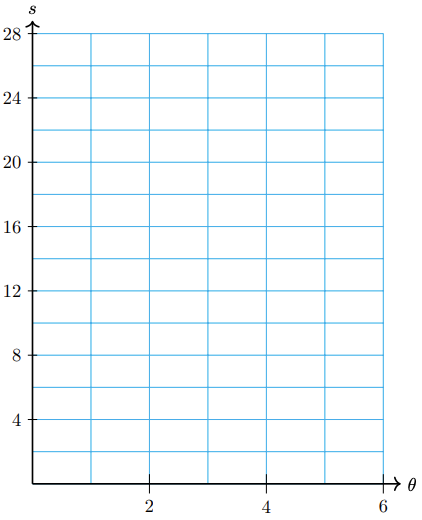
-
If you double the angle, what happens to the arc length? What happens if you triple \(\theta\)?
-
-
-
Sketch several concentric circles with increasing radii, and draw an angle of 2 radians through all of them.
-
Find the arc length determined by an angle of 2 radians on circles of given radius.
\(r\) 1 2 3 4 5 6 \(s\) -
Graph \(s\) against \(r\). What is the slope of the graph?
-
If you double the radius \(r\), what happens to the arc length? What happens if you triple \(r\)?
-
-
Recall that to calculate a fraction of a revolution in degrees, we divide the angle by \(360^{\circ}\). For example, \(90^{\circ}\) is \(\frac{1}{4}\) of a revolution because \(\frac{90^{\circ}}{360^{\circ}}=\frac{1}{4}\).
-
Write an expression that gives the fraction of a revolution for an angle \(\theta\) in radians.
-
Use your expression to calculate what fraction of a revolution is represented by each of the following angles: \(\theta=\frac{3 \pi}{4}, \quad \theta=\frac{5 \pi}{3}, \quad \theta=\frac{7 \pi}{6}\).
-
Applications
For the following exercises, use the arc length formula to answer the questions.
-
Big Ben.
-
Through how many radians does the minute hand of a clock sweep between 9:05 pm and 9:30 pm?
-
The dial of Big Ben's clock in London is 23 feet in diameter. How long is the arc traced by the minute hand between \(9: 05 \mathrm{pm}\) and \(9: 30 \mathrm{pm}\)?
-
-
Floral Clock. The largest clock ever constructed was the Floral Clock in the garden of the 1904 World's Fair in St. Louis. The hour hand was 50 feet long, the minute hand was 75 feet long, and the radius of the clock's face was 112 feet.
-
If you started at the 12 and walked 500 feet clockwise around the clock face, through how many radians would you walk?
-
If you started your walk at noon, how long would it take the minute hand to reach your position? How far did the tip of the minute hand move in its arc?
-
-
The Foucault Pendulum. In 1851 Jean-Bernard Foucault demonstrated the rotation of the earth with a pendulum installed in the Pantheon in Paris. Foucault's pendulum consisted of a cannonball suspended on a 67 meter wire, and it swept out an arc of 8 meters on each swing. Through what angle did the pendulum swing? Give your answer in radians and then in degrees, rounded to the nearest hundredth.
-
Linear Distance. A wheel with radius 40 centimeters is rolled a distance of 1000 centimeters on a flat surface. Through what angle has the wheel rotated? Give your answer in radians and then in degrees, rounded to one decimal place.
-
Distance Between Cities. Cosumnes River College (Sacramento, California) and Stony Brook University (Stony Brook, New York) are 2,544 miles apart along the surface of the Earth. Assuming that the radius of the Earth is 3,963 miles, find the radian measure of the central angle having vertex at the center of the Earth that has Cosumnes River College on one side and Stony Brook University on the other.
-
Distance on the Surface of the Earth (MyOpenMath). Find the distance along an arc on the surface of the earth that subtends a central angle of 10 minutes (recall, 1 minute = 1/60 degree). For this exercise, assume the radius of the earth is 3960 miles.
This page titled 7.2.2: Homework was last modified on Tue, 08 Jul 2025 17:44:24 GMT and is shared under a not declared license and was authored, remixed, and/or curated by Roy Simpson.
The book could not be loaded just now.