Opening the book…
Reading Questions
- In a right triangle, what are the definitions of \(\sin(\theta)\), \(\cos(\theta)\), and \(\tan(\theta)\) in terms of the opposite side, adjacent side, and hypotenuse?
- What is a Pythagorean triple?
- Can the right triangle definitions of the trigonometric functions be applied to an obtuse triangle?
- If you are given the lengths of the opposite and adjacent sides in a right triangle, what theorem must you use to find the length of the hypotenuse?
- What is the cofunction of the tangent function?
- What does the Cofunction Identity theorem state about \(\sin(20^\circ)\)?
- Why is the value of \(\cos(\theta)\) always less than or equal to 1 for any acute angle \(\theta\)?
- Is it possible for \(\sec(\theta)\) to equal \(\frac{1}{2}\) for an angle \(\theta\) in a right triangle? Explain why or why not.
- What happens to the value of \(\sin(\theta)\) as \(\theta\) increases from 0° to 90°?
- What is the difference between an exact value, like \(\sqrt{2}\), and an approximate value, like 1.414?
Skills Refresher
Review the following skills you will need for this section.
For the following exercises, write two more ratios equivalent to the given fraction.
-
\(\dfrac{10}{4}\)
-
\(\dfrac{6}{8}\)
-
\(0.6\)
-
\(1.5\)
For the following exercises, compute the slope of the line.


For the following exercises, solve.
-
\(\dfrac{12}{x} = 48\)
-
\(\dfrac{60}{x} = 80\)
For the following exercises, solve the formula for the specified variable.
-
\( C = 2 \pi r\) for \(r\) (Circumference of a Circle)
-
\( r = \frac{d}{t}\) for \(t\)
-
\(P = 2a + b - c\) for \(a\)
-
\(x = \frac{2}{3}y + 10\) for \(y\)
-
\(S = 2 \pi r h + 2\pi r^2\) for \(h\) (Surface Area of a Right Circular Cylinder)
- Answers
-
(Many answers are possible for 1-4.)
-
\(\dfrac{5}{2}, \dfrac{20}{8}\)
-
\(\dfrac{3}{4}, \dfrac{12}{16}\)
-
\(\dfrac{3}{5}, \dfrac{12}{20}\)
-
\(\dfrac{6}{4}, \dfrac{12}{8}\)
-
\(\dfrac{2}{5}\)
-
\(\dfrac{-8}{5}\)
-
\(\dfrac{-6}{5}\)
-
\(\dfrac{1}{2}\)
-
\(\dfrac{1}{4}\)
-
\(\dfrac{3}{4}\)
-
\(r = \frac{C}{2\pi}\)
-
\(t = \frac{d}{r} \)
-
\(a = \frac{P - b + c}{2}\)
-
\(y = \frac{3}{2}(x - 10)\)
-
\(h = \frac{S - 2\pi r^2}{2 \pi r} \)
-
Homework
Vocabulary Check
-
The sequences of natural numbers, (3, 4, 5) and (7, 24, 25), are both examples of ___.
-
Just like the tangent and cotangent, the secant and cosecant are called ___.
Concept Check
-
Sketch a figure that illustrates why \(\cos 25^{\circ}\) is the same for every right triangle with a \(25^{\circ}\) angle.
-
Sketch a figure that illustrates why \(\cos \theta\) decreases as \(\theta\) increases from \(0^{\circ}\) to \(90^{\circ}\).
-
Linda says that \(\sin \theta=\frac{4}{7}\) in the figure. Is she correct? Why or why not?

True or False? For the following exercises, determine if the statement is true or false. If true, cite the definition or theorem stated in the text supporting your claim. If false, explain why it is false and, if possible, correct the statement.
-
Given a triangle having \( \theta \) as one of its interior angles, the tangent of the angle \( \theta \) is the ratio of the side opposite \( \theta \) to the side adjacent to \( \theta \).
-
\( \sin\left( 60^{ \circ } \right) = 0.8660 \)
-
The value of a trigonometric function of an angle is equal to the value of its cofunction at the complement of the angle.
Basic Skills
For the following exercises, fill in the table.
-

\(\sin\) \(\cos\) \(\tan\) \(\theta\) \(\phi\) -

\(\sin\) \(\cos\) \(\tan\) \(\theta\) \(\phi\) -

\(\sin\) \(\cos\) \(\tan\) \(\theta\) \(\phi\) -

\(\sin\) \(\cos\) \(\tan\) \(\theta\) \(\phi\) -
In each of the figures for the previous exercises, what is the relationship between the angles \(\theta\) and \(\phi\)?
-
Study the tables for the previous problems. What do you notice about the values of the sine and cosine for the angles \( \theta \) and \( \phi \)? Explain why this is true.
-
There is a relationship between the tangent, the sine, and the cosine of any angle. Study the tables for the previous problems to discover this relationship. Write your answer as an equation.
For the following exercises,
(a) Find the length of the unknown side.
(b) Find the sine, cosine, and tangent of \(\theta\). Round your answers to four decimal places.


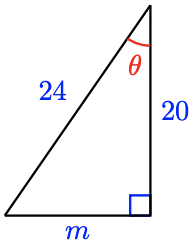


For the following exercises, find exact values for the six trigonometric ratios of the angle \(\theta\).


For the following exercises,
(a) Sketch and label the sides of a right triangle with angle \(\theta\).
(b) Sketch and label another right triangle with angle \(\theta\) and longer sides.
-
\(\cos \theta=\dfrac{3}{5}\)
-
\(\tan \theta=\dfrac{7}{2}\)
-
\(\tan \theta=\dfrac{11}{4}\)
-
\(\sin \theta=\dfrac{4}{9}\)
-
\(\sin \theta=\dfrac{1}{9}\)
-
\(\cos \theta=\dfrac{7}{8}\)
For the following exercises, use a trigonometric ratio to write an equation for \(x\) in terms of \(\theta\).


For the following exercises, write algebraic expressions for the six trigonometric ratios of the angle \(\theta\).


For the following exercises, write the expression in terms of sine and cosine, and simplify.
-
\(\dfrac{\csc t}{\cot t}\)
-
\(\dfrac{\tan v}{\sec v}\)
-
\(\sec \beta-\tan \beta\)
-
\(\cot \alpha + \csc \alpha\)
For the following exercises, choose all values from the list below that are exactly equal to, or decimal approximations for, the given trigonometric ratio. (Try not to use a calculator!)\[\begin{array}{|ccccc|}
\hline \sin 30^{\circ} & \cos 45^{\circ} & \sin 60^{\circ} & \tan 45^{\circ} & \tan 60^{\circ} \\[6pt] 0.5000 & 0.5774 & 0.7071 & 0.8660 & 1.0000 \\[6pt] \frac{1}{\sqrt{2}} & \frac{2}{\sqrt{2}} & \frac{3}{\sqrt{2}} & \frac{1}{2} & \frac{\sqrt{2}}{2} \\[6pt] \frac{1}{\sqrt{3}} & \frac{2}{\sqrt{3}} & \frac{\sqrt{3}}{2} & \sqrt{3} & \frac{\sqrt{3}}{3} \\[6pt] \hline
\end{array}\nonumber\]
-
\(\cos 30^{\circ}\)
-
\(\sin 45^{\circ}\)
-
\(\tan 30^{\circ}\)
-
\(\cos 60^{\circ}\)
For the following exercises, evaluate. Give exact values.
-
\(\sin \left(30^{\circ}\right)\)
-
\(\tan \left(45^{\circ}\right)\)
-
\(\sin \left(60^{\circ}\right)\)
-
\(\csc \left(30^{\circ}\right)\)
-
\(\cot \left(45^{\circ}\right)\)
-
\(\csc \left(60^{\circ}\right)\)
Synthesis Questions
For the following exercises, evaluate.
-
\(4 \cot \left( 60^{\circ}\right)+2 \sec \left(45^{\circ}\right)\)
-
\(\dfrac{1}{2} \csc \left(30^{\circ}\right) -\dfrac{1}{4} \cot \left(30^{\circ}\right)\)
For the following exercises, solve the equation assuming that \( \theta \) is an acute angle in a right triangle.
-
\(3 \csc \left(\theta\right)+2=8\)
-
\(-2 \sec \left(\theta\right)+8=6\)
-
\(\sqrt{2} \sec \left(\theta\right)=2\)
-
\(\sqrt{3} \cot \left(\theta\right)=1\)
-

-
Use the figure to explain what happens to \(\tan \theta\) as \(\theta\) increases, and why.
-
Use the figure to explain what happens to \(\cos \theta\) as \(\theta\) increases, and why.
-
For the following exercises, explain why the trigonometric ratio is not correct.
-
\(\sin \theta=\dfrac{5}{9}\)

-
\(\tan \theta = \dfrac{4}{7}\)

-
\(\cos \theta=\dfrac{21}{20}\)

-
\(\sin \theta = \dfrac{8}{10}\)

For the following exercises, sketch and label a right triangle, then fill in the blank.
-
-
If \(\sin \theta=0.2358\), then \(\cos \left(90^{\circ}-\theta\right)= \)_______.
-
If \(\cos \alpha=\frac{3}{11}\), then _______ \(\left(90^{\circ}-\alpha\right)=\frac{3}{11}\).
-
If \(\sin 42^{\circ}=n\), then \(\cos \)_______\(=n\).
-
If \(\cos 13^{\circ}=z\), then \(\sin\)_______\( = z\).
-
-
-
If \(\cos \beta=\frac{2}{\sqrt{7}}\), then \(\sin \left(90^{\circ}-\beta\right)= \)_______.
-
If \(\sin \phi=0.693\), then _______\(-\left(90^{\circ}-\phi\right)=0.693\).
-
If \(\cos 87^{\circ}=p\), then \(\sin \)_______\( =p\).
-
If \(\sin 59^{\circ}=w\), then \(\cos\)_______\(=w\).
-
-
-
If \(\sin \phi=\frac{5}{13}\) and \(\cos \phi=\frac{12}{13}\), then \(\tan \phi= \)_______.
-
If \(\cos \beta=\frac{1}{\sqrt{10}}\), and \(\sin \beta=\frac{3}{\sqrt{10}}\), then \(\tan \beta= \)_______.
-
If \(\tan B=\frac{2}{\sqrt{5}}\) and \(\cos B=\frac{\sqrt{5}}{3}\), then \(\sin B= \)_______.
-
If \(\sin W=\sqrt{\frac{3}{7}}\) and \(\tan W=\frac{\sqrt{3}}{2}\), then \(\cos W= \)_______.
-
-
-
If \(\cos \theta=\frac{2}{\sqrt{10}}\) and \(\sin \theta=\sqrt{\frac{3}{5}}\), then \(\tan \theta= \)_______.
-
If \(\sin \alpha=\frac{\sqrt{2}}{4}\), and \(\cos \alpha=\frac{\sqrt{14}}{4}\), then \(\tan \alpha= \)_______.
-
If \(\tan A=\frac{\sqrt{7}}{3}\) and \(\cos A=\frac{3}{4}\), then \(\sin A=\)_______.
-
If \(\sin V=\sqrt{\frac{10}{5}}\) and \(\tan V=\frac{2}{5}\), then \(\cos V=\)_______.
-
-
Explain why the cosine of a \(73^{\circ}\) angle is always the same, no matter what size triangle the angle is in. Illustrate your explanation with a sketch.
-
-
What is the slope of the line through the origin and point \(P\)?
-
What is the tangent of the angle \(\theta\)?
-
On the same grid, sketch an angle whose tangent is \(\frac{8}{5}\)

-
-
Which of the following numbers are equal to \(\cos 45^{\circ}\)?
-
\(\dfrac{\sqrt{2}}{2}\)
-
\(\dfrac{1}{\sqrt{2}}\)
-
\(\dfrac{2}{\sqrt{2}}\)
-
\(\sqrt{2}\)
-
-
Which of the following numbers are equal to \(\tan 30^{\circ}\)?
-
\(\sqrt{3}\)
-
\(\dfrac{1}{\sqrt{3}}\)
-
\(\dfrac{\sqrt{3}}{3}\)
-
\(\dfrac{3}{\sqrt{3}}\)
-
-
Which of the following numbers are equal to \(\tan 60^{\circ}\)?
-
\(\sqrt{3}\)
-
\(\dfrac{1}{\sqrt{3}}\)
-
\(\dfrac{\sqrt{3}}{3}\)
-
\(\dfrac{3}{\sqrt{3}}\)
-
-
Which of the following numbers are equal to \(\sin 60^{\circ}\)?
-
\(\dfrac{3}{\sqrt{2}}\)
-
\(\dfrac{\sqrt{3}}{2}\)
-
\(\dfrac{\sqrt{2}}{3}\)
-
\(\dfrac{2}{\sqrt{3}}\)
-
Challenge Problems
-
The diagram shows a unit circle. Find six line segments whose lengths are, respectively, \(\sin t, \cos t, \tan t, \sec t, \csc t\), and \(\cot t\).

-
The figure shows a unit circle and an angle \(\theta\) in standard position. Each of the six trigonometric ratios for \(\theta\) is represented by the length of a line segment in the figure. Find the line segment for each ratio, and explain your choice.

This page titled 4.1.2: Homework was last modified on Tue, 08 Jul 2025 17:44:03 GMT and is shared under a not declared license and was authored, remixed, and/or curated by Roy Simpson.
The book could not be loaded just now.