Opening the book…
Reading Questions
- Is \(\cos(A+B)\) equivalent to \(\cos(A) + \cos(B)\)? Explain why or why not.
- What is the Sum Identity for the cosine function?
- What is the Difference Identity for the sine function?
- How can the Sum and Difference Identities be used to find an exact value for \(\cos(105^\circ)\)?
- This section proves the Cofunction Identity \(\cos(\frac{\pi}{2} - \theta) = \sin(\theta)\). What primary identity was used to begin this proof?
- What is the Sum Identity for the tangent function?
- If you need to find \(\sin(\alpha - \beta)\) and you are only given \(\sin(\alpha)\) and \(\tan(\beta)\) (along with their quadrants), what other trigonometric values must you find first?
- How can the Sum and Difference Identities be used to simplify an expression like \(\cos(2x)\cos(3x) - \sin(2x)\sin(3x)\) into a single trigonometric function?
Skills Refresher
For the following exercises,
(a) Compute \(f(2), f(3)\), and \(f(2+3)\).
(b) Determine if it is true that \(f(a+b)=f(a)+f(b)\) whenever the function values are defined.
-
\(f(x)=3 x+2\)
-
\(f(x)=x^2\)
-
\(f(x)=\sqrt{x}\)
-
\(f(x)=\dfrac{1}{x}\)
-
\(f(x)=|x|\)
-
\(f(x)=2^x\)
- Answers
-
-
-
8, 11, 17
-
Not true
-
-
-
4, 9, 25
-
Not true
-
-
-
\(\sqrt{2}, \sqrt{3}, \sqrt{5}\)
-
Not true
-
-
-
\(\dfrac{1}{2}, \dfrac{1}{3}, \dfrac{1}{5}\)
-
Not true
-
-
-
2, 3, 5
-
Not true
-
-
-
4, 8, 32
-
Not true
-
-
Homework
Concept Check
-
Explain why \(f(a+b)=f(a)+f(b)\) is not a valid application of the Distributive Law.
-
Nhat says that \(\sin \left(\theta+\frac{\pi}{6}\right)=\frac{1}{2}+\sin \left(\theta\right)\). Is she correct? Explain.
-
Piyali says that \(\tan \left(\theta+\frac{\pi}{4}\right)=\frac{1+\tan \left(\theta\right)}{1-\tan \left(\theta\right)}\). Is she correct? Explain.
Basic Skills
-
Show that \(\cos \left(45^{\circ}+45^{\circ}\right)\) is not equal to \(\cos \left(45^{\circ}\right)+\cos \left(45^{\circ}\right)\).
-
Show that \(\tan \left(60^{\circ}-30^{\circ}\right)\) is not equal to \(\tan \left(60^{\circ}\right)-\tan \left(30^{\circ}\right)\).
-
Use your calculator to verify that \(\tan \left(87^{\circ}-29^{\circ}\right)\) is not equal to \(\tan \left(87^{\circ}\right)-\tan \left(29^{\circ}\right)\).
-
Use your calculator to verify that \(\cos \left(52^{\circ}+64^{\circ}\right)\) is not equal to \(\cos \left(52^{\circ}\right)+\cos \left(64^{\circ}\right)\).
-
Use graphs to show that \(\sin \left(x-\frac{\pi}{6}\right)\) is not equivalent to \(\sin \left(x\right)-\sin \left(\frac{\pi}{6}\right)\).
-
Use graphs to show that \(\tan \left(x+\frac{\pi}{4}\right)\) is not equivalent to \(\tan \left(x\right)+\tan \left(\frac{\pi}{4}\right)\).
For the following exercises, use the Sum and Difference Identities to find the exact value. You may have need of the Ratio, Reciprocal, or Symmetry Identities as well.
-
\(\cos(15^{\circ})\)
-
\(\sin(15^{\circ})\)
-
\(\tan(15^{\circ})\)
-
\(\cos(75^{\circ})\)
-
\(\cos(165^{\circ})\)
-
\(\sin(165^{\circ})\)
-
\(\sec(165^{\circ})\)
-
\(\sin(105^{\circ})\)
-
\(\csc(195^{\circ})\)
-
\(\cot(255^{\circ})\)
-
\(\tan(375^{\circ})\)
-
\(\cos\left(\dfrac{13\pi}{12}\right)\)
-
\(\sin\left(\dfrac{11\pi}{12}\right)\)
-
\(\tan\left(\dfrac{13\pi}{12}\right)\)
-
\(\cos \left( \dfrac{7\pi}{12} \right)\)
-
\(\tan \left( \dfrac{17\pi}{12} \right)\)
-
\(\sin \left( \dfrac{\pi}{12} \right)\)
-
\(\cot \left( \dfrac{11\pi}{12} \right)\)
-
\(\csc \left( \dfrac{5\pi}{12} \right)\)
-
\(\sec \left( -\dfrac{\pi}{12} \right)\)
-
\(\sin\left(\dfrac{29\pi}{12}\right)\)
For the following exercises, find the exact value of the expression without using a calculator.
-
\(\cos\left(-10^\circ\right)\cos\left(35^\circ\right) + \sin\left(-10^\circ\right)\sin\left(35^\circ\right)\)
-
\(\cos\left(\dfrac{7\pi}{9}\right)\cos\left(\dfrac{2\pi}{9}\right) - \sin\left(\dfrac{7\pi}{9}\right)\sin\left(\dfrac{2\pi}{9}\right)\)
-
\(\sin\left(\dfrac{7\pi}{9}\right)\cos\left(\dfrac{2\pi}{9}\right) + \cos\left(\dfrac{7\pi}{9}\right)\sin\left(\dfrac{2\pi}{9}\right)\)
-
\(\sin(80^\circ)\cos(55^\circ) + \cos(80^\circ)\sin(55^\circ)\)
For the following exercises, find exact values for the trigonometric ratios. (Do not use a calculator!)
-
Suppose \(\cos \left(\alpha\right) = \dfrac{3}{5}, \sin \left(\alpha\right) = \dfrac{4}{5}, \cos \left(\beta\right) = \dfrac{5}{13}\), and \(\sin \left(\beta\right) = \dfrac{-12}{13}\). Evaluate the following.
-
\(\cos (\alpha + \beta )\)
-
\(\sin (\alpha + \beta )\)
-
\(\tan (\alpha + \beta )\)
-
-
Suppose \(\cos \left(\alpha\right) = \dfrac{-2}{3}, \sin \left(\alpha\right) = \dfrac{\sqrt{5}}{3}, \cos \left(\beta\right) = \dfrac{\sqrt{3}}{2}\), and \(\sin \left(\beta\right) = \dfrac{-1}{2}\). Evaluate the following.
-
\(\cos (\alpha - \beta )\)
-
\(\sin (\alpha - \beta )\)
-
\(\tan (\alpha - \beta )\)
-
-
If \(\tan \left(t\right) = \dfrac{3}{4}\) and \(\tan\left( s\right) = \dfrac{-7}{24}\), find exact values for the following.
-
\(\tan (s + t)\)
-
\(\tan (s - t)\)
-
-
If \(\tan \left(x\right) = -3\) and \(\tan \left(y\right) = -5\), find exact values for the following.
-
\(\tan (x + y)\)
-
\(\tan (x - y)\)
-
-
Suppose \(\cos \left(\theta\right) = \dfrac{15}{17}\) and \(\sin \left(\phi\right) = \dfrac{3}{5}\), where \(\theta\) and \(\phi\) are in quadrant I. Evaluate the following.
-
\(\cos (\theta + \phi )\)
-
\(\tan (\theta - \phi )\)
-
-
Suppose \(\cos \left(\theta\right) = \dfrac{15}{17}\), where \(\theta\) is in quadrant IV, and \(\sin \left(\phi\right) = \dfrac{3}{5}\), where \(\phi\) is in quadrant II. Evaluate the following.
-
\(\sin (\theta - \phi )\)
-
\(\tan (\theta + \phi )\)
-
-
If \(\sin \left(\alpha\right) = \dfrac{12}{13}, \dfrac{\pi}{2} < \alpha < \pi\), and \(\cos \left(\beta\right) = \dfrac{-3}{5}, \pi < \beta < \dfrac{3\pi}{2}\), find exact values for the following.
-
\(\sin (\alpha + \beta )\)
-
\(\cos (\alpha + \beta )\)
-
\(\tan (\alpha + \beta )\)
-
Sketch the angles \(\alpha, \beta\) and \(\alpha + \beta\).
-
-
If \(\cos \left(\alpha\right) = \dfrac{3}{8}, \dfrac{3\pi}{2} < \alpha < 2\pi\), and \(\sin \left(\beta\right) = \dfrac{-1}{4}, \pi < \beta < \dfrac{3\pi}{2}\), find exact values for the following.
-
\(\sin (\alpha - \beta )\)
-
\(\cos (\alpha - \beta )\)
-
\(\tan (\alpha - \beta )\)
-
Sketch the angles \(\alpha, \beta\) and \(\alpha - \beta\).
-
-
If \(\alpha\) is a Quadrant IV angle with \(\cos(\alpha) = \dfrac{\sqrt{5}}{5}\), and \(\sin(\beta) = \dfrac{\sqrt{10}}{10}\), where \(\dfrac{\pi}{2} < \beta < \pi\), find
-
\(\cos(\alpha + \beta)\)
-
\(\sin(\alpha + \beta)\)
-
\(\tan(\alpha + \beta)\)
-
\(\cos(\alpha - \beta)\)
-
\(\sin(\alpha - \beta)\)
-
\(\tan(\alpha - \beta)\)
-
-
If \(\csc(\alpha) = 3\), where \(0 < \alpha < \dfrac{\pi}{2}\), and \(\beta\) is a Quadrant II angle with \(\tan(\beta) = -7\), find
-
\(\cos(\alpha + \beta)\)
-
\(\sin(\alpha + \beta)\)
-
\(\tan(\alpha + \beta)\)
-
\(\cos(\alpha - \beta)\)
-
\(\sin(\alpha - \beta)\)
-
\(\tan(\alpha - \beta)\)
-
-
If \(\sin(\alpha) = \dfrac{3}{5}\), where \(0 < \alpha < \dfrac{\pi}{2}\), and \(\cos(\beta) = \dfrac{12}{13}\) where \(\dfrac{3\pi}{2} < \beta < 2\pi\), find
-
\(\sin(\alpha + \beta)\)
-
\(\cos(\alpha - \beta)\)
-
\(\tan(\alpha - \beta)\)
-
-
If \(\sec(\alpha) = -\dfrac{5}{3}\), where \(\dfrac{\pi}{2} < \alpha < \pi\), and \(\tan(\beta) = \dfrac{24}{7}\), where \(\pi < \beta < \dfrac{3\pi}{2}\), find
-
\(\csc(\alpha - \beta)\)
-
\(\sec(\alpha + \beta)\)
-
\(\cot(\alpha + \beta)\)
-
-
If \(\sin \left(\theta\right)=0.2\) and \(\cos \left(\theta\right)>0\), find \(\sin \left(\theta+\frac{\pi}{3}\right)\).
-
If \(\cos \left(\theta\right)=0.6\) and \(\sin \left(\theta\right)<0\), find \(\cos \left(\theta+\frac{3 \pi}{4}\right)\).
For the following exercises, use the Sum and Difference Identities to expand each expression. Simplify your answers completely.
-
\(\sin \left(\theta-270^{\circ}\right)\)
-
\(\cos \left(270^{\circ}+\theta\right)\)
-
\(\cos \left(t+\frac{\pi}{6}\right)\)
-
\(\sin \left(t-\frac{2 \pi}{3}\right)\)
-
\(\tan \left(\beta-\frac{\pi}{6}\right)\)
-
\(\tan \left(\phi+\frac{\pi}{4}\right)\)
-
Use the Sum Identities for sine and cosine to derive a formula for each expression. Then use graphs to verify your formula.
-
\(\cos (\theta + 90^{\circ})\)
-
\(\sin (\theta + 90^{\circ})\)
-
-
Use the Sum Identities for sine and cosine to derive a formula for each expression. Then use graphs to verify your formula.
-
\(\cos (\theta+\pi)\)
-
\(\sin (\theta+\pi)\)
-
-
Use the Difference Identities for sine and cosine to derive formulas for the following.
-
\(\cos \left(\theta-\dfrac{\pi}{2}\right)\)
-
\(\sin \left(\theta-\dfrac{\pi}{2}\right)\)
-
For the following exercises, graph one cycle of the function by hand.
-
\( f(x) = \sin\left( 4x \right) \cos\left( 3x \right) - \cos\left( 4x \right)\sin\left( 3x \right) \)
-
\( f(x) = \sin\left( x \right) \cos\left( 2x \right) + \cos\left( 2x \right)\sin\left( x \right) \)
-
\( f(x) = \frac{1}{5} \cos\left( 5x \right) \cos\left( 2x \right) + \frac{1}{5}\sin\left( 5x \right)\sin\left( 2x \right) \)
-
\( f(x) = 2 \cos\left( x \right) \cos\left( 2x \right) - 2\sin\left( x \right)\sin\left( 2x \right) \)
Synthesis Questions
For the following exercises, simplify the function using the Sum and Difference Identities.
-
\(f(x)=\sin\left(x+\dfrac{\pi}{2}\right)\)
-
\(f(x)=\cos\left(x-\dfrac{\pi}{4}\right)\)
-
\(f(x)=\tan\left(\pi-x\right)\)
-
\(f(x)=\sin\left(\dfrac{\pi}{6}-x\right)\)
-
\(f(x)=\cos\left(x+\dfrac{11\pi}{12}\right)\)
-
\(f(x)=\cos\left(\dfrac{2\pi}{3}-x\right)\)
For the following exercises,
(a) Use graphs to decide if the equation is an identity.
(b) If the equation is not an identity, find a value of the variable that makes the equation false.
-
\(\sin \left(\dfrac{\pi}{2}+\beta\right)=1+\sin \left(\beta\right)\)
-
\(\cos \left(\dfrac{\pi}{3}-\beta\right)=\cos \left(\beta-\dfrac{\pi}{3}\right)\)
-
\(\sin \left(A+180^{\circ}\right)=-\sin \left(A\right)\)
-
\(\cos \left(\phi+\dfrac{\pi}{3}\right)=\dfrac{1}{2}+\cos \left(\phi\right)\)
-
\(\sin \left(x+\dfrac{\pi}{4}\right)=\dfrac{\sqrt{2}}{2}\left(\sin \left(x\right)+\cos \left(x\right)\right)\)
-
\(2 \cos \left(x-\dfrac{\pi}{6}\right)=\sin \left(x\right)+\sqrt{3} \cos \left(x\right)\)
-
\(\sin \left(x-\dfrac{\pi}{3}\right)+\cos \left(x+\dfrac{\pi}{6}\right)=0\)
-
-
Use a graphing device to draw the graph of \(f(x) = \sin(x) + \cos(x)\) using \(-\pi \leq x \leq 2\pi\) and \(-2 \leq y \leq 2\). Does the graph of this function appear to be a sinusoid? If so, approximate the amplitude and phase shift of the sinusoid. What is the period of this sinusoid.
-
Use one of the sum identities to rewrite the expression \(\sin\left(x + \frac{\pi}{4}\right)\). Then use the values of \(\sin\left(\frac{\pi}{4}\right)\) and \(\cos\left(\frac{\pi}{4}\right)\) to further rewrite the expression.
-
Use the result from part (b) to show that the function \(f(x) = \sin(x) + \cos(x)\) is indeed a sinusoidal function. What is its amplitude, phase shift, and period?
-
-
-
Use a graphing device to draw the graph of \(g(x) = \sin(x) + \sqrt{3}\cos(x)\) using \(-\pi \leq x \leq 2\pi\) and \(-2.5 \leq y \leq 2.5\). Does the graph of this function appear to be a sinusoid? If so, approximate the amplitude and phase shift of the sinusoid. What is the period of this sinusoid.
-
Use one of the sum identities to rewrite the expression \(\sin\left(x + \frac{\pi}{3}\right)\). Then use the values of \(\sin\left(\frac{\pi}{3}\right)\) and \(\cos\left(\frac{\pi}{3}\right)\) to further rewrite the expression.
-
Use the result from part (b) to show that the function \(g(x) = \sin(x) + \sqrt{3}\cos(x)\) is indeed a sinusoidal function. What is its amplitude, phase shift, and period?
-
Proofs
-
Use the Difference Identities for sine and cosine to prove the statement.
-
\(\cos \left(\dfrac{\pi}{2}-\theta\right)=\sin \left(\theta\right)\)
-
\(\sin \left(\dfrac{\pi}{2}-\theta\right)=\cos \left(\theta\right)\)
-
For the following exercises, prove the identity.
-
\(\cos(\theta - \pi) = -\cos(\theta)\)
-
\(\sin(\pi - \theta) = \sin(\theta)\)
-
\(\tan\left(\theta + \dfrac{\pi}{2} \right) = -\cot(\theta)\)
-
\(\sin(\alpha + \beta) + \sin(\alpha - \beta) = 2\sin(\alpha)\cos(\beta)\)
-
\(\sin(\alpha + \beta) - \sin(\alpha - \beta) = 2\cos(\alpha) \sin(\beta)\)
-
\(\cos(\alpha + \beta) + \cos(\alpha - \beta) = 2\cos(\alpha) \cos(\beta)\)
-
\(\cos(\alpha + \beta) - \cos(\alpha - \beta) = -2\sin(\alpha) \sin(\beta)\)
-
\(\dfrac{\sin(\alpha+\beta)}{\sin(\alpha-\beta)} = \dfrac{1+\cot(\alpha) \tan(\beta)}{1 - \cot(\alpha) \tan(\beta)}\)
-
\(\dfrac{\cos(\alpha + \beta)}{\cos(\alpha - \beta)} = \dfrac{1 - \tan(\alpha)\tan(\beta)}{1 + \tan(\alpha)\tan(\beta)}\)
-
\(\dfrac{\tan(\alpha + \beta)}{\tan(\alpha - \beta)} = \dfrac{\sin(\alpha)\cos(\alpha) + \sin(\beta)\cos(\beta)}{\sin(\alpha)\cos(\alpha) - \sin(\beta)\cos(\beta)}\)
-
\(\dfrac{\sin(t + h) - \sin(t)}{h} = \cos(t) \left(\dfrac{\sin(h)}{h} \right) + \sin(t) \left( \dfrac{\cos(h) - 1}{h} \right)\)
-
\(\dfrac{\cos(t + h) - \cos(t)}{h} = \cos(t) \left( \dfrac{\cos(h) - 1}{h} \right) - \sin(t) \left(\dfrac{\sin(h)}{h} \right)\)
-
\(\dfrac{\tan(t + h) - \tan(t)}{h} = \left( \dfrac{\tan(h)}{h} \right) \left(\dfrac{\sec^{2}(t)}{1 - \tan(t)\tan(h)} \right)\)
-
\(\cot\left(A+B\right) = \dfrac{\cot\left(A\right)\cot\left(B\right) - 1}{\cot\left(A\right) + \cot\left(B\right)}\)
-
\(\cot\left(A-B\right) = \dfrac{\cot\left(A\right)\cot\left(B\right) + 1}{\cot\left(B\right) - \cot\left(A\right)}\)
-
\(\tan\left(\theta + 45^{\circ}\right) = \dfrac{1 + \tan\left(\theta\right)}{1 - \tan\left(\theta\right)}\)
-
\(\dfrac{\cos\left(A+B\right)}{\sin\left(A\right)\cos\left(B\right)} = \cot\left(A\right) - \tan\left(B\right)\)
-
\(\cot\left(A\right) + \cot\left(B\right) = \dfrac{\sin\left(A+B\right)}{\sin\left(A\right)\sin\left(B\right)}\)
-
\(\dfrac{\sin\left(A-B\right)}{\sin\left(A+B\right)} = \dfrac{\cot\left(B\right) - \cot\left(A\right)}{\cot\left(B\right) + \cot\left(A\right)}\)
-
\(\cos\left(A+B+C\right) = \cos\left(A\right)\cos\left(B\right)\cos\left(C\right) - \cos\left(A\right)\sin\left(B\right)\sin\left(C\right) - \sin\left(A\right)\cos\left(B\right)\sin\left(C\right) - \sin\left(A\right)\sin\left(B\right)\cos\left(C\right)\)
-
\(\tan\left(A+B+C\right) = \dfrac{\tan\left(A\right) + \tan\left(B\right) + \tan\left(C\right) - \tan\left(A\right)\tan\left(B\right)\tan\left(C\right)}{1 - \tan\left(B\right)\tan\left(C\right) - \tan\left(A\right)\tan\left(C\right) - \tan\left(A\right)\tan\left(B\right)}\)
-
Verify the Cofunction Identities for tangent, secant, cosecant and cotangent.
-
Verify the Difference Identities for sine and tangent.
Challenge Problems
-
Prove the identity\[\sin\left(\theta\right) + \cos\left(\theta\right) = \sqrt{2}\sin\left(\theta + 45^{\circ}\right).\nonumber \]Explain why this shows that\[ -\sqrt{2} \leq \sin\left(\theta\right) + \cos\left(\theta\right) \leq \sqrt{2}\nonumber \]for all angles \(\theta \). For which \(\theta \) between \(0^{\circ} \) and \(360^{\circ} \) would \(\sin\left(\theta\right)+ \cos\left(\theta\right) \) be the largest?
For the following exercises, verify the Addition and Subtraction Identities for acute angles.
-
The figure below shows a right triangle inscribed in a rectangle.

-
Label the legs \(l_1\) and \(l_2\) of the right triangle with their lengths.
-
Explain why \(\theta_1=\beta\) and \(\theta_2=\alpha+\beta\). Label the diagram with these angles.
-
Label the legs \(s_1\) and \(s_2\) of the bottom triangle with their lengths.
-
Label the legs \(s_3\) and \(s_4\) of the top left triangle with their lengths.
-
Label the legs \(s_5\) and \(s_6\) of the top right triangle with their lengths.
-
Use the fact that the opposite sides of a rectangle are equal to state the addition formulas for sine and cosine.
-
-
The figure below shows a right triangle inscribed in a rectangle.

-
Label the legs \(l_1\) and \(l_2\) of the right triangle with their lengths.
-
Explain why \(\theta_1=\beta\) and \(\theta_2=\alpha-\beta\). Label the diagram with these angles.
-
Label the legs \(s_1\) and \(s_2\) of the bottom triangle with their lengths.
-
Label the legs \(s_3\) and \(s_4\) of the top left triangle with their lengths.
-
Label the legs \(s_5\) and \(s_6\) of the top right triangle with their lengths.
-
Use the fact that the opposite sides of a rectangle are equal to state the subtraction formulas for sine and cosine.
-
-
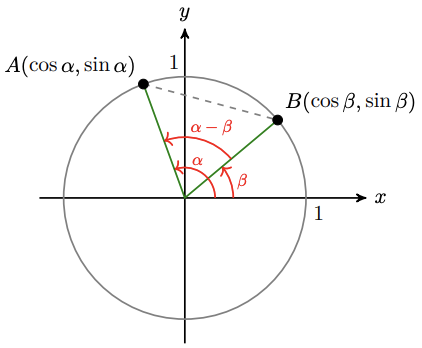
Follow the steps to prove the difference of angles formula for cosine,\[\cos (\alpha-\beta)=\cos \left(\alpha\right) \cos \left(\beta\right)+\sin \left(\alpha\right) \sin \left(\beta\right)\nonumber \]
-
Write an expression for \((A B)^2\), the square of the distance between the points \(A\) and \(B\), using the Law of Cosines for \(\triangle A O B\).
-
Write another expression for \((A B)^2\) using the Distance Formula and the coordinates of \(A\) and \(B\).
-
Equate the two expressions for \((A B)^2\) you obtained in (a) and (b). Simplify the equation to obtain \(\cos (\alpha-\beta)=\cos \alpha \cos \beta+\sin \alpha \sin \beta\)
-
-
For any positive angles \(A \), \(B \), and \(C \) such that \(A+B+C=90^{\circ} \), show that\[ \tan\left(A\right)\tan\left(B\right) + \tan\left(B\right)\tan\left(C\right) + \tan\left(C\right)\tan\left(A\right) = 1. \nonumber \]
-
Prove the identity\[\sin\left(A+B\right)\cos\left(B\right) - \cos\left(A+B\right)\sin\left(B\right) = \sin\left(A\right). \nonumber \]Note that the right side depends only on \(A \), while the left side depends on both \(A \) and \(B \).
-
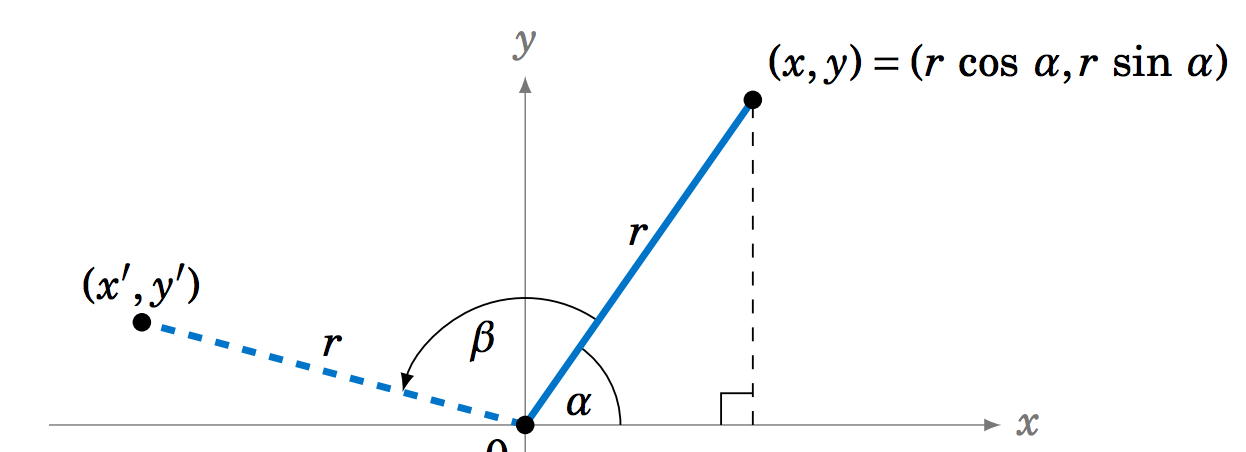
A line segment of length \(r > 0 \) from the origin to the point \((x,y) \) makes an angle \(\alpha \) with the positive \(x\)-axis, so that \((x,y) = \left(r\cos\left(\alpha\right), r\sin\left(\alpha\right)\right) \), as in the figure below. What are the endpoint's new coordinates \((x^{\prime},y^{\prime}) \) after a counterclockwise rotation by an angle \(\beta\)? Your answer should be in terms of \(r \), \(\alpha \), and \(\beta \).
This page titled 9.2.2: Homework was last modified on Tue, 08 Jul 2025 17:45:41 GMT and is shared under a not declared license and was authored, remixed, and/or curated by Roy Simpson.
The book could not be loaded just now.