4.1: The Trigonometric Functions - Right Triangle Definition
Math 375: Pre-Calculus · LibreTexts
0%
Contents
Text
Size
From LibreTexts, under CC BY-SA 12, as the source states it; its equations are written in TeX, which the PDF shows typeset. This page at LibreTexts.
4.1: The Trigonometric Functions - Right Triangle Definition
Opening the book…
Section Preview
Note to the Instructor (click to expand)
This section introduces the student to the Right Triangle definition of the trigonometric functions. As such, all angles will be acute (and in degrees); however, if given an angle (rather than the sides of a triangle) and asked to evaluate a trigonometric function, the angle will strictly be an acute special angle. Therefore, using technology (e.g., calculators) to evaluate any trigonometric function in this section is strictly avoided so as to get the student familiar with right triangle trigonometry at a fundamental level.
Core Prerequisites (i.e., "Understanding the Lesson"): The following prerequisite topics (which have not already been listed as prerequisites in previous sections of this text) are required to understand the core concepts in this lesson.
The following is a list of learning objectives for this section.
Learning Objectives (click to expand)
Find the value of a trigonometric function of an unknown angle in a right triangle given at least two sides of the triangle.
Compute the values of the remaining trigonometric functions of an unknown angle within a right triangle given one trigonometric ratio.
Use the Ratio, Reciprocal, and Pythagorean Identities, along with Right Triangle Trigonometry, to compute trigonometric values.
Find the exact value of a trigonometric function for a special angle.
Use the Cofunction Identities to find the value of a trigonometric function.
Use exact values to simplify an expression involving trigonometric functions.
Recognize and understand the constraints on the values of certain trigonometric functions.
Introduction to Right Triangle Trigonometry
Our initial foray into Trigonometry involved defining the trigonometric functions in terms of points on the Cartesian plane and the distances from those points to the origin. In this chapter, we focus on Trigonometry outside of a coordinate system. Specifically, we redefine the trigonometric functions in terms of ratios of sides of a right triangle.
If \(\theta\) is one of the angles in a right triangle, where the side opposite \( \theta \) is called "opposite," the side adjacent to \( \theta \) is called "adjacent," and the hypotenuse is named as such, we define the trigonometric functions of \( \theta \) as follows:\[ \begin{array}{|ccc|ccc|}
\hline
\text{Function} & & \text{Ratio} & \text{Function} & & \text{Ratio} \\[6pt] \hline
\sin\left( \theta \right) & = & \dfrac{\text{opposite}}{\text{hypotenuse}} & \csc\left( \theta \right) & = & \dfrac{\text{hypotenuse}}{\text{opposite}} \\[6pt] \cos\left( \theta \right) & = & \dfrac{\text{adjacent}}{\text{hypotenuse}} & \sec\left( \theta \right) & = & \dfrac{\text{hypotenuse}}{\text{adjacent}} \\[6pt] \tan\left( \theta \right) & = & \dfrac{\text{opposite}}{\text{adjacent}} & \cot\left( \theta \right) & = & \dfrac{\text{adjacent}}{\text{opposite}} \\[6pt] \hline \end{array} \nonumber \]
While this definition looks different than our coordinate definition of the trigonometric functions, it is, in fact, the same definition if we restrict the coordinates in our original definition to the first quadrant. While it might seem limiting for us to create a new definition of the trigonometric functions by restricting our original definition, this new definition serves a greater purpose—it simplifies Trigonometry immensely. It allows us to separate the triangle from the Cartesian coordinate system.
Example \(\PageIndex{1}\)
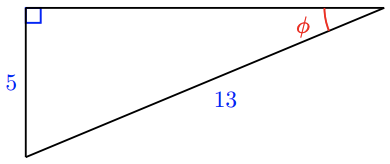
Find all trigonometric ratios of the labeled angle in each triangle.
Figure \(\PageIndex{1}\)
Figure \(\PageIndex{2}\)
Solutions
The side opposite angle \(\phi\) is 5 and the hypotenuse is 13. Let \(x\) be the length of the side adjacent to \(\phi\). To find \(x\), we invoke the Pythagorean Theorem.\[\begin{array}{rrclcr} & x^2+5^2 & = & 13^2 & \quad & (\text{Pythagorean Theorem}) \\[6pt] \implies & x^2+25 & = & 169 & \quad & (\text{simplifying}) \\[6pt] \implies & x^2 & = & 144 & \quad & (\text{subtracting }25\text{ from both sides}) \\[6pt] \implies & x & = & \pm 12 & \quad & (\text{Extraction of Roots}) \\[6pt] \implies & x & = & 12 & \quad & (x\text{ must be positive---it's a side length}) \\[6pt] \end{array}\nonumber\]Therefore,\[\begin{array}{rccclcrcccl} \sin\left(\phi\right) & = & \dfrac{\text{opposite}}{\text{hypotenuse}} & = & \dfrac{5}{13} & \qquad & \csc\left(\phi\right) & = & \dfrac{\text{hypotenuse}}{\text{opposite}} & = & \dfrac{13}{5} \\[6pt] \cos\left(\phi\right) & = & \dfrac{\text{adjacent}}{\text{hypotenuse}} & = & \dfrac{12}{13} & \qquad & \sec\left(\phi\right) & = & \dfrac{\text{hypotenuse}}{\text{adjacent}} & = & \dfrac{13}{12} \\[6pt] \tan\left(\phi\right) & = & \dfrac{\text{opposite}}{\text{adjacent}} & = & \dfrac{5}{12} & \qquad & \cot\left(\phi\right) & = & \dfrac{\text{adjacent}}{\text{opposite}} & = & \dfrac{12}{5} \\[6pt] \end{array}\nonumber\]
The side opposite angle \(\beta\) is \(\sqrt{5}\) and the hypotenuse is 3. Labeling the side adjacent to \(\beta\) as \(x\), we get\[\begin{array}{rrclcr} & x^2+\left(\sqrt{5}\right)^2 & = & 3^2 & \quad & (\text{Pythagorean Theorem}) \\[6pt] \implies & x^2+5 & = & 9 & \quad & (\text{simplifying}) \\[6pt] \implies & x^2 & = & 4 & \quad & (\text{subtracting }5\text{ from both sides}) \\[6pt] \implies & x & = & 2 & \quad & (\text{Extraction of Roots}) \\[6pt] \end{array}\nonumber\]Therefore,\[\begin{array}{rccclcrcccl} \sin\left(\beta\right) & = & \dfrac{\text{opposite}}{\text{hypotenuse}} & = & \dfrac{\sqrt{5}}{3} & \qquad & \csc\left(\beta\right) & = & \dfrac{\text{hypotenuse}}{\text{opposite}} & = & \dfrac{3}{\sqrt{5}} \\[6pt] \cos\left(\beta\right) & = & \dfrac{\text{adjacent}}{\text{hypotenuse}} & = & \dfrac{2}{3} & \qquad & \sec\left(\beta\right) & = & \dfrac{\text{hypotenuse}}{\text{adjacent}} & = & \dfrac{3}{2} \\[6pt] \tan\left(\beta\right) & = & \dfrac{\text{opposite}}{\text{adjacent}} & = & \dfrac{\sqrt{5}}{2} & \qquad & \cot\left(\phi\right) & = & \dfrac{\text{adjacent}}{\text{opposite}} & = & \dfrac{2}{\sqrt{5}} \\[6pt] \end{array}\nonumber\]
The result of the computation to find the missing side in Example \(\PageIndex{1}\) part (a) reveals one of the Pythagorean triples, \((5,12,13)\).
Definition: Pythagorean Triple
A Pythagorean triple consists of three positive integers \(a\), \(b\), and \(c\), such that \(a^2 + b^2 = c^2\).
There are an infinite number of Pythagorean triples, but the common ones found in Trigonometry textbooks are \((3,4,5)\), \((5,12,13)\), and \((7,24,25)\). Triangles having sides lengths matching Pythagorean triples get a special name.
Definition: Pythagorean Triangle
A right triangle whose sides form a Pythagorean triple is called a Pythagorean triangle.
It can be proved that every Pythagorean triangle must be a right triangle. For more information, see this Wikipedia page.
Checkpoint \(\PageIndex{1}\)
Find the sine of the labeled angle in the triangle below. Round the answer to 4 decimal places.
Figure \(\PageIndex{3}\)
Answer
\(\sin\left(\alpha\right) \approx 0.7442\)
The following example illustrates a necessary skill for us as we move forward in Trigonometry.
Example \(\PageIndex{2}\)
Write algebraic expressions for the six trigonometric ratios of the angle \(\theta\) if the hypotenuse has length 2 and the side adjacent to \(\theta\) has length \(D\).
Solution
We begin by finding the missing side, which we shall call \(x\).\[\begin{array}{rrclcr} & D^2+x^2 & = & 2^2 & \quad & (\text{Pythagorean Theorem}) \\[6pt] \implies & D^2+x^2 & = & 4 & \quad & \\[6pt] \implies & x^2 & = & 4-D^2 & \quad & \\[6pt] \implies & x & = & \sqrt{4-D^2} & \quad & \\[6pt] \end{array}\nonumber\]We can now fill in the values of the trigonometric ratios.\[\begin{array}{rcccccrcccc} \sin\left(\theta\right) & = & \dfrac{\text{opposite}}{\text{hypotenuse}} & = & \dfrac{\sqrt{4-D^2}}{2} & \qquad & \csc\left(\theta\right) & = & \dfrac{\text{hypotenuse}}{\text{opposite}} & = & \dfrac{2}{\sqrt{4-D^2}} \\[6pt] \cos\left(\theta\right) & = & \dfrac{\text{adjacent}}{\text{hypotenuse}} & = & \dfrac{D}{2} & \qquad & \sec\left(\theta\right) & = & \dfrac{\text{hypotenuse}}{\text{adjacent}} & = & \dfrac{2}{D} \\[6pt] \tan\left(\theta\right) & = & \dfrac{\text{opposite}}{\text{adjacent}} & = & \dfrac{\sqrt{4-D^2}}{D} & \qquad & \cot\left(\theta\right) & = & \dfrac{\text{adjacent}}{\text{opposite}} & = & \dfrac{D}{\sqrt{4-D^2}} \\[6pt] \end{array}\nonumber\]
Checkpoint \(\PageIndex{2}\)
If the hypotenuse of a right triangle is \(h\) and the side opposite \(\theta\) is \(L\), write expressions in \(h\) and \(L\) for all six trigonometric functions of \(\theta\).
Caution: Right Triangle Trigonometry Works For... Right Triangles
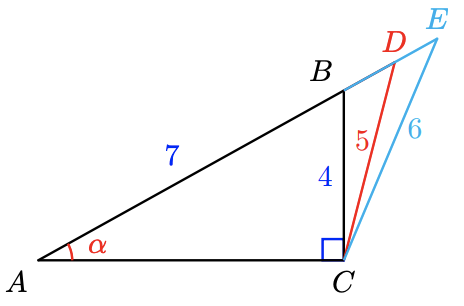
To calculate the trigonometric function of an angle within a triangle, it is crucial that the triangle be a right triangle. For example, in the triangle below, \(\sin\left(\alpha\right)= \frac{4}{7}\), because \(\triangle ABC\) is a right triangle. It is not true that \(\sin\left(\alpha\right)=\frac{5}{7}\), or \(\sin\left(\alpha\right)=\frac{6}{7}\).
Figure \(\PageIndex{4}\)
Revisiting the Fundamental Identities
Our previous identities (the Ratio, Reciprocal, and Pythagorean Identities) still hold when using the right triangle definition of the trigonometric functions. For example, notice that:\[\sin\left(\theta\right) = \dfrac{\text{opposite}}{\text{hypotenuse}} = \dfrac{1}{\frac{\text{hypotenuse}}{\text{opposite}}} = \dfrac{1}{\csc\left(\theta\right)}.\nonumber\]We leave it to the reader to show that all other Reciprocal Identities also hold.
Likewise:\[\tan\left(\theta\right) = \dfrac{\text{opposite}}{\text{adjacent}} = \dfrac{\frac{\text{opposite}}{\text{hypotenuse}}}{\frac{\text{adjacent}}{\text{hypotenuse}}} = \dfrac{\sin\left(\theta\right)}{\cos\left(\theta\right)}.\nonumber\]Again, we leave it to the reader to finish showing that both Ratio Identities still hold.
Finally, it is left as a homework exercise to show that the Pythagorean Identity still holds with this new definition.
Example \(\PageIndex{3}\)
If \(\theta\) is an acute angle in a right triangle and \(\tan\left(\theta\right) = \frac{15}{8}\), compute the remaining trigonometric ratios of \(\theta\).
Solution
It is best to sketch the right triangle with \(\theta\) and where the side adjacent to \(\theta\) has length 8 and the side opposite \(\theta\) has length 15.
Figure \(\PageIndex{5}\)
Using the Pythagorean Theorem, we get\[\begin{array}{rrcl} & 8^2+15^2 & = & h^2 \\[6pt] \implies & 289 & = & h^2 \\[6pt] \implies & 17 & = & h \\[6pt] \end{array}\nonumber\]Hence,\[\begin{array}{rclcrcccccl} \sin\left(\theta\right) & = & \dfrac{15}{17} & \implies & \csc\left(\theta\right) & = & \dfrac{1}{\sin\left(\theta\right)} & = & \dfrac{1}{15/17} & = & \dfrac{17}{15} \\[6pt] \cos\left(\theta\right) & = & \dfrac{8}{17} & \implies & \sec\left(\theta\right) & = & \dfrac{1}{\cos\left(\theta\right)} & = & \dfrac{1}{8/17} & = & \dfrac{17}{8} \\[6pt] \tan\left(\theta\right) & = & \dfrac{15}{8} & \implies & \cot\left(\theta\right) & = & \dfrac{1}{\tan\left(\theta\right)} & = & \dfrac{1}{15/8} & = & \dfrac{8}{15} \\[6pt] \end{array}\nonumber\]
Checkpoint \(\PageIndex{3}\)
If \(\beta\) is an acute angle in a right triangle and \(\csc\left(\beta\right) = \frac{2}{\sqrt{3}}\), compute the remaining trigonometric ratios of \(\beta\).
If \(\sin\left(\theta\right) = \frac{3}{7}\) and \(\cos\left(\theta\right) = \frac{2\sqrt{10}}{7}\), where \(\theta\) is an acute angle within a right triangle, find the value of \(\cot\left(\theta\right)\) without drawing a triangle.
If \(\lambda\) is an acute angle in a right triangle, \(\tan\left(\lambda\right) = \frac{2}{3}\), and \(\cos\left(\lambda\right) = \frac{3}{\sqrt{13}}\), find \(\sin\left(\lambda\right)\) using only the Ratio Identities.
Right Triangle Trigonometry and the Special Angles
Now that we have a right triangle definition for the trigonometric functions, we can use our special triangles to help us quickly evaluate the trigonometric functions at \(30^{\circ}\), \(45^{\circ}\), and \(60^{\circ}\) angles. These angles are foundations upon which we build the rest of Trigonometry.
Table \(\PageIndex{1}\): Fundamental Trigonometric Ratios for the Special Angles
The exact values for these trigonometric ratios should be committed to memory. A great way to remember them is to know the two special triangles in Figure \(\PageIndex{6}\) below. Writing down the three trigonometric ratios for the special angles from these triangles is simple.
Figure \(\PageIndex{6}\):Left: The \(45^{\circ}\)-\(45^{\circ}\)-\(90^{\circ}\) special triangle, Right: The \(30^{\circ}\)-\(60^{\circ}\)-\(90^{\circ}\) special triangle
For example, we can quickly compute \(\tan\left(60^{\circ}\right)\) and \(\sec\left(30^{\circ}\right)\) by sketching the \(30^{\circ}\)-\(60^{\circ}\)-\(90^{\circ}\) triangle and finding the ratios of the relevant sides:\[\sec\left(30^{\circ}\right) = \frac{\text{hypotenuse}}{\text{adjacent}}=\frac{2}{\sqrt{3}} \quad \quad \quad \tan\left(60^{\circ}\right)=\frac{\text{opposite}}{\text{adjacent}}=\frac{\sqrt{3}}{1}=\sqrt{3}.\]
These are exact values for the trigonometric ratios, but we can also find decimal approximations. Use a calculator to verify the following approximate values.
It is essential to understand the difference between exact and approximate values. The decimal approximations above are rounded off. Even if a calculator shows ten or twelve digits, the values are not precisely correct—although they are adequate for most practical calculations.
Computational Note: To Rationalize or Not To Rationalize... That is the Question
Did you notice that we left \(\sec\left(30^{\circ}\right) = \frac{2}{\sqrt{3}}\) with a radical in its denominator? This is quite common in Trigonometry. While one can rationalize the denominator to get\[\sec\left(30^{\circ}\right) = \dfrac{2}{\sqrt{3}} \cdot \dfrac{\sqrt{3}}{\sqrt{3}} = \dfrac{2\sqrt{3}}{3},\nonumber\]the need to do so with numerical expressions (expressions not involving variables) is an antiquated "throwback" to the days when calculators did not exist. As such, unless it truly simplifies an expression, we will be okay with leaving radicals in the denominators of numerical expressions for the rest of mathematics.
Example \(\PageIndex{5}\)
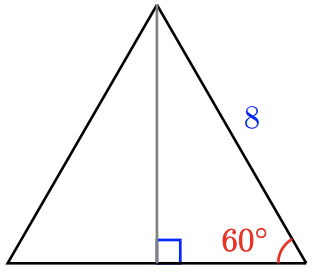
Matterhorn Chocolate bars are sold in boxes shaped like triangular prisms. The two triangular ends of a box are equilateral triangles with 8-centimeter sides. When stacking the boxes on a shelf, the second level will be a triangle’s altitude above the bottom level. Find the exact length of the triangle’s altitude, \(h\).
Solution
We have seen this question before (near the beginning of the textbook). The altitude divides the triangle into two \(30^{\circ}\)-\(60^{\circ}\)-\(90^{\circ}\) right triangles, as shown in Figure \(\PageIndex{7}\) below.
Figure \(\PageIndex{7}\)
The altitude is adjacent to the \(30^{\circ}\) angle and the hypotenuse of the right triangle is 8 centimeters. Thus, using the fact that we already know \(\cos\left(30^{\circ}\right) = \frac{\sqrt{3}}{2}\), we get\[\begin{array}{rrclr} & \cos\left(30^{\circ}\right) & = & \dfrac{\text{adjacent}}{\text{hypotenuse}} & (\text{Fill in the values.}) \\[6pt] \implies & \dfrac{\sqrt{3}}{2} & = & \dfrac{h}{8} & \\[6pt] \implies & h & = & 8\left(\dfrac{\sqrt{3}}{2}\right)=4 \sqrt{3} & (\text{multiplying both sides by 8}) \\[6pt] \end{array}\nonumber\]The altitude is exactly \(4\sqrt{3}\) centimeters long. From this exact answer, we can find approximations to any degree of accuracy we like. You can check that \(4\sqrt{3} \approx 6.9282\), so the altitude is approximately \(6.9\) centimeters long.
Checkpoint \(\PageIndex{5}\)
Show that \(\cos^2\left(60^{\circ}\right)+\sin^2\left(60^{\circ}\right)=1\).
Let \(x = 60^{\circ}\) and \(y=45^{\circ}\). Evaluate:\[\sqrt{3}\csc\left(x\right)-\dfrac{5}{\sqrt{2}}\sec\left(y\right)+\sqrt{6}\tan\left(90^{\circ}-x\right)\sin\left(y\right)\nonumber\]
Solution
Using our two special triangles in Figure \(\PageIndex{6}\), we get\[\begin{array}{rcl} \sqrt{3}\csc\left(x\right)-\dfrac{5}{\sqrt{2}}\sec\left(y\right)+\sqrt{6}\tan\left(90^{\circ}-x\right)\sin\left(y\right) & = & \sqrt{3}\csc\left(60^{\circ}\right)-\dfrac{5}{\sqrt{2}}\sec\left(45^{\circ}\right)+\sqrt{6}\tan\left(90^{\circ}-60^{\circ}\right)\sin\left(45^{\circ}\right) \\[6pt] & = & \sqrt{3}\csc\left(60^{\circ}\right)-\dfrac{5}{\sqrt{2}}\sec\left(45^{\circ}\right)+\sqrt{6}\tan\left(30^{\circ}\right)\sin\left(45^{\circ}\right) \\[6pt] & = & \cancel{\sqrt{3}}\left(\dfrac{2}{\cancel{\sqrt{3}}}\right)-\left(\dfrac{5}{\cancel{\sqrt{2}}}\right)\left(\dfrac{\cancel{\sqrt{2}}}{1}\right)+\left(\cancel{\sqrt{6}}\right)\left(\dfrac{1}{\cancel{\sqrt{3}}}\right)\left(\dfrac{1}{\cancel{\sqrt{2}}}\right) \\[6pt] & = & 2-5+1 \\[6pt] & = & -2 \end{array}\nonumber\]
Checkpoint \(\PageIndex{6}\)
Evaluate and write as a single expression:\[3\cos\left(45^{\circ}\right)-2\cot\left(30^{\circ}\right)\nonumber\]
Answer
\(\dfrac{3-2\sqrt{6}}{\sqrt{2}}\)
Cofunction Identities
The following definition may answer a burning question you have had since being introduced to trigonometric functions.
Definition: Cofunction
The sine and cosine are called cofunctions. Likewise, the tangent and cotangent, as well as the secant and cosecant, are called cofunctions.
We say the sine is the cofunction of the cosine, and the cosine is the cofunction of the sine. The same holds for tangent and cotangent, and secant and cosecant. Now that we have a definition for cofunctions, what's the big deal?
The right triangle definition of the trigonometric functions reveals a new identity that was not so obvious when working with the coordinate definition of trigonometric functions. Consider the right triangle in Figure \(\PageIndex{8}\) below.
At this point, I hope you can see a budding relationship between a function and its cofunction. The following theorem summarizes the results (the proof of which will be held off until we have more mathematics to work with).
Observations of Values for Trigonometric Functions Using Right Triangle Trigonometry
We have now spent a decent amount of time with the trigonometric functions—both defined in terms of coordinates on the Cartesian plane and in terms of ratios of sides of right triangles. It's now time to formalize some observations.
Trigonometric Functions are Invariant When Scaling Right Triangles
The trigonometric function of an angle is the same for any right triangle, no matter the size or orientation of the triangle. Another way to say this is the values of the trigonometric functions are invariant under scaling of the right triangle. For example, Figure \(\PageIndex{9}\) (below) shows three right triangles, each with a \(50^{\circ}\) angle. Although the sides of the triangle may be bigger or smaller, the ratio \(\frac{\text{opposite}}{\text{hypotenuse}}\) is always the same for that angle because the triangles are similar. Therefore, \(\sin\left(50^{\circ}\right)\) is the same for all three right triangles.
Figure \(\PageIndex{9}\)
Similarly, the values of all the other trigonometric functions at \(50^{\circ}\) remain constant when we scale the triangles to be larger or smaller.
Interactive Element: Trig Ratios Are Invariant Under Scaling
The following Interactive Element might help you visualize why the trigonometric ratios of a fixed angle do not depend on the size of the right triangle.
Interact: Drag the red point along the horizontal base to grow or shrink the triangle; the \(50^{\circ}\) angle at the corner stays fixed.
Observation: Every side length changes as you resize the triangle, yet the ratio \(\frac{\text{opposite}}{\text{hypotenuse}}=\sin\left(50^{\circ}\right)\) stays the same—similar triangles share the same trigonometric ratios.
Some Trigonometric Functions Have Limited Ranges
Consider the right triangle definition of the trigonometric functions. Since the hypotenuse is the longest side of a right triangle, the ratios\[\sin\left(\theta\right) = \dfrac{\text{opposite}}{\text{hypotenuse}} \quad \text{and} \quad \cos\left(\theta\right) = \dfrac{\text{adjacent}}{\text{hypotenuse}}\nonumber\]will always be less than 1.
Moreover, if we think about the coordinate definition of the trigonometric functions,\[\sin\left(\theta\right) = \dfrac{y}{r} \quad \text{and} \quad \cos\left(\theta\right) = \dfrac{x}{r}.\nonumber\]Since \(r = \sqrt{x^2+y^2} \geq \sqrt{y^2} = |y|\) and \(r = \sqrt{x^2+y^2} \geq \sqrt{x^2} = |x|\),\[\begin{array}{rcccccccl} |y| \leq r & \implies & \dfrac{|y|}{r} \leq 1 & \implies & \left| \dfrac{y}{r} \right| \leq 1 & \implies & \left| \sin\left(\theta\right) \right| \leq 1 & \implies & -1 \leq \sin\left(\theta\right) \leq 1 \\[6pt] & & & & \text{and} & & & & \\[6pt] |x| \leq r & \implies & \dfrac{|x|}{r} \leq 1 & \implies & \left| \dfrac{x}{r} \right| \leq 1 & \implies & \left| \cos\left(\theta\right) \right| \leq 1 & \implies & -1 \leq \cos\left(\theta\right) \leq 1 \\[6pt] \end{array}\nonumber\]The only times the sine or cosine become \(1\) or \(-1\) is when the given angle is a quadrantal angle.
Example \(\PageIndex{8}\)
If \(\theta\) is an angle within a right triangle, is it possible for \(\sec\left(\theta\right) = \frac{1}{2}\)? Explain.
Solution
\(\sec\left(\theta\right)\) is the ratio of the hypotenuse to the adjacent side of \(\theta\); however, the hypotenuse of a right triangle is always longer than the other sides. Therefore, the ratio \(\frac{\text{hypotenuse}}{\text{adjacent}}\) must be greater than 1 (by the discussion before this example, the secant can attain a value of 1 only if the given angle is a quadrantal angle).
Checkpoint \(\PageIndex{8}\)
Can \(\csc\left(\theta\right)\) ever be 2?
Answer
Yes!
Using Special Angles to Approximate Trigonometric Functions at Other Angles
In a right triangle, as the angle \(\theta\) increases, \(\sin\left(\theta\right)\) increases but \(\cos\left(\theta\right)\) decreases. Figure \(\PageIndex{10}\) (below) demonstrates why this is true. In each right triangle, the hypotenuse has the same length. However, as the angle increases, the opposite side gets longer, and the adjacent side gets shorter.
Figure \(\PageIndex{10}\)
Interactive Element: As the Angle Opens, Sine Rises and Cosine Falls
The following Interactive Element might help you visualize how sine and cosine change as the acute angle grows while the hypotenuse is held fixed.
Interact: Drag the red point along the base; the top corner glides along the arc of the fixed-length hypotenuse.
Observation: As the angle increases, the opposite side lengthens and the adjacent side shortens, so \(\sin\) increases toward \(1\) while \(\cos\) decreases toward \(0\).
We can use the special angles as benchmarks for estimating and mental calculation. For example, we know that \(\sin\left(60^{\circ}\right) \approx 0.8660\), so if \(\sin\left(\theta\right) = 0.95\) for some unknown angle \(\theta\) within a right triangle, we know that \(\theta > 60^{\circ}\), because as \(\theta\) increases, the sine of \(\theta\) increases as well.
Example \(\PageIndex{9}\)
If \(\cos\left(\alpha\right)>\frac{\sqrt{3}}{2}\), where \(\alpha\) is an angle within a right triangle, what can we say about \(\alpha\)?
Solution
As an angle increases from \(0^{\circ}\) to \(90^{\circ}\), its cosine decreases (why?). Now, \(\cos\left(30^{\circ}\right) = \dfrac{\sqrt{3}}{2}\), so if \(\cos\left(\alpha\right)>\frac{\sqrt{3}}{2}\), then \(\alpha\) must be less than \(30^{\circ}\).
Checkpoint \(\PageIndex{9}\)
If \(1<\tan\left(\beta\right)<\sqrt{3}\), where \(\beta\) is one of the angles in a right triangle, what can we say about \(\beta\)?
Answer
\(45^{\circ}<\beta<60^{\circ}\)
Hidden Resources: CalFresh
CalFresh (formerly known as Food Stamps) is a nutrition program that helps students and their families buy healthy foods.
How Does CalFresh Work?
CalFresh benefits are issued on an electronic benefit transfer (EBT) card that works like a debit card and can be used at most grocery stores and many farmers' markets to buy food. You can even use CalFresh to purchase food online through Amazon and Walmart.com.
If you are on a limited income and are struggling to buy the healthy foods that you need, then CalFresh may be able to help! Plus, CalFresh benefits do not impact your financial aid, and you do not need your parents' tax return information to apply.
For more information, please see this page on the CRC website.
Success in Mathematics: Why Study Mathematics? (Part 1)
Until modern times, only a tiny percent of people had the opportunity to be "liberally educated." These people were not studying to learn a job or trade - they wanted to learn what other humans had thought and created. They were also trying to develop new knowledge. Menaechmus (350 B.C.E) was this kind of student. As he studied geometry, he discovered the properties of conic sections. Others built on his knowledge. Apollonius (350 B.C.E) wrote an eight-chapter book about conic sections.
Today we use our knowledge of conic sections to predict orbits, build telescopes, locate ships at sea, make "eyes" for robots, and collect solar energy. But we also study conic sections as an accomplishment of our human ancestors. In developing their equations, we also develop logic and creative problem-solving skills. Think about the football coach who has his team doing agility drills and running through tires. Why? When has a football team ever had to run through tires during a game? Similarly, with the right attitude, you can develop your ability to reason and think in your life outside of college by doing mathematics. You are responsible for recognizing that learning and studying may be valuable even when it is not immediately practical.
One problem with teaching mathematics in the K-12 system - and I see it as a major difficulty - is that there is virtually nothing the pupils learn that has a non-trivial application in today's world. The most a teacher can tell a student who inquires, entirely reasonably, "How is this useful?" is that almost all mathematics finds uses, in many cases important ones, and that what they learn in school leads on to mathematics that definitely is used.
- Keith Devlin, Standford University
By "non-trivial," Dr. Devlin means that many real-life applications require mathematics beyond what is studied in high school.
Younger students often ask, " When will I use this math?" Their teachers often reply, "You need to learn this math to go on to the next course. In college, you can take math that is very powerful for doing all kinds of practical things." Do you think this is the best reply to give to the student? Explain.
I've often pondered the best mixture of application and theory in a mathematics course. My love of mathematics lies in theory; however, my research in mathematics is in applications. As a student, which do you prefer? Explain.