Opening the book…
- Note to the Instructor (click to expand)
- The Sum and Difference, Double-Angle, and Half-Angle Identities must be memorized (at least for the sine and cosine). Do not fall into the trap of allowing students to have these on a note card during exams — they will not have such luxury in Calculus.
The following is a list of learning objectives for this section.
- Learning Objectives (click to expand)
-
- Use the Power Reduction Identities to rewrite the power of a trigonometric function in terms of single powers.
- Use a Half-Angle Identity to find the exact value of a trigonometric function.
- Prove an identity using a Half-Angle Identity.
- Use the Half-Angle Identities to graph a function.
The Power Reduction Identities
The Double-Angle Identities can be used to derive the Power Reduction Identities, which are formulas we can use to reduce the power of a given expression involving even powers of sine or cosine. They allow us to rewrite the even powers of sine or cosine in terms of the first power of cosine. These formulas are essential in higher-level math courses, Calculus in particular. Also called the Power Reduction Formulas (or, simply, the Reduction Formulas), these form three identities and are easily derived from the Double-Angle Identities.
The Power Reduction Identities for the sine and cosine are needed throughout the rest of Trigonometry, Calculus, and Differential Equations. While not as prevalent as the Pythagorean Theorem or the Quadratic Formula, the need to commit them to memory and their importance cannot be overstated. The tangent version is less common and can be derived from the sine and cosine versions if needed.
Using the Reduction Identities to Rewrite an Expression Without Powers Greater Than 1
The Power Reduction Identities are frequently used in Calculus to make an otherwise impossible problem possible. This is because working with higher powers of trigonometric functions can be problematic in Integral Calculus.
Write an equivalent expression for \(\cos^4\left(x\right)\) that does not involve any powers of sine or cosine greater than \(1\).
- Solution
-
We will apply the Reduction Identity for cosine twice.\[\begin{array}{rclcl}\cos^4\left(x\right) & = & \left(\cos^2\left(x\right)\right)^2 & & \\[6pt] & = & \left(\dfrac{1+\cos(2x)}{2}\right)^2 & \quad & \left(\text{Reduction Identity}\right) \\[6pt] & = & \dfrac{1}{4}\left(1+2\cos(2x)+\cos^2(2x)\right) & \quad & \left(\text{distribution}\right) \\[6pt] & = & \dfrac{1}{4}+\dfrac{1}{2}\cos(2x)+\dfrac{1}{4}\left(\dfrac{1+\cos(4x)}{2}\right) & \quad & \left(\text{distribution and Reduction Identity}\right) \\[6pt] & = & \dfrac{1}{4}+\dfrac{1}{2}\cos(2x)+\dfrac{1}{8}+\dfrac{1}{8}\cos(4x) & \quad & \left(\text{distribution}\right) \\[6pt] & = & \dfrac{3}{8}+\dfrac{1}{2}\cos(2x)+\dfrac{1}{8}\cos(4x) & \quad & \left(\text{combining like terms}\right) \\[6pt] \end{array}\nonumber\]
Write an equivalent expression for \(\sin^4\left(3x\right)\) that does not involve any powers of sine or cosine greater than \(1\).
- Answer
-
\(\dfrac{3}{8} - \dfrac{1}{2}\cos\left(6x\right) + \dfrac{1}{8}\cos\left(12x\right)\)
Revisiting Proofs of Identities
The Power Reduction Identities can come in handy when trying to prove identities.
Prove\[\sin^3(2x)=\dfrac{1}{2}\sin(2x)\left[1-\cos(4x)\right].\nonumber\]
- Solution
-
We will work on simplifying the left side of the equation.\[\begin{array}{rclcl}\text{LHS} & = & \sin^3(2x) & & \\[6pt] & = & \sin(2x)\cdot\sin^2(2x) & & \\[6pt] & = & \sin(2x)\left[\dfrac{1-\cos(4x)}{2}\right] & \quad & \left(\text{Power Reduction Identity}\right) \\[6pt] & = & \sin(2x)\left(\dfrac{1}{2}\right)[1-\cos(4x)] & & \\[6pt] & = & \dfrac{1}{2}\sin(2x)[1-\cos(4x)] & & \\[6pt] & = & \text{RHS} & & \\[6pt] \end{array}\nonumber\]
In Example \(\PageIndex{2}\), we substituted \(\dfrac{1-\cos(4x)}{2}\) for \(\sin^2(2x)\). This is because the Power Reduction Identity states\[\sin^2\left(\theta\right)=\dfrac{1-\cos(2\theta)}{2}.\nonumber\]We let \(\theta=2x\), so \(2\theta=4x\).
Prove that\[10\cos^4\left(x\right)=\dfrac{15}{4}+5\cos(2x)+\dfrac{5}{4}\cos(4x).\nonumber\]
- Answer
-
\[\begin{array}{rclcl}10\cos^4\left(x\right) & = & 10\left(\cos^2\left(x\right)\right)^2 & & \\[6pt] & = & 10\left[\dfrac{1+\cos(2x)}{2}\right]^2 & \quad & \left(\text{Power Reduction Identity}\right) \\[6pt] & = & \dfrac{10}{4}\left[1+2\cos(2x)+\cos^2(2x)\right] & \quad & \left(\text{distribution}\right) \\[6pt] & = & \dfrac{10}{4}+\dfrac{10}{2}\cos(2x)+\dfrac{10}{4}\left(\dfrac{1+\cos(4x)}{2}\right) & \quad & \left(\text{distribution and Power Reduction Identity}\right) \\[6pt] & = & \dfrac{10}{4}+\dfrac{10}{2}\cos(2x)+\dfrac{10}{8}+\dfrac{10}{8}\cos(4x) & & \\[6pt] & = & \dfrac{30}{8}+5\cos(2x)+\dfrac{10}{8}\cos(4x) & & \\[6pt] & = & \dfrac{15}{4}+5\cos(2x)+\dfrac{5}{4}\cos(4x) & & \\[6pt] \end{array}\nonumber\]
The Half-Angle Identities
The next set of identities can be quickly derived from the Power Reduction Identities by replacing \(\theta\) with \(\dfrac{\alpha}{2}\) and taking the square root of both sides. These are known as the Half-Angle Identities.
Note that the Half-Angle Identities are preceded by a \(\pm\) sign. This does not mean that both the positive and negative expressions are valid. Instead, it depends on the quadrant in which \(\dfrac{\theta}{2}\) terminates.
I have been using the convention in this textbook to call all our theorems based on the trigonometric functions by the term "identities." That is, we have learned the Pythagorean Identities, the Ratio Identities, the Symmetry Identities, the Double-Angle Identities, and so on. You will also hear of these referred to as "formulas." That is, a student from another class might say, "Double-Angle Formulas." This is fine. The only reason for my convention is that the word "identity" has more meaning. It implies that the statement is always true. On the other hand, the word "formula" is a bit more circumstantial (i.e., not always true). In the context of the theorems we have presented so far, you could use either terminology and you would still be correct.
Using the Half-Angle Identities to Evaluate Trigonometric Functions
Find the exact value of \(\sin\left(15^{\circ}\right)\).
- Solution
-
Since \(15^{\circ}=\dfrac{30^{\circ}}{2}\), we use the Half-Angle Identity for sine:\[\begin{array}{rclcl}\sin\left(15^{\circ}\right) & = & \sin\left(\dfrac{30^{\circ}}{2}\right) & & \\[6pt] & = & +\sqrt{\dfrac{1-\cos\left(30^{\circ}\right)}{2}} & \quad & \left(\text{since }15^{\circ}\in\mathrm{QI}\text{, }\sin\left(15^{\circ}\right)\text{ is positive}\right) \\[6pt] & = & \sqrt{\dfrac{1-\dfrac{\sqrt{3}}{2}}{2}} & & \\[6pt] & = & \sqrt{\dfrac{2-\sqrt{3}}{4}} & & \\[6pt] & = & \dfrac{\sqrt{2-\sqrt{3}}}{2} & & \\[6pt] \end{array}\nonumber\]Remember that we can check the answer with a graphing calculator.
Find the exact value of \(\cos\left(\dfrac{\pi}{8}\right)\).
- Answer
-
\(\sqrt{\dfrac{\sqrt{2}+1}{2\sqrt{2}}}=\sqrt{\dfrac{2+\sqrt{2}}{4}}=\dfrac{\sqrt{2+\sqrt{2}}}{2}\)
When using a Half-Angle Identity, you must address the \(\pm\) sign. To do this, you consider the quadrant within which the half-angle terminates. For example, suppose you are given \(\cos\left(\theta\right)=\dfrac{5}{7}\), where \(\theta\in\mathrm{QIV}\). If you are then asked to find \(\cos\left(\dfrac{\theta}{2}\right)\), you should start by determining the quadrant within which \(\dfrac{\theta}{2}\) lies because that will determine the sign of \(\cos\left(\dfrac{\theta}{2}\right)\). We use the fact that \(\theta\in\mathrm{QIV}\) to do this. This implies\[\begin{array}{rrcccl} & \dfrac{3\pi}{2} & \lt & \theta & \lt & 2\pi \\[6pt] \implies & \dfrac{3\pi}{4} & \lt & \dfrac{\theta}{2} & \lt & \pi \\[6pt] \end{array}\nonumber\]Hence, \(\dfrac{\theta}{2}\in\mathrm{QII}\). We then use the Half-Angle Identity and the given information to finish the problem.\[\begin{array}{rcl}\cos\left(\dfrac{\theta}{2}\right) & = & -\sqrt{\dfrac{1+\cos\left(\theta\right)}{2}} \\[6pt] & = & -\sqrt{\dfrac{1+\dfrac{5}{7}}{2}} \\[6pt] & = & -\sqrt{\dfrac{7+5}{14}} \\[6pt] & = & -\sqrt{\dfrac{12}{14}} \\[6pt] & = & -\sqrt{\dfrac{6}{7}} \\[6pt] \end{array}\nonumber\]
Given that \(\tan\left(\alpha\right)=\dfrac{8}{15}\) and \(\alpha\) lies in quadrant III, find the exact value of the following:
- \(\sin\left(\dfrac{\alpha}{2}\right)\)
- \(\cos\left(\dfrac{\alpha}{2}\right)\)
- \(\tan\left(\dfrac{\alpha}{2}\right)\)
- Solutions
-
Using the given information, we draw the triangle shown below.

Figure \(\PageIndex{1}\) Using the Pythagorean Theorem, we find the hypotenuse to be 17. Therefore, we can calculate\[\sin\left(\alpha\right)=-\dfrac{8}{17}\nonumber\]and\[\cos\left(\alpha\right)=-\dfrac{15}{17}.\nonumber\]Before we start, we must remember that if \(\alpha\) is in quadrant III, then \(\pi\lt\alpha\lt\dfrac{3\pi}{2}\), so \(\dfrac{\pi}{2}\lt\dfrac{\alpha}{2}\lt\dfrac{3\pi}{4}\). This means that the terminal side of \(\dfrac{\alpha}{2}\) is in quadrant II.
- To find \(\sin\left(\dfrac{\alpha}{2}\right)\), we begin by writing the Half-Angle Identity for sine. Then, we substitute the value of the cosine we found from the triangle above and simplify.\[\begin{array}{rclcl}\sin\left(\dfrac{\alpha}{2}\right) & = & \pm\sqrt{\dfrac{1-\cos\left(\alpha\right)}{2}} & \quad & \left(\text{Half-Angle Identity}\right) \\[6pt] & = & \pm\sqrt{\dfrac{1-\left(-\dfrac{15}{17}\right)}{2}} & & \\[6pt] & = & \pm\sqrt{\dfrac{\dfrac{32}{17}}{2}} & & \\[6pt] & = & \pm\sqrt{\dfrac{32}{34}} & & \\[6pt] & = & \pm\sqrt{\dfrac{16}{17}} & & \\[6pt] & = & \pm\dfrac{4}{\sqrt{17}} & & \\[6pt] & = & \dfrac{4}{\sqrt{17}} & \quad & \left(\dfrac{\alpha}{2}\in\mathrm{QII}\right) \\[6pt] \end{array}\nonumber\]We choose the positive value of \(\sin\left(\dfrac{\alpha}{2}\right)\) because the angle terminates in quadrant II and sine is positive in quadrant II.
- To find \(\cos\left(\dfrac{\alpha}{2}\right)\), we will write the Half-Angle Identity for cosine, substitute the value of the cosine we found from the triangle, and simplify.\[\begin{array}{rclcl}\cos\left(\dfrac{\alpha}{2}\right) & = & \pm\sqrt{\dfrac{1+\cos\left(\alpha\right)}{2}} & \quad & \left(\text{Half-Angle Identity}\right) \\[6pt] & = & \pm\sqrt{\dfrac{1+\left(-\dfrac{15}{17}\right)}{2}} & & \\[6pt] & = & \pm\sqrt{\dfrac{\dfrac{2}{17}}{2}} & & \\[6pt] & = & \pm\sqrt{\dfrac{2}{34}} & & \\[6pt] & = & \pm\sqrt{\dfrac{1}{17}} & & \\[6pt] & = & -\dfrac{1}{\sqrt{17}} & \quad & \left(\dfrac{\alpha}{2}\in\mathrm{QII}\right) \\[6pt] \end{array}\nonumber\]We choose the negative value of \(\cos\left(\dfrac{\alpha}{2}\right)\) because the angle is in quadrant II and the cosine is negative in quadrant II.
- To find \(\tan\left(\dfrac{\alpha}{2}\right)\), we write the Half-Angle Identity for the tangent. Again, we substitute the value of the cosine we found from the triangle and simplify.\[\begin{array}{rclcl}\tan\left(\dfrac{\alpha}{2}\right) & = & \pm\sqrt{\dfrac{1-\cos\left(\alpha\right)}{1+\cos\left(\alpha\right)}} & \quad & \left(\text{Half-Angle Identity}\right) \\[6pt] & = & \pm\sqrt{\dfrac{1-\left(-\dfrac{15}{17}\right)}{1+\left(-\dfrac{15}{17}\right)}} & & \\[6pt] & = & \pm\sqrt{\dfrac{\dfrac{32}{17}}{\dfrac{2}{17}}} & & \\[6pt] & = & \pm\sqrt{\dfrac{32}{2}} & & \\[6pt] & = & -\sqrt{16} & \quad & \left(\dfrac{\alpha}{2}\in\mathrm{QII}\right) \\[6pt] & = & -4 & & \\[6pt] \end{array}\nonumber\]We choose the negative value of \(\tan\left(\dfrac{\alpha}{2}\right)\) because \(\dfrac{\alpha}{2}\) lies in quadrant II, and tangent is negative in quadrant II.
Given that \(\sin\left(\alpha\right)=-\dfrac{4}{5}\) and \(\alpha\) lies in quadrant IV, find the exact value of \(\cos\left(\dfrac{\alpha}{2}\right)\).
- Answer
-
\(-\dfrac{2}{\sqrt{5}}\)
The following example requires us to recall how to find an acute angle using the inverse trigonometric function. For a review of this skill, please see section 3.2.
A bicycle ramp is constructed for high-level competition with an angle of \(\theta\) formed by the ramp and the ground. Another ramp is to be constructed half as steep for novice competition. If \(\tan\left(\theta\right)=\dfrac{5}{3}\) for higher-level competition, what is the measurement of the angle for novice competition?
- Solution
-
Since the angle for novice competition measures half the steepness of the angle for the high-level competition, and \(\tan\left(\theta\right)=\dfrac{5}{3}\) for high competition, we can find \(\cos\left(\theta\right)\) from the right triangle and the Pythagorean Theorem so that we can use the Half-Angle Identities (see the figure below).
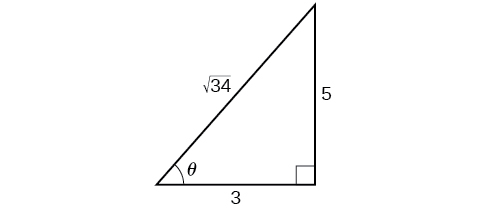
Figure \(\PageIndex{2}\) We see that \(\cos\left(\theta\right)=\dfrac{3}{\sqrt{34}}\). We can use the Half-Angle Identity for tangent:\[\tan\left(\dfrac{\theta}{2}\right)=\sqrt{\dfrac{1-\cos\left(\theta\right)}{1+\cos\left(\theta\right)}}.\nonumber\]Since \(\tan\left(\theta\right)\) is in the first quadrant, so is \(\tan\left(\dfrac{\theta}{2}\right)\).\[\begin{array}{rcl}\tan\left(\dfrac{\theta}{2}\right) & = & \sqrt{\dfrac{1-\dfrac{3}{\sqrt{34}}}{1+\dfrac{3}{\sqrt{34}}}} \\[6pt] & = & \sqrt{\dfrac{\sqrt{34}-3}{\sqrt{34}+3}} \\[6pt] & \approx & 0.57 \\[6pt] \end{array}\nonumber\]We can take the inverse tangent to find the angle: \(\tan^{-1}(0.57)\approx 29.7^{\circ}\). So, the angle of the ramp for novice competition is \(\approx 29.7^{\circ}\).
Revisiting Graphs of Trigonometric Functions
Graph the function.\[y=3\sin^2\left(\frac{x}{2}\right)\nonumber\]
- Solution
- We begin by recognizing this as the square of a Half-Angle Identity.\[\begin{array}{rcl}y & = & 3\sin^2\left(\dfrac{x}{2}\right)\\[6pt] & = & 3\left[\pm\sqrt{\dfrac{1-\cos\left(x\right)}{2}}\right]^2 \\[6pt] & = & 3\left(\dfrac{1-\cos\left(x\right)}{2}\right) \\[6pt] & = & -\dfrac{3}{2}\cos\left(x\right)+\dfrac{3}{2} \\[6pt] \end{array}\nonumber\]We see this is a reflected cosine function with amplitude \(\dfrac{3}{2}\), period \(2\pi\), step size \(\dfrac{\pi}{2}\), phase shift 0, and vertical shift \(\dfrac{3}{2}\). Using all this information, we obtain the following graph.

Figure \(\PageIndex{3}\)
Graph the function.\[y=-2\cos^2\left(3x\right)-1\nonumber\]
- Answer
-

Figure \(\PageIndex{4}\)
This page titled 9.4: Half-Angle and Power Reduction Identities was last modified on Tue, 08 Jul 2025 17:45:46 GMT and is shared under a CC BY-SA 12 license and was authored, remixed, and/or curated by Roy Simpson.
The book could not be loaded just now.