Opening the book…
3.9 Newton's Method
- Apply Newton's method to approximate solutions of equations by using iterative processes.
Task: Find the solutions of the equation \(f(x)=0\).
Note that the solutions of the above equation corresponds to the \( x\)-intercepts of the graph of \(f\). We use the following iterative process to obtain the solutions.
Newton’s Method
By sketching a graph of \(f\), we can estimate a root of \(f(x)=0\). Let’s call this estimate \(x_0\). We then draw the tangent line to \(f\) at \(x_0\). If \(f′(x_0)≠0\), this tangent line intersects the \(x\)-axis at some point \((x_1,0)\). Now let \(x_1\) be the next approximation to the actual root. Typically, \(x_1\) is closer than \(x_0\) to an actual root. Next we draw the tangent line to \(f\) at \(x_1\). If \(f′(x_1)≠0\), this tangent line also intersects the \(x\)-axis, producing another approximation, \(x_2\). We continue in this way, deriving a list of approximations: \(x_0,\, x_1,\, x_2,\, ….\) Typically, the numbers \(x_0,\, x_1,\, x_2,\, …\) quickly approach an actual root \(x^*\), as shown in the following figure.
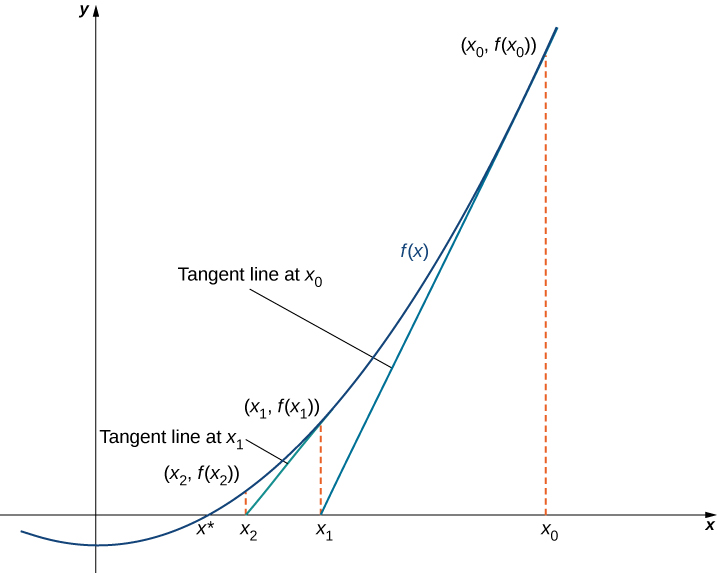
Figure \(\PageIndex{14}\): A graph illustrating the iterative process of Newton's method. From OpenStax Calculus Volume 1, licensed under CC-BY-NC-SA.
Now, let's calculate the approximations \(x_0,\, x_1,\, x_2,\, ….\). Suppose that \(x_0\) is our first approximation. Usually, this approximation is obtained by guessing, or from a sketch of the graph, or from a graphing device or app. Then, the approximation \(x_1\) is defined by letting \((x_1,0)\) be the \(x\)-intercept of the tangent line to \(f\) at \(x_0\). The equation of this tangent line is given by
\[y=f(x_0)+f′(x_0)(x−x_0). \nonumber \]
Therefore, \((x_1,0)\) is on the line and must satisfy
\[f(x_0)+f′(x_0)(x_1−x_0)=0.\nonumber \]
If \(f'(x_0)\neq\), we can solve this equation for \(x_1\), so
\[x_1=x_0−\frac{f(x_0)}{f'(x_0)}.\nonumber \]
Similarly, the point \((x_2,0)\) is the \(x\)-intercept of the tangent line to \(f\) at \(x_1\). Therefore, \(x_2\) satisfies the equation
\[x_2=x_1−\frac{f(x_1)}{f'(x_1)}.\nonumber \]
In general, for \(n>0,x_n\) satisfies
\[x_n=x_{n−1}−\frac{f(x_{n−1})}{f'(x_{n−1})}.\label{Newton} \]
Use Newton's Method to approximate a root of the equation \( 2x^3 + 3x + 1 = 0 \). Let \( x_0 = -1 \) be the initial approximation.
Use Newton's Method to find \( \sqrt[5]{2}\) corrected to six decimal places.
Use Newton's Method to find, correct to eight decimal places, a solution to the equation \( \sin x = x \). Let \( x_0 = 1 \) be the initial approximation.
This page titled 3.9: Newton's Method was last modified on Sun, 07 Dec 2025 01:10:58 GMT and is shared under a CC BY 4.0 license and was authored, remixed, and/or curated by Kevin Palencia.
The book could not be loaded just now.