Opening the book…
2.1 The Definition of the Derivative
- Given a curve and a specific point, calculate the slope of the tangent line using the limit of the difference quotient, with correct application of the formula.
- Identify and apply the derivative as the limit of a difference quotient to find instantaneous rates of change.
Tangent Lines
Let \( f(x) \) be a function defined on an open interval containing two distinct points \( a \) and \( x \), where \( x \neq a \). The secant line to the curve \( y = f(x) \) through the points \( P(a, f(a)) \) and \( Q(x, f(x)) \) is the line passing through both points with slope
\[
m_{\text{sec}} = \frac{f(x) - f(a)}{x - a}
\]
We can also write this slope as
\[
m_{\text{sec}} = \frac{f(a + h) - f(a)}{h},
\]
where \( h \neq 0 \) and \( x = a + h \).
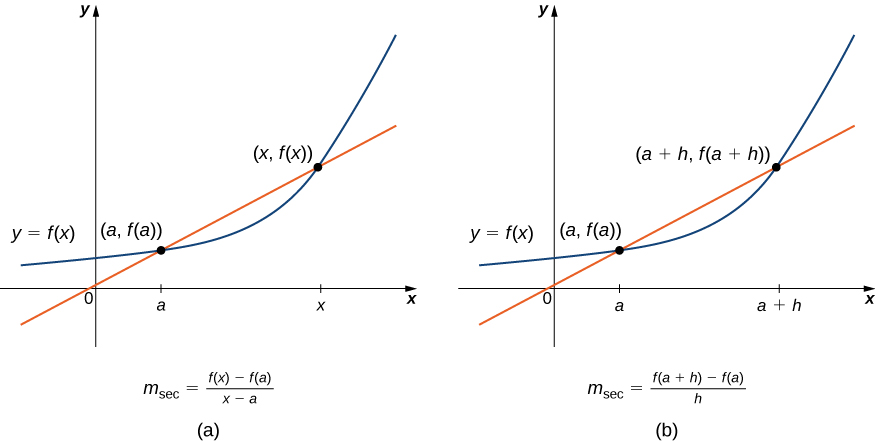
Figure \(\PageIndex{1}\): The slope of a secant line. From OpenStax Calculus Volume 1, licensed under CC-BY-NC-SA.
Find the equation of the secant line to the curve \( y = x^2 \) that passes through the points \( (3, 9) \) and \( (5, 25) \).
Let \( f(x) \) be a function defined on an open interval containing \( a \). The tangent line to the curve \( y = f(x) \) at the point \( P(a, f(a)) \) is the line passing through \( P \) with slope
\[
m_{\text{tan}} = \lim_{x \to a} \frac{f(x) - f(a)}{x - a}
\]
provided that the limit exists.
We can also express the above limit as
\[
m_{\text{tan}} = \lim_{h \to 0} \frac{f(a + h) - f(a)}{h},
\]
where \( h \neq 0 \) and \( x = a + h \).
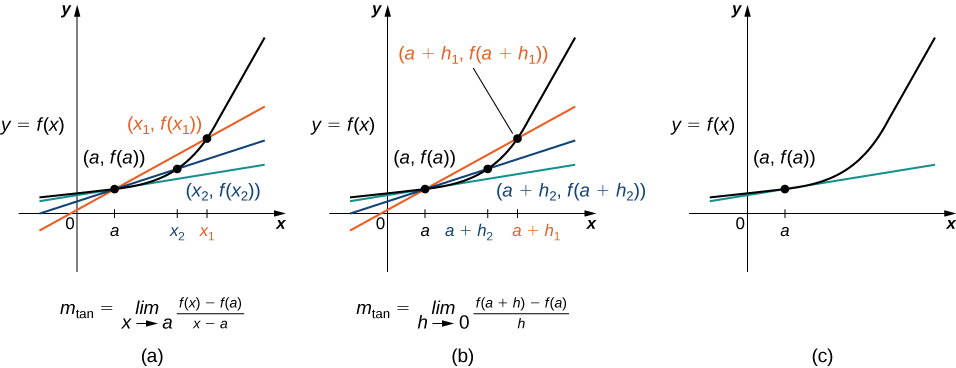
Figure \(\PageIndex{2}\): The slope of tangent line. From OpenStax Calculus Volume 1, licensed under CC-BY-NC-SA.
Find the equation of the tangent line to the curve \( f(x) = x^2 \) at \( x = 3 \).
The graph of \( f(x) \) is shown below. Estimate and list all values of \( x \) where \( f(x) \) appears to have a horizontal tangent line.

Figure \(\PageIndex{3}\): Graph of \(f(x) \)
The Derivative of a Function at a Point
Let \( f(x) \) be a function defined in an open interval containing \( a \). The derivative of the function \( f(x) \) at \( a \), denoted by \( f'(a) \), is defined by
\[
f'(a) = \lim_{x \to a} \frac{f(x) - f(a)}{x - a}
\]
provided that the limit exists.
We can also write the above limit as
\[
f'(a) = \lim_{h \to 0} \frac{f(a + h) - f(a)}{h},
\]
where \( h \neq 0 \) and \( x = a + h \).
Calculate the following derivatives using the definition of the derivative:
(a) \( f'(3) \), where \( f(x) = x^2 \)
(b) \( f'(2) \), where \( f(x) = 3x^2 - 4x + 1 \)
This page titled 2.1: The Definition of the Derivative was last modified on Sun, 07 Dec 2025 01:10:59 GMT and is shared under a CC BY 4.0 license and was authored, remixed, and/or curated by Kevin Palencia.
The book could not be loaded just now.