Opening the book…
- Explain how the factors of a quadratic expression relate to the zeros of the quadratic function
- Use various factoring techniques to change a quadratic expression from standard form to factored form
- Use factoring techniques to solve quadratic equations
We’ve seen how vertex form and intelligent use of the axis of symmetry can help draw an accurate graph of the quadratic function defined by the equation \(f(x) = ax^2 + bx + c \). When drawing the graph of the parabola, it is helpful to know where the graph crosses the \(x\)-axis. That is the primary goal of this section: to find the zero crossings or \(x\)-intercepts of the parabola.
Before we begin, you’ll need to review the techniques that will enable you to factor the quadratic expression \(ax^2 + bx + c\).
Factoring \(ax^2 + bx + c\) when \(a = 1\)
Our intent in this section is to provide a quick review of techniques used to factor quadratic trinomials. We begin by showing how to factor trinomials having the form \(ax^2 + bx + c\), where the leading coefficient is \(a = 1\); that is, trinomials having the form \(x^2+bx+c\). In the next section, we will address the technique used to factor \(ax^2+bx+c\) when \(a \neq 1\).
Let’s begin with an example.
Factor \(x^{2}+16 x-36\)
Solution
Note that the leading coefficient, the coefficient of \(x^2\), is \(a=1\). This is an important observation because the technique presented here will not work when the leading coefficient does not equal 1.
Note the constant term of the trinomial \(x^2 + 16x - 36\) is -36. List all integer pairs whose product equals -36.
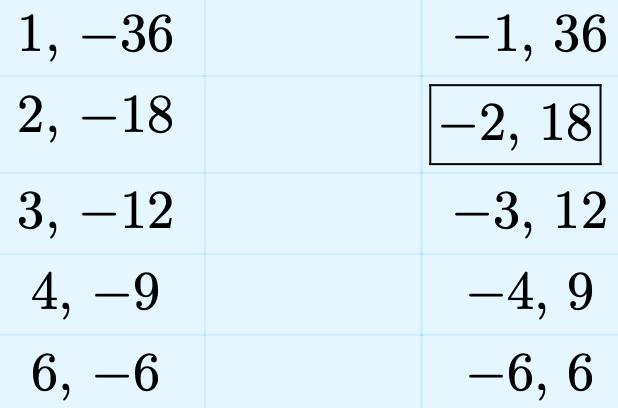
Note that we’ve framed the pair -2, 18. We’ve done this because the sum of this pair of integers equals the coefficient of \(x\) in the trinomial expression \(x^2 + 16x - 36\). Use this framed pair to factor the trinomial.
\[x^{2}+16 x-36=(x-2)(x+18) \nonumber \]
It is important that you check your result. Use the distributive property to multiply.
\[\begin{aligned}(x-2)(x+18) &=x(x+18)-2(x+18) \\ &=x^{2}+18 x-2 x-36 \\ &=x^{2}+16 x-36 \end{aligned} \nonumber \]
Thus, our factorization is correct.
Let’s summarize the technique.
To factor the quadratic \(x^2 + bx + c\), proceed as follows:
- List all the integer pairs whose product equals \(c\).
- Circle or frame the pair whose sum equals the coefficient of \(x\), namely \(b\). Use this pair to factor the trinomial.
Let’s look at another example.
Factor the trinomial \(x^{2}-25 x-84\)
Solution
List all the integer pairs whose product is -84.
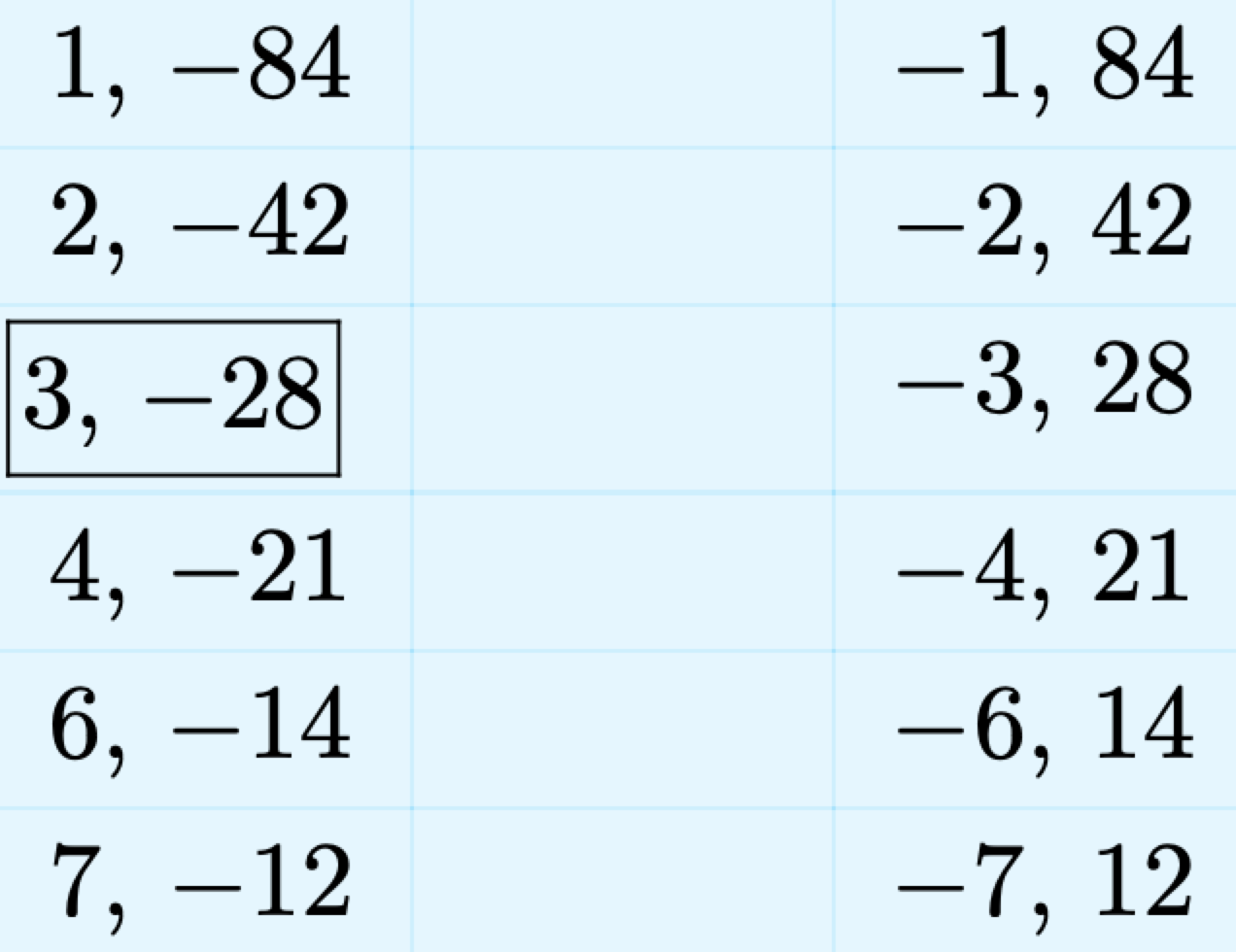
We’ve framed the pair whose sum equals the coefficient of \(x\), namely -25. Use this pair to factor the trinomial.
\[x^{2}-25 x-84=(x+3)(x-28) \nonumber \]
Check
\[\begin{aligned}(x+3)(x-28) &=x(x-28)+3(x-28) \\ &=x^{2}-28 x+3 x-84 \\ &=x^{2}-25 x-84 \end{aligned} \nonumber \]
Thus, our factorization is correct.
With experience, several ideas can accelerate the process.
- As you list the integer pairs, if you happen to note that the current pair has the appropriate sum, there is no need to list the remaining integer pairs. Simply halt the process of listing the integer pairs and use the current pair to factor the trinomial.
- Some students are perfectly happy being asked, “Can you think of an integer pair whose product is \(c\) and whose sum is \(b\) (where \(b\) and \(c\) refer to the coefficients of \(x^2 +bx+c\))?” If you can pick the pair “out of the air” like this, all is well and good. Use the integer pair to factor the trinomial, and don’t bother listing any integer pairs.
Now, let’s investigate how to proceed when the leading coefficient is not 1.
Factoring \(a x^{2}+b x+c\) when \(a \neq 1\)
When \(a \neq 1\), we use a technique called the \(a\cdot c\)-test to factor the trinomial \(ax^2 + bx + c\). The process is best explained with an example.
Factor \(2x^2 + 13x - 24\).
Solution
Note that the leading coefficient does not equal 1. Indeed, the coefficient of \(x^2\) in this example is \(a=2\). Therefore, the technique of the previous examples will not work. Thus, we turn to a similar technique called the \(ac\)-test.
First, compare \[2 x^{2}+13 x-24 \qquad \text { and } \qquad a x^{2}+b x+c \nonumber \]
and note that \(a = 2\), \(b = 13\), and \(c = -24\). Compute the product of \(a\) and \(c\). This is how the technique earns its name, “\(ac\)-test.”
\[a c=(2)(-24)=-48 \nonumber \]
List all integer pairs whose product is \(ac\) = -48.
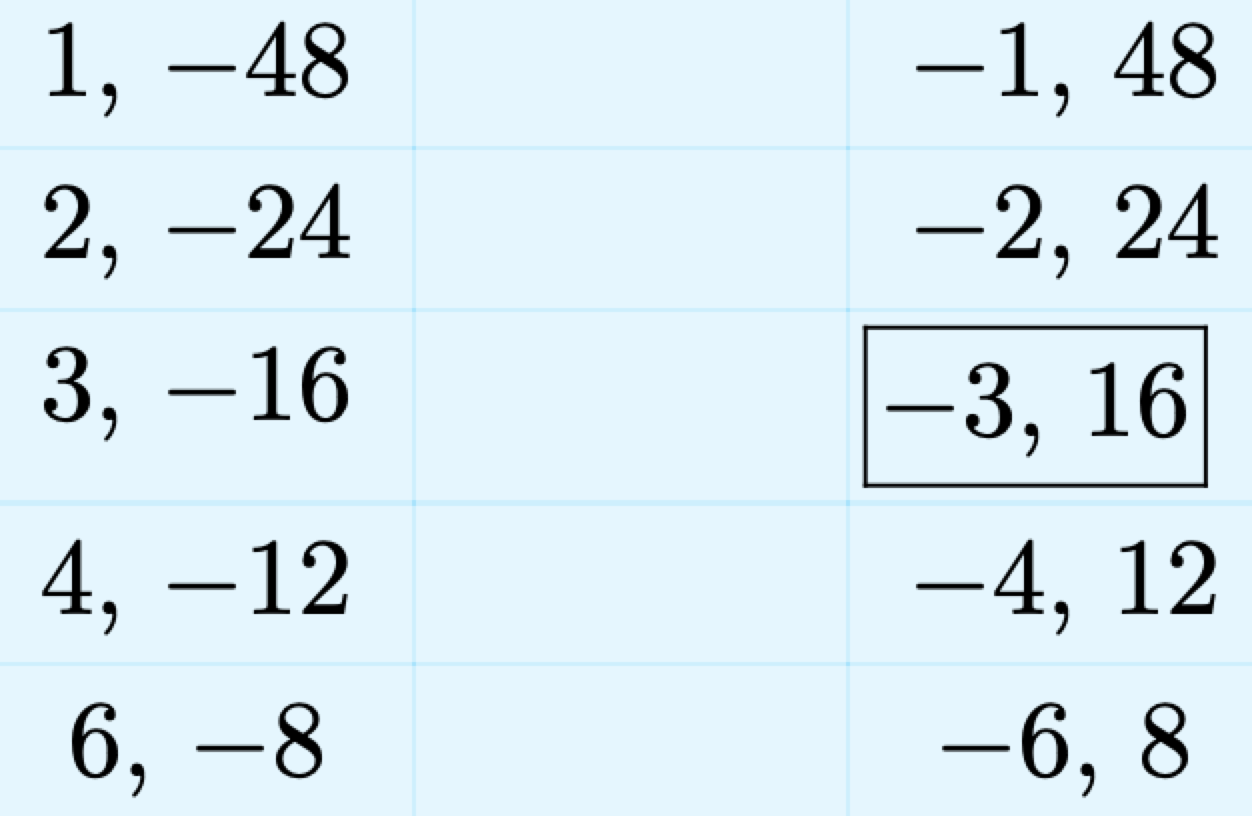
We’ve framed the pair whose sum is \(b = 13\). The next step is to rewrite the trinomial \(2x^2 + 13x - 24\), splitting the middle term into a sum, using our framed integer pair.
\[2 x^{2}+13 x-24=2 x^{2}-3 x+16 x-24 \nonumber \]
We factor an \(x\) out of the first two terms, then an 8 out of the last two terms. This process is called factoring by grouping.
\[2 x^{2}-3 x+16 x-24=x(2 x-3)+8(2 x-3) \nonumber \]
We now factor out a common factor of \(2x - 3\).
\[x(2 x-3)+8(2 x-3)=(x+8)(2 x-3) \nonumber \]
It’s helpful to see the complete process as a coherent unit.
\[\begin{aligned} 2 x^{2}+13 x-24 &=2 x^{2}-3 x+16 x-24 \\ &=x(2 x-3)+8(2 x-3) \\ &=(x+8)(2 x-3) \end{aligned} \nonumber \]
Check
Again, it is essential to verify the answer through multiplication.
\[\begin{aligned}(x+8)(2 x-3) &=x(2 x-3)+8(2 x-3) \\ &=2 x^{2}-3 x+16 x-24 \\ &=2 x^{2}+13 x-24 \end{aligned} \nonumber \]
Because this is the original trinomial, our solution checks.
Let’s summarize this process.
To factor the quadratic \(ax^2 + bx + c\), proceed as follows:
- List all integer pairs whose product equals \(ac\).
- Circle or frame the pair whose sum equals the coefficient of \(x\), namely \(b\).
- Use the circled pair to express the middle term \(bx\) as a sum.
- Factor by “grouping.”
Let’s look at another example.
Factor \(3 x^{2}+34 x-24\)
Solution
Compare
\[3 x^{2}+34 x-24 \quad \text { and } \quad a x^{2}+b x+c \nonumber \]
and note that \(a = 3\), \(b = 34\) and \(c = -24\). List all integer pairs whose product equals \(ac\) = (3)(-24) = -72.
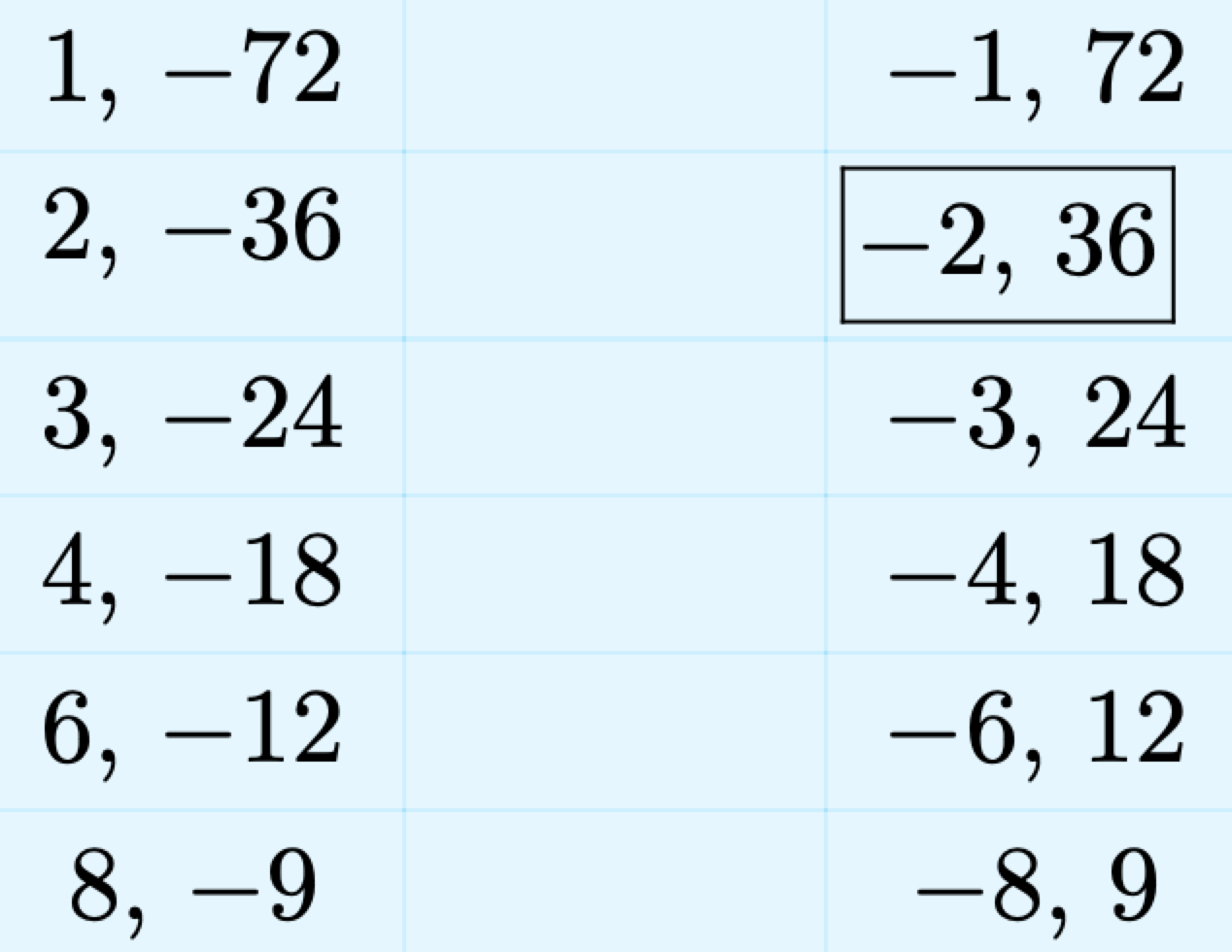
We’ve framed the pair whose sum is the same as \(b = 34\), the coefficient of \(x\) in \(3x^2 + 34x - 24\). Again, shortcuts are possible. If you can “think” of a pair whose product is \(a\cdot c\) = -72 and whose sum is \(b = 34\), then it is not necessary to list any integer pairs. Alternatively, if you come across the needed pair as you are listing them, then you can halt the process. There is no need to list the remaining pairs if you have the one you need.
Use the framed pair to express the middle term as a sum, then factor by grouping.
\[\begin{aligned} 3 x^{2}+34 x-24 &=3 x^{2}-2 x+36 x-24 \\ &=x(3 x-2)+12(3 x-2) \\ &=(x+12)(3 x-2) \end{aligned} \nonumber \]
We leave it to the reader to check this result.
Intercepts
The points where the graph of a function crosses the \(x\)-axis are called the \(x\)-intercepts of the graph of the function. Consider the graph of the quadratic function \(f\) in the figure below.
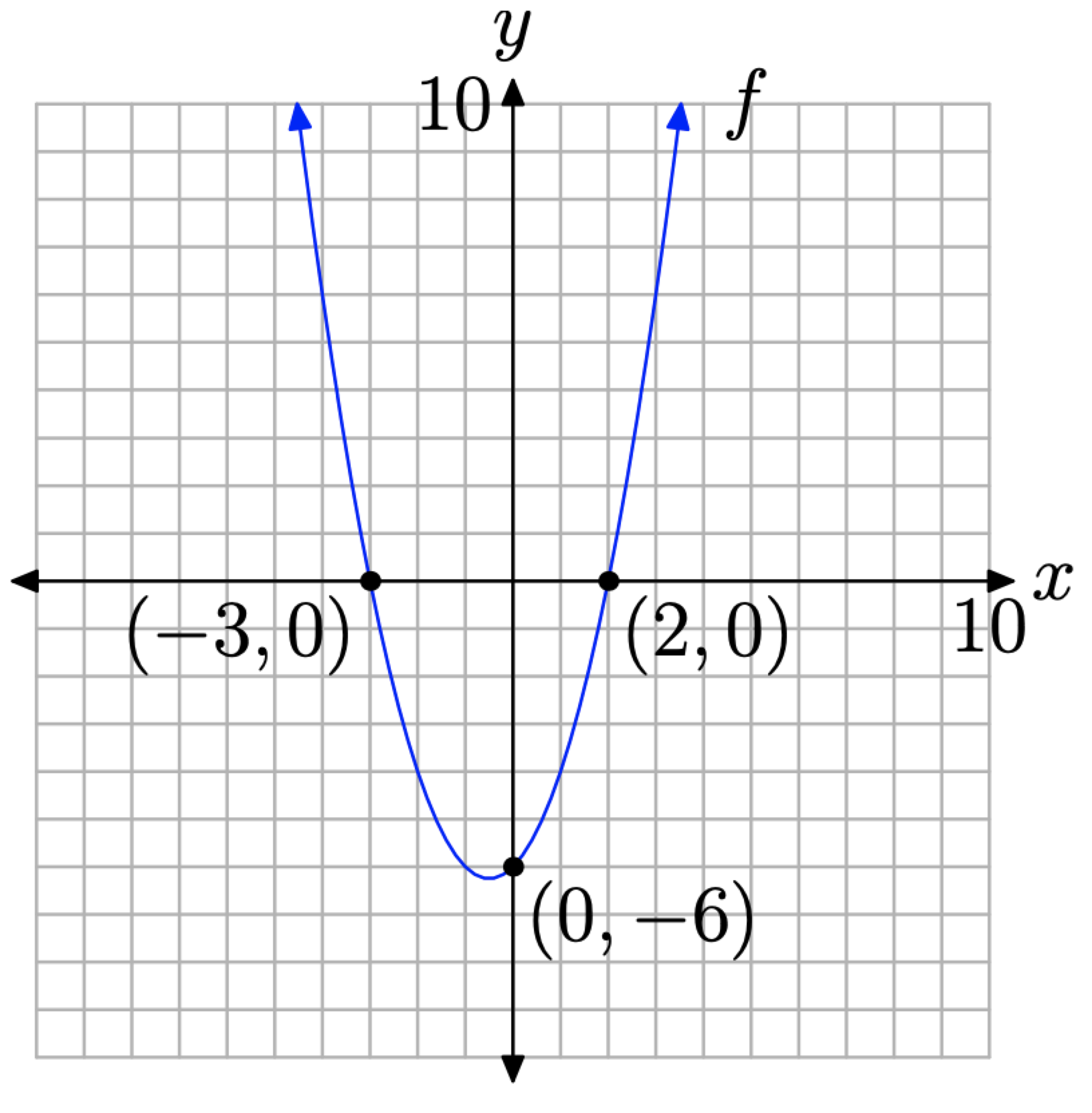
Note that the graph of \(f\) crosses the \(x\)-axis at (-3, 0) and (2, 0). These are the \(x\)-intercepts of the parabola. Note that the \(y\)-coordinate of each \(x\)-intercept is zero.
In function notation, the solutions of \(f(x) = 0\) (note the similarity to y = 0) are the \(x\)-coordinates of the points where the graph of\(f\) crosses the \(x\)-axis. Analyzing the graph of \(f\), we see that both -3 and 2 are solutions of \(f(x) = 0\).
Thus, the process for finding the \(x\)-intercepts is straightforward.
To find the \(x\)-intercepts of the graph of any function, set \(y = 0\) and solve for \(x\). Alternatively, if function notation is used, set \(f(x) = 0\) and solve for \(x\).
Let’s look at an example.
Find the \(x\)-intercepts of the graph of the quadratic function defined by \(y = x^2 + 2x - 48\).
Solution
To find the \(x\)-intercepts, first set y = 0.
\[0=x^{2}+2 x-48 \nonumber \]
Next, factor the trinomial on the right. Note that the coefficient of \(x^2\) is 1. We need only think of two integers whose product equals the constant term -48 and whose sum equals the coefficient of x, namely 2. The numbers 8 and -6 come to mind, so the trinomial factors as follows (readers should check this result).
\[0=(x+8)(x-6) \nonumber \]
To complete the solution, we need to utilize a crucial property of the real numbers known as the zero product property.
In our case, we have \(0 = (x + 8)(x - 6)\). Therefore, it must be the case that either
\[x+8=0 \qquad \text { or } \qquad x-6=0 \nonumber \]
These equations can be solved independently to produce
\[x=-8 \quad \text { or } \quad x=6 \nonumber \]
Thus, the \(x\)-intercepts of the graph of \(y = x^2 + 2x-48\) are located at (-8, 0) and (6, 0).
If \(a\) and \(b\) are any real numbers such that \(a\cdot b = 0\), then either \(a = 0\) or \(b = 0\).
Let’s look at another example.
Find the \(x\)-intercepts of the graph of the quadratic function \(f(x) = 2x^2 - 7x - 15\).
Solution
To find the \(x\)-intercepts of the graph of the quadratic function f, we begin by setting
\[f(x)=0\nonumber \]
Of course, \(f(x) = 2x^2 - 7x - 15\), so we can substitute to obtain
\[2 x^{2}-7 x-15=0 \nonumber \]
We will now use the \(a\cdot c\)-test to factor the trinomial on the left. Note that \(a\cdot c\) = (2)(-15) = -30. List the integer pairs whose products equal -30.
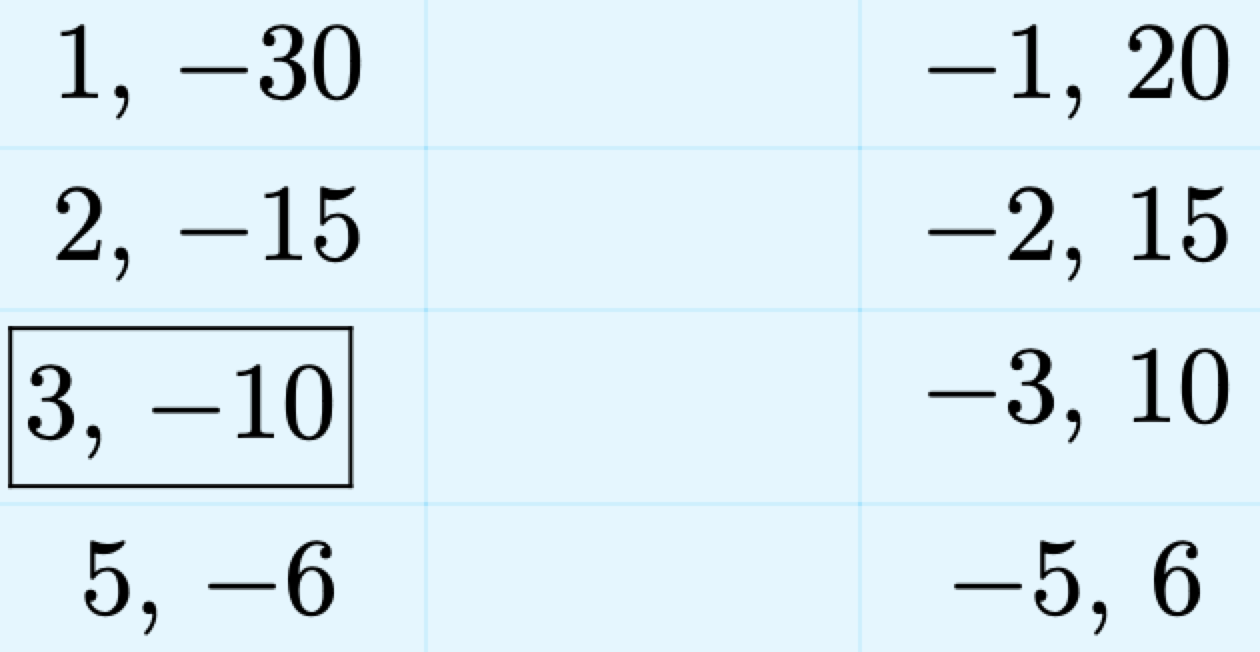
Note that the framed pair sums to the coefficient of \(x\) in \(2x^2 - 7x - 15\). Use the framed pair to express the middle term as a sum, then factor by grouping
\[\begin{aligned} 2 x^{2}-7 x-15 &=0 \\ 2 x^{2}+3 x-10 x-15 &=0 \\ x(2 x+3)-5(2 x+3) &=0 \\(x-5)(2 x+3) &=0 \end{aligned} \nonumber \]
Now we can use the zero product property. Either
\[x-5=0 \qquad \text { or } \qquad 2 x+3=0 \nonumber \]
Each of these can be solved independently to obtain
\[x=5 \qquad \text { or } \qquad x=-3 / 2 \nonumber \]
Thus, the \(x\)-intercepts of the graph of the quadratic function \(f(x) = 2x^2 - 7x - 15\) are located at (-3/2, 0) and (5, 0).
One more definition is in order.
The solutions of \(f(x) = 0\) are called the zeros of the function \(f\).
Thus, in the last example, both -3/2 and 5 are zeros of the quadratic function \(f(x) = 2x^2-7x-15\). Note the intimate relationship between the zeros of the quadratic function and the \(x\)-intercepts of the graph. Note that -3/2 is a zero and (-3/2, 0) is an \(x\)-intercept. Similarly, 5 is a zero and (5, 0) is an \(x\)-intercept.
To find the \(y\)-intercepts of the graph of any function, set \(x = 0\) and solve for \(y\). Alternatively, if function notation is used, evaluate \(f(0)\).
Find the \(y\)-intercept of the quadratic function defined by \(f(x) = x^2 - 3x - 11\).
Solution
Evaluate the function at \(x = 0\).
\[f(0)=(0)^{2}-3(0)-11=-11 \nonumber \]
The coordinates of the \(y\)-intercept are (0, -11).
Putting it All Together
We will find both \(x\)- and \(y\)-intercepts extremely useful when graphing a quadratic function.
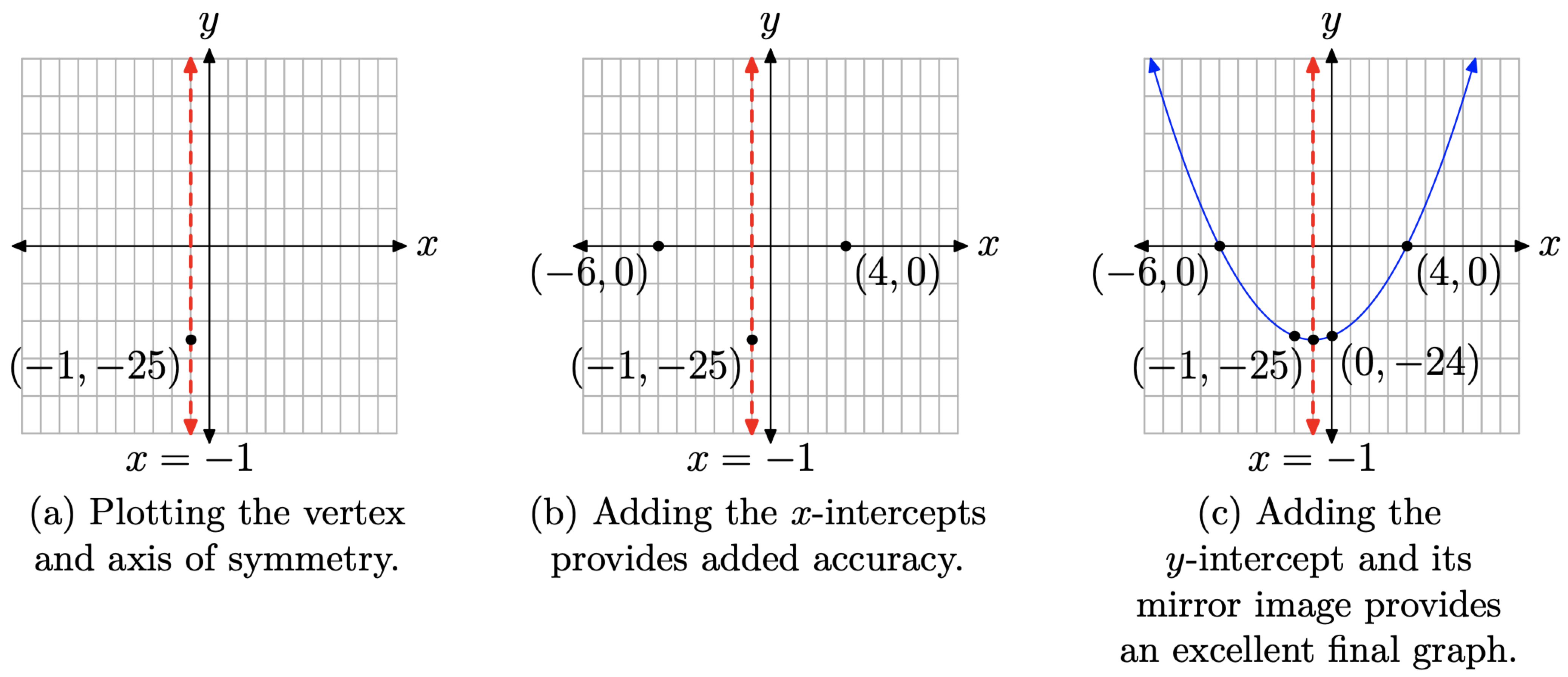
Place the quadratic function \(y = x^2 + 2x - 24\) in vertex form. Plot the vertex and axis of symmetry and label them with their coordinates and equation, respectively. Find and plot the \(x\)- and \(y\)-intercepts of the parabola and label them with their coordinates.
Solution
Take half of the coefficient of x, square it, then add and subtract this amount to balance the equation. Factor and combine coefficients.
\[\begin{array}{l}{y=x^{2}+2 x+1-1-24} \\ {y=(x+1)^{2}-25}\end{array} \nonumber \]
The graph is a parabola that opens upward; it is shifted 1 unit to the left and 25 units downward. This information is enough to plot and label the vertex, then plot and label the axis of symmetry.
To find the \(x\)-intercepts, let y = 0 in \(y = x^2 + 2x - 24\).
\[0=x^{2}+2 x-24 \nonumber \]
The leading coefficient is \(a=1\). The integer pair -4 and 6 has a product of -24 and a sum of 2. Thus, the right-hand side factors as follows.
\[0=(x+6)(x-4) \nonumber \]
In order that this product equals zero, either
\[x+6=0 \qquad \text { or } \qquad x-4=0 \nonumber \]
Solve each of these linear equations independently.
\[x=-6 \qquad \text { or } \qquad x=4 \nonumber \]
Recall that we let \(y = 0\). We’ve found two solutions, \(x = -6\) and \(x = 4\). Thus, we have \(x\)-intercepts at (-6, 0) and (4, 0).
Finally, to find the \(y\)-intercept, let \(x = 0\) in \(y = x^2+2x-24\). With this substitution, \(y = -24\). Thus, the \(y\)-intercept is (0, -24). Note that we’ve also included the mirror image of the \(y\)-intercept across the axis of symmetry.
Let’s look at one more example.
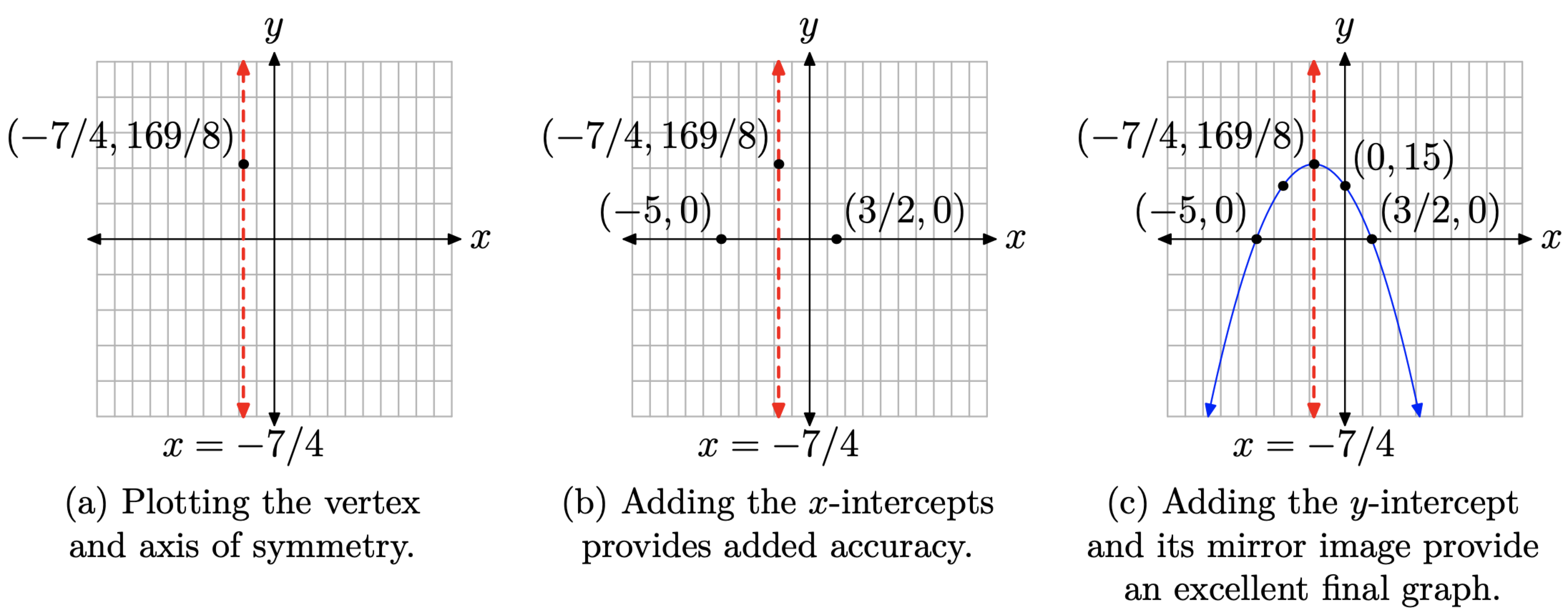
Plot the parabola represented by the equation \(f(x) = -2x^2-7x+15\). Plot and label the vertex, axis of symmetry, and the \(x\)- and \(y\)-intercepts.
Solution
First, factor out a -2.
\[f(x)=-2\left[x^{2}+\frac{7}{2} x-\frac{15}{2}\right] \nonumber \]
Half of 7/2 is 7/4. Squared, this amounts to 49/16. Add and subtract this last amount to keep the equation balanced.
\[f(x)=-2\left[x^{2}+\frac{7}{2} x+\frac{49}{16}-\frac{49}{16}-\frac{15}{2}\right] \nonumber \]
The first three terms inside the parentheses form a perfect square trinomial. The last two constants are combined with a common denominator.
\[\begin{array}{l}{f(x)=-2\left[\left(x^{2}+\frac{7}{2} x+\frac{49}{16}\right)-\frac{49}{16}-\frac{120}{16}\right]} \\ {f(x)=-2\left[\left(x+\frac{7}{4}\right)^{2}-\frac{169}{16}\right]}\end{array} \nonumber \]
Finally, redistribute the -2.
\[f(x)=-2\left(x+\frac{7}{4}\right)^{2}+\frac{169}{8} \nonumber \]
The graph of this last equation is a parabola that opens downward, translated 7/4 units to the left and 169/8 units upward. This is enough information to plot and label the vertex and axis of symmetry.
To find the \(y\)-intercepts, set \(f(x) = 0\) in \(f(x) = -2x^2 - 7x + 15\). We will also multiply both sides of the resulting equation by -1.
\[\begin{array}{l}{0=-2 x^{2}-7 x+15} \\ {0=2 x^{2}+7 x-15}\end{array} \nonumber \]
After comparing \(2x^2 + 7x - 15\) with \(ax^2 + bx + c\), we note that the integer pair -3 and 10 have product equal to \(a\cdot c\) = -30 and sum equal to \(b = 7\). Use this pair to express the middle term of \(2x^2 + 7x - 15\) as a sum and then factor by grouping.
\[\begin{array}{l}{0=2 x^{2}-3 x+10 x-15} \\ {0=x(2 x-3)+5(2 x-3)} \\ {0=(x+5)(2 x-3)}\end{array} \nonumber \]
By the zero product property, either \[x+5=0 \qquad \text { or } \qquad 2 x-3=0 \nonumber \]
Solve these linear equations independently. \[x=-5 \qquad \text { or } \qquad x=\frac{3}{2} \nonumber \]
These \(x\)-values are the zeros of \(f\) (they make \(f(x) = 0\)), so we have \(x\)-intercepts at (-5, 0) and (3/2, 0).
Finally, to find the \(y\)-intercept, set \(x = 0\) in \(f(x) = -2x^2 - 7x + 15\) to get f(0) = 15. Note the positioning of the \(y\)-intercept (0, 15) and its mirror image across the axis of symmetry.
Solving Quadratic Inequalities by Graphing
We can recall an earlier section where we obtained solutions for linear inequalities, which are intervals of numbers. With quadratic inequalities, the process is similar to that of linear inequalities, but now, instead of lines, we have parabolas.
We can use the zeros (or roots) of a graph of a quadratic equation to solve for quadratic inequalities. Recall, the zeros (or roots) of a graph are the \(x\)-intercepts, i.e., \(y = 0\).
Solve \(x^2 - 3x - 4\geq 0\) by using the graphing method.
Solution
We first begin by graphing \(x^2 - 3x - 4\) as we would in the previous section. Recall, the \(x\)-coordinate of the vertex is \(-\dfrac{b}{2a}\). Hence,
\[-\dfrac{b}{2a}=-\dfrac{-3}{2(1)}=\dfrac{3}{2}=1.5\nonumber\]
The \(y\)-coordinate of the vertex is \(x^2 - 3x - 4\) evaluated for \(x = 1.5\):
\[(1.5)^2-3(1.5)-4=-6.25\nonumber\]
The vertex is at \((1.5, -6.25)\). The \(y\)-intercept is when \(x = 0\):
\[0^2-3(0)-4=-4\nonumber\]
and the \(x\)-intercepts are when \(x^2 - 3x - 4 = 0\). Solving for the roots we get
\[\begin{aligned}x^2-3x-4&=0 \\ (x-4)(x+1)&=0 \\ x-4=0\quad&\text{or}\quad x+1=0 \\ x=4\quad&\text{or}\quad x=-1\end{aligned}\]
Thus, the intercepts are \((0, -4),\: (4, 0),\) and \((-1, 0)\) with a vertex at \((1.5, -6.25)\). Now we draw the graph:

Given \(x^2 - 3x - 4\geq 0\) says we are specifically looking for the values of \(x^2 - 3x - 4\) that are greater than or equal to zero. In other words, we are looking for all \(y\)-values that are above the \(x\)-axis because that is where all the \(y\)-values are positive. Looking at the graph above, these are all the values on the blue parts of the graph. Thus, using the graphing method, the solution is \((-∞, -1] ∪ [4, ∞)\). Note, we use brackets since it is \(\geq\).
Notice, we ignore the red part of the parabola since this is where \(x^2 - 3x - 4\) is negative, i.e., all the \(y\)-values are negative, because we were only looking for when \(x^2 - 3x - 4\geq 0\), the parts of the graph above the \(x\)-axis.
This page titled 2.6: Zeros of the Quadratic was last modified on Fri, 29 Aug 2025 03:30:36 GMT and is shared under a CC BY-NC 4.0 license and was authored, remixed, and/or curated by Math Department via source content that was edited to the style and standards of the LibreTexts platform.
The book could not be loaded just now.