Opening the book…
- Simplify a rational equation by clearing fractions
- Determine excluded values of a rational equation
- Solve a rational equation algebraically and verify if the solution is valid
- Solve a rational inequality by using a graph or a number line
In this section, we'll look at some strategies for solving equations involving fractions or rational terms.
If your equation has rational expressions, multiply both sides of the equation by the least common denominator to clear the equation of rational expressions.
Let’s look at an example.
Solve \(\dfrac{x}{2}-\dfrac{2}{3}=\dfrac{3}{4}\) for \(x\).
Solution
To clear this equation of fractions, we will multiply both sides by LCM\((2, 3, 4)\), which is 12, distribute 12, then cancel and solve.
\[\begin{aligned} \frac{x}{2}-\frac{2}{3} &=\frac{3}{4}\\12\left(\frac{x}{2}-\frac{2}{3}\right) &=\left(\frac{3}{4}\right) 12 \\ 12\left(\frac{x}{2}\right)-12\left(\frac{2}{3}\right) &=\left(\frac{3}{4}\right) 12 \\ 6 x-8 &=9\\6 x &=17 \\ x &=\frac{17}{6} \end{aligned} \nonumber \]
We’ll leave it to our readers to check this solution.
Let’s try another example.
Solve \(6=\dfrac{5}{x}+\dfrac{6}{x^{2}} \) for \(x\).
Solution
In this equation, the denominators are 1, x, and \(x^2\), and the common denominator for both sides of the equation is \(x^2\). Consequently, we begin the solution by first multiplying both sides of the equation by \(x^2\) and note the restriction \(x\neq 0\) to check our later solutions against.
\[
\begin{aligned}
6 &= \frac{5}{x} + \frac{6}{x^{2}} \\
x^{2}(6) &= \left(\frac{5}{x} + \frac{6}{x^{2}}\right)x^{2} \\
x^{2}(6) &= \left(\frac{5}{x}\right)x^{2} + \left(\frac{6}{x^{2}}\right)x^{2} \\
6x^{2} &= 5x + 6 \\
6x^{2} - 5x - 6 &= 0 \\
6x^{2} + 4x - 9x - 6 &= 0 \\
2x(3x + 2) - 3(3x + 2) &= 0 \\
(2x - 3)(3x + 2) &= 0
\end{aligned}
\nonumber\]
The zero product property forces either
\[2 x-3=0 \quad \text { or } \quad 3 x+2=0 \nonumber \]
Each of these linear equations is easily solved.
\[x=\frac{3}{2} \quad \text { or } \quad x=-\frac{2}{3} \nonumber \]
Let’s look at another example.
Solve \(\dfrac{5x+5}{x+2}+3x=\dfrac{x^2}{x+2}\) for \(x\).
Solution
The denominators in this equation are \(x+2\) and \(1\), so the common denominator is \(x+2\). Consequently, we begin the solution by multiplying both sides of the equation by \(x+2\) and note the restriction \(x \neq -2\) to check our later solutions against.
\[
\begin{aligned}
\frac{5x+5}{x+2} + 3x
&= \frac{x^2}{x+2} \\[6pt]
(x+2)\left(\frac{5x+5}{x+2} + 3x\right)
&= (x+2)\left(\frac{x^2}{x+2}\right) \\[6pt]
\frac{(x+2)(5x+5)}{x+2} \;+\; 3x(x+2)
&= \frac{(x+2)x^2}{x+2} \\[6pt]
5x+5 \;+\; 3x(x+2)
&= x^2 \\[6pt]
5x+5 \;+\; 3x^2 + 6x
&= x^2 \\[6pt]
3x^2 + 11x + 5
&= x^2 \\[6pt]
3x^2 + 11x + 5 - x^2
&= 0 \\[6pt]
2x^2 + 11x + 5
&= 0
\end{aligned}
\]
Now we factor the quadratic:
\[
\begin{aligned}
2x^2 + 11x + 5 &= 0 \\
2x^2 + x + 10x + 5 &= 0 \\
(2x^2 + x) + (10x + 5) &= 0 \\
x(2x+1) + 5(2x+1) &= 0 \\
(2x+1)(x+5) &= 0
\end{aligned}
\nonumber \]
The zero product property forces either
\[
2x+1=0 \quad \text{or} \quad x+5=0
\nonumber \]
Each of these linear equations is easily solved.
\[
x=-\tfrac{1}{2} \quad \text{or} \quad x=-5
\nonumber \]
Since neither solution violates the restriction \(x \neq -2\), both solutions are valid.
\[
\text{Final Answer: } x = -\tfrac{1}{2}, \; -5
\nonumber \]
Let’s look at another example.
Solve \(\dfrac{2}{x^{2}}=1-\dfrac{2}{x}\) for \(x\).
Solution
The denominators in this equation are \(x^2\), \(x\), and \(1\), so the common denominator is \(x^2\). Consequently, we begin the solution by multiplying both sides of the equation by \(x^2\) and note the restriction \(x \neq 0\) to check our later solutions against.
\[
\begin{aligned}
\frac{2}{x^{2}}
&= 1 - \frac{2}{x} \\[6pt]
x^{2}\left(\frac{2}{x^{2}}\right)
&= x^{2}(1) \;-\; x^{2}\left(\frac{2}{x}\right) \\[6pt]
\frac{2x^{2}}{x^{2}}
&= x^{2} - \frac{2x^{2}}{x} \\[6pt]
2
&= x^{2} - 2x \\[6pt]
0
&= x^{2} - 2x - 2
\end{aligned}
\]
We now solve the quadratic equation:
\[
x^{2} - 2x - 2 = 0
\nonumber\]
Using the quadratic formula:
\[
\begin{aligned}
x &= \frac{-(-2) \pm \sqrt{(-2)^{2} - 4(1)(-2)}}{2(1)} \\[6pt]
&= \frac{2 \pm \sqrt{4 + 8}}{2} \\[6pt]
&= \frac{2 \pm \sqrt{12}}{2} \\[6pt]
&= \frac{2 \pm 2\sqrt{3}}{2} \\[6pt]
&= 1 \pm \sqrt{3}
\end{aligned}
\nonumber\]
Since neither solution violates the restriction \(x \neq 0\), both are valid.
\[
\text{Final Answer: } x = 1 + \sqrt{3}, \; 1 - \sqrt{3}
\nonumber\]
Let’s look at another example.
Solve \(\dfrac{1}{x+2}-\dfrac{x}{2-x}=\dfrac{x+6}{x^{2}-4}\) for \(x\)
Solution
First note the restrictions from the denominators: \(x\neq -2,\,2\).
Factor the denominators: \(x^{2}-4=(x-2)(x+2)\) and \(2-x=-(x-2)\).
Now multiply the entire equation by the common denominator \((x-2)(x+2)\):
\[
\begin{aligned}
\left(\frac{1}{x+2}-\frac{x}{2-x}\right)
&= \left(\frac{x+6}{(x-2)(x+2)}\right) \\[6pt]
(x-2)(x+2)\left(\frac{1}{x+2}+\frac{x}{x-2}\right)
&= (x-2)(x+2)\left(\frac{x+6}{(x-2)(x+2)}\right) \\[6pt]
\left(\frac{(x-2)(x+2)}{x+2}+\frac{x(x-2)(x+2)}{x-2}\right)
&= \left(\frac{(x-2)(x+2)(x+6)}{(x-2)(x+2)}\right) \\[6pt]
(x-2) + x(x+2)
&= x+6 \\[6pt]
x-2 + x(x+2)
&= x+6 \\[6pt]
x^{2}+3x-2
&= x+6 \\[6pt]
x^{2}+2x-8
&= 0 \\[6pt]
(x+4)(x-2)
&= 0
\end{aligned}
\]
Thus \(x+4=0\) or \(x-2=0\), so \(x=-4\) or \(x=2\).
Checking the restrictions \(x\neq -2,\,2\), we must discard \(x=2\).
\[
\text{Final Answer: } x=-4
\nonumber\]
Rational Inequalities
In earlier chapters, we discussed many types of inequalities, and a key aspect of inequalities is that we know the solutions are always intervals of numbers. Hence, we now discuss rational inequalities where the solutions are intervals, but we take one critical detail into account. Since rational inequalities and equations contain excluded values, we must consider this when obtaining the solution. In fact, we use the excluded values and \(x\)-intercepts, if any, to determine the intervals that make the inequality true. Again, with inequalities, we are trying to find intervals of numbers in which the statement is true.
Step 1. Rewrite the inequality so that only zero is on the right side.
Step 2. Determine where the rational expression is undefined or equals zero.
Step 3. Graph the values found in Step 2. on a number line split into intervals.
Step 4. Take a test point within each interval and determine the sign of the result.
Step 5. Determine the solution, where the solution is the interval in which makes the inequality true.
Be careful when determining the intervals. Recall, where the expression is undefined is not included in the interval, i.e., always use parenthesis for the values in which the expression is undefined.
Solve \(\dfrac{x-3}{x+1}>0\).
Solution
Step 1. Rewrite the inequality so that only zero is on the right side.
Since \(\dfrac{x-3}{x+1}>0\) already has zero on the right side, this step is done.
Step 2. Determine where the rational expression is undefined or equals zero.
To obtain where the rational expression equals zero, we set the numerator equal to zero: \[\begin{aligned} x − 3 &= 0\\ x &= 3\end{aligned}\] To obtain where the expression is undefined, we find its excluded value(s) by setting the denominator equal to zero: \[\begin{aligned}x + 1 &= 0\\ x &= −1\end{aligned}\]
Step 3. Graph the values found in Step 2 on a number line, and split into intervals.
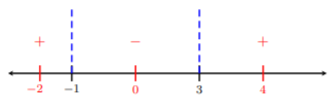
Label \(-1\) and \(3\) on a blank real number line:

Step 4. Take a test point within each interval and determine the sign of the result.
We take test values on each side of \(−1\) and \(3\). Let’s choose relatively easy numbers such as \(−2,\: 0,\) and \(4\). We evaluate the right-hand side at each of these numbers:
\[
\begin{array}{c|c|c}
x & \dfrac{x-3}{x+1} & \text{Sign} \\ \hline
-2 & 5 & + \\
0 & -3 & - \\
4 & \tfrac{1}{5} & +
\end{array}
\nonumber\]
Step 5. Determine the solution, where the solution is the interval that makes the inequality true.
Since \(\dfrac{x − 3}{x + 1} > 0\) (from Step 1.), then we are looking for where the test values are positive. Looking at the number line above, we see these are the values to the left of \(−1\) and to the right of \(3\). Thus, the solution is \((−∞, −1) ∪ (3, ∞)\).
We always use a parenthesis for the value that is excluded since this value makes the rational expression undefined. Using a bracket or parenthesis for where the expression equals zero is determined by the original inequality sign, e.g., \(<, >\) use parenthesis, and \(≥, ≤\) use brackets.
Solve \(\dfrac{2x+3}{x-2}\leq 1\).
Solution
Step 1. Rewrite the inequality so that only zero is on the right side.
We rewrite \(\dfrac{2x+3}{x-2}\leq 1\) so that there is zero on the right side, and as one fraction: \[\dfrac{2x+3}{x-2}\leq 1\\ \dfrac{2x+3}{x-2}-1\leq 0\\ \dfrac{2x+3}{x-2}-\dfrac{x-2}{x-2}\leq 0\\ \dfrac{2x+3-x+2}{x-2}\leq 0\\ \dfrac{x+5}{x-2}\leq 0\nonumber\]
Step 2. Determine where the rational expression is undefined or equals zero.
To obtain where the rational expression equals zero, we set the numerator equal to zero: \[\begin{aligned} x + 5 &= 0\\ x &= −5\end{aligned}\] To obtain the excluded values, we set the denominator equal to zero: \[\begin{aligned}x − 2 &= 0 \\x &= 2\end{aligned}\]
Step 3. Graph the values found in Step 2 on a number line, and split into intervals.
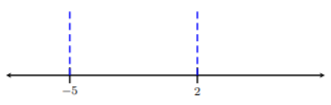
Label \(−5\) and \(2\) on a blank number line:
Step 4. Take a test point within each interval and determine the sign of the result.
We take test values on each side of \(−5\) and \(2\). Let’s choose fairly easy numbers such as \(−6,\: 0,\) and \(3\). We plug these numbers into \(\dfrac{x + 5}{x − 2}\) and determine whether the value is positive or negative:

\[
\begin{array}{c|c|c}
x & \dfrac{x+5}{x-2} & \text{Sign} \\ \hline
-6 & \tfrac{1}{8} & + \\
0 & -\tfrac{5}{2} & - \\
3 & 8 & +
\end{array}
\nonumber\]
Step 5. Determine the solution, where the solution is the interval that makes the inequality true.
Since \(\dfrac{x + 5}{x − 2} ≤ 0\) (from Step 1.), then we are looking for where the test values are negative or equal to zero. Looking at the number line above, we see these are the values between \(−5\) and \(2\). Thus, the solution is \([−5, 2)\).
We used a bracket on \(−5\) since the original inequality was \(≤\) and a parenthesis on \(2\) since \(2\) was an excluded value.
This page titled 3.5: Solving Rational Equations was last modified on Fri, 29 Aug 2025 03:30:37 GMT and is shared under a CC BY-NC 4.0 license and was authored, remixed, and/or curated by Math Department.
The book could not be loaded just now.