Opening the book…
Practice Makes Progress
Earl the squirrel has only ten more days until hibernation. He needs to save 50 more acorns. He is tired of collecting acorns and so he is only able to gather 8 acorns every 2 days.
a) Let \(t\) represent time in days (independent variable). Let \(N\) represent the number of acorns collected (dependent variable). Set up an appropriately scaled coordinate system on graph paper.
b) At time \(t = 0\), Earl has collected zero of the acorns he needs. To what point does this correspond? Plot this point.
c) After two days (\(t = 2\)), Earl has collected 8 acorns. Move 2 days to the right and 8 acorns up. Plot this point. What are its coordinates?
d) Continue plotting every 2 days, adding 8 acorns, until you reach 14 days.
e) Treating the situation as continuous, draw a line through your data points.
f) Use the graph to determine how many acorns Earl will have collected after 10 days. Will it be enough?
g) Convert the rate of 8 acorns every 2 days to a unit rate of acorns per day.
h) Fill in the missing entries in the table below.
| t | N |
|---|---|
| 0 | 0 |
| 1 | 0 + 4(1)=4 |
| 2 | |
| 3 | |
| 0 + 4(4)=16 | |
| 24 | |
| 8 | |
| 10 | |
| 12 | |
| 14 |
i) Write a linear equation that represents \(N\), the number of acorns collected after \(t\) days.
j) Use your equation to predict the number of acorns after 10 days. Does this agree with your graph in part (f)?
Set up a coordinate system on a sheet of graph paper, plotting the points \(P(-1, 3)\) and \(Q(5, -3)\) and drawing the line through them.
a) What can you say about the slope of the line?
b) Find the slope of the line.
c) Find the equation of this line.
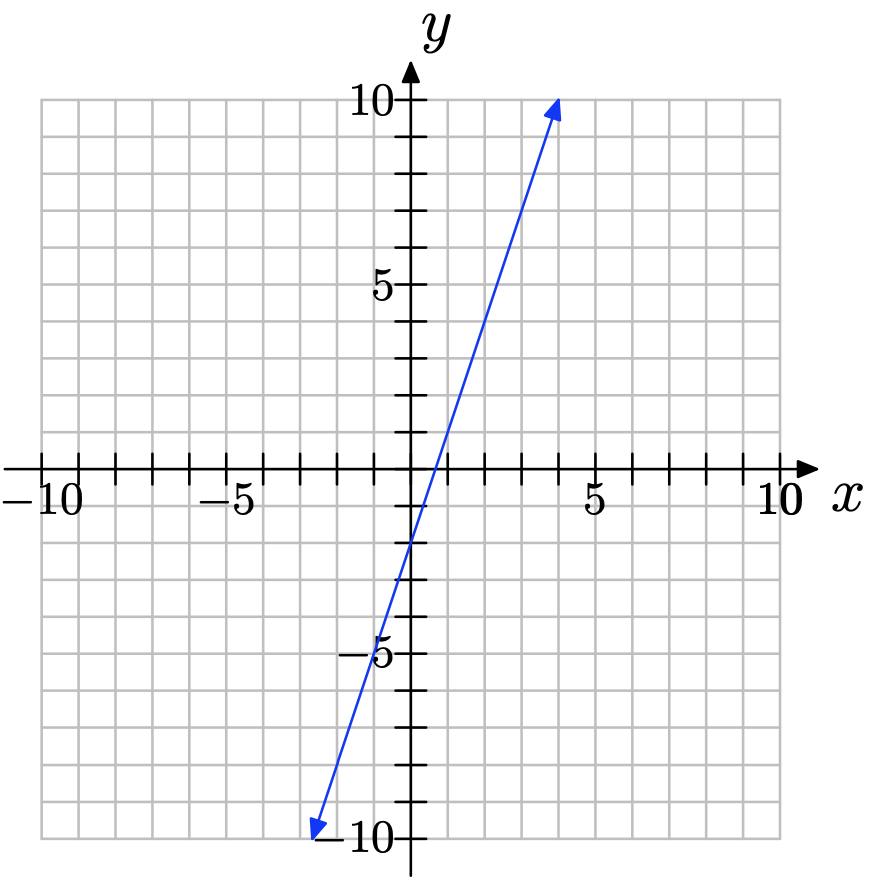
Find the equation of the line graphed below.
The following coordinate system shows the graphs of three lines. Match each slope:
slope \(= 1\)
slope \(= \frac{2}{3}\)
slope \(= -2\)

Draw a line through the point \(P(1, 3)\) that is parallel to the line through the origin and the point \((4,-1)\). Then find the equation of both lines.
Draw a coordinate system from \(-10\) to \(10\) on both axes.
a) Draw a line through \((-1, -2)\) with slope \(\frac{3}{4}\)
b) Draw another through \((0, 1)\) with slope \(\frac{4}{3}\)
c) Are they parallel, perpendicular, or neither?

When construction crews talk about the grade of a road, it is equivalent to slope but written as a percentage. For example a slope of 1/4 could be written as a grade of 25%.
a) Express 8% grade as slope
b) Hill drops 16 ft over 180 ft — what is the grade?
c) What does 0% grade mean?
In this section, you practiced:
- Finding the slope of a line through 2 points
- Finding the equation of a line through 2 points
- Finding the equation of a line given its slope and a point
- Finding the equation of a line given its graph
- Representing a linear relation numerically using a table
- Representing a linear relation graphically in a coordinate plane
- Representing a linear relation symbolically as a formula
- Using linear equations to model real-world scenarios
From the list of skills above:
- I can complete these independently without notes:
- I can complete these, but need to reference an example or other resource to help:
- I don’t understand these yet:
It’s okay to not be fully confident with every skill yet! But it’s essential to continue making progress. Identify at least one step you will take to improve your understanding of the topics you listed in parts 2 or 3 above:
- Visit the math lab
- Contact my instructor
- Re-work practice problems
- Ask a classmate or friend for help
This page titled 1.2P: Practice was last modified on Fri, 05 Dec 2025 20:04:05 GMT and is shared under a CC BY-NC 4.0 license and was authored, remixed, and/or curated by Math Department.
The book could not be loaded just now.