Opening the book…
Remember the Extreme Value Theorem: a continuous function on a closed interval must achieve its maximum and minimum values on that interval (either at its endpoints or at a critical point).
Lets find these extrema the function \(f(x)=x^3-3x\) on the interval \([-3,3]\):
We start by finding our critical points, so we differentiate: \(f'(x)=3x^2-3\)
Remember that critical points are where the derivative equals zero or doesnt exist. Since this \(f'\) is a polynomial, we know it always exists and therefore only need to look when \(f'(x)=0\):
\(3x^2-3=0 \longrightarrow x=\pm 1\)
Now to help us visualize the graph, we will make a sign chart for \(f'\) on \([-3,3]\):

We can clearly see that the only possible extreme values can occur at the following points:
\(f(-3)=(-3)^3-3\cdot (-3)=-18 \longrightarrow (-3,-18)\)
\(f(-1)=(-1)^3-3\cdot (-1)=2 \longrightarrow (-1,2)\)
\(f(1)=1^3-3\cdot 1=-2 \longrightarrow (1,-2)\)
\(f(3)=3^3-3\cdot 3=18 \longrightarrow (3,18)\)
Here is where we find our answers: maximum at \((3,18)\), minimum at \((-3,-18)\)
But at \(\textcolor{blue}{x=1}\) and \(\textcolor{green}{x=-1}\) this graph still acts like it has a minimum and maximum respectively:
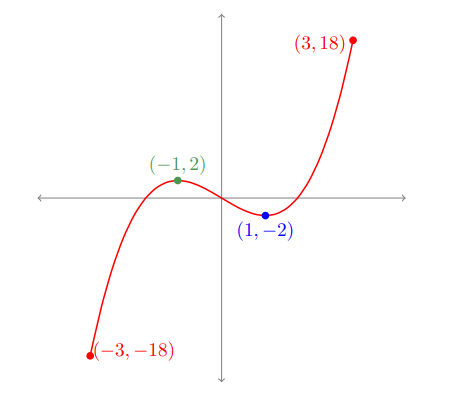
While not the largest or smallest overall value of \(f\), these points are the largest and smallest when compared to only nearby points. We call these local maximums and local minimums.
When on a closed interval, the sign chart is not necessary to solve for extrema, (but it can be helpful if it is hard to tell which is bigger between two points, and will be a skill we rely on in the near future so its good practice!)
Find the extrema for \(g(x)=(x-8)\sqrt[3]{x}\) on \([-1,8]\)
Solution
First we rewrite \(g(x)=x^{\frac{4}{3}}-8x^{\frac{1}{3}}\)
So \(\displaystyle{g'(x)=\frac{4}{3}x^{\frac{1}{3}}-\frac{8}{3}x^{-\frac{2}{3}}=\frac{4x-8}{3x^{\frac{2}{3}}}}\)
\(g'(x)=0\) occurs when \(4x-8=0 \longrightarrow x=2\)
\(g'(x)=DNE\) occurs when \(3x^{\frac{2}{3}}=0 \longrightarrow x=0\)
These critical points \(x=0,2\) and our endpoints \(x=-1,8\) are the only candidates for an extreme value of \(g(x)\) on this interval
\(g(-1)=(-1-8)\cdot \sqrt[3]{-1}=9\)
\(g(0)=(0-8)\cdot \sqrt[3]{0}=0\)
\(g(2)=(2-8)\cdot \sqrt[3]{2}=-6\sqrt[3]{2}\)
\(g(8)=(8-8)\cdot \sqrt[3]{8}=0\)
We clearly see our maximum at \((-1,9)\) and minimum at \((2,-6\sqrt[3]{2})\)
Here is the graph (which we will learn to sketch soon) of the function in the above example:

In some situations, you may be given a function without an interval.
This may be because there is a natural domain to consider, like for \(\textcolor{blue}{f(x)=x\sqrt{4-x^2}} \)
Clearly this function is only defined when \(4-x^2\ge 0\), which is \(x\in [-2,2]\)
Also \(\displaystyle{f'(x)=1\cdot (4-x^2)^{\frac{1}{2}}+x\cdot \frac{1}{2}(4-x^2)^{-\frac{1}{2}}\cdot (-2x)=\frac{4-2x^2}{\sqrt{4-x^2}}}\)
So \(f'(x)=0\) when \(4-x^2=0 \longrightarrow x=\pm \sqrt{2}\)
and \(f'(x)=DNE\) when \(\sqrt{4-x^2}=0 \longrightarrow x=\pm 2\)
Since our interval endpoints (\(x=\pm 2\)) are also critical points of \(f\), we see these four are our only possible locations for extrema.
\(f(-2)=-2\cdot \sqrt{4-(-2)^2}=0\)
\(f(-\sqrt{2})=-\sqrt{2}\cdot \sqrt{4-(-\sqrt{2})^2}=-2\)
\(f(\sqrt{2})=\sqrt{2}\cdot \sqrt{4-(\sqrt{2})^2}=2\)
\(f(2)=2\cdot \sqrt{4-2^2}=0\)
So our maximum is at \((\sqrt{2},2)\) and minimum is at \((-\sqrt{2},-2)\)
Again here is the graph of \(f(x)\) that confirms our findings:

As we can see, in these cases, there is no practical difference between being given a closed interval as a domain and discovering it yourself. The maximums and minimums of the function will occur at critical points or endpoints of the interval either way!
Of course not all functions have a closed interval as a domain, so this won't work for everything. If we are unlucky like this, then a sign chart will help immensely.
For example, lets find all local extrema for \(f(x)=4\tan^{-1}(x)-2x\)
This function has domain \((-\infty,\infty)\) which is not a closed interval.
Again we start by differentiating \(\displaystyle{f'(x)=\frac{4}{1+x^2}-2=\frac{2-2x^2}{1+x^2}}\)
We have \(f'(x)=0\) when \(2-2x^2=0 \longrightarrow x=\pm 1\)
And \(f'(x)=DNE\) when \(1+x^2=0\) (which has no real solutions, so never)
Since we have no endpoints to check, we make a sign chart: 
\(\displaystyle{ f(-1)=4\tan^{-1}(-1)-2\cdot (-1)=2-\pi}\)
Since \(f'(x)\) changes from \(+\) to \(-\) at \(x=-1\), we have a local maximum at \((-1,2-\pi)\).
\(\displaystyle{ f(1)=4\tan^{-1}(1)-2\cdot 1=\pi-2}\)
Since \(f'(x)\) changes from \(-\) to \(+\) at \(x=1\), we have a local minimum at \((1,\pi-2)\).
The natural question is "are these two points the absolute maximum and minimum for \(f(x)\) on \((-\infty,\infty)\) ?
The sign chart says we are increasing when \((1,\infty)\), so as we travel right, the values of \(f(x)\) get larger, and the largest value in this interval would be reached as \(x\to \infty\)
\(\displaystyle{\lim_{x\to \infty} f(x)=\lim_{x\to \infty} 4\tan^{-1}(x)-2x=4\cdot \frac{\pi}{2}-2\cdot \infty=-\infty}\)
Similarly, the sign chart says we are increasing on \((-\infty,-1)\) so as we travel left, the values of \(f(x)\) get smaller, and our smallest value in the interval would occur as \(x\to -\infty\)
\(\displaystyle{\lim_{x\to -\infty} f(x)=\lim_{x\to -\infty} 4\tan^{-1}(x)-2x=4\cdot \left(- \frac{\pi}{2}\right)-2\cdot (-\infty)=+\infty}\)
Clearly there is no biggest or smallest value for \(f(x)\) on its domain, so we say it does not have an absolute maximum or minimum.
Remember the Extreme Value Theorem only promises an absolute maximum and minimum when the domain is a closed interval! If this is not the case, we can only look for local maximums and minimums (but they might be lucky enough to still be absolute extrema)
This page titled 11.3: Extreme Values was last modified on Thu, 13 Mar 2025 20:04:48 GMT and is shared under a CC BY-NC-SA 4.0 license and was authored, remixed, and/or curated by Kenn Huber.
The book could not be loaded just now.