Opening the book…
While the area of a triangle formula \(\displaystyle{A=\frac{1}{2}bh}\) is simple, it only applies when the base and height are perpendicular. There is a more general formula to find the area of a triangle as a function of two legs and the angle \(t\) between them ( with \(0<t<\pi\) ):

We can see that \(\displaystyle{ \sin(C)=\frac{h}{a}}\), so we can solve for \(h=a\sin(C)\) to get our new area formula: \(\displaystyle{A_{\triangle}= \frac{1}{2}ab\sin(C)}\)
This works with any permutation of letters in the triangle: \(\displaystyle{A_{\triangle}= \frac{1}{2}bc\sin(A)=\frac{1}{2}ac\sin(B)}\)
Notice that when \(\displaystyle{t=\frac{\pi}{2}}\) is a right angle, since \(\displaystyle{ \sin\left(\frac{\pi}{2}\right)=1}\) then this becomes the classic right triangle area formula \(\displaystyle{A=\frac{1}{2}bh}\)
What is the area of triangle UVW with \(u=4, v=3, W=\displaystyle{\sec^{-1}\left( 4\right)}\)
Solution
Start with a helper triangle for the angle W:

\(A=\displaystyle{\frac{1}{2}\cdot u\cdot v \cdot \sin\left( W\right)=\frac{1}{2}\cdot 4 \cdot 3 \cdot \frac{\sqrt{15}}{4}=3\sqrt{15}}\)
Here is a related rates example using this area formula:
An isosceles triangle has two legs 10 meters long, and the angle between them is expanding at \(\displaystyle{\frac{1}{3}}\) radian per minute. How quickly is the area changing when the angle is \(\displaystyle{\cos^{-1}\left( \frac{3}{5}\right)}\)?

Solution
We start by collecting the easy things:
Given Rate: \(C'=\displaystyle{\frac{1}{3}}\)
Wanted Rate: \(A'\)
When: \(C=\displaystyle{\cos^{-1}\left( \frac{3}{5}\right)}\)
For the equation, remember we have \(A=\displaystyle{\frac{1}{2}ab\sin(C)}\).
In this problem, the values of \(a\) and \(b\) are both constant and equal to 10.
\(A=\displaystyle{\frac{1}{2}\cdot 10\cdot 10\cdot \sin(C)}\)
\(\left(\displaystyle{A=50\sin(C)}\right)'\)
\(A'=50\cos(C)\cdot C'\)
We use the when diagram for our helper triangle to find \(\cos(C)\):

\(\displaystyle{A'=50\cdot \frac{3}{5}\cdot \frac{1}{3}=10}\)
So the area is increasing at 10 meters\(^2\) per minute.
You may have noticed that many diagrams boil down to a triangle, and it isn't always a right triangle. There are two powerful laws we can use to solve for missing pieces of a non-right triangle.

\(h\) here can be written using the left triangle: \(\displaystyle{\sin(C)=\frac{h}{a}}\) or the right triangle: \(\displaystyle{\sin(A)=\frac{h}{a}}\)
Solving each for \(h\) we can set them equal to each other and get \(a\sin(C)=C\sin(A)\).
Doing this for all three cases we see that:
\(\displaystyle{\frac{\sin(A)}{a}=\frac{\sin(B)}{b}=\frac{\sin(C)}{c}}\)
This is known as The Law Of Sines. Anytime you know one matching pair in a triangle (angle and side across from it), the law of sines can be used.
Alternatively, we could use the Pythagorean Theorem on the left and right triangles to get:
\(x^2+h^2=a^2\) and \((b-x)^2+h^2=c^2\)
Solving for \(h^2\) we can set these equal to each other:
\(a^2-x^2=c^2-(b-x)^2\)
\(c^2=a^2+b^2-2bx\)
And we can use the left triangle to get \(\displaystyle{\cos(C)=\frac{x}{a}}\) so we plug in \(x=a\cos(C)\) and get:
\(c^2=a^2+b^2-2ab\cos(C)\)
This is known as The Law of Cosines. If you know 2 or 3 sides of any triangle, you can use the law of cosines to find the third (or any angle you want to focus on by interchanging the variables)
\(a^2=b^2+c^2-2bc\cos(A)\) and \(b^2=a^2+c^2-2ac\cos(B)\)
In any triangle, as long as you know three out of the six possible sides and angles, you should be able to find the other three. (The only exception to this is if you know three angles and no sides, since there would be infinitely many answers to this case).
Triangle ABC has constant side \(c=6\) inches, and angle \(A=\csc^{-1}\left(3\right)\). If side \(a\) is increasing by 2 inches per hour, how much is angle \(C\) changing by when \(a=12\) inches?
Solution
We start this related rates question by collecting:
Given Rate: \(a'=2\)
Wanted Rate: \(C'\)
When: \(a=12\)
Then we need to find the equation that relates \(a\) and \(C\).
By the law of sines we know \(\displaystyle{\frac{\sin(A)}{a}=\frac{\sin(C)}{c}}\)
Therefore we can plug in the constant values to get: \(\displaystyle{\frac{\sin\left(\csc^{-1}\left(3\right)\right)}{a}=\frac{\sin(C)}{6}}\)
The helper triangle simplies this further:

Finally we have our equation: \(\displaystyle{\frac{\frac{1}{3}}{a}=\frac{\sin(C)}{6} \longrightarrow 2=a\sin(C)}\)
Now we differentiate with respect to time (measured in hours):
\(\left( 2=a\sin(C)\right)'\)
\(0=a'\cdot \sin(C)+a\cdot \cos(C)\cdot C'\)
\(0=2\cdot \sin(C)+12\cdot \cos(C)\cdot C'\)
We use then when, \(a=12\) in our equation to get \(2=12\sin(C) \longrightarrow \sin(C)=\frac{1}{6}\)
This gives another helper triangle (neither of these has been a when diagram)
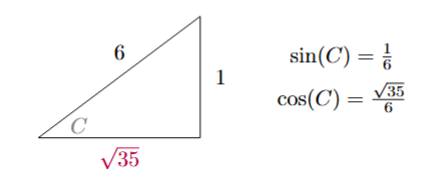
Plugging these in finally gives us \(\displaystyle{ 0=2\cdot \frac{1}{6}+12\cdot \frac{\sqrt{35}}{6}\cdot C'}\)
Since \(C'=\displaystyle{-\frac{1}{6\sqrt{35}} }\), we know \(C\) is decreasing at \(\displaystyle{\frac{1}{6\sqrt{35}}}\) radians per hour.
A man is attempting to go from one side of the circular pond to the other. If he were to paddle directly across the 10 meter diameter, it would take him 20 seconds. If he were to run around half of the circumference instead, it would take him 20 seconds. Instead of paddling directly across, if he directs his boat at an angle, he can boat a diagonal chord of the circle and then run the rest of the way. What is the shortest amount of time he can make it from one side to the other?

Solution
We want to minimize the total travel time, which would be the sum of each leg's distance over rate.
The rate directly across is \(\displaystyle{\frac{10 \textit{ meters}}{20 \textit{ seconds}} =\frac{1}{2}}\) meters per second.
That means the time in the boat is \(\displaystyle{\frac{p}{\frac{1}{2}}=2p}\) seconds.
The rate to run around the edge is \(\displaystyle{\frac{10\pi \textit{ meters}}{20 \textit{ seconds}}=\frac{\pi}{2}}\) meters per second.
That means the time running is \(\displaystyle{ \frac{r}{\frac{\pi}{2}}=\frac{2r}{\pi}}\) seconds
Our optimizing function is thus \(\displaystyle{ T(p,r)=2p+\frac{2r}{\pi}}\)
We can relate both of these quantities to the value of angle \(z\) in the diagram:
\(r=5z\) is the arc length formula for a fraction of a circle and the law of cosines gives us:
\(p^2=5^2+5^2-2\cdot 5\cdot 5\cdot \cos(\pi-z)\)
( Fun fact: \(\cos(\pi -z)=\cos(\pi)\cos(z)+\sin(\pi)\sin(z)=-\cos(z)\) )
\(p^2=50+50\cos(z) \longrightarrow p=5\sqrt{2+2\cos(z)}\)
Plugging these in give us our single variable version of \(T\):
\(\displaystyle{T(z)=2\cdot 5\sqrt{2+2\cos(z)}+\frac{2\cdot 5z}{\pi}=10\sqrt{2+2\cos(z)}+\frac{10}{\pi}z}\)
This has domain \([0,\pi]\) based on our diagram. Now we can differentiate to find our critical points:
\(\displaystyle{ T'(z)=10\cdot \frac{1}{2}(2+2\cos(z))^{-\frac{1}{2}}\cdot (-2\sin(z))+\frac{10}{\pi}=\frac{10}{\pi}-\frac{10\sin(z)}{\sqrt{2+2\cos(z)}}}\)
First \(T'(z)=0 \longrightarrow \displaystyle{ \frac{10}{\pi}=\frac{10\sin(z)}{\sqrt{2+2\cos(z)}}}\)
\(\pi \sin(z)=\sqrt{2+2\cos(z)}\)
\(\pi^2 \sin^2(z)=2+2\cos(z)\)
\(\pi^2-\pi^2 \cos^2(z)=2+2\cos(z)\)
\(0=\pi^2 \cos^2(z)+2\cos(z)+(2-\pi^2)\)
\(\displaystyle{ \cos(z)=\frac{-2\pm \sqrt{4-4\pi^2(2-\pi^2)}}{2\pi^2}=\frac{-1}{\pi^2} \pm \left(1-\frac{1}{\pi^2}\right) }\)
\(\cos(z)=\displaystyle{1-\frac{2}{\pi^2} \longrightarrow z=\cos^{-1}\left( 1-\frac{2}{\pi^2}\right)}\) or \(\cos(z)=-1 \longrightarrow z=\pi\)
Also \(T'(z)=\)DNE when \(2+2\cos(z)=0 \longrightarrow z=\pi\)
Before we plug in the critical and endpoints, lets make a quick sign chart:

We can see that the minimum time would definitely not occur at the interior critical point, so it must be one of our endpoints. Furthermore, from the start we knew that these both take the same amount of time: \(T(0)=T(\pi)=\)20 seconds!
This page titled 12.5: Trigonometric Applications was last modified on Thu, 13 Mar 2025 20:04:49 GMT and is shared under a CC BY-NC-SA 4.0 license and was authored, remixed, and/or curated by Kenn Huber.
The book could not be loaded just now.