Opening the book…
The goal of this section is to find the derivatives of the six trigonometric functions. In order to do this, we will need to be able to evaluate \(\frac{0}{0}\) limits involving these trig functions.
Thankfully most of these can be calculated as long as we can determine \(\displaystyle{\lim_{t\to 0}\frac{\sin(t)}{t}}\)
To find this limit, consider the diagram in the unit circle below for \(\displaystyle{t\in \left(0,\frac{\pi}{2}\right)}\):

Its pretty clear that in terms of length: \(0\le \textcolor{orange}{a}\le \textcolor{red}{b}\le \textcolor{blue}{c}\)
Lets focus on the three shapes individually to solve for each:

This gives us \(\sin(t)\le t \le \tan(t)\) for all \(t\in \displaystyle{\left(0,\frac{\pi}{2}\right)}\)
If we divide all three sides by \(\sin(t)\) (which is positive), this becomes:
\(\displaystyle{ \frac{\sin(t)}{\sin(t)}\le \frac{t}{\sin(t)}\le \frac{\tan(t)}{\sin(t)}}\)
Then we take the reciprocal of all terms (which switches the direction of the inequality):
\(\displaystyle{\frac{\sin(t)}{\sin(t)}\ge \frac{\sin(t)}{t}\ge \frac{\sin(t)}{\tan(t)}}\)
Lastly we simplify the outside two functions:
\(\displaystyle{1\ge \frac{\sin(t)}{t}\ge \cos(t)}\)
This inequality is going to be very useful when trying to take \(\displaystyle{\lim_{t\to 0} \frac{\sin(t)}{t}}\), but we still need one more limit property to evaluate it!
First, if we know that \(f(x),g(x)\) and \(h(x)\) are functions that satisfy \(\textcolor{purple}{f(x)}\le \textcolor{blue}{g(x)}\le \textcolor{brown}{h(x)}\), and we know that \(\textcolor{purple}{\displaystyle{\lim_{x\to a} f(x)}}\), \(\textcolor{blue}{\displaystyle{\lim_{x\to a}g(x)}}\), and \(\textcolor{brown}{\displaystyle{\lim_{x\to a}h(x)}}\) all exist, then we must have \(\displaystyle{\textcolor{purple}{\lim_{x\to a} f(x)}\le \textcolor{blue}{\lim_{x\to a} g(x)}\le \textcolor{brown}{\lim_{x\to a} h(x)}}\)

Unfortunately, if we don't know the middle limit exists, this becomes useless:
Consider \(\textcolor{purple}{f(x)=\cos(x)-2}\), \(\textcolor{blue}{g(x)=\displaystyle{\sin\left( \frac{\pi}{x}\right)}}\) and \(\textcolor{brown}{h(x)=x^2+1}\) near \(a=0\):
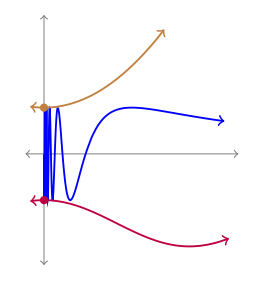
Clearly \(\textcolor{purple}{f(x)}\le \textcolor{blue}{g(x)} \le \textcolor{brown}{h(x)}\), and \(\textcolor{purple}{\displaystyle{\lim_{x\to 0^+} f(x)=-1}}\), \(\textcolor{brown}{\displaystyle{\lim_{x\to 0^+} h(x)=1}}\), but \(\textcolor{blue}{\displaystyle{\lim_{x\to 0^+} g(x)=DNE}}\) and we cannot say \(\textcolor{purple}{-1}\le \textcolor{blue}{DNE} \le \textcolor{brown}{1}\), so the inequality fails!
Luckily if \(\displaystyle{\textcolor{purple}{\lim_{x\to a} f(x)}= \textcolor{brown}{ \lim_{x\to a} h(x)}}\), there is no space for \(\textcolor{blue}{\displaystyle{\lim_{x\to a} g(x)=DNE}}\) to occur.
This result is called the Squeeze Theorem:
When \(f(x),g(x)\) and \(h(x)\) are functions that satisfy \(\textcolor{purple}{f(x)}\le \textcolor{blue}{g(x)}\le \textcolor{brown}{h(x)}\), and we know that \(\displaystyle{\textcolor{purple}{ \lim_{x\to a} f(x)} =\textcolor{brown}{\lim_{x\to a}h(x)}}\), then we must have \(\displaystyle{\textcolor{purple}{\lim_{x\to a} f(x)}= \textcolor{blue}{\lim_{x\to a} g(x)}= \textcolor{brown}{\lim_{x\to a} h(x)}} \)

The Squeeze Theorem is useful in situations when the limit of some component in a function does not exist, but is multiplied by a component that has a limit of zero:
Evaluate the following limits by using the Squeeze Theorem:
(a) \(\displaystyle{\lim_{x\to 0} x^2\sin\left( \frac{\pi}{x}\right)}\)
(b) \(\displaystyle{ \lim_{x\to \infty} \frac{5x+\cos(x^3)}{\sqrt{x^2+4}}}\)
Solution
(a) This cannot turn into \(\displaystyle{ \left( \lim_{x\to 0} x^2 \right) \left( \lim_{x\to 0} \sin \left( \frac{\pi}{x}\right) \right)=0\cdot DNE}\)
( besides what even is \(0\cdot DNE\) anyway? )
Instead we see that \(-1\le \displaystyle{ \sin \left( \frac{\pi}{x}\right)} \le 1\) for all \(x\ne 0\)
If we multiply all three sides by \(x^2\), this becomes:
\(\displaystyle{-x^2\le x^2\sin\left( \frac{\pi}{x}\right)\le x^2}\)
Since \(\displaystyle{\lim_{x\to 0} -x^2=-0^2=0}\) and \(\displaystyle{\lim_{x\to 0} x^2=0^2=0}\)
by the Squeeze Theorem, we must have \(\displaystyle{\lim_{x\to 0} x^2\sin\left( \frac{\pi}{x}\right)=0}\)
(b) Since \(\displaystyle{\lim_{x\to \infty} \cos(x^3)=DNE}\) we cannot use the division limit law
Instead we again use the fact that \(-1\le \cos(x^3)\le 1\) for all \(x\)
If we add \(5x\) to all three sides, then divide by \(\sqrt{x^2+4}\) we get:
\(\displaystyle{\frac{5x-1}{\sqrt{x^2+4}}\le \frac{5x+\cos(x^3)}{\sqrt{x^2+4}}\le \frac{5x+1}{\sqrt{x^2+4}}}\)
We have \(\displaystyle{\lim_{x\to \infty} \frac{5x-1}{\sqrt{x^2+4}}=\lim_{x\to \infty} \frac{5x}{\sqrt{x^2}}=\lim_{x\to \infty} \frac{5x}{x}=\lim_{x\to \infty} 5=5}\)
and have \(\displaystyle{\lim_{x\to \infty} \frac{5x+1}{\sqrt{x^2+4}}=\lim_{x\to \infty} \frac{5x}{\sqrt{x^2}}=\lim_{x\to \infty} \frac{5x}{x}=\lim_{x\to \infty} 5=5}\)
Therefore by the Squeeze Theorem, \(\displaystyle{\lim_{x\to \infty} \frac{5x+\cos(x^3)}{\sqrt{x^2+4}}=5}\)
Note that the Squeeze Theorem works for any type of limit ( one-sided, double sided, or infinite ) as long as the resulting limits on the two outside functions match.
Since we know \(1\ge \displaystyle{\frac{\sin(t)}{t}}\ge \cos(t)\), and see \(\displaystyle{\lim_{t\to 0^+} 1=1}\) and \(\displaystyle{\lim_{t\to 0^+} \cos(t)=\cos(0)=1}\)
We know that \(\displaystyle{\lim_{t\to 0^+} \frac{\sin(t)}{t}=1}\) must hold by the Squeeze Theorem!
( A similar picture and inequalities in quadrant 4 will give us \(\displaystyle{\lim_{t\to 0^-}\frac{\sin(t)}{t}=1}\) as well. )
Therefore we can officially say that \(\displaystyle{\lim_{t\to 0}\frac{\sin(t)}{t}=1}\)
This can be generalized to say that \(\sin(t)\approx t\) when \(t\) is close to zero.
This can be useful when taking other \(\frac{0}{0}\) limits involving trigonometric functions:
Evaluate each of the following limits.
(a) \(\displaystyle{ \lim_{x\to 0} \frac{\sin(2x)}{3x}}\)
(b) \(\displaystyle{ \lim_{z\to 0} \frac{\tan(8z)}{\sin(4z)}}\)
(c) \(\displaystyle{ \lim_{w\to \pi} \frac{\sin(w)}{5w}}\)
(d) \(\displaystyle{ \lim_{h\to 0} \frac{\cos(h)-1}{h}}\)
Solution
(a) \(\displaystyle{ \lim_{x\to 0} \frac{\sin(2x)}{3x}=\lim_{x\to 0} \frac{\sin(2x)}{3x}\cdot \textcolor{orange}{\frac{2x}{2x}}=\lim_{x\to 0} \frac{\sin(2x)}{\textcolor{orange}{2x}}\cdot \frac{\textcolor{orange}{2x}}{3x}}\)
\(=\displaystyle{ \left( \lim_{x\to 0} \frac{\sin(2x)}{2x}\right)\cdot \left( \lim_{x\to 0} \frac{2}{3}\right)}=\displaystyle{ 1\cdot \frac{2}{3}=\frac{2}{3}}\)
(b) \(\displaystyle{ \lim_{z\to 0} \frac{\tan(8z)}{\sin(4z)}=\lim_{z\to 0} \frac{\sin(8z)}{\cos(8z)\sin(4z)}\cdot \textcolor{green}{\frac{8z}{8z}}\cdot \textcolor{brown}{\frac{4z}{4z}}=\lim_{z\to 0} \frac{\sin(8z)}{\textcolor{green}{8z}}\cdot \frac{\textcolor{brown}{4z}}{\sin(4z)}\cdot \frac{\textcolor{green}{8z}}{\textcolor{brown}{4z}\cos(8z)}}\)
\(=\displaystyle{ \left( \lim_{z\to 0} \frac{\sin(8z)}{8z}\right)\cdot \left( \lim_{z\to 0} \frac{4z}{\sin(4z)}\right)\cdot \left( \lim_{z\to 0} \frac{2}{\cos(z)}\right)}=\displaystyle{ 1\cdot 1\cdot \frac{2}{1}=2}\)
(c) \(\displaystyle{ \lim_{w\to \pi} \frac{\sin(w)}{5w}}\) this limit is not \(\frac{0}{0}\), we can legally plug in \(w=\pi\):
\(=\displaystyle{ \frac{\displaystyle{\lim_{w\to \pi} \sin(w)}}{\displaystyle{\lim_{w\to \pi} 5w}}}=\displaystyle{ \frac{ \sin(\pi )}{5\pi}=0}\)
(d) \(\displaystyle{ \lim_{h\to 0} \frac{\cos(h)-1}{h}=\lim_{h\to 0} \frac{\cos(h)-1}{h}\cdot \textcolor{red}{\frac{\cos(h)+1}{\cos(h)+1}}=\lim_{h\to 0} \frac{\cos^2(h)-1}{h( \cos(h)+1)}}\)
\(\displaystyle{=\lim_{h\to 0} \frac{-\sin^2(h)}{h( \cos(h)+1)}\cdot \textcolor{purple}{\frac{h}{h}}=\lim_{h\to 0} \frac{\sin(h)}{h}\cdot \frac{\sin(h)}{\textcolor{purple}{h}}\cdot \frac{-\textcolor{purple}{h}}{ \cos(h)+1 } }\)
\(\displaystyle{=\left(\lim_{h\to 0} \frac{\sin(h)}{h}\right)\cdot \left(\lim_{h\to 0} \frac{\sin(h)}{h}\right)\cdot \left(\lim_{h\to 0} \frac{-h}{\cos(h)+1}\right)}=\displaystyle{ 1\cdot 1 \cdot \frac{-0}{1+1}=0}\)
Finally we have all the tools we need to find the derivatives of the six trigonometric functions!
We start with \(\textcolor{red}{f(x)=\sin(x)}\):
\(\displaystyle{ f'(a)=\lim_{h\to 0} \frac{f(a+h)-f(a)}{h}=\lim_{h\to 0} \frac{\sin(a+h)-\sin(a)}{h}=\lim_{h\to 0} \frac{\left(\sin(a)\cos(h)-\sin(h)\cos(a)\right)-\sin(a)}{h}}\)
\(\displaystyle{=\lim_{h\to 0} \sin(a)\left(\frac{\cos(h)-1}{h}\right)-\left( \frac{\sin(h)}{h}\right)\cos(a)=\sin(a)\cdot 0-1\cdot\cos(a)=\cos(a)} \)
This makes sense if you look at the graphs!

Next is \(\textcolor{brown}{g(x)=\cos(x)}\):
\(\displaystyle{ g'(a)=\lim_{h\to 0} \frac{g(a+h)-g(a)}{h}=\lim_{h\to 0} \frac{\cos(a+h)-\cos(a)}{h}=\lim_{h\to 0} \frac{\left(\cos(a)\cos(h)+\sin(h)\sin(a)\right)-\cos(a)}{h}}\)
\(\displaystyle{=\lim_{h\to 0} \cos(a)\left(\frac{\cos(h)-1}{h}\right)-\left( \frac{\sin(h)}{h}\right)\sin(a) =\cos(a)\cdot 0-1\cdot\sin(a)=-\sin(a)}\)
And once again this makes sense if you look at the graphs!

Since the other four trigonometric functions can be written as fractions with sine and cosine, we can use the quotient rule to evaluate their derivatives:
If \(f(x)=\tan(x)=\displaystyle{\frac{\sin(x)}{\cos(x)}}\), then
\(f'(x)=\displaystyle{ \frac{(\sin(x))'(\cos(x))-(\sin(x))(\cos(x))'}{[\cos(x)]^2}} \)
\(\displaystyle{=\frac{\cos(x)\cdot \cos(x)-\sin(x)\cdot (-\sin(x))}{\cos^2(x)}}\)
\(\displaystyle{=\frac{\sin^2(x)+\cos^2(x)}{\cos^2(x)}=\frac{1}{\cos^2(x)}= \sec^2(x)}\)
If \(f(x)=\cot(x)=\displaystyle{\frac{\cos(x)}{\sin(x)}}\)
\(f'(x)=\displaystyle{ \frac{(\cos(x))'(\sin(x))-(\cos(x))(\sin(x))'}{[\sin(x)]^2}} \)
\(\displaystyle{=\frac{(-\sin(x))\cdot \sin(x)-\cos(x)\cdot \cos(x)}{\cos^2(x)}} \)
\(\displaystyle{=\frac{-(\sin^2(x)+\cos^2(x))}{\sin^2(x)}=\frac{-1}{\sin^2(x)}= -\csc^2(x)}\)
If \(f(x)=\sec(x)=\displaystyle{\frac{1}{\cos(x)}}\), then
\(f'(x)=\displaystyle{ \frac{(1)'(\cos(x))-(1)(\cos(x))'}{[\cos(x)]^2}}\)
\(\displaystyle{=\frac{0\cdot \cos(x)-1\cdot (-\sin(x))}{\cos^2(x)}}\)
\(\displaystyle{=\frac{\sin(x)}{\cos^2(x)}=\frac{1}{\cos(x)}\cdot \frac{\sin(x)}{\cos(x)}= \sec(x)\tan(x)}\)
If \(f(x)=\csc(x) =\displaystyle{\frac{1}{\sin(x)} }\), then
\(f'(x)=\displaystyle{ \frac{(1)'(\sin(x))-(1)(\sin(x))'}{[\sin(x)]^2}} \)
\(\displaystyle{=\frac{0\cdot \sin(x)-1\cdot (\cos(x))}{\sin^2(x)}} \)
\(\displaystyle{=\frac{-\cos(x)}{\sin^2(x)}=\frac{-1}{\sin(x)}\cdot \frac{\cos(x)}{\sin(x)}=- \csc(x)\cot(x)}\)
These six derivatives can be used in combination with our other differentiation formulas!
Find the derivative of each function below
(a) \(\displaystyle{f(x)=x^3\sec(x)} \)
(b) \(p(t)=\displaystyle{ \frac{\tan(t)}{t^4+1}}\)
Solution
(a) \(\displaystyle{ f'(x)=(x^3)'(\sec(x))+(x^3)(\sec(x))'=(3x^2)(\sec(x))+(x^3)(\sec(x)\tan(x))=3x^2\sec(x) + x^3 \sec(x)\tan(x)}\)
(b) \(p'(t)=\displaystyle{ \frac{(\tan(t))'(t^4+1)-(\tan(t))(t^4+1)'}{(t^4+1)^2}}=\displaystyle{ \frac{(\sec^2(t))(t^4+1)-(\tan(t))(4t^3)}{(t^4+1)^2}}=\displaystyle{ \frac{ (t^4+1)\sec^2(t) - (4t^3)\tan(t )}{(t^4+1)^2}}\)
This page titled 8.2: Trig Derivatives was last modified on Thu, 13 Mar 2025 20:04:47 GMT and is shared under a CC BY-NC-SA 4.0 license and was authored, remixed, and/or curated by Kenn Huber.
The book could not be loaded just now.