Opening the book…
Now that we know how to handle limits at values of \(x\) outside of the domain of a given rational function, we can describe how they effect its graph.
Let \(R(x)\) be a rational function with domain \(D\), and consider some real number \(a\notin D\)
Case 1: \(R(x)\) will have a vertical asymptote at \(x=a\) when:
\(\displaystyle{ \lim_{x\to a^+} R(x)=\pm \infty} \) or \(\displaystyle{ \lim_{x\to a^-} R(x)=\pm \infty} \)

Case 2: \(R(x)\) will have a hole at \((a,L)\) when:
\(\displaystyle{ \lim_{x\to a} R(x)=L} \)
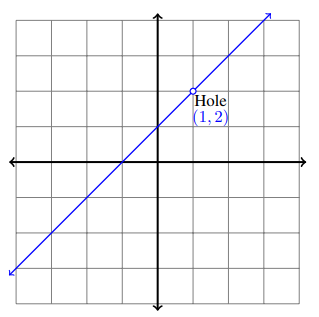
These are the only two possible outcomes for limits outside of the domain of a rational function.
Find all vertical asymptotes and holes for the function \(p(x)=\displaystyle{\frac{2x^2-10x+8}{x^3-16x}}\)
Solution
We start by factoring the numerator and denominator completely to get \(p(x)=\displaystyle{\frac{2(x-1)(x-4)}{x(x-4)(x+4)}}\)
We see our domain contains all \(x\) values except for \(x=0,4,-4\), so we take limits at these values.
\(\displaystyle{\lim_{x\to 0^+}p(x)=\lim_{x\to 0^+} \frac{2(x-1)}{x(x+4)}=\frac{2\cdot(-1)}{0^+\cdot 4}=-\infty}\)
This means we have a vertical asymptote at \(x=0\)
(the limit for \(x\to 0^-\) is \(+\infty\), if you try it)
\(\displaystyle{\lim_{x\to 4^+}p(x)=\lim_{x\to 4^+} \frac{2(x-1)}{x(x+4)}=\frac{2\cdot 3}{4\cdot 8}=\frac{3}{16}}\)
\(\displaystyle{\lim_{x\to 4^-}p(x)=\lim_{x\to 4^-} \frac{2(x-1)}{x(x+4)}=\frac{2\cdot 3}{4\cdot 8}=\frac{3}{16}}\)
Since these match and are finite, we have a hole at \(\displaystyle{\left( 4,\frac{3}{16}\right)}\)
\(\displaystyle{\lim_{x\to -4^+}p(x)=\lim_{x\to -4^+} \frac{2(x-1)}{x(x+4)}=\frac{2\cdot(-5)}{-4\cdot 0^+}=+\infty}\)
This means we have a vertical asymptote at \(x=-4\)
(the limit for \(x\to -4^-\) is \(-\infty\), if you try it)
In case you are curious, below is the graph of \( y=p(x)\)
Notice how it agrees with the results of our limits above.

You may notice in the graphs we make for rational functions, that there are sometimes another type of asymptote that runs horizontally instead of vertically. These are called horizontal asymptotes, and they are quite different than their vertical counterparts.
A horizontal asymptote is a line \(y=a\) that the graph of your function \(y=f(x)\) gets close to when \(x\) is very large (far to the right) or very large and negative (far to the left).
Another way of saying this is we have a horizontal asymptote at \(y=a\) when:
\(\displaystyle{ \lim_{x\to \infty} f(x)=a}\) or \(\displaystyle{ \lim_{x\to -\infty} f(x)=a}\)
It is important to realize that the symbols \(\infty\) and \(-\infty\) are not real numbers.
( That means you cannot say things like \(\textcolor{red}{0\cdot \infty =0}\) or \(\textcolor{red}{\infty-\infty=0}\) or \(\textcolor{red}{\displaystyle{ \frac{\infty}{-\infty}=-1}}\) )
When taking limits to positive or negative infinity, we cannot just plug them into \(f(x)\) (like we would have done for limits at real numbers)
Obviously then, before we can find horizontal asymptotes of functions reliably, we should practice taking these infinite limits.

If \(p>0\) is a fixed exponent for \(x\), then \(\displaystyle{ \lim_{x\to \infty} x^p=+\infty}\)
(since when \(x\) is very large and positive, \(x^p\) will be very large and positive.)
PIC.93B

If \(p<0\) is a fixed exponent for \(x\), then \(\displaystyle{ \lim_{x\to \infty} x^p=0}\)
(since when \(x\) is very large and positive, \(x^p\) will be the reciprocal of a very large number.)
Furthermore, as long as large negative numbers are allowed in the domain of \(x^p\):
\(\displaystyle{ \lim_{x\to -\infty} x^p}\) is \(0\) when \(p<0\) and either \(\infty\) or \(-\infty\) when \(p>0\)
This makes a few limits pretty straightforward:
\(\displaystyle{\lim_{x\to \infty} x^2=+\infty}\) and \(\displaystyle{\lim_{x\to \infty} x^3=+\infty}\)
It is fairly obvious then that \(\displaystyle{\lim_{x\to \infty} x^3+x^2=+\infty}\)
(since a large positive number plus a large positive number gives a large positive number)
But what about \(\displaystyle{\lim_{x\to \infty} x^3-x^2}\) ?
Remember we cannot say this limit is just \(\infty - \infty\), since this does not represent a number.
(a large positive number minus a large positive number could be positive, negative, or zero)
Instead, we re-write this as \(\displaystyle{\lim_{x\to \infty} x^3 \left(1- \frac{1}{x}\right)=\infty\cdot 1=\infty}\)
(a large positive number times a number close to \(1\) is a large positive number)
We know since \(\displaystyle{\lim_{x\to \infty} \frac{1}{x}=0}\), that the \(x^2\) term is actually infinitely small compared to the \(x^3\) term.
In fact, for any polynomial \( \textcolor{red}{p(x)=a_nx^n+a_{n-1}x^{n-1}+\dots+a_1 x+a_0} \) we can see that
\(\displaystyle{ \lim_{x\to \infty} p(x)=\lim_{x\to \infty} a_n x^n\left( 1+\frac{\frac{a_{n-1}}{a_n}}{x}+\dots \frac{\frac{a_1}{a_n}}{x^{n-1}}+\frac{\frac{a_0}{a_n}}{x^n}\right) = \lim_{x\to \infty} a_nx^n \cdot 1} \)
\(\displaystyle{ \lim_{x\to -\infty} p(x)=\lim_{x\to -\infty} a_n x^n\left( 1+\frac{\frac{a_{n-1}}{a_n}}{x}+\dots \frac{\frac{a_1}{a_n}}{x^{n-1}}+\frac{\frac{a_0}{a_n}}{x^n}\right) = \lim_{x\to -\infty} a_nx^n \cdot 1} \)
Again we see that the value of this limit is completely dependent on the largest power term: \(a_nx^n\)
This translates to the fact that when taking a limit to positive or negative infinity, only the fastest growing/largest power term is important. The author denotes this property as the "Lebron James Rule": when taking infinite limits we only pay attention to the biggest strongest term.
This makes infinite limits of polynomials very easy.
Evaluate each infinite limit below.
(a) \(\displaystyle{ \lim_{x\to \infty} 12x^2+4x-59}\)
(b) \(\displaystyle{ \lim_{x\to \infty} -\frac{1}{3}x^3+2x+1}\)
(c) \(\displaystyle{ \lim_{x\to -\infty} 8x^9+6000x^7-3x^2}\)
Solution
Remember in polynomials, the largest power does all the work:
(a) \( \displaystyle{ \lim_{x\to \infty} 12x^2+4x-59=\lim_{x\to \infty} 12x^2 =12(+\infty)^2= +\infty}\)
(b) \(\displaystyle{ \lim_{x\to \infty} -\frac{1}{3}x^3+2x+1 =\lim_{x\to \infty} -\frac{1}{3}x^3=-\frac{1}{3}\cdot (+\infty)^3 =-\infty}\)
(c) \(\displaystyle{ \lim_{x\to -\infty} 8x^9+6000x^7-3x^2=\lim_{x\to -\infty} 8x^9=8(-\infty)^9=-\infty}\)
We can see that \(\displaystyle{ \lim_{x\to \infty} p(x)=\pm \infty}\) and \(\displaystyle{ \lim_{x\to -\infty} p(x)=\pm \infty}\) will always occur for any polynomial.
Since these limits are never a real number, a polynomial will never have a horizontal asmyptote.
Rational functions, on the other hand, can definitely end up with horizontal asymptotes.
We can use the Lebron James rule on them as well!
Evaluate each infinite limit below.
(a) \(\displaystyle{ \lim_{x\to \infty} \frac{6x^2+2x+1}{3x^2+5}}\)
(b) \(\displaystyle{ \lim_{x\to -\infty} \frac{4x^6+5x-1}{8x^6+15}}\)
(c) \(\displaystyle{ \lim_{x\to \infty} \frac{x^3+2x^2}{3x^5+5x-1}}\)
(d) \(\displaystyle{ \lim_{x\to -\infty} \frac{-2x^4+5x-1}{x^3+7x+3}} \)
Solution
(a) \(\displaystyle{ \lim_{x\to \infty} \frac{6x^2+2x+1}{3x^2+5}= \lim_{x\to \infty} \frac{6x^2}{3x^2}= \lim_{x\to \infty} 2=2}\)
(b) \(\displaystyle{ \lim_{x\to -\infty} \frac{4x^6+5x-1}{8x^6+15}=\lim_{x\to -\infty} \frac{4x^6}{8x^6}=\lim_{x\to -\infty} \frac{1}{2}=\frac{1}{2}}\)
(c) \(\displaystyle{ \lim_{x\to \infty} \frac{x^3+2x^2}{3x^5+5x-1}=\lim_{x\to \infty} \frac{x^3}{3x^5}=\lim_{x\to \infty} \frac{1}{3x^2}=0 }\)
(d) \(\displaystyle{ \lim_{x\to -\infty} \frac{-2x^4+5x-1}{x^3+7x+3} =\lim_{x\to -\infty} \frac{-2x^4}{x^3}=\lim_{x\to -\infty} -2x =+\infty }\)
We just have to be careful that we correctly choose which term is largest:

As a general rule, if it is not obvious which term is biggest, simplify first!
This page titled 3.5: Asymptotes was last modified on Thu, 13 Mar 2025 20:04:51 GMT and is shared under a CC BY-NC-SA 4.0 license and was authored, remixed, and/or curated by Kenn Huber.
The book could not be loaded just now.