Opening the book…
While there is still more to explore when taking the limits of rational functions, we must first become familiar with how we can use them in equations and inequalities.
Remember earlier when solving a linear equations containing any fractions, we multiplied both sides by the same number (the common denominator) to eliminate all of the fractions:
\(\displaystyle{ \frac{1}{2} x+1=\frac{1}{3}x-2}\)
\(\displaystyle{ \frac{1}{2} x\cdot \textcolor{red}{6}+1\cdot \textcolor{red}{6}=\frac{1}{3}x\cdot \textcolor{red}{6}-2\cdot \textcolor{red}{6}}\)
\(\displaystyle{ 3x+6=2x-12}\)
The end result is a new (nicer) equation with the same solutions as the original (which has solution \(x=-18\))
A rational equation is any equation involving rational functions.
We solve these just like we do above, by multiplying by the common denominator to eliminate all fraction terms. The only thing we must be careful of, is to ensure that our solutions are in the domain of any function involved in the original equation.
Find all solutions to \(\displaystyle{ \frac{2}{x+3}-\frac{3}{x-2}=2 }\)
Solution
We start by multiplying all terms by the common denominator: \(\textcolor{purple}{(x+3)(x-2)}\)
\(\displaystyle{ \frac{2}{x+3}\cdot \textcolor{purple}{(x+3)(x-2)}-\frac{3}{x-2}\cdot \textcolor{purple}{(x+3)(x-2)}=2\cdot \textcolor{purple}{(x+3)(x-2)} }\)
This simplifies mightily into:
\(2(x-2)-3(x+3)=2(x+3)(x-2)\)
Distribute and collect like terms to get
\(-x-13=2x^2+2x-12\)
Since this is quadratic, we move everything to one side and then factor
\(0=2x^2+3x+1\)
\(0=(2x+1)(x+1)\)
Therefore our final solutions are \(x=-\dfrac{1}{2},-1\)
Since both of these values make sense in the original rational equation, they are both solutions.
In this example, the domain of the functions on the left side of the original equation did not effect our final answer, but it is always important to check!
Here are some examples where the domain is important:
Find all solutions to \(\displaystyle{ \frac{3x}{x+4}+\frac{4x}{x-3}=\frac{84}{x^2+x-12} }\)
Solution
We start by multiplying all terms by the common denominator: \(\textcolor{orange}{(x-3)(x+4)}\)
\(\displaystyle{ \frac{3x}{x+4} \textcolor{orange}{(x-3)(x+4)}+\frac{4x}{x-3}\textcolor{orange}{(x-3)(x+4)}=\frac{84}{(x+4)(x-3)} \textcolor{orange}{(x-3)(x+4)} }\)
This simplifies into:
\(3x(x-3)+4x(x+4)=84\)
Distribute and collect like terms to one side to get
\(7x^2+7x-84=0\)
Finally we factor
\(7(x-3)(x+4)=0\)
Therefore our possible solutions are \(x=-4,3\)
Since neither of these values make sense in the original rational equation, there are no solutions: \(\emptyset \)
Find all solutions to \(\displaystyle{ \frac{x}{x+4}+\frac{4}{x-4}=\frac{x^2+16}{x^2-16} }\)
Solution
We start by multiplying all terms by the common denominator: \(\textcolor{red}{(x-2)(x+2)}\)
\(\displaystyle{ \frac{x}{x+4}\textcolor{red}{(x-4)(x+4)}+\frac{4}{x-4} \textcolor{red}{(x-4)(x+4)}=\frac{x^2+16}{(x-4)(x+4)} \textcolor{red}{(x-4)(x+4)} }\)
This simplifies into:
\(x(x-4)+4(x+4)=x^2+16\)
Distribute and collect like terms to get
\(x^2+16=x^2+16\)
This equation is always true regardless of the value of \(x\)
Since \(x=4,-4\) are not allowed in the original equation, these are the only numbers not in our solution set:
\(x\in (-\infty,-4)\cup (-4,4)\cup (4,\infty) \)
Besides equations, we will also sometimes need to solve inequalities involving rational functions. Thankfully, these are done in a very similar fashion to quadratic inequalities: sign charts!
Find the solutions for the following inequalities
(a) \(\dfrac{x-1}{x+2} > 0\)
(b) \(\dfrac{x-1}{x+2} \le 0 \)
Solution
(a) First we can see that the roots of the numerator are \(x=1\) and the roots of the denominator are \(x=-2\)
Now we set up a sign chart separated by these roots

Since the inequality is strict, the roots of the top do not satisfy it.
The roots of the bottom are not in the domain, so they will not satisfy it either.
Our solution should be any interval which is overall \(\textcolor{red}{+}\) in the top row.
\(x\in (-\infty,-2)\cup (1,\infty)\)
(b) Again we can see that the roots of the numerator are \(x=1\) and the roots of the denominator are \(x=-2\)
Now we set up a sign chart separated by these roots

Since the inequality is not strict, the roots of the top do satisfy it.
The roots of the bottom are not in the domain, so they will not satisfy the inequality.
Our solution should be any interval which is overall \(\textcolor{red}{-}\) in the top row and any roots of the top.
\( x\in (-2,1]\)
Just make sure you are always comparing to zero on one side, and that you can completely factor the top and bottom of the other side. Once you have them factored, you can make a sign chart separated by the roots of the top and bottom polynomials like we did in the last examples.
Find all solutions to \(\displaystyle{ \frac{20x-8x^2}{x^2-4} \ge -x}\)
Solution
First we subtract everything to the left side and find a common denominator:
\(\displaystyle{ \frac{(20x-8x^2)+x(x^2-4)}{x^2-4} \ge 0}\)
We can simplify and factor the top and bottom of this fraction
\(\displaystyle{ \frac{x(x-4)^2}{(x-2)(x+2)} \ge 0}\)
The roots of the numerator are \(x=0,4\) the roots of the denominator are \(x=2,-2\)
We make a sign chart separated by these roots:
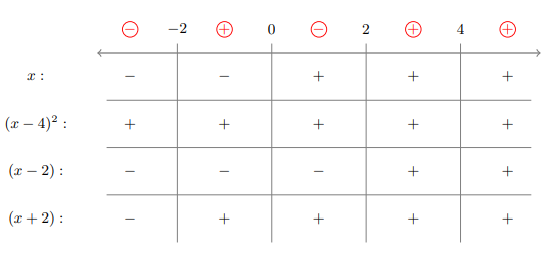
Since the inequality is not strict, the roots of the top do satisfy it.
The roots of the bottom are not in the domain, so they will not satisfy it either.
Our solution should be any interval which is overall \(\textcolor{red}{+}\) in the top row and the roots of our numerator.
\(x\in (-2,0]\cup (2,\infty)\)
Solving equations and inequalities of rational functions is very similar to our methods of solving them for polynomials. The only thing we must remember, is to make sure that we never use any answers that cause us to divide by zero in any expression along the way.
This page titled 3.3: Using Rational Functions was last modified on Thu, 13 Mar 2025 20:04:50 GMT and is shared under a CC BY-NC-SA 4.0 license and was authored, remixed, and/or curated by Kenn Huber.
The book could not be loaded just now.