Opening the book…
Reading Questions
- What does the Fundamental Theorem of Calculus, Part 1 (FTC1) state about the derivative of an integral function \(F(x) = \displaystyle \int_a^x f(t) \, dt\)?
- If \(g(x) = \displaystyle \int_1^x \frac{1}{t^3+1} dt\), what is \(g^{\prime}(x)\) according to FTC1?
- How is the Chain Rule incorporated into FTC1 when the upper limit of integration is a function \(u(x)\), i.e., for \(F(x) = \displaystyle \int_a^{u(x)} f(t) \, dt\)?
- What is the general form of FTC1 when both limits of integration are functions, \(F(x) = \displaystyle \int_{L(x)}^{U(x)} f(t) \, dt\)?
- What does the Fundamental Theorem of Calculus, Part 2 (FTC2), also known as the Evaluation Theorem, state?
- What is an "antiderivative" of a function \(f(x)\)?
- To evaluate \(\displaystyle \int_a^b f(x) dx\) using FTC2, what are the two main steps?
- When using FTC2, does it matter which antiderivative of \(f(x)\) you choose? Explain why or why not regarding the constant of integration \(C\).
- How does FTC2 provide a more powerful and practical technique for evaluating definite integrals compared to using the limit of Riemann sums?
- What is the relationship between differentiation and integration as established by the Fundamental Theorem of Calculus (both parts considered)?
Homework
In exercises 1 - 12, use the Fundamental Theorem of Calculus, Part 1, to find each derivative.
1) \(\displaystyle \frac{d}{dx}\left[\int^x_1e^{−t^2}\,dt \right] \)
2) \(\displaystyle \frac{d}{dx}\left[\int^x_1e^{cost}\,dt \right] \)
- Answer
- \(\displaystyle \frac{d}{dx}\left[\int^x_1e^{cost}\,dt \right] = e^{\cos t}\)
3) \(\displaystyle \frac{d}{dx}\left[\int^x_3\sqrt{9−y^2}\,dy \right] \)
4) \(\displaystyle \frac{d}{dx}\left[\int^x_3\frac{ds}{\sqrt{16−s^2}} \right] \)
- Answer
- \(\displaystyle \frac{d}{dx}\left[\int^x_3\frac{ds}{\sqrt{16−s^2}} \right] = \frac{1}{\sqrt{16−x^2}}\)
5) \(\displaystyle \frac{d}{dx}\left[\int^{2x}x_t\,dt \right] \)
6) \(\displaystyle \frac{d}{dx}\left[\int^{\sqrt{x}}_0t\,dt \right] \)
- Answer
- \(\displaystyle \frac{d}{dx}\left[\int^{\sqrt{x}}_0t\,dt \right] = \sqrt{x}\frac{d}{dx}\big(\sqrt{x}\big)=\frac{1}{2}\)
7) \(\displaystyle \frac{d}{dx}\left[\int^{\sin x}_0\sqrt{1−t^2}\,dt \right] \)
8) \(\displaystyle \frac{d}{dx}\left[\int^1_{\cos x}\sqrt{1−t^2}\,dt \right] \)
- Answer
- \(\displaystyle \frac{d}{dx}\left[\int^1_{\cos x}\sqrt{1−t^2}\,dt \right] = −\sqrt{1−\cos^2x}\frac{d}{dx}\big(\cos x\big)=|\sin x|\sin x\)
9) \(\displaystyle \frac{d}{dx}\left[\int^{\sqrt{x}}_1\frac{t^2}{1+t^4}\,dt \right] \)
10) \(\displaystyle \frac{d}{dx}\left[\int^{x^2}_1\frac{\sqrt{t}}{1+t}\,dt \right] \)
- Answer
- \(\displaystyle \frac{d}{dx}\left[\int^{x^2}_1\frac{\sqrt{t}}{1+t}\,dt \right] = 2x\dfrac{|x|}{1+x^2}\)
11) \(\displaystyle \frac{d}{dx}\left[\int^{\ln x}_0e^t\,dt \right] \)
12) \(\displaystyle \frac{d}{dx}\left[\int^{e^{x}}_1\ln u^2\,du \right] \)
- Answer
- \(\displaystyle \frac{d}{dx} \left[ \int^{e^{x}}_1\ln u^2\,du \right] = \ln(e^{2x})\dfrac{d}{dx}\big(e^x\big)=2xe^x\)
13) The graph of \(\displaystyle y=\int^x_0f(t)\,dt\), where \(f\) is a piecewise constant function, is shown here.
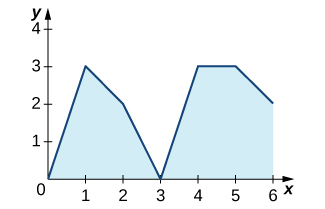
a. Over which intervals is \(f\) positive? Over which intervals is it negative? Over which intervals, if any, is it equal to zero?
b. What are the maximum and minimum values of \(f\)?
14) The graph of \(\displaystyle y=\int^x_0f(t)\,dt\), where \(f\) is a piecewise constant function, is shown here.

a. Over which intervals is \(f\) positive? Over which intervals is it negative? Over which intervals, if any, is it equal to zero?
b. What are the maximum and minimum values of \(f\)?
- Answer
- a. \(f\) is positive over \([1,2]\) and \([5,6]\), negative over \( [0,1]\) and \([3,4]\), and zero over \([2,3]\) and \([4,5]\).
b. The maximum value is \(2\) and the minimum is \(−3\).
15) The graph of \(\displaystyle y=\int^x_0ℓ(t)\,dt\), where \(ℓ\) is a piecewise linear function, is shown here.

a. Over which intervals is \(ℓ\) positive? Over which intervals is it negative? Over which, if any, is it zero?
b. Over which intervals is \(ℓ\) increasing? Over which is it decreasing? Over which, if any, is it constant?
16) The graph of \(\displaystyle y=\int^x_0ℓ(t)\,dt\), where \( ℓ\) is a piecewise linear function, is shown here.

a. Over which intervals is \(ℓ\) positive? Over which intervals is it negative? Over which, if any, is it zero?
b. Over which intervals is \(ℓ\) increasing? Over which is it decreasing? Over which intervals, if any, is it constant?
- Answer
- a. \(ℓ\) is positive over \([0,1]\) and \([3,6]\), and negative over \([1,3]\).
b. It is increasing over \([0,1]\) and \([3,5]\), and it is constant over \([1,3]\) and \([5,6]\).
In exercises 17 - 36, evaluate each definite integral using the Fundamental Theorem of Calculus, Part 2.
17) \(\displaystyle \int^2_{−1}(x^2−3x)\,dx\)
18) \(\displaystyle \int^3_{−2}(x^2+3x−5)\,dx\)
- Answer
- \(\displaystyle F(x)=\frac{x^3}{3}+\frac{3x^2}{2}−5x,\quad F(3)−F(−2)=−\frac{35}{6}\)
19) \(\displaystyle \int^3_{−2}(t+2)(t−3)dt\)
20) \(\displaystyle \int^3_2(t^2−9)(4−t^2)dt\)
- Answer
- \(F(x)=−\dfrac{t^5}{5}+\dfrac{13t^3}{3}−36t,\quad F(3)−F(2)=\frac{62}{15}\)
21) \(\displaystyle \int^2_1x^9\,dx\)
22) \(\displaystyle \int^1_0x^{99}\,dx\)
- Answer
- \(F(x)=\dfrac{x^{100}}{100},\quad F(1)−F(0)=\dfrac{1}{100}\)
23) \(\displaystyle \int^8_4(4t^{5/2}−3t^{3/2})dt\)
24) \(\displaystyle \int^4_{1/4}\left(x^2−\dfrac{1}{x^2}\right)\,dx\)
- Answer
- \(F(x)=\dfrac{x^3}{3}+\dfrac{1}{x},\quad F(4)−F\left(\tfrac{1}{4}\right)=\frac{1125}{64}\)
25) \(\displaystyle \int^2_1\frac{2}{x^3}\,dx\)
26) \(\displaystyle \int^4_1\frac{1}{2\sqrt{x}}\,dx\)
- Answer
- \(F(x)=\sqrt{x},\quad F(4)−F(1)=1\)
27) \(\displaystyle \int^4_1\frac{2−\sqrt{t}}{t^2}\,dt\)
28) \(\displaystyle \int^{16}_1\frac{dt}{t^{1/4}}\)
- Answer
- \( F(t)=\frac{4}{3}t^{3/4},\quad F(16)−F(1)=\frac{28}{3}\)
29) \(\displaystyle \int^{2 \pi }_0\cos \theta \,d \theta \)
30) \(\displaystyle \int^{ \pi /2}_0\sin \theta \,d \theta \)
- Answer
- \(F( \theta )=−\cos \theta ,\quad F(\frac{ \pi }{2})−F(0)=1\)
31) \(\displaystyle \int^{ \pi /4}_0\sec^2 \theta \,d \theta \)
32) \(\displaystyle \int^{ \pi /4}_0\sec \theta \tan \theta \,d \theta \)
- Answer
- \(F( \theta )=\sec \theta ,\quad F(\frac{ \pi }{4})−F(0)=\sqrt{2}−1\)
33) \(\displaystyle \int^{ \pi /4}_{ \pi /3}\csc \theta \cot \theta \,d \theta \)
34) \(\displaystyle \int^{ \pi /2}_{ \pi /4}\csc^2 \theta \,d \theta \)
- Answer
- \(F( \theta )=−\cot \theta ,\quad F(\frac{ \pi }{2})−F(\frac{ \pi }{4})=1\)
35) \(\displaystyle \int^2_1\left(\frac{1}{t^2}−\frac{1}{t^3}\right)\,dt\)
36) \(\displaystyle \int^{−1}_{−2}\left(\frac{1}{t^2}−\frac{1}{t^3}\right)\,dt\)
- Answer
- \( F(t)=−\dfrac{1}{t}+\dfrac{1}{2t^2},\quad F(−1)−F(−2)=\frac{7}{8}\)
In exercises 37 - 40, use the evaluation theorem to express the integral as a function \(F(x)\).
37) \(\displaystyle \int^x_at^2\,dt\)
38) \(\displaystyle \int^x_1e^t\,dt\)
- Answer
- \(F(x)=e^x−e\)
39) \(\displaystyle \int^x_0\cos t\,dt\)
40) \(\displaystyle \int^x_{−x}\sin t\,dt\)
- Answer
- \(F(x)=0\)
In exercises 41 - 44, identify the roots of the integrand to remove absolute values, then evaluate using the Fundamental Theorem of Calculus, Part 2.
41) \(\displaystyle \int^3_{−2}|x|\,dx\)
42) \(\displaystyle \int^4_{−2}∣t^2−2t−3∣\,dt\)
- Answer
- \(\displaystyle \int^{−1}_{−2}(t^2−2t−3)\,dt−\int^3_{−1}(t^2−2t−3)\,dt+\int^4_3(t^2−2t−3)\,dt=\frac{46}{3}\)
43) \(\displaystyle \int^ \pi _0|\cos t|\,dt\)
44) \(\displaystyle \int^{ \pi /2}_{− \pi /2}|\sin t|\,dt\)
- Answer
- \(\displaystyle −\int^0_{− \pi /2}\sin t\,dt+\int^{ \pi /2}_0\sin t\,dt=2\)
5.4E: Exercises is shared under a not declared license and was authored, remixed, and/or curated by LibreTexts.
The book could not be loaded just now.