Opening the book…
- Solve linear equations in one variable algebraically.
- Find the slope of a line passing through two points.
- Find the equation of a line in slope-intercept form.
- Find the equation of a line in point-slope form.
- Find the equation of a line in standard form.
Solving Linear Equations in One Variable
A linear equation is an equation of a straight line, written in one variable. The only power of the variable is \(1\). Linear equations in one variable may take the form \(ax +b=0\) and are solved using basic algebraic operations. We begin by classifying linear equations in one variable as one of three types: identity, conditional, or inconsistent.
- An identity equation is true for all values of the variable. Here is an example of an identity equation: \[3x=2x+x \nonumber \] The solution set consists of all values that make the equation true. For this equation, the solution set is all real numbers because any real number substituted for \(x\) will make the equation true.
- A conditional equation is true for only some values of the variable. For example, if we are to solve the equation \(5x+2=3x−6\), we have the following: \[\begin{align*} 5x+2&=3x-6 \\ 2x &=-8 \\ x&=-4 \end{align*} \] The solution set consists of one number: \({−4}\). It is the only solution and, therefore, we have solved a conditional equation.
- An inconsistent equation results in a false statement. For example, if we are to solve \(5x−15=5(x−4)\), we have the following: \[\begin{align*} 5x−15 &=5x−20 \\ 5x−15-5x &= 5x−20-5x \\ −15 &\neq −20 \end{align*}\]Indeed, \(−15≠−20\). There is no solution because this is an inconsistent equation.
Solving linear equations in one variable involves the fundamental properties of equality and basic algebraic operations. A brief review of those operations follows.
A linear equation in one variable can be written in the form
\[Ax+B=0\]
where \(A\) and \(B\) are real numbers, where \(A≠0\).
The following steps are used to manipulate an equation and isolate the unknown variable, so that the last line reads \(x=\)_________, if \(x\) is the unknown. There is no set order, as the steps used depend on what is given:
- We may add, subtract, multiply, or divide an equation by a number or an expression as long as we do the same thing to both sides of the equal sign. Note that we cannot divide by zero.
- Apply the distributive property as needed: \(A(B+C)=AB+AC\).
- Isolate the variable on one side of the equation.
- When the variable is multiplied by a coefficient in the final stage, multiply both sides of the equation by the reciprocal of the coefficient.
Solve the following equation: \(2x+7=19\).
Solution
This equation can be written in the form \(Ax +B=0\) by subtracting 19 from both sides. However, we may proceed to solve the equation in its original form by performing algebraic operations.
\[\begin{align*} 2x+7&=19\\ 2x&=12\qquad \text{Subtract 7 from both sides}\\ x&=6\qquad \text{Multiply both sides by } \dfrac{1}{2} \text{ or divide by } 2 \end{align*}\]
The solution is \(6\).
Solve the linear equation: \(2x+1=−9\).
- Answer
-
\(x=−5\)
Solve the following equation: \(4(x−3)+12=15−5(x+6)\).
Solution
Apply standard algebraic properties.
\[\begin{align*} 4(x-3)+12&=15-5(x+6)\\ 4x-12+12&=15-5x-30\qquad \text{Apply the distributive property}\\ 4x&=-15-5x\qquad \text{Combine like terms}\\ 9x&=-15\qquad \text{Place x terms on one side and simplify}\\ x&=-\dfrac{15}{9}\qquad \text{Multiply both sides by } \dfrac{1}{9} \text { , the reciprocal of } 9\\ x&=-\dfrac{5}{3} \end{align*}\]
Analysis
This problem requires the distributive property to be applied twice, and then the properties of algebra are used to reach the final line, \(x=-\dfrac{5}{3}\).
Solve the equation in one variable: \(−2(3x−1)+x=14−x\).
- Answer
-
\(x=-3\)
Finding a Linear Equation in TWO Variables
A linear equation in TWO variables can be written in the form
\[Ax+By=C\]
where \(A\) , \(B\) and \(C\) are real numbers, where \(A\) and \(B\) are NOT BOTH equal to zero.
Perhaps the most familiar form of a linear equation is the slope-intercept form, written as \[y=mx+b\] where \(m=\text{slope}\) and \((0,b)\) is the \(y\) -intercept.
Identify the slope and \(y\)-intercept, given the equation \(2x + 3y = 6\).
Solution
We must re-write this equation into \(y=mx+b\) form, as follows:
\[\begin{align*}2x + 3y &= 6 \\ 3y &= -2x + 6 \\ y &= -\frac{2}{3}x + \frac{6}{3} \\ y &= -\frac{2}{3}x + 2 \end{align*}\]
the given line has a slope of \(m=-\dfrac{2}{3}\). The \(y\)-intercept is \((0,2)\).
Analysis
The \(y\)-intercept is the point at which the line crosses the \(y\)-axis. On the \(y\)-axis, \(x=0\). We can always identify the \(y\)-intercept when the line is in slope-intercept form, as it will always equal the value of \(b\). Or, we can just substitute \(x=0\) into the original equation and solve for \(y\).
The slope of a line refers to the ratio of the vertical change in \(y\) over the horizontal change in \(x\) between any two points on a line. It indicates the direction in which a line slants as well as its steepness. Slope is sometimes described as rise over run.
If the slope is positive, the line slants to the right. If the slope is negative, the line slants to the left. As the slope increases, the line becomes steeper. Some examples are shown in Figure \(\PageIndex{2}\). The lines indicate the following slopes: \(m=−3\), \(m=2\), and \(m=\dfrac{1}{3}\).
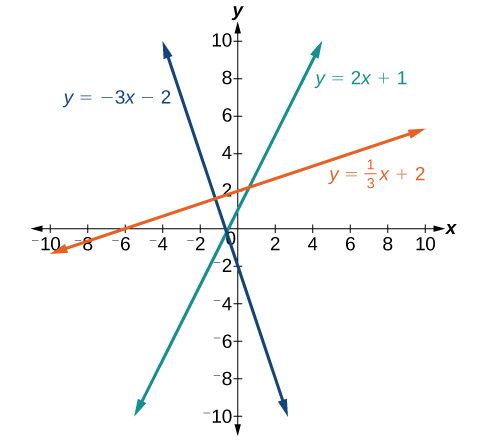
The slope of a line, \(m\), represents the change in \(y\) over the change in \(x\). Given two points, \((x_1,y_1)\) and \((x_2,y_2)\), the following formula determines the slope of a line containing these points:
\[m=\dfrac{y_2-y_1}{x_2-x_1}\]
Find the slope of a line that passes through the points \((2,−1)\) and \((−6,3)\).
Solution
We substitute the \(y\)-values and the \(x\)-values into the formula.
\[\begin{align*} m&= \dfrac{3-(-1)}{-6-2}\\ &= \dfrac{3+1}{-8} \\ &= \dfrac{4}{-8}\\ &= -\dfrac{4}{8} \\ &= -\dfrac{1}{2} \end{align*}\]
The slope is \(-\dfrac{1}{2}\)
Analysis
It does not matter which point is called \((x_1,y_1)\) or \((x_2,y_2)\). As long as we are consistent with the order of the \(y\) terms and the order of the \(x\) terms in the numerator and denominator, the calculation will yield the same result.
Find the slope of the line that passes through the points \((−2,8)\) and \((1,4)\).
- Answer
-
\(m=-\dfrac{4}{3}\)
Identify the slope and \(y\)-intercept, given the equation \(y=2x-4\).
Solution
As the line is in \(y=mx+b\) form, the given line has a slope of \(2\). The \(y\)-intercept is \((0,−4)\).
Analysis
The slope is an integer, so we can interpret this as a unit ratio \(\frac{2}{1}\) when we are thinking of the behavior of the graph.
The Point-Slope Formula
Given the slope and one point on a line, we can find the equation of the line using the point-slope formula.
\[y−y_1=m(x−x_1)\]
This is an important formula, as it will be used in other areas of college algebra and often in calculus to find the equation of a tangent line. We need only one point and the slope of the line to use the formula. After substituting the slope and the coordinates of one point into the formula, we simplify it and write it in slope-intercept form.
Given one point and the slope, the point-slope formula will lead to the equation of a line:
\[y−y_1=m(x−x_1)\]
Write the equation of the line with slope \(m=−3\) and passing through the point \((4,8)\). Write the final equation in slope-intercept form.
Solution
Using the point-slope formula, substitute \(−3\) for m and the point \((4,8)\) for \((x_1,y_1)\).
\[\begin{align*} y-y_1&= m(x-x_1)\\ y-8&= -3(x-4)\\ y-8&= -3x+12\\ y&= -3x+20 \end{align*}\]
Analysis
Note that any point on the line can be used to find the equation. If done correctly, the same final equation will be obtained.
Given \(m=4\), find the equation of the line in slope-intercept form passing through the point \((2,5)\).
- Answer
-
\(y=4x−3\)
Find the equation of the line passing through the points \((3,4)\) and \((0,−3)\). Write the final equation in slope-intercept form.
Solution
First, we calculate the slope using the slope formula and two points.
\[\begin{align*} m&= \dfrac{-3-4}{0-3}\\ m&= \dfrac{-7}{-3}\\ m&= \dfrac{7}{3}\\ \end{align*}\]
Next, we use the point-slope formula with the slope of \(\dfrac{7}{3}\), and either point. Let’s pick the point \((3,4)\) for \((x_1,y_1)\).
\[\begin{align*} y-4&= \dfrac{7}{3}(x-3)\\ y-4&= \dfrac{7}{3}x-7\\ y&= \dfrac{7}{3}x-3\\ \end{align*}\]
In slope-intercept form, the equation is written as \(y=\dfrac{7}{3}x-3\)
Analysis
To prove that either point can be used, let us use the second point \((0,−3)\) and see if we get the same equation.
\[\begin{align*} y-(-3)&= \dfrac{7}{3}(x-0)\\ y+3&= \dfrac{7}{3}x\\ y&= \dfrac{7}{3}x-3\\ \end{align*}\]
We see that the same line will be obtained using either point. This makes sense because we used both points to calculate the slope.
Standard Form of a Line
Recall the definition of a linear equation in TWO variables. When \(A\), \(B\), and \(C\) are integers, this equation is called the standard form of a line.
\[Ax+By=C\]
The \(x\)- and \(y\)-terms are on one side of the equal sign and the constant term is on the other side.
Find the equation of the line with \(m=−6\) and passing through the point \(\left(\dfrac{1}{4},−2\right)\). Write the equation in standard form.
Solution
We begin using the point-slope formula.
\[\begin{align*} y-(-2)&= -6\left(x-\dfrac{1}{4}\right)\\ y+2&= -6x+\dfrac{3}{2}\\ \end{align*}\]
From here, we multiply through by \(2\), as no fractions are permitted in standard form, and then move both variables to the left aside of the equal sign and move the constants to the right.
\[\begin{align*} 2(y+2)&= \left(-6x+\dfrac{3}{2}\right)2\\ 2y+4&= -12x+3\\ 12x+2y&= -1 \end{align*}\]
This equation is now written in standard form.
Find the equation of the line in standard form with slope \(m=−\dfrac{1}{3}\) and passing through the point \((1,\dfrac{1}{3})\).
- Answer
-
\(x+3y=2\)
Vertical and Horizontal Lines
Recall the definition of a linear equation in TWO variables requires that \(A\) , \(B\) and \(C\) are real numbers, where \(A\) and \(B\) are NOT BOTH equal to zero.
\[Ax+By=C\]
The equations of vertical and horizontal lines occur when ONE of the values \(A\) or \(B\) is equal to zero.
When \(B= 0\), the equation represents a vertical line and is given by:
We simplify this into the form:
\[x=h\]
where \(h\) is a constant. The slope of a vertical line is undefined, and regardless of the \(y\)-value of any point on the line, the \(x\)-coordinate of every point will be \(k\).
Suppose that we want to find the equation of a line containing the following points: \((−3,−5)\),\((−3,1)\),\((−3,3)\), and \((−3,5)\). First, we will find the slope.
Zero in the denominator means that the slope is undefined and, therefore, we cannot use the point-slope formula. However, we can plot the points.
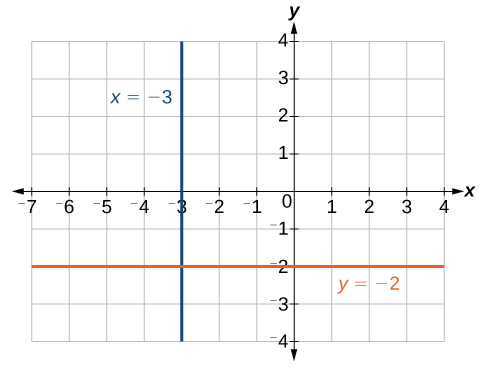
Notice that the y-coordinates vary, however ALL of the \(x\)-coordinates are the same. This is a vertical line through \(x=−3\). See Figure \(\PageIndex{3}\).
Similarly,
When \(A= 0\), the equation represents a horizontal line and is given by:
We simplify this into the form:
\[y=k\]
where \(k\) is a constant. The slope of a horizontal line is zero, and for every \(x\)-value of any point on the line, the \(y\)-coordinate will always be \(k\).
Suppose we want to find the equation of a line that contains the following set of points: \((−2,−2)\),\((0,−2)\),\((3,−2)\), and \((5,−2)\). We can use the point-slope formula. First, we find the slope using any two points on the line.
\[\begin{align*} m&= \dfrac{-2-(-2)}{0-(-2)}\\ &= \dfrac{0}{2}\\ &= 0 \end{align*}\]
Use any point for \((x_1,y_1)\) in the formula, or use the y-intercept.
\[\begin{align*} y-(-2)&= 0(x-3)\\ y+2&= 0\\ y&= -2 \end{align*}\]
The graph is a horizontal line through \(y=−2\). Notice that the x-coordinates vary, however ALL of the y-coordinates are the same. See Figure \(\PageIndex{3}\).
Find the equation of the line passing through the given points: \((1,−3)\) and \((1,4)\).
Solution
The \(x\)-coordinate of both points is \(1\). Therefore, we have a vertical line, \(x=1\).
Find the equation of the line passing through \((−5,2)\) and \((2,2)\).
- Answer
-
Horizontal line: \(y=2\)
Access these online resources for additional instruction and practice with linear equations.
- Solving linear equations
- Equation of a line given two points
Key Concepts
- We can solve linear equations in one variable in the form \(ax +b=0\) using standard algebraic properties. See Example and Example.
- Given two points, we can find the slope of a line using the slope formula. See Example.
- We can identify the slope and \(y\)-intercept of an equation in slope-intercept form. See Example.
- We can find the equation of a line given the slope and a point. See Example.
- We can also find the equation of a line given two points. Find the slope and use the point-slope formula. See Example.
- The standard form of a line has no fractions. See Example.
- Horizontal lines have a slope of zero and are defined as \(y=c\), where \(c\) is a constant.
- Vertical lines have an undefined slope (zero in the denominator), and are defined as \(x=c\), where \(c\) is a constant. See Example.
Contributors and Attributions
The OpenStax College name, OpenStax College logo, OpenStax College book covers, OpenStax CNX name, and OpenStax CNX logo are not subject to the creative commons license and may not be reproduced without the prior and express written consent of Rice University. For questions regarding this license, please contact partners@openstaxcollege.org. If you use this textbook as a bibliographic reference, then you should cite it as follows: OpenStax College, Models and Applications. OpenStax CNX. Apr 1, 2015 http://cnx.org/contents/c49b7453-abd...baac08df9ebc@4. If you redistribute this textbook in a print format, then you must include on every physical page the following attribution: "Download for free at http://cnx.org/contents/c49b7453-abd...baac08df9ebc@4." If you redistribute part of this textbook, then you must retain in every digital format page view (including but not limited to EPUB, PDF, and HTML) and on every physical printed page the following attribution: "Download for free at http://cnx.org/contents/c49b7453-abd...baac08df9ebc@4."
This page titled 2.2: Linear Equations was last modified on Thu, 10 Sep 2026 01:03:18 GMT and is shared under a CC BY 4.0 license and was authored, remixed, and/or curated by Leif Jordan (College of the Desert) via source content that was edited to the style and standards of the LibreTexts platform.
The book could not be loaded just now.