Opening the book…
The notion of equality is fundamental in mathematics, and especially in algebra and algebraic thinking. The equal symbol “=” expresses a relationship. It is not an operation and it should not be read left-to-right. It also does not mean “… and the answer is …”.
For your work to be clear and easily understood by others, it is essential that you use the equal symbol appropriately. We will strengthen your understanding of the equal sign by considering when a statement is true, and by using a pan-balance model for the equal sign.
Always, Sometimes, or Never
We will explore three ways of thinking about statements. There are three possibilities for a statement: always true, sometimes true, or never true.
For example, the statements \(10=10\) and \(11=13-2\) are always true for these whole numbers. However, the statements \(1=2\) and \(20=4+17\) are never true. Statements that are sometimes true can be trickier to think about. For example, \(11=13-x\) could be true only if \(x=2\), but other values like \(x=3\) will make it false. So this means that \(11=13-x\) is sometimes true.
Discussion:
- Examine the following equations. Decide: Is the statement always true, sometimes true, or never true? Justify your answers.
- \(5+3=8\)
- \(\dfrac{2}{3} + \dfrac{1}{2} = \dfrac{3}{5} \)
- \(5 + 3 = y \)
- \(y=y\)
- Consider the equation\(18 - 7 = \_\_\_ \ldotp \nonumber \)
- Fill in the blank with something that makes the equation always true.
- Fill in the blank with something that makes the equation always false.
- Fill in the blank with something that makes the equation sometimes true and sometimes false.
When using the equal sign to solve problems, it is common to misuse it. While you could get a correct answer, the process can still be incorrect. The following discussion discusses an incorrect process to solve \(2.30+3.20-1.50\).
Discussion:
What issues do you perceive when using the following process: \(2.30 + 3.20 = 5.50 - 1.50 = 4 \nonumber \)? How can we solve \(2.30+3.20-1.50\) using a correct process?
The answer is 4, and that is correct. However, the solution is unclear and incorrect. It is true that
\[2.30 + 3.20 = 5.50 \ldotp \nonumber \]
But it is not true that
\[2.30 + 3.20 = 5.50 - 1.40 \ldotp \nonumber \]
Notice that each equal sign used in a process means that everything is equal to the original expression, so this process would claim that \(2.30 + 3.20 = 4\), which is also not true. The incorrect use of the equal symbol makes a calculation difficult to understand.
Discussion:
- Can you write a good definition of the symbol “=”? What does it mean and what does it represent?
- Give some examples. When should the symbol “=”’ be used, and when should it not be used?
- Do these two equations express the same relationships or different relationships? Explain your answer: \(x^{2} - 1 = (x + 1)(x - 1) \ldotp\) \((x+1)(x-1) = x^{2} -1 \ldotp\)
Pan-Balance Scale Model
This picture shows a (very simplistic) two-pan balance scale. Such a scale allows you to compare the weight of two objects. Place one object in each pan. If one side is lower than the other, then that side holds heavier objects. If the two sides are balanced, then the objects on each side weigh the same.
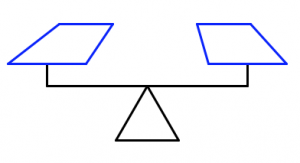
In the following discussion and examples, we will explore the idea of keeping the two sides balanced and connect it to algebraic thinking.
Discussion:
In the pictures below:
- The orange triangles all weigh the same.
- The green circles all weigh the same.
- The purple squares all weigh the same.
- The silver stars all weigh the same.
- The scale is balanced.
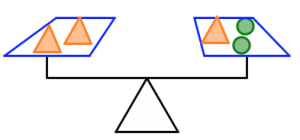
1. In the picture below, what do you know about the weights of the triangles and the circles? How do you know it?
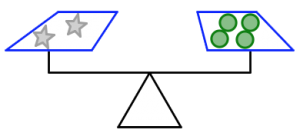
2. In the picture below, what do you know about the weights of the circles and the stars? How do you know it?
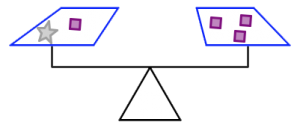
3. In the picture below, what do you know about the weights of the stars and the squares? How do you know it?
Notice that the picture starts by giving you five assumptions, the first four confirm that all figures that look the same will weigh the same, and the last one supposes that the scale is balanced. From the rest of the section and for the assigned problems, please make these assumptions.
In the first representation above, you could remove one triangle on each side and still keep the balance. Which will result in one triangle on one side and two circles on the other. This means that one triangle weighs the same as two circles.
In the second representation, you could group the figures. If you have two stars on the left and four circles on the right, an approach to work on this is to distribute the weight equally for each of the figures. In other words, we could assign two circles to each star. So each star has the weight of two circles.
In the third representation, you could remove one square on each side, which will result in one star on the left and two squares on the right. Therefore, one star weighs the same as two squares.
This foundational discussion will drive the problems and examples for this section.
In the pictures below:
- The orange triangles all weigh the same.
- The green circles all weigh the same.
- The purple squares all weigh the same.
- The scale is balanced.
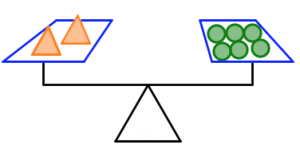
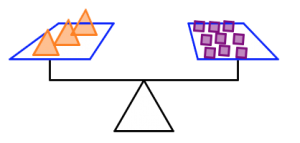
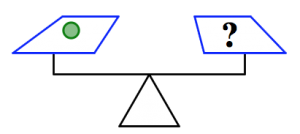
How many purple squares will balance with one circle? Justify your answer.
Solution
The solutions will vary. Here is one solution:
From the second representation, one triangle is the same as three squares. Then, in the first representation, we could replace six squares with two triangles, and then we have that six squares are the same as six circles. Therefore, one circle is the same as one purple square.
Discussion:
What do these type of problems have to do with the “=” symbol?
Notice that while we provided a solution in words, we could also represent this by using equations. Below, we provide a different solution and we also represent it in a different way. We use equations and the equal sign for solving the question from the previous example: How many purple squares will balance with one circle?
Using the first representation we have:
\[2 \text{ triangles}= 6\text{ circles}\]
This is equivalent to saying:
\[1 \text{ triangle}=3 \text{ circles}\]
Now, using the second representation, we have the following equation:
\[3 \text{ triangles}=9 \text{ squares}\]
Which is equivalent to saying:
\[1 \text{ triangle}=3 \text{ squares}\]
Now by using the two results: \(1 \text{ triangle}=3 \text{ circles}\) and that \(1 \text{ triangle}=3 \text{ squares}\), notice that both include \(1\) triangle. So, we have that
\[3 \text{ circles}=1 \text{ triangle}=3 \text{ squares}\]
Which means that:
\[3 \text{ circles}=3 \text{ squares}\]
And we can conclude that:
\[1 \text{ circle}=1 \text{ square}\]
To purposefully connect algebraic processes with balance scales, you could think about figures to represent a specific variable. Let's start by thinking about a scale that is balanced with one square and five circles on the left side and two squares and two circles on the right side. If you think of squares as a representation of \(x\) and circles as units or just whole numbers, then you will have the equation:
\[x+5=2x+2\]
Use a pan balance representation to solve the equation \(x+5=2x+2\). Include a pan-balance representation to the left and annotate your representation with the corresponding equation to the right of the representation.
Solution

Then we say that x=3.
We will expand on this idea in Section 4.6.
Although this representation has limitations, especially with negative numbers, the key idea of keeping an equation balanced is key to understanding algebraic reasoning and the meaning of the equal sign.
This page titled 4.4: Appropriate Use of the Equal Sign was last modified on Tue, 16 Jun 2026 02:38:05 GMT and is shared under a CC BY-SA 4.0 license and was authored, remixed, and/or curated by Michelle Manes via source content that was edited to the style and standards of the LibreTexts platform.
The book could not be loaded just now.