Opening the book…
One of the things that makes fractions such a difficult concept to learn is that you have to think about them in a lot of different ways, depending on the problem at hand. For now, we are going to think of a fraction as the answer to a division problem.
The Pies per Child Model
Suppose 6 pies are to be shared equally among 3 children. This yields 2 pies per kid. We write \[\dfrac{6}{3} = 2 \ldotp \nonumber \]
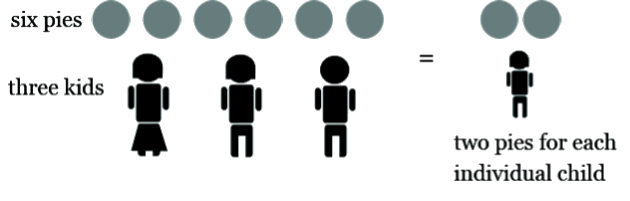
The fraction \(\frac{6}{3}\) is equivalent to the division problem \(6 \div 3 = 2\). It represents the number of pies one whole child receives when three kids share six pies equally.
In the same way:
- Sharing 10 pies among 2 kids yields \(\dfrac{10}{2} = 5\) pies per kid.
- Sharing 8 pies among 2 kids yields \(\dfrac{8}{2} = 4\) pies per kid.
- Sharing 5 pies among 5 kids yields \(\dfrac{5}{5} = 1\) pie per kid.
- Sharing 1 pie among 2 kids yields \(\dfrac{1}{2}\), which we call “one half.”
Notice that sharing 1 pie among 2 kids introduces the concept of fractions less than one. If one pie is shared equally between two kids, then each child receives a portion of the pie, which we choose to call “half.”
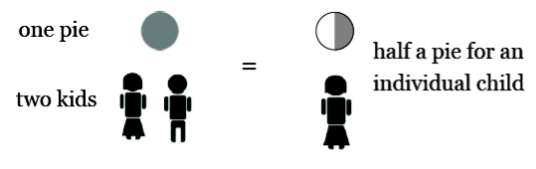
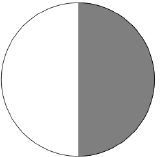
Thus, you can associate the number \(\dfrac{1}{2}\) to the picture of a circle split in two parts with one part shaded. When you split a circle into two equal parts, each part has a size of \(\dfrac{1}{2}\).
In the same way, if you split a circle (a whole) into three equal parts, each part is a third. By shading one of those parts, you represent one third, that is, \(\dfrac{1}{3}\). (And this is indeed the amount of pie an individual child would receive if one pie is shared among three.)
If you split a circle (a whole) into five equal parts, each part is a fifth. By shading one of those parts, you represent one fifth, that is, \(\dfrac{1}{5}\). This is the amount of pie an individual receives if one pie is shared among five kids. Notice that three fifths is three parts of size one fifth and is written as \(\dfrac{3}{5}\), the amount of pie an individual receives if three pies are shared among five children.
Discussion:
Carefully explain why this is true: If five kids share three pies equally, each child receives an amount that looks like this:
 Figure \(\PageIndex{1}\): Amount of pie each child would receive. (This image was AI generated)
Your explanation will probably require both words and pictures.
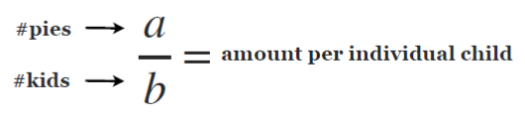
In our model, a fraction \(\dfrac{a}{b}\) represents the amount of pie an individual child receives when \(a\) pies are shared equally by \(b\) kids.
Discussion:
- What is \(\dfrac{2}{2}\)? What is \(\dfrac{7}{7}\)? What is \(\dfrac{100}{100}\)? How can you use the Pies per Child Model to make sense of \(\dfrac{a}{a}\) for any positive whole number
 ?
- What is \(\dfrac{2}{1}\)? What is \(\dfrac{7}{1}\)? What is \(\dfrac{1876}{1}\)? How can you use the Pies per Child Model to make sense of \(\dfrac{b}{1}\) for any positive whole number
 ?
- Write the answer to this division problem: “I have no pies to share among thirteen kids.” How can you generalize this division problem to make a general statement about fractions?
For a fraction \(\dfrac{a}{b}\), the top number \(a\) (which, for us, is the number of pies) is called the numerator of the fraction, and the bottom number (the number of kids), is called the denominator of the fraction.
Most people insist that the numerator and denominator each be whole numbers, but they do not have to be. To understand why the numerator and denominator need not be whole numbers, we must first be a little gruesome. Instead of dividing pies, let’s divide kids! Here is one kid:

Using the Pie per Child Model, the fraction \(\dfrac{1}{\left( \dfrac{1}{2} \right)}\) would represent one pie to each “group” of half a child. So how much would a whole child receive? Well, we would have a picture like this:
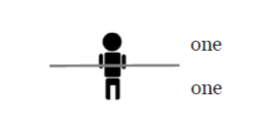
Notice that in this context, the whole child gets two pies, which can be justified by the following process:
\[\frac{1}{\left( \dfrac{1}{2} \right)} = 2 \ldotp \nonumber \]
Discussion:
Draw pictures for these problems if it helps!
- What does \(\dfrac{1}{\left( \dfrac{1}{3} \right)}\)represent? Justify your answer using the Pies per Child Model.
- What is \(\dfrac{1}{\left( \dfrac{1}{6} \right)}\)? Justify your answer.
- Explain why the fraction \(\dfrac{5}{\left( \dfrac{1}{2} \right)}\) represents the number 10. (How much pie is given to half a kid? To a whole kid?)
- What is \(\dfrac{4}{\left( \dfrac{1}{3} \right)}\)? Justify your answer.
- Challenge: Two-and-a-half pies are to be shared equally among four-and-a-half children. How much pie does an individual (whole) child receive? Justify your answer.




Fractions Less than One, Greater than One, and Mixed Numbers
A fraction with a numerator smaller than its denominator is called a fraction less than one. In school math jargon, it is sometimes called a proper fraction. For example, \(\frac{45}{58}\) is “proper.”
A fraction with a numerator larger than its denominator is called a fraction greater than one. In school math jargon, it is sometimes called an improper fraction. For example, \(\frac{7}{3}\) is “improper.” Despite their name and these prejudices, improper fractions are useful nonetheless!
You can write an improper fraction as a combination of a whole number and a proper fraction, which is often called a “mixed number.”
With a mixed number, you have a good sense of the overall size of the number: “a little more than five,” or “a bit less than 17.” But it is often easier to do calculations with improper fractions instead of using the mixed numbers. Let's explore some examples.
If seven pies are shared among three kids, then each kid will certainly receive two whole pies, leaving one pie to share among the three children.
Thus, \(\dfrac{7}{3}\) equals 2 plus \(\dfrac{1}{3}\). People write: \(\dfrac{7}{3} = 2 \dfrac{1}{3}\) and call the result a mixed number. One can also write: \(2 + \dfrac{1}{3}\) which is what \(2 \dfrac{1}{3}\) really means. But most people choose to omit the plus sign.
If 4 kids share 23 pies, we can give them each 5 whole pies. That uses 20 pies, and there are 3 pies left over.
|
|
|
|
|
Those three pies are still to be shared equally by the four kids. We have: \[\dfrac{23}{4} = 5 \dfrac{3}{4} \ldotp \nonumber \]
For fun, let's write the number 2 as a fraction with denominator 5: \[2 = \dfrac{10}{5} \ldotp \nonumber \]
So: \[2 \dfrac{1}{5} = 2 + \dfrac{1}{5} = \dfrac{10}{5} + \dfrac{1}{5} = \dfrac{11}{5} \ldotp \nonumber \]
We have written the mixed number \(2 \dfrac{1}{5}\) as the improper fraction \(\dfrac{11}{5}\).
Discussion:
- Write each of the following as a mixed number. Explain how you got your answer. \(\dfrac{17}{3}, \qquad \dfrac{8}{5}, \qquad \dfrac{100}{3}, \qquad \dfrac{200}{199} \ldotp\)
- Convert each of these mixed numbers into “improper” fractions. Explain how you got your answer. \(3 \dfrac{1}{4}, \qquad 5 \dfrac{1}{6}, \qquad 1 \dfrac{3}{11}, \qquad 200 \dfrac{1}{200} \ldotp\)
Students are often asked to memorize the names “proper fractions,” “improper fractions,” and “mixed number” so that they can follow directions on tests and problem sets.
But, to a mathematician, these names are not at all important! There is no “correct” way to express an answer (assuming, that the answer is mathematically the right number). We often wish to express our answer in a simpler form, but sometimes the context will tell you what form is “simple” and what form is more complicated.
As you work on problems in this chapter, decide for yourself which type of fraction would be best to work with as you do your task.
This page titled 3.1: What is a Fraction? was last modified on Tue, 16 Jun 2026 02:38:01 GMT and is shared under a CC BY-SA 4.0 license and was authored, remixed, and/or curated by Michelle Manes via source content that was edited to the style and standards of the LibreTexts platform.
The book could not be loaded just now.