Opening the book…
Exercises 1-18
Analyze the given equations and questions thoroughly. For slope fields, provide a visual sketch if needed.
Sketch slope field for \(y' = e^{x-y}\). How do the solutions behave as \(x\) grows? Can you guess a particular solution by looking at the slope field?
- Answer
-

Figure \(\PageIndex{1}\): Slope fields for \(y' = e^{x-y}\): (CC BY-SA 4.0; Neelam Shukla) Yes
Sketch slope field for \(y' = x^2\).
- Answer
-
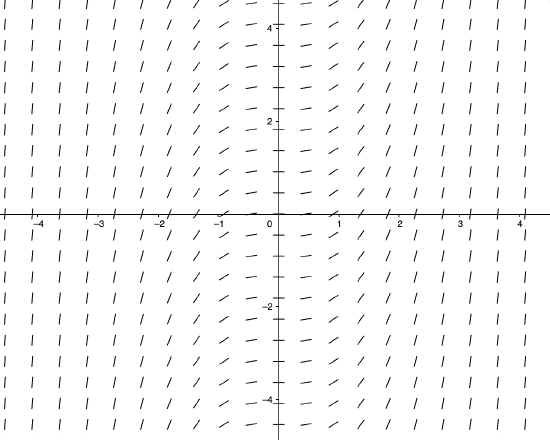
Figure \(\PageIndex{2}\): Slope fields for \(y' = x^2 \): (CC BY-SA 4.0; Neelam Shukla)
Sketch slope field for \(y' = y^2\).
Is it possible to solve the equation \(y' = \frac {xy}{\cos {x}} \) for \(y (0) = 1\)? Justify.
Is it possible to solve the equation \( y' = y \sqrt {\left \vert x \right \vert}\) for \( y(0) = 0 \)? Is the solution unique? Justify.
Match equations \(y' = 1 - x\), \(y' = x - 2y\), \( y' = x(1 - y) \) to slope fields. Justify.


Figure \(\PageIndex{3}\): Slope fields (a) on the left, (b) in the middle, and (c) on the right.
- Answer
-
- \( y' = 1 - x \), Graph (b): As the slope does not depend on y and does not change as y changes, but is 0 (horizontal line) when x=1
- \(y' = x - 2y\), Graph (c): As the slope changes as x and y change, but notice the values of (x, y) when it is 0, (-2,-1), (0, 0), (2,1)
- \( y' = x(1 - y) \), Graph (a): Notice when the slope (dy/dx) is 0, the values of (x, y), for x=0 for every value of y or y=1 and for every value of x
Take \(y' = f(x, y)\), \( y(0) = 0\), where \( f(x, y) > 1 \) for all \(x\) and \(y\). If the solution exists for all \(x\), can you say what happens to \(y(x)\) as \(x\) goes to positive infinity? Explain.
Given the differential equation \( (y - x)y' = 0\) with initial condition \( x(0) = 0 \).
- Find two distinct solutions.
- Explain why this does not violate Picard’s theorem.
Hint: Picard–Lindelöf Theorem:
If \(f(x,y)\) is continuous in some rectangle around \((x_0, y_0) \) and Lipschitz continuous in \(y\), then the initial value problem
\( y' = f(x,y), y(x_0) = y_0 \) has a unique solution in some interval around \( x_0 \). Uniqueness depends on the Lipschitz condition in \(y\).
- Answer
-
- The two solutions are \( y = x \) and \( y = 0\)
- We are unable to write a function as y'= f(x,y). Picard’s theorem guarantees uniqueness only when f(x,y) is Lipschitz in y. At (0, 0) and along line \( x=y \) function fails the Lipschitz condition. Hence, this does not violate Picard’s theorem.
Suppose \(y'=f(x,y)\). What will the slope field look like? Explain and sketch an example, if you know the following about \(f(x,y)\)?
- \(f\) does not depend on \(y\).
- \(f\) does not depend on \(x\).
- \(f,(t,t)=0\) for any number \(t\).
- \(f(x,0)=0\) and \(f(x,1)=1\) for all \(x\).
Find a solution to \(y'=|y|, y(0)=0\). Does Picard’s theorem apply?
- Answer
-
- \(
\quad y(x) = 0, \quad y(x) = \begin{cases} Ce^{-x}, & x \le 0 \\[1mm]
Ce^x, & x \ge 0 \end{cases} \) - The Picard's theorem does not apply as the function is not continuous at \(y =0\).
- \(
Take an equation \(y'=(y-2x)g(x,y)+2\) for some function \(g(x,y)\). Can you solve the problem for the initial condition \(y(0)=0\), and if so what is the solution?
Suppose \(y'=f(x,y)\) is such that \(f(x,1)=0\) for every \(x,f\) is continuous and \(\frac{\partial f}{\partial y}\) exists and is continuous for every \(x\) and \(y\).
- Guess a solution given the initial condition \(y(0)=1\).
- Can graphs of two solutions of the equation for different initial conditions ever intersect?
- Given \(y(0)=0\), what can you say about the solution. In particular, can \(y(x)>1\) for any \(x\)? Can \(y(x)=1\) for any \(x\)? Why or why not?
Sketch the slope field of \( y' = y^3 \). Can you visually find the solution that satisfies \( y(0) = 0\)?
- Answer
-

Figure \(\PageIndex{4}\): Slope field for \( y' = y^3 \). Line segments appear to be flat in the middle, increasing and curving upward above the middle line segments, decreasing and curving downward below the middle line segments.
Is it possible to solve \( y' = xy \) for \( y(0) = 0 \)? Is the solution unique?
- Answer
-
Yes, a solution exists. The equation is \(y'=f(x,y)\) where \(f(x,y)=xy\). The function \(f(x,y)\) is continuous and \(\frac{\partial f}{\partial y}=x\), which is also continuous near \((0, 0)\). So a solution exists and is unique. In fact, \(y=0\) is the solution.
Is it possible to solve \( y' = \frac {x}{x^2 - 1}\) for \( y(1) = 0 \)?
- Answer
-
No, the equation is not defined at \((x,y) = (1, 0)\).
Match equations \( y' = \sin x\), \(y' = \cos y\), \(y' = y \cos (x)\) to slope fields. Justify.


- Answer
-
- \(y'=\cos y\)
- \(y'=y\cos (x)\)
- \(y'=\sin x\)
Justification left to the reader.
Suppose
\[f(y)=\left\{\begin{array}{cc}{0}&{if\: y>0,} \\ {1}&{if\: y\leq 0.}\end{array}\right.\nonumber\]
Does \(y'=f(y)\), \(y(0)=0\) have a continuously differentiable solution? Does Picard's theorem apply? Why, or why not?
- Answer
-
Picard's Theorem does not apply as \(f\) is not continuous at \(y=0\). The equation does not have a continuously differentiable solution. Suppose it did. Notice that \(y'(0)=1\). By the first derivative test, \(y(x)>0\) for small positive \(x\). But then for those \(x\) we would have \(y'(x)=0\), so clearly the derivative cannot be continuous.
Consider an equation of the form \(y'=f(x)\) for some continuous function \(f\), and an initial condition \(y(x_{0})=y_{0}\). Does a solution exist for all \(x\)? Why or why not?
- Answer
-
The solution is \(y(x)=\int_{x_{0}}^{x}f(s)ds+y_{0}\), and this does indeed exist for every \(x\).
This page titled 1.4E: Exercises for Section 1.4 was last modified on Mon, 16 Mar 2026 02:39:12 GMT and is shared under a CC BY-NC-SA 3.0 license and was authored, remixed, and/or curated by Vinh Kha Nguyen, Neelam R. Shukla, and Fatemeh Yarahmadi.
The book could not be loaded just now.