Opening the book…
Exercises 1-13
Solve the following exercises using Laplace transforms and related techniques for differential equations.
Verify the Laplace transforms given in Table 5.2.1 by deriving them using the definition of the Laplace transform.
Using the Heaviside function \[u(t)= \left\{ \begin{array}{cc} 0 & {\rm{if~}}t<0, \\ 1 & {\rm{if~}}t \geq 0.\end{array} \right. \nonumber \] write down the piecewise function that is \(0\) for \(t<0, t^2\) for \(t\) in \([0,1]\) and \(t\) for \(t>1\).
- Answer
-
\(f(t) = t^2 u(t) + t(1-t)u(t-1)\)
Using the Laplace transform solve
\[ mx'' + cx'+kx =0,\quad x(0)=a, \quad x'(0)=b.\nonumber\]
where \(m>0,c>0,k>0\), and \(c^2-4km>0\) (system is overdamped).
Using the Laplace transform solve
\[ mx'' + cx'+kx =0,\quad x(0)=a, \quad x'(0)=b.\nonumber\]
where \(m>0,c>0,k>0\), and \(c^2-4km<0\) (system is underdamped).
- Answer
-
\(x(t) = e^{-\frac{c}{2m}t} \left( a \cos\left(\frac{\sqrt(4km-c^2}{2m}\right) + \frac{2m b + c a}{\sqrt(4km-c^2)} \sin\left(\frac{\sqrt(4km-c^2}{2m}\right)t\right). \)
Using the Laplace transform solve
\[ mx'' + cx'+kx =0,\quad x(0)=a, \quad x'(0)=b.\nonumber\]
where \(m>0,c>0,k>0\), and \(c^2=4km\) (system is critically damped).
Solve \(x''+x=u(t-1)\) for initial conditions \(x(0)=0\) and \(x'(0)=0\).
- Answer
-
\(x(t) = u(t - 1) (1 - \cos(t - 1))\)
Suppose \(\mathcal{L}\{f(t)\}=F(s)\), then show
\[ \mathcal{L}\{-tf(t)\}=F'(s).\nonumber\]
Hint: Differentiate under the integral sign.
Solve \(x'''+x=t^3u(t-1)\) for initial conditions \(x(0)=1\) and \(x'(0)=0\), \(x''(0)=0\).
- Answer
-
\(x(t) = \frac{2}{3}e^{\frac{1}{2}t}\cos(\frac{\sqrt3}{2}t)+\frac{1}{3}e^{-t}+4(t-1)[-5+3(t-1)+3(t-1)^2+(t-1)^3+\frac{2}{3}e^{-(t-1)}+\frac{13}{2}e^{\frac{1}{2}(t-1)}\cos(\frac{\sqrt 3(t-1)}{2} -3\sqrt 3e^{\frac{1}{2}(t-1)}\sin(\frac{\sqrt 3(t-1)}{2}]\)
Show the second shifting property: \( \mathcal{L}\{f(t-a)u(t-a)\}=e^{-as}\mathcal{L}\{f(t)\} \).
Define
\[ f(t)= \left\{ \begin{array}{ccc} (t-1)^2 & if~1 \leq t<2, \\ 3-t & if~2 \leq t<3, \\ 0 & otherwise. \end{array} \right. \nonumber\]
- Sketch the graph of \(f(t)\).
- Write down \(f(t)\) using the Heaviside function.
- Solve \(x''+x=f(t), x(0)=0,x'(0)=0\) using Laplace transform.
- Answer
-
-
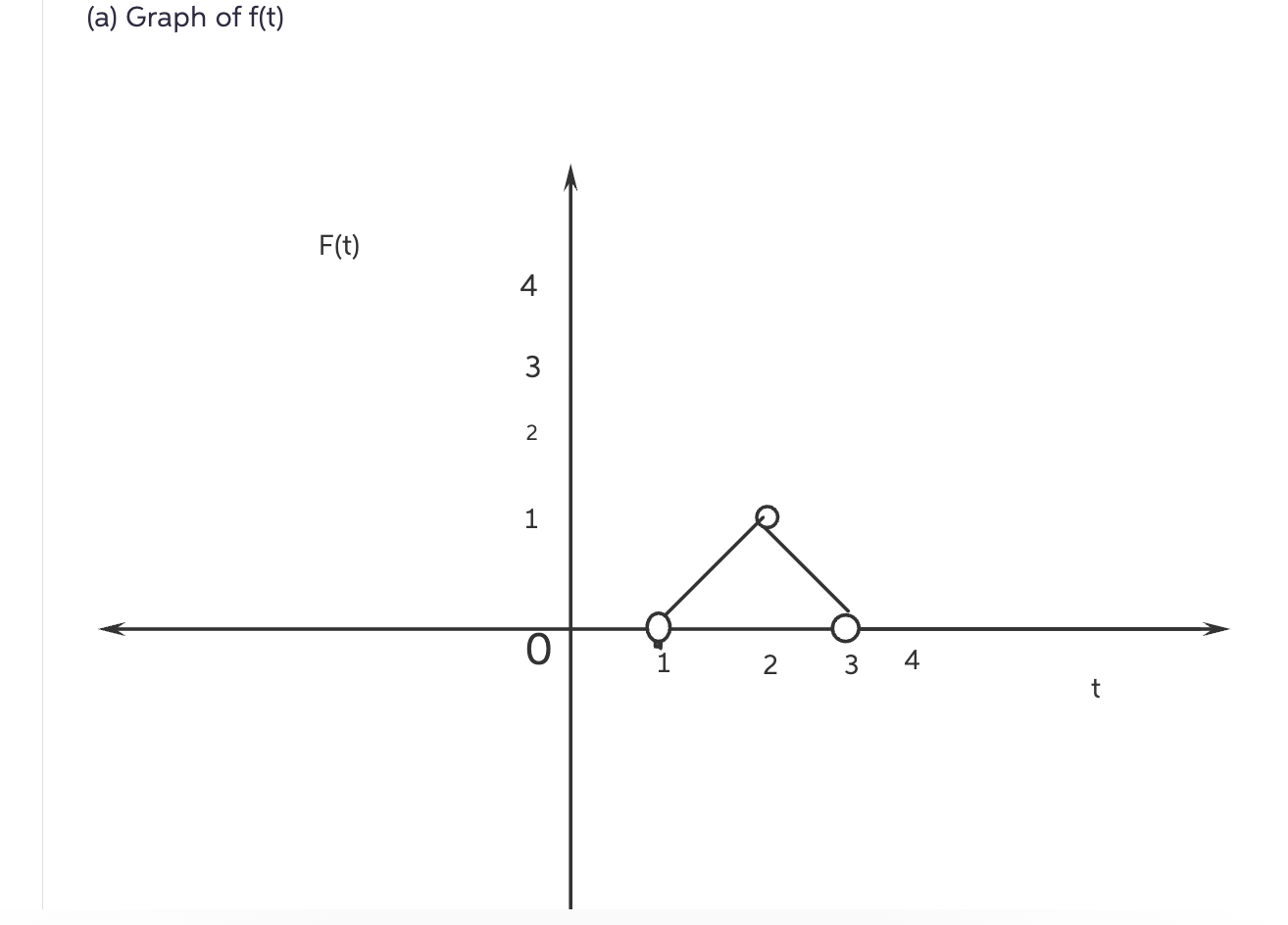
Figure \(\PageIndex{1}\): Graph of \(f(t) =(t-1)^2 : 1 \leq t<2, =3-t : 2 \leq t<3\) and \(= 0\) otherwise. - \(f(t)= (t-1)^2[u(t-1)-u(t-2)]+(3-t)[u(t-2)-u(t-3)]\)
- \(x(t) =u_1(t)[-2+(t-1)^2+2\cos(t-1)]+u_2(t)[2-3(t-2)-9t-2)^2-2\cos(t-2)+3\sin(t-2)]+u_3(t)[t-3-\sin(t-3)]\)
-
Find the transfer function for \(mx'' + cx'+kx =f(t)\) (assuming the initial conditions are zero).
Solve \(x''-x=(t^2-1)u(t-1)\) for initial conditions \(x(0)=1,x'(0)=2\) using the Laplace transform.
- Answer
-
\(x(t)=(2e^{t-1}-t^{2}-1)u(t-1)-\frac{1}{2}e^{-t}+\frac{3}{2}e^{t}\)
Find the transfer function for \(x'+x=f(t)\) (assuming the initial conditions are zero).
- Answer
-
\(H(s)=\frac{1}{s+1}\)
This page titled 5.2E: Exercises for Section 5.2 was last modified on Thu, 10 Apr 2025 05:36:06 GMT and is shared under a CC BY-NC-SA 3.0 license and was authored, remixed, and/or curated by Vinh Kha Nguyen, Neelam R. Shukla, and Fatemeh Yarahmadi.
The book could not be loaded just now.