Opening the book…
Exercises 1-9
Analyze the differential equations by constructing phase diagrams, finding critical points, classifying their stability, and sketching solutions.
Consider \(x' = x^2\).
- Draw the phase diagram, find the critical points and mark them stable or unstable.
- Sketch typical solutions of the equation.
- Find \(\lim \limits_{t\to\infty} x(t)\) for the solution with the initial condition \(x(0) = -1\).
- Answer
-
-
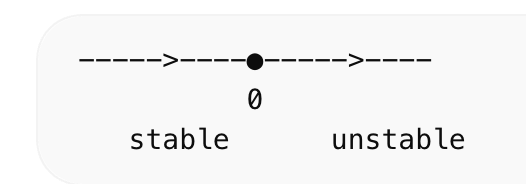
Figure \(\PageIndex{1}\): Phase diagram for \(x' = x^2 > 0\) for all \(x \ne 0 \), and \( 0\) is critical point. Slope lines will approach toward zero for \(x<0\) and move away from zero for \(x>0\) (CC BY-SA 4.0; Neelam Shukla)
- \(x=0\) is unstable (semistable), \(x=0\) is stable from the left, and unstable from the right.
- \( x(t) = \frac{1}{-1 - t} = -\frac{1}{1+t}:\lim \limits_{t\to\infty} x(t) = 0\)
-
Let \(x' = \sin x\).
- Draw the phase diagram for \(-4\pi \leq x \leq 4\pi \). On this interval, mark the critical points stable or unstable.
- Sketch typical solutions of the equation.
- Find \(\lim \limits_{t\to\infty} x(t)\) for the solution with the initial condition \(x(0) = 1\).
- Answer
-
- Critical points are \(x = -4\pi, -3\pi, -2\pi, -\pi, 0, \pi, 2\pi, 3\pi, 4\pi. \).

Figure \(\PageIndex{1}\): Phase diagram for \(x' = \sin x\\) for \(-4\pi \leq x \leq 4\pi \). Thick dots represent stable and hollow dots represent unstable critical points. (CC BY-SA 4.0; Neelam Shukla) - If \( 2k \pi < x(0) < (2k+1)\pi \), then \(\sin x>0 \) and the solution
increases toward the stable equilibrium \((2k+1)\pi\).
whereas if \((2k+1)\pi < x(0) < (2k+2)\pi\), then \(\sin x<0\) and the solution
decreases toward the stable equilibrium \((2k+1)\pi\). - \(\pi\)
- Critical points are \(x = -4\pi, -3\pi, -2\pi, -\pi, 0, \pi, 2\pi, 3\pi, 4\pi. \).
Suppose \(f(x)\) is positive for \(0 < x < 1\), it is zero when \(x=0\) and \(x=1\), and it is negative for all other \(x\).
- Draw the phase diagram for \(x' = f(x)\), find the critical points and mark them stable or unstable.
- Sketch typical solutions of the equation.
- Find \(\lim \limits_{t\to\infty} x(t)\) for the solution with the initial condition \(x(0) = 0.5\).
- Answer
-
- \(0,\: 1,) are critical points.

Figure \(\PageIndex{3}\): Phase diagram for \(f(x)\) is positive for \(0 < x < 1\), it is zero when \(x=0\) and \(x=1\), and it is negative for all other \(x\) (CC BY-SA 4.0; Neelam Shukla) - \begin{cases}
f(x) > 0, & 0 < x < 1,\\
f(x) = 0, & x = 0,1,\\
f(x) < 0, & \text{otherwise}.
\end{cases}\begin{cases}
x = 0 \text{ is unstable},\\
x = 1 \text{ is stable}.
\end{cases} - 1
- \(0,\: 1,) are critical points.
Start with the logistic equation \(\frac{dx}{dt} = kx (M -x)\). Suppose that we modify our harvesting. That is we will only harvest an amount proportional to current population. In other words we harvest \(hx\) per unit of time for some \(h > 0\) (Similar to earlier example with \(h\) replaced with \(hx\)).
- Construct the differential equation.
- Show that if \(kM > h\), then the equation is still logistic.
- What happens when \(kM < h\)?
A disease is spreading through the country. Let \(x\) be the number of people infected. Let the constant \(S\) be the number of people susceptible to infection. The infection rate \(\frac{dx}{dt}\) is proportional to the product of already infected people, \(x\), and the number of susceptible but uninfected people, \(S-x\).
- Write down the differential equation.
- Supposing \(x(0) > 0\), that is, some people are infected at time \(t=0\), what is \(\displaystyle \lim_{t\to\infty} x(t)\).
- Does the solution to part b) agree with your intuition? Why or why not?
Let \(x' = (x-1)(x-2)x^2\).
- Sketch the phase diagram and find critical points.
- Classify the critical points.
- If \(x(0) = 0.5\) then find \(\lim \limits_{t\to\infty} x(t)\).
- Answer
-
- \(0,\: 1,\: 2\) are critical points.
- \(x=0\) is unstable (semistable), \(x=1\) is stable, and \(x=2\) is unstable.
- \(1\)
Let \(x' = e^{-x}\).
- Find and classify all critical points.
- Find \(\lim \limits_{t\to\infty} x(t)\) given any initial condition.
- Answer
-
- There are no critical points.
- \(\infty\)
Assume that a population of fish in a lake satisfies\(\frac{dx}{dt} = kx (M -x)\). Now suppose that fish are continually added at \(A\) fish per unit of time.
- Find the differential equation for \(x\).
- What is the new limiting population?
- Answer
-
- \(\frac{dx}{dt}=kx(M-x)+A\)
- \(\frac{kM+\sqrt{(kM)^{2}+4Ak}}{2k}\)
Suppose \(\frac{dx}{dt} = (x-\alpha)(x-\beta)\) for two numbers \(\alpha < \beta\). For (b), (c), and (d), find \(\displaystyle \lim_{t\to\infty} x(t)\) based on the phase diagram.
- Find the critical points, and classify them.
- \(x(0) < \alpha\),
- \(\alpha < x(0) < \beta\),
- \(\beta < x(0)\).
- Answer
-
- \(\alpha\) is a stable critical point, \(\beta\) is an unstable one.
- \(\alpha\)
- \(\alpha\)
- \(\infty\) or DNE.
Let \(x' = e^{2x}\).
- Find and classify all critical points.
- Find \(\lim \limits_{t\to\infty} x(t)\) given any initial condition.
- Answer
-
- There are no critical points.
- \(\infty\)
This page titled 1.9E: Exercises for Section 1.9 was last modified on Tue, 10 Mar 2026 23:40:05 GMT and is shared under a CC BY-NC-SA 3.0 license and was authored, remixed, and/or curated by Vinh Kha Nguyen, Neelam R. Shukla, and Fatemeh Yarahmadi.
The book could not be loaded just now.