Opening the book…
Exercises 1 - 4
Sketch the curves below by eliminating the parameter \(t\). Give the orientation of the curve.
- \( x=t^2+2t, \quad y=t+1\)
- Answer
-
Orientation: bottom to top
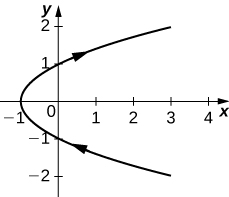
Figure \(\PageIndex{1}\): A parabola open to the right with \( (−1, 0) \) being the leftmost point (the vertex), with arrow on the curve indicating the direction going from smaller \(y\) values to larger.
- \( x=\cos(t), \quad y=\sin(t), \quad \text{for } (0,2π]\)
- \( x=2t+4, \quad y=t−1\)
- Answer
-
Orientation: left to right

Figure \(\PageIndex{2}\): A straight line passing through \( (0, −3) \) and \( (6, 0) \) with an arrow along the line pointing up and to the right.
- \( x=3−t, \quad y=2t−3, \quad \text{for }1.5≤t≤3\)
Exercise 5
Eliminate the parameter and sketch the graph.
- \(x=2t^2,\quad y=t^4+1\)
- Answer
-
\( y=\dfrac{x^2}{4}+1\)

Figure \(\PageIndex{3}\): Half a parabola starting at the origin and passing through \( (2, 2) \) with arrow on the curve up and to the right.
Exercises 6 - 9
Use technology (CAS or calculator) to sketch the parametric equations.
- [T] \(x=t^2+t, \quad y=t^2−1\)
- [T] \( x=e^{−t}, \quad y=e^{2t}−1\)
- Answer
-

Figure \(\PageIndex{4}\): A decreasing, concave up curve passing through the points through \( (1, 0) \) and \( (0, 3) \) with arrow on the curve pointing up and to the left.
- [T] \( x=3\cos t, \quad y=4\sin t\)
- [T] \( x=\sec t, \quad y=\cos t\)
- Answer
-

Figure \(\PageIndex{5}\): A graph with asymptotes at the \(x\) and \(y\) axes. There is a portion of the graph in the third quadrant that is decreasing and concave down with arrow pointing down and to the right. There is a portion of the graph in the first quadrant that is decreasing and concave up with arrow pointing down and to the right.
Exercises 10 - 20
Sketch the parametric equations by eliminating the parameter. Indicate any asymptotes of the graph.
- \( x=e^t, \quad y=e^{2t}+1\)
- \( x=6\sin(2θ), \quad y=-4\cos(2θ)\)
- Answer
-

Figure \(\PageIndex{6}\): An ellipse centered at the origin with a vertical minor axis of length 8, and a horizontal major axis of length 12. The arrows along the ellipse go counterclockwise.
- \( x=\cos θ, \quad y=2\sin(2θ)\)
- \( x=3−2\cos θ, \quad y=−5+3\sin θ\)
- Answer
-

Figure \(\PageIndex{7}\): An ellipse in the fourth quadrant with a horizontal minor axis of length \(4\), and a vertical major axis of length \(6\), with center at \( (3,-5) \). The arrows go clockwise.
- \( x=4+2\cos θ, \quad y=−1+\sin θ\)
- \( x=\sec t, \quad y=\tan t\)
- Answer
-
Asymptotes are \( y=x\) and \( y=−x\)

Figure \(\PageIndex{8}\): A graph with asymptotes at \(y = x\) and \(y = −x\). The first branch of the graph occurs in the second and third quadrants with vertex at \((−1, 0)\). The second branch of the graph occurs in the first and fourth quadrants with vertex as \((1, 0)\).
- \( x=\ln(2t), \quad y=t^2\)
- \( x=e^t, \quad y=e^{2t}\)
- Answer
-
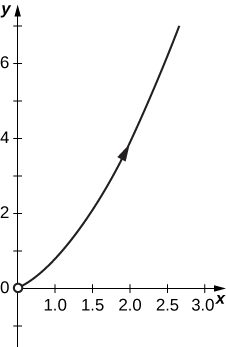
Figure \(\PageIndex{9}\): A curve starting at the origin with an open hole at the origin, and increasing with a concave up graph to the right, with arrow pointing up and to the right.
- \( x=e^{−2t}, \quad y=e^{3t}\)
- \( x=t^3, \quad y=3\ln t\)
- Answer
-

Figure \(\PageIndex{10}\): A curve with asymptote being the \(y\)-axis. The curve starts in the fourth quadrant against the \(y\)-axis, and increases rapidly, passing through \((1, 0)\) at which point is increases much more slowly. The curve is concave down throughout.
- \( x=4\sec θ, \quad y=3\tan θ\)
Exercises 21 - 38
Convert the parametric equations of a curve into rectangular form. No sketch is necessary. State the domain of the rectangular form.
- \( x=t^2−1, \quad y=\dfrac{t}{2}\)
- Answer
- \( x=4y^2−1;\) domain: \( x∈[1,∞)\).
- \( x=\dfrac{1}{\sqrt{t+1}}, \quad y=\dfrac{t}{1+t}, \quad \text{for }t>−1\)
- \( x=4\cos θ, \quad y=3\sin θ, \quad \text{for }t∈(0,2π]\)
- Answer
- \( \dfrac{x^2}{16}+\dfrac{y^2}{9}=1;\) domain \( x∈[−4,4].\)
- \( x=\cosh t, \quad y=\sinh t\)
- \( x=2t−3, \quad y=6t−7\)
- Answer
- \( y=3x+2;\) domain: all real numbers.
- \( x=t^2, \quad y=t^3\)
- \( x=1+\cos t, \quad y=3−\sin t\)
- Answer
- \( (x−1)^2+(y−3)^2=1\); domain: \( x∈[0,2]\).
- \( x=\sqrt{t}, \quad y=2t+4\)
- \( x=\sec t, \quad y=\tan t, \quad \text{for } π≤t<\frac{3π}{2}\)
- Answer
- \( y=\sqrt{x^2−1}\); domain: \( x∈(−\infty,-1]\).
- \( x=2\cosh t, \quad y=4\sinh t\)
- \( x=\cos(2t), \quad y=\sin t\)
- Answer
- \( y^2=\dfrac{1−x}{2};\) domain: \( x∈[-1,1].\)
- \( x=4t+3, \quad y=16t^2−9\)
- \( x=t^2, \quad y=2\ln t, \quad \text{for }t≥1\)
- Answer
- \( y=\ln x;\) domain: \( x∈[1,∞).\)
- \( x=t^3, \quad y=3\ln t, \quad \text{for }t≥1\)
- \( x=t^n, \quad y=n\ln t, \quad \text{for } t≥1,\) where \(n\) is a natural number
- Answer
- \( y=\ln x;\) domain: \( x∈(0,∞).\)
- \( x=\ln(5t), \quad y=\ln(t^2)\) where \( 1≤t≤e\)
- \( x=2\sin(8t), \quad y=2\cos(8t)\)
- Answer
- \( x^2+y^2=4;\) domain: \( x∈[−2,2].\)
- \( x=\tan t, \quad y=\sec^2t−1\)
Exercises 39 - 48
The pairs of parametric equations represent lines, parabolas, circles, ellipses, or hyperbolas. Name the type of basic curve that each pair of equations represents.
- \( x=3t+4, \quad y=5t−2\)
- Answer
- line
- \( x−4=5t, \quad y+2=t\)
- \( x=2t+1, \quad y=t^2−3\)
- Answer
- parabola
- \( x=3\cos t, \quad y=3\sin t\)
- \( x=2\cos(3t), \quad y=2\sin(3t)\)
- Answer
- circle
- \( x=\cosh t, \quad y=\sinh t\)
- \( x=3\cos t, \quad y=4\sin t\)
- Answer
- ellipse
- \( x=2\cos(3t), \quad y=5\sin(3t)\)
- \( x=3\cosh(4t) \quad y=4\sinh(4t)\)
- Answer
- the right branch of a horizontally opening hyperbola
- \( x=2\cosh t, \quad y=2\sinh t\)
Exercises 49 - 50
The following exercises involve parametric equations for a circle.
- Show that \( x=h+r\cos θ, \quad y=k+r\sin θ\) represents the equation of a circle.
- Use the equations in the preceding problem to find a set of parametric equations for a circle whose radius is \(5\) and whose center is \( (−2,3)\).
Exercises 51 - 53
Use a graphing utility to graph the curve represented by the parametric equations and identify the curve from its equation.
- [T] \( x=θ+\sin θ, \quad y=1−\cos θ\)
- Answer
-
The equations represent a cycloid.

Figure \(\PageIndex{11}\): A graph starting at \((−6, 0)\) increasing rapidly to a sharp point at \((−3, 2)\) and then decreasing rapidly to the origin. The graph is symmetric about the \(y\) axis, so the graph increases rapidly to \((3, 2)\) before decreasing rapidly to \((6, 0)\).
- [T] \( x=2t−2\sin t, \quad y=2−2\cos t\)
- [T] \( x=t−0.5\sin t, \quad y=1−1.5\cos t\)
- Answer
-

Figure \(\PageIndex{12}\): A sinusoidal graph with minimum \(y\)-value \(-0.5\) and maximum \(y\)-value 2.5. The minima occur at \(x=-2\pi, 0, 2\pi), and the maxima occur at \(x=-\pi, \pi\).
- An airplane traveling horizontally at 100 m/s over flat ground at an elevation of 4000 meters must drop an emergency package on a target on the ground. The trajectory of the package is given by \( x=100t, \quad y=−4.9t^2+4000, \quad \text{where }t≥0\) where the origin is the point on the ground directly beneath the plane at the moment of release. How many horizontal meters before the target should the package be released in order to hit the target?
- The trajectory of a bullet is given by \( x=v_0(\cos α)t, \quad y=v_0(\sin α)t−\frac{1}{2}gt^2\) where \( v_0=500\) m/s, \(g=9.8=9.8\text{ m/s}^2\), and \( α=30\) degrees. When will the bullet hit the ground? How far from the gun will the bullet hit the ground?
- Answer
- 22,092 meters at approximately 51 seconds.
- [T] Use technology to sketch the curve represented by \( x=\sin(4t), \quad y=\sin(3t), \quad \text{for }0≤t≤2π\).
- [T] Use technology to sketch \( x=2\tan(t), \quad y=3\sec(t), \quad \text{for }−π<t<π.\)
- Answer
-

Figure \(\PageIndex{13}\): A graph with asymptotes roughly near \(y = \frac{3}{2}x\) and y = −\frac{3}{2}x. The upper branch of the graph is in the first and second quadrants with vertex at \((0, 3)\). The lower branch of the graph is in the third and fourth quadrants with vertex at \((0, −3)\).
- Sketch the curve known as an epitrochoid, which gives the path of 3a point on a circle of radius \(b\) as it rolls on the outside of a circle of radius \(a\). The equations are
\( x=(a+b)\cos t−c⋅\cos\left[\frac{(a+b)t}{b}\right], \quad y=(a+b)\sin t−c⋅\sin\left[\frac{(a+b)t}{b}\right]\).
Let \( a=1,\;b=2,\;c=1.\)
- [T] Use technology to sketch the spiral curve given by \( x=t\cos(t), \quad y=t\sin(t)\) for \( −2π≤t≤2π.\)
- Answer
-

Figure \(\PageIndex{14}\): A graph starting at roughly \((−6, −1)\) decreasing to a minimum in the third quadrant near \((−1, −4.8)\) increasing through roughly \((0, −4.7)\) and \((3, 0)\) to a maximum near \((1, 1.9)\) before decreasing through \((0, 1.5)\) to the origin. The graph is symmetric about the \(y\)- axis, so the graph increases through \((0, 1.5)\) to a maximum in the second quadrant, decreases again through \((0, −4.7)\), and then increases to \((6, −1)\).
- [T] Use technology to graph the curve given by the parametric equations \( x=2\cot(t), \quad y=1−\cos(2t), \quad \text{for }−π/2≤t≤π/2.\) This curve is known as the witch of Agnesi.
- [T] Sketch the curve given by parametric equations \( x=\cosh(t), \quad y=\sinh(t),\) for \( −2≤t≤2.\)
- Answer
-

Figure \(\PageIndex{15}\): A hyperbola with only the right branch shown. A vertex occurs at the point \((1, 0)\). The graph has asymptotes \(y=x\) and \(y=-x\).
This page titled 5.1E: Exercises for Section 5.1 was last modified on Mon, 31 Mar 2025 02:25:21 GMT and is shared under a CC BY-NC-SA 4.0 license and was authored, remixed, and/or curated by Doli Bambhania, Rani Fischer, Lisa Mesh, and Danny Tran.
The book could not be loaded just now.