Opening the book…
Exercises 1 - 3
Write the appropriate \( ε − δ\) definition for each of the given statements.
- \(\displaystyle \lim_{t →b}g(t)=M\)
- Answer
- For every \( ε >0\), there exists a \( δ >0\), so that if \(0 <|t −b| < δ\), then \(|g(t) −M| < ε\)
- \(\displaystyle \lim_{x →c}h(x)=L\)
- \(\displaystyle \lim_{x →a} φ(x)=A\)
- Answer
- For every \( ε >0\), there exists a \( δ >0\), so that if \(0 <|x −a| < δ\), then \(| φ(x) −A| < ε\)
Exercises 4 - 5
The following graph of the function \(f\) in Figure \(\PageIndex{1}\) satisfies \(\displaystyle \lim_{x →2}f(x)=2\). In the following exercises, determine a value of \( δ >0\) that satisfies each statement.
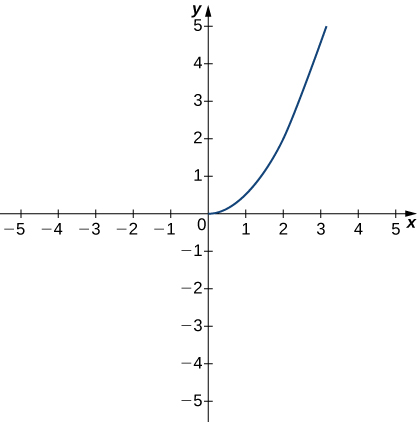
- If \(0 <|x −2| < δ\), then \(|f(x) −2| <1\).
- If \(0 <|x −2| < δ\), then \(|f(x) −2| <0.5\).
- Answer
- \( δ ≤0.25\)
Exercises 6 - 7
The following graph of the function \(f\) in Figure \(\PageIndex{2}\) satisfies \(\displaystyle \lim_{x →3}f(x)= −1\). In the following exercises, determine a value of \( δ >0\) that satisfies each statement.
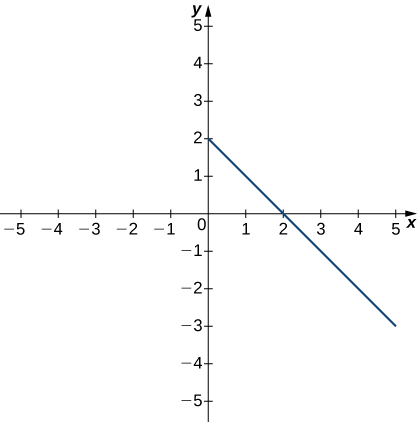
- If \(0 <|x −3| < δ\), then \(|f(x)+1| <1\).
- If \(0 <|x −3| < δ\), then \(|f(x)+1| <2\).
- Answer
- \( δ ≤2\)
Exercises 8 - 9
The following graph of the function \(f\) in Figure \(\PageIndex{3}\) satisfies \(\displaystyle \lim_{x →3}f(x)=2\). In the following exercises, for each value of \( ε\), find a value of \( δ >0\) such that the precise definition of limit holds true.
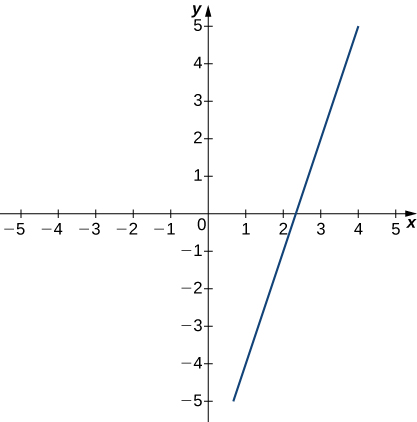
- \( ε=1.5\)
- \( ε=3\)
- Answer
- \( δ ≤1\)
[T] Exercises 10 - 11
Use a graphing calculator to find a number \( δ\) such that the statements hold true.
- \(\left|\sin(2x) −\frac{1}{2}\right| <0.1\), whenever \(\left|x −\frac{ π}{12}\right| < δ\)
- \(\left|\sqrt{x −4} −2\right| <0.1\), whenever \(|x −8| < δ\)
- Answer
- \( δ <0.3900\)
Exercises 12 - 16
Use the precise definition of limit to prove the given limits.
- \(\displaystyle \lim_{x →2}\,(5x+8)=18\)
- \(\displaystyle \lim_{x →3}\frac{x^2 −9}{x −3}=6\)
- Answer
- Let \( δ= ε\). If \(0 <|x −3| < ε\), then \(\left|\dfrac{x^2 −9}{x −3} - 6\right| = \left|\dfrac{(x+3)(x −3)}{x −3} - 6\right| = |x+3 −6|=|x −3| < ε\).
- \(\displaystyle \lim_{x →2}\frac{2x^2 −3x −2}{x −2}=5\)
- \(\displaystyle \lim_{x →0}x^4=0\)
- Answer
- Let \( δ=\sqrt[4]{ ε}\). If \(0 <|x| <\sqrt[4]{ ε}\), then \(\left|x^4-0\right|=x^4 < ε\).
- \(\displaystyle \lim_{x →2}\,(x^2+2x)=8\)
Exercises 17 - 19
Use the precise definition of limit to prove the given one-sided limits.
- \(\displaystyle \lim_{x →5^ −}\sqrt{5 −x}=0\)
- Answer
- Let \( δ= ε^2\). If \(- ε^2 < x - 5 < 0,\) we can multiply through by \(-1\) to get \(0 <5-x < ε^2.\)
Then \(\left|\sqrt{5 −x} - 0\right|=\sqrt{5 −x} < \sqrt{ ε^2} = ε\).
- \(\displaystyle \lim_{x →0^+}f(x)= −2\), where \(f(x)=\begin{cases}8x −3, & \text{if }x <0\\4x −2, & \text{if }x ≥0\end{cases}\).
- \(\displaystyle \lim_{x →1^ −}f(x)=3\), where \(f(x)=\begin{cases}5x −2, & \text{if }x <1\\7x −1, & \text{if }x ≥1\end{cases}\).
- Answer
- Let \( δ= ε/5\). If \( − ε/5 < x - 1 <0,\) we can multiply through by \(-1\) to get \(0 <1-x < ε/5.\)
Then \(|f(x) −3|=|5x-2-3| = |5x −5| = 5(1-x),\) since \(x <1\) here.
And \(5(1-x) < 5( ε/5) = ε\).
Exercises 20 - 22
Use the precise definition of limit to prove the given infinite limits.
- \(\displaystyle \lim_{x →0}\frac{1}{x^2}= ∞\)
- \(\displaystyle \lim_{x → −1}\frac{3}{(x+1)^2}= ∞\)
- Answer
- Let \( δ=\sqrt{\frac{3}{N}}\). If \(0 <|x+1| <\sqrt{\frac{3}{N}}\), then \(f(x)=\frac{3}{(x+1)^2} >N\).
- \(\displaystyle \lim_{x →2} −\frac{1}{(x −2)^2}= − ∞\)
Exercises 23 - 28
- An engineer is using a machine to cut a flat square of Aerogel of area \(144 \,\text{cm}^2\). If there is a maximum error tolerance in the area of \(8 \,\text{cm}^2\), how accurately must the engineer cut on the side, assuming all sides have the same length? How do these numbers relate to \( δ\), \( ε\), \(a\), and \(L\)?
- Answer
- \(0.033 \text{ cm}, \, ε=8,\, δ=0.33,\,a=12,\,L=144\)
- Use the precise definition of limit to prove that the following limit does not exist: \(\displaystyle \lim_{x →1}\frac{|x −1|}{x −1}.\)
- Using precise definitions of limits, prove that \(\displaystyle \lim_{x →0}f(x)\) does not exist, given that \(f(x)\) is the ceiling function. (Hint: Try any \( δ <1\).)
- Answer
- Answers may very.
- Using precise definitions of limits, prove that \(\displaystyle \lim_{x →0}f(x)\) does not exist: \(f(x)=\begin{cases}1, & \text{if }x\text{ is rational}\\0, & \text{if }x\text{ is irrational}\end{cases}\). (Hint: Think about how you can always choose a rational number \(0 <d\), >
- Using precise definitions of limits, determine \(\displaystyle \lim_{x →0}f(x)\) for \(f(x)=\begin{cases}x, & \text{if }x\text{ is rational}\\0, & \text{if }x\text{ is irrational}\end{cases}\). (Hint: Break into two cases, \(x\) rational and \(x\) irrational.)
- Answer
- \(0\)
- Using the function from the previous exercise, use the precise definition of limits to show that \(\displaystyle \lim_{x →a}f(x)\) does not exist for \(a ≠0\)
Exercises 29 - 31
Suppose that \(\displaystyle \lim_{x →a}f(x)=L\) and \(\displaystyle \lim_{x →a}g(x)=M\) both exist. Use the precise definition of limits to prove the following limit laws:
- \(\displaystyle \lim_{x →a}(f(x) −g(x))=L −M\)
- Answer
- \(f(x) −g(x)=f(x)+( −1)g(x)\)
- \(\displaystyle \lim_{x →a}[cf(x)]=cL\) for any real constant \(c\) (Hint: Consider two cases: \(c=0\) and \(c ≠0\).)
- \(\displaystyle \lim_{x →a}[f(x)g(x)]=LM\). (Hint: \(|f(x)g(x) −LM|= |f(x)g(x) −f(x)M +f(x)M −LM| ≤|f(x)||g(x) −M| +|M||f(x) −L|.)\)
- Answer
- Answers may vary.
This page titled 2.5E: Exercises for Section 2.5 was last modified on Mon, 31 Mar 2025 02:25:21 GMT and is shared under a CC BY-NC-SA 4.0 license and was authored, remixed, and/or curated by Doli Bambhania, Rani Fischer, Lisa Mesh, and Danny Tran.
The book could not be loaded just now.