Opening the book…
(1) Which of the following calculations solves this problem according to the order of operations?
8 + 6 × (3 + 6) ÷ 2 – 4
(i) 8 + 6 × (3 + 6) ÷ 2 – 4
→ 8 + 6 × (3 + 6) ÷ 2
→ 8 + 6 × (3 + 3)
→ 8 + (18 + 3)
→ 8 + 21
→ 29
(ii) 8 + 6 × (3 + 6) ÷ 2 – 4
→ 8 + 6 × 9 ÷ 2 – 4
→ 8 + 54 ÷ 2 – 4
→ 8 + 27 – 4
→ 35 – 4
→ 31
(iii) 8 + 6 × (3 + 6) ÷ 2 – 4
→ 8 + (18 + 6) ÷ 2 – 4
→ 8 + (18 + 3) – 4
→ 8 + 21 – 4
→ 29 – 4
→ 25
(iv) 8 + 6 × (3 + 6) ÷ 2 – 4
→ 8 + 6 × (3 + 3) – 4
→ 8 + (18 + 3) – 4
→ 8 + 21 – 4
→ 29 – 4
→ 25
(v) 8 + 6 × (3 + 6) ÷ 2 – 4
→ 14 × (9) ÷ 2 – 4
→ 14 × (9) ÷ 2
→ (126) ÷ 2
→ (63)
→ 63
(2) Miguel has a coupon for 20% off any purchase in a furniture store. He decides to purchase a desk originally priced at $80. Excluding tax, how much does Miguel save on his purchase?
(i) $2
(ii) $4
(iii) $16
(iv) $40
(3) Sylvia is charged 8% tax for her $2 cheeseburger. How much does Sylvia owe the cashier?
(i) $1.84
(ii) $2.08
(iii) $2.16
(iv) $2.80
Profit, Loss, and Revenue
The following terms will be used in the next class. Make sure you understand what they mean.
- Revenue: This is the amount of money that a business receives when it sells a product or service.
- Net profit: The net profit is the actual amount of money a business makes after expenses. Expenses are something a person or people spend money on. The expression for this is:
Net profit = Revenue − Expenses
Example: A restaurant might charge a customer $10 for a meal, but it cost the restaurant $4 for the food, $1 for the waiter’s paycheck, and $1 for the building. You need to add up all the restaurant’s expenses ($4 + $1 + $1 = $6). Then you subtract it from the total amount they make ($10) to figure out the net profit. The expression would be 10 – (4 + 1 + 1) = 4. The restaurant’s net profit is $4.
- Net loss: A net loss is similar to net profit, but a business has a net loss if the net profit is a negative number.
Example: If the restaurant’s expenses were higher than the revenue, they would have a net loss. They could pay the waiter more ($5) and the building could cost more ($3). The expression would be 10 – (4 + 5 + 3) = −2. The restaurant’s net loss is $2.
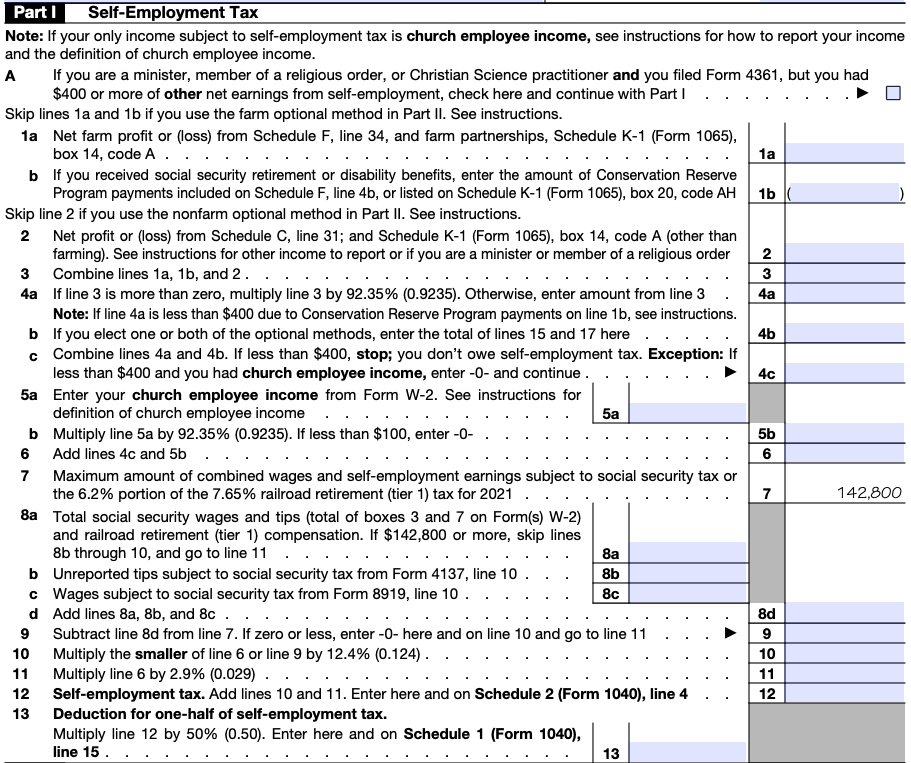
In Collaboration 1.7, you are going to be working through a tax form like the one shown below. This is a Schedule SE tax form. People who are self employed use this form to calculate how much tax they owe. Please take a few minutes to read it in preparation for Collaboration 1.7.


After Preparation 1.7 (survey)
You should be able to do the following things for the next class. Rate how confident you are on a scale of 1–5 (1 = not confident and 5 = very confident).
Before beginning Collaboration 1.7, you should understand the concepts and demonstrate the skills listed below.
|
Skill or Concept: I can … |
Rating from 1 to 5 |
|
follow the order of operations. |
|
|
find a percent of a number. |
|
|
estimate 1% of a number. |
If your confidence ratings are below 3 for any of these skills/concepts, what are three things you might do to increase your confidence in these areas? If your confidence ratings are all 3 or above for these skills/concepts, what are three things your classmates might do to increase their confidence in these areas?
This page titled 1.8.1: Preparation 1.8 was last modified on Wed, 15 May 2024 07:37:43 GMT and is shared under a CC BY-NC 4.0 license and was authored, remixed, and/or curated by Carnegie Math Pathways (WestEd) .
The book could not be loaded just now.