Opening the book…
Reading Questions
- What is a reference angle?
- How is a reference triangle for an angle \(\theta\) constructed?
- Are reference angles ever negative or greater than 90°?
- What is the reference angle for 150°?
- What is the reference angle for 300°?
- Explain the Reference Angle Theorem in your own words.
- What two pieces of information are needed to evaluate a trigonometric function at a non-acute angle without a calculator?
- If you are trying to find an angle \(\theta\) in Quadrant III where \(\sin(\theta) = -0.5\), what is the first step in finding the reference angle using a calculator?
- Once you find the reference angle \(\hat{\theta}\), how do you find the actual angle \(\theta\) if it terminates in Quadrant II?
- Once you find the reference angle \(\hat{\theta}\), how do you find the actual angle \(\theta\) if it terminates in Quadrant IV?
Homework
Vocabulary Check
-
The ___ for \(\theta\) is the positive acute angle formed between the terminal side of \(\theta\) and the \(x\)-axis.
Concept Check
-
Camille wants an obtuse angle, \(\theta\), that satisfies \(\sin \left(\theta\right)=0.3\). Ivan presses some buttons on his calculator and reports that \(\theta \approx 17.46^{\circ}\). Explain Ivan's error and give a correct approximation of \(\theta\) accurate to two decimal places.
True or False? For the following exercises, determine if the statement is true or false. If true, cite the definition or theorem stated in the text supporting your claim. If false, explain why it is false and, if possible, correct the statement.
-
To construct a reference triangle for an angle, we must choose a point \(P\) on the terminal side of \( \theta \) and draw a line from point \(P\) perpendicular to the \(y\)-axis.
-
The trigonometric ratios of any angle are equal to the ratios of its reference angle, except for sign. The sign of the ratio is determined by the quadrant.
Basic Skills
-
Give the lengths of the legs and the hypotenuse of each right triangle.
-
-
Explain why the length of the horizontal leg of the right triangle is \(−x\).


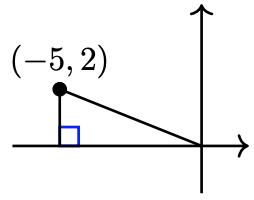
For the following exercises, find the reference angle for the given angle. Make a sketch showing the angle, the reference angle, and the reference triangle.
-
\(\theta = 100^{\circ}\)
-
\(A = 125^{\circ}\)
-
(MyOpenMath) \(\beta = 216^{\circ}\)
-
\( \theta = 194^{ \circ } \, 15^{\prime} \)
-
\(\alpha = 242^{\circ}\)
-
\(\phi = 297^{\circ}\)
-
\( \lambda = 137^{ \circ } \, 50^{\prime} \)
-
\(\theta = 336^{\circ}\)
For the following exercises, find three angles between \(90^{\circ}\) and \(360^{\circ}\) having the given reference angle, and sketch all four angles on the same grid.
-
\(15^{\circ}\)
-
\(26^{\circ}\)
-
\(40^{\circ}\)
-
\(50^{\circ}\)
-
\(68^{\circ}\)
-
\(75^{\circ}\)
For the following exercises, find the exact value of the trigonometric function using reference angles and quadrants (do not use a calculator).
-
\( \cos\left( 120^{ \circ } \right) \)
-
\( \sin\left( 135^{ \circ } \right) \)
-
\( \tan\left( 150^{ \circ } \right) \)
-
\( \sec\left( 225^{ \circ } \right) \)
-
\( \sin\left( 240^{ \circ } \right) \)
-
\( \cot\left( 210^{ \circ } \right) \)
-
\( \csc\left( 330^{ \circ } \right) \)
-
\( \cos\left( 315^{ \circ } \right) \)
-
\( \sin\left( 300^{ \circ } \right) \)
-
\( \cos\left( -150^{ \circ } \right) \)
-
\( \sin\left( -210^{ \circ } \right) \)
-
\( \sec\left( -315^{ \circ } \right) \)
-
\( \sin\left( 585^{ \circ } \right) \)
-
\( \cos\left( 840^{ \circ } \right) \)
-
\( \tan\left( -585^{ \circ } \right) \)
For the following exercises, use the values below to find the value of the trigonometric function. Do not use a calculator!
\(\cos \left(23^{\circ}\right) \approx 0.9205 \quad \sin \left(46^{\circ}\right) \approx 0.7193 \quad \tan \left(78^{\circ}\right) \approx 4.7046\)
-
\(\cos \left(157^{\circ}\right)\)
-
\(\sin \left(226^{\circ}\right)\)
-
\(\csc \left(314^{\circ}\right)\)
-
\(\sec \left(203^{\circ}\right)\)
-
\(\tan \left(258^{\circ}\right)\)
-
\(\cot \left(282^{\circ}\right)\)
-
\(\sin \left(-134^{\circ}\right)\)
-
\(\cos \left(-383^{\circ}\right)\)
-
On the circle in the figure, all angles are shown in standard position. Find the measure in degrees of the angles labeled (a) - (i) and state their reference angles.

-
-
Draw three angles, one in each quadrant except the first, whose reference angle is \(60^{\circ}\).
-
Find exact values for the sine, cosine, and tangent of each angle in part (a).
-
-
-
Draw three angles, one in each quadrant except the first, whose reference angle is \(30^{\circ}\).
-
Find exact values for the sine, cosine, and tangent of each angle in part (a).
-
-
-
Draw three angles, one in each quadrant except the first, whose reference angle is \(45^{\circ}\).
-
Find exact values for the sine, cosine, and tangent of each angle in part (a).
-
-
Complete the table with exact values.
\(\theta\) \(30^{\circ}\) \(45^{\circ}\) \(60^{\circ}\) \(120^{\circ}\) \(135^{\circ}\) \(150^{\circ}\) \(210^{\circ}\) \(225^{\circ}\) \(240^{\circ}\) \(300^{\circ}\) \(315^{\circ}\) \(330^{\circ}\) \(\sin \left(\theta\right)\) \(\cos \left(\theta\right)\) \(\tan \left(\theta\right)\) \(\csc \left(\theta\right)\) \(\sec \left(\theta\right)\) \(\cot \left(\theta\right)\)
For the following exercises, find a second angle between \(0^{\circ}\) and \(360^{\circ}\) with the given trigonometric ratio.
-
\(\sin \left(75^{\circ}\right)\)
-
\(\cos \left(32^{\circ}\right)\)
-
\(\tan \left(84^{\circ}\right)\)
-
\(\csc \left(16^{\circ}\right)\)
-
\(\sec \left(47^{\circ}\right)\)
-
\(\cot \left(56^{\circ}\right)\)
For the following exercises, use the given information to find an approximation of \( \theta \) to the nearest degree if \(0^{\circ} \le \theta \lt 360^{\circ}\).
-
\(\tan \left(\theta\right) = 8.1443\) with \( \theta \in \mathrm{QIII} \)
-
\(\sin \left(\theta\right)=0.7880\) with \( \theta \in \mathrm{QII} \)
-
\(\cos \left(\theta\right)=0.9205\) with \( \theta \in \mathrm{QIV} \)
-
\(\tan \left(\theta\right)=-3.4874\) with \( \theta \in \mathrm{QII} \)
-
\(\sin \left(\theta\right)=-0.9962\) with \( \theta \in \mathrm{QIV} \)
-
\(\cos \left(\theta\right)=-0.0349\) with \( \theta \in \mathrm{QII} \)
-
\(\sin \left(\theta\right)=0.8381\) where \( \cos\left(\theta\right) \gt 0 \)
-
\(\tan \left(\theta\right)=-2.1728\) where \( \sin\left(\theta\right) \gt 0 \)
-
\(\cos \left(\theta\right)=-0.2155\) where \( \tan\left(\theta\right) \gt 0 \)
-
\(\sin \left(\theta\right)=-0.1179\) where \( \tan\left(\theta\right) \lt 0 \)
-
\(\cos \left(\theta\right)=0.1818\) where \( \csc\left(\theta\right) \lt 0 \)
-
\(\tan \left(\theta\right)=1.7531\) where \( \sec\left(\theta\right) \lt 0 \)
-
\(\csc \left(\theta\right)=2.8549\) where \( \cos\left(\theta\right) \lt 0 \)
-
\(\sec \left(\theta\right)=-1.3888\) where \( \csc\left(\theta\right) \gt 0 \)
-
\(\cot \left(\theta\right)=-0.9411\) where \( \cos\left(\theta\right) \lt 0 \)
For the following exercises, use the given information to find the exact value of \( \theta \) if \(0^{\circ} \le \theta \lt 360^{\circ}\). Do not use a calculator!
-
\(\tan \left(\theta\right) = \sqrt{3}\) with \( \theta \in \mathrm{QIII} \)
-
\(\sin \left(\theta\right) = \frac{1}{2}\) with \( \theta \in \mathrm{QII} \)
-
\(\cos \left(\theta\right) = \frac{1}{\sqrt{2}} \) with \( \theta \in \mathrm{QIV} \)
-
\(\tan \left(\theta\right) = -1\) with \( \theta \in \mathrm{QII} \)
-
\(\sin \left(\theta\right) = -\frac{\sqrt{3}}{2} \) with \( \theta \in \mathrm{QIV} \)
-
\(\cos \left(\theta\right) = -\frac{1}{2} \) with \( \theta \in \mathrm{QII} \)
-
\(\sin \left(\theta\right) = \frac{1}{\sqrt{2}} \) where \( \cos\left(\theta\right) \gt 0 \)
-
\(\tan \left(\theta\right) = -\frac{1}{\sqrt{3}}\) where \( \sin\left(\theta\right) \gt 0 \)
-
\(\cos \left(\theta\right) = -\frac{\sqrt{3}}{2}\) where \( \tan\left(\theta\right) \gt 0 \)
-
\(\sin \left(\theta\right) = -\frac{1}{2} \) where \( \tan\left(\theta\right) \lt 0 \)
-
\(\cos \left(\theta\right) = \frac{1}{2}\) where \( \csc\left(\theta\right) \lt 0 \)
-
\(\tan \left(\theta\right) = 1\) where \( \sec\left(\theta\right) \lt 0 \)
-
\(\csc \left(\theta\right) = 2\) where \( \cos\left(\theta\right) \lt 0 \)
-
\(\sec \left(\theta\right)= -\frac{2}{\sqrt{3}}\) where \( \csc\left(\theta\right) \gt 0 \)
-
\(\cot \left(\theta\right)= -\sqrt{3}\) where \( \cos\left(\theta\right) \lt 0 \)
Synthesis Questions
For the following exercises, find exact values for all solutions between \(0^{\circ}\) and \(360^{\circ}\).
-
\(\cos \left(\theta\right)=-\cos \left(24^{\circ}\right)\)
-
\(\tan \left(\theta\right)=-\tan \left(9^{\circ}\right)\)
-
\(\sin \left(\theta\right)=-\sin \left(66^{\circ}\right)\)
-
\(\cos \left(\theta\right)=-\cos \left(78^{\circ}\right)\)
-
\(\tan \left(\theta\right)=-\tan \left(31^{\circ}\right)\)
-
\(\sin \left(\theta\right)=-\sin \left(42^{\circ}\right)\)
-
Later we will be able to show that \(\sin \left(18^{\circ}\right)=\frac{\sqrt{5}-1}{4}\). What is the exact value of \(\sin \left(162^{\circ}\right)\)?
-
Later we will be able to show that \(\cos \left(36^{\circ}\right)=\frac{\sqrt{5}+1}{4}\). What is the exact value of \(\cos \left(144^{\circ}\right)\)?
For the following exercises,
(a) Sketch an angle in standard position with the given properties.
(b) Find \(\cos \left(\theta\right)\), \(\sin \left(\theta\right)\), and \(\tan \left(\theta\right)\).
(c) Find the angle \(\theta\), rounded to tenths of a degree.
-
The point (−5, 12) is on the terminal side.
-
The point (12, 9) is on the terminal side.
-
\(\cos \left(\theta\right) = −0.8\)
-
\(\cos \left(\theta\right) = \frac{5}{13}\)
-
\(\cos \left(\theta\right) = \frac{3}{11}\)
-
\(\cos \left(\theta\right) = -\frac{5}{6}\)
-
\(\tan \left(\theta\right) = -\frac{1}{6}\)
-
\(\tan \left(\theta\right) = \frac{9}{5}\)
-
\(\tan \left(\theta\right) = 4\)
-
\(\tan \left(\theta\right) = -1\)
For the following exercises,
(a) Find the sine and cosine of the angle.
(b) Sketch the supplement of the angle in standard position. (Use congruent triangles.)
(c) Find the sine and cosine of the supplement.
(d) Find the angle and its supplement, rounded to the nearest degree.


For the following exercises, refer to the following table of values.
| \(\theta\) | \(15^{\circ}\) | \(25^{\circ}\) | \(65^{\circ}\) | \(75^{\circ}\) | \(105^{\circ}\) | \(115^{\circ}\) | \(155^{\circ}\) | \(165^{\circ}\) |
| \(\cos \left(\theta\right)\) | ||||||||
| \(\sin \left(\theta\right)\) | ||||||||
| \(\tan \left(\theta\right)\) |
-
Use your calculator to fill in the table. Round values to four decimal places.
-
For each angle \(\theta\) in the table, the angle \(180^{\circ} − \theta\) is also in the table.
-
What is true about \(\sin \theta\) and \(\sin(180^{\circ} − \theta)\)?
-
What is true about \(\cos \theta\) and \(\cos(180^{\circ} − \theta)\)?
-
What is true about \(\tan \theta\) and \(\tan(180^{\circ} − \theta)\)?
-
The following exercises preview the concept of solving trigonometric equations (a topic reserved for later in the course). For each equation, find two different angles between \( 0^{ \circ } \) and \( 360^{ \circ } \) that satisfy the equation. Round your answers to the nearest \(0.1^{\circ}\).
-
\(\sin \left(\theta\right)=0.7\)
-
\(\sin \left(\theta\right)=0.1\)
-
\(\dfrac{\sin \left(\theta\right)}{6}=0.14\)
-
\(\dfrac{5}{\sin \left(\theta\right)}=6\)
-
\(4.8=\dfrac{3.2}{\sin \left(\theta\right)}\)
-
\(1.5=\dfrac{\sin \left(\theta\right)}{0.3}\)
For the following exercises, fill in the blanks with complements or supplements.
-
If \(\sin \left(57^{\circ}\right)=q\), then \(\sin \left(\rule{8mm}{0.15mm}\right) =q\), and \(\cos \left(\rule{8mm}{0.15mm}\right)\) and \(\cos \left(\rule{8mm}{0.15mm}\right)\) both equal \( q \).
-
If \(\sin \left(18^{\circ}\right) = w\), then \(\sin \left(\rule{8mm}{0.15mm}\right) = w\), \(\cos \left(\rule{8mm}{0.15mm}\right) = w\), and \(\cos \left(\rule{8mm}{0.15mm}\right) = -w\).
-
If \(\cos \left(74^{\circ}\right)=m\), then \(\cos \left(\rule{8mm}{0.15mm}\right) =-m\), and \(\sin \left(\rule{8mm}{0.15mm}\right) \) and \(\sin \left(\rule{8mm}{0.15mm}\right) \) both equal \(m\).
-
If \(\cos \left(36^{\circ}\right) = t\), then \(\cos \left(\rule{8mm}{0.15mm}\right) = -t\), and \(\sin \left(\rule{8mm}{0.15mm}\right) \) and \(\sin \left(\rule{8mm}{0.15mm}\right) \) both equal \(t\).
-
-
Sketch the line \(y = \dfrac{3}{4} x\).
-
A point on the line with a positive \(x\)-coordinate.
-
The line \(y = \frac{3}{4} x\) makes an angle with the positive \(x\)-axis. What is that angle?
-
Repeat parts (a) through (c) for the line \(y = \frac{-3}{4} x\), except find a point with a negative \(x\)-coordinate.
-
-
-
Sketch the line \(y = \frac{5}{3} x\).
-
Find a point on the line with a positive \(x\)-coordinate.
-
The line \(y = \frac{5}{3} x\) makes an angle with the positive \(x\)-axis. What is that angle?
-
Repeat parts (a) through (c) for the line \(y = \frac{-5}{3} x\), except find a point with a negative \(x\)-coordinate.
-
For the following exercises,
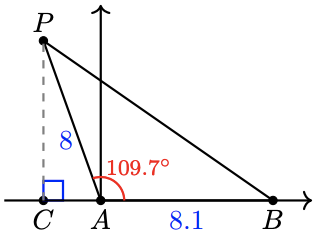
(a) Find the coordinates of point \(P\). Round to two decimal places.
(b) Find the sides \(B C\) and \(P C\) of \(\triangle P C B\).
(c) Find side \(P B\).

Challenge Problems
-
Why are the sines of supplementary angles equal, but the cosines are not? What about the tangents of supplementary angles?
This page titled 4.1.2: Homework was last modified on Thu, 10 Jul 2025 22:13:02 GMT and is shared under a not declared license and was authored, remixed, and/or curated by Roy Simpson.
The book could not be loaded just now.