Opening the book…
- Note to the Instructor (click to expand)
- The material in this section is the traditional introduction to polar coordinates. You will cover all the basics except graphing polar equations (which is done in the next section).
The following is a list of learning objectives for this section.
- Learning Objectives (click to expand)
-
- Graph an ordered pair given in polar coordinates.
- Give multiple representations for a point in polar coordinates.
- Sketch a region in the polar coordinate system.
- Convert an ordered pair from polar to rectangular coordinates or vice versa.
- Express a polar equation in rectangular coordinates.
- Express a rectangular equation in polar coordinates.
Location by Coordinates
One of the most valuable applications of trigonometric ratios allows us to find distances or locations specified by angles. Starting with the definitions of sine and cosine,\[\cos\left(\theta\right) = \dfrac{x}{r} \quad \text{and} \quad \sin\left(\theta\right)=\dfrac{y}{r}\nonumber\]we can solve for \(x\) and \(y\), the coordinates of points on the terminal side of the angle, and obtain the following results.
These formulas make sense when we think of the unit circle. On a unit circle, the coordinates of a point designated by an angle \(\theta\) are \(\left(\cos\left(\theta\right), \sin\left(\theta\right)\right)\), as shown in Figure \(\PageIndex{1}\). On a circle of radius \(r\), the angle \(\theta\) forms a similar triangle whose dimensions are scaled up by a factor of \(r\). In particular, the legs of the new triangle are \(r\) times larger than the original triangle.

Point \(P\) is located 6 centimeters from the origin in the direction of \(292^{\circ}\). Find the coordinates of \(P\), rounded to the nearest hundredths.
- Solution
-
The location of point \(P\) is shown below. We see that \(r=6\), and we can use a calculator to evaluate \(\cos\left(292^{\circ}\right)\) and \(\sin\left(292^{\circ}\right)\).

Figure \(\PageIndex{2}\) \[\begin{array}{rclcrcl} x & = & r\cos\left(292^{\circ}\right) & \quad \text{and} & y & = & r\sin\left(292^{\circ}\right) \\[6pt] & \approx & 6(0.3746) & & & \approx & 6(-0.9272) \\[6pt] & \approx & 2.2476 & & & \approx & -5.5632 \\[6pt] \end{array}\nonumber\]The coordinates of \(P\) are approximately \(\left(2.25, -5.56\right)\).
You find an old map that shows a buried treasure located 500 yards from the big oak tree in the direction \(215^{\circ}\), as shown below. You don't have anything with you to measure angles, but you have your calculator.

- Find the cosine of \(215^{\circ}\). How far west should you walk from the big oak to be directly north of the treasure?
- Find the tangent of \(215^{\circ}\). How far south should you walk from your present location before you begin digging?
- Answers
-
- 409.58 yds
- 286.79 yds
The Cartesian coordinate system is also called the rectangular coordinate system because it describes a location in the plane as the vertex of a rectangle. To construct a rectangular coordinate system, we begin with two perpendicular axes intersecting at the origin. The \(x\)- and \(y\)-coordinates of a point indicate the length and width of a rectangle with one vertex at the origin. The point \(P(x, y)\) sits at the opposite vertex of the rectangle, as shown in Figure \(\PageIndex{4}\).
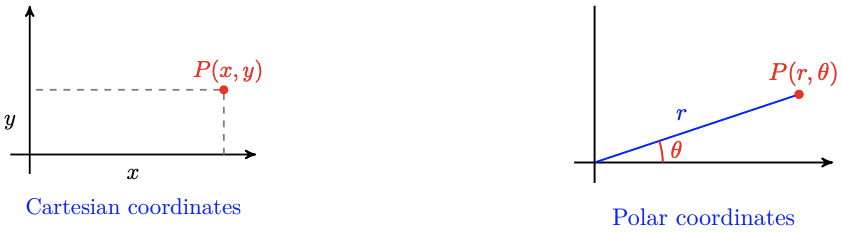
Previously, we used vectors to specify a location by giving a distance and a direction. For example, we might say that the airport is located 5 miles southwest of the city center. This method of designating locations is so helpful that we will construct a new coordinate system using the same tools: distance and direction.
We describe the location of a point \(P\) in the plane by measuring the distance, \(|r|\), from \(P\) to the pole, and the angle, \(\theta\), that \(\vec{OP}\) makes with the polar axis (measured counterclockwise). The components of the ordered pair, \(\left(r, \theta\right)\), are called the polar coordinates of the point \(P\).
In our work with polar coordinates, we always use radians for the angle \(\theta\). For example, the point \(P\left(2, \frac{\pi}{2}\right)\) is located 2 units from the pole at an angle of \(\frac{\pi}{2}\) radians, and \(Q(3,4)\) is located 3 units from the pole at an angle of 4 radians. The graphs of \(P\) and \(Q\) are shown in Figure \(\PageIndex{5}\).

A piece of graph paper in rectangular coordinates consists of a grid of horizontal and vertical lines. These are the lines \(x=k\) and \(y=k\), for evenly spaced values of \(k\). Each vertical grid line consists of points with the same \(x\)-coordinate, and each horizontal grid line is made up of points with the same \(y\)-coordinate. The grid lines are benchmarks to help us locate points with specific rectangular coordinates.
A piece of graph paper in polar coordinates consists of a grid of concentric circles and radial lines, as shown in Figure \(\PageIndex{6}\). Each circle consists of points with the same \(r\)-coordinate, all the same distance from the pole. All points with the same \(\theta\)-coordinate lie on the same radial line. This grid helps us locate points with specific polar coordinates.

Plotting Points in the Polar Coordinate System
You are used to thinking in rectangular coordinates: to locate a point, we move so many units left or right and so many units up or down. When working in polar coordinates, we want to "think radially"—how far to move from the pole and in which direction.
Plot the points whose polar coordinates are given: \(A\left(1, \frac{\pi}{2}\right)\) and \(B\left(2, \frac{7\pi}{4}\right)\).
- Solution
-
To plot point \(A\), we move 1 unit away from the pole in the direction \(\frac{\pi}{2}\), as shown below. To plot point \(B\), we move 2 units away from the pole in the direction \(\frac{7\pi}{4}\).

Figure \(\PageIndex{7}\)
We are used to "plugging in" a value for \(x\) and using the given equation or relation to find the corresponding value of \(y\). This is why most of us think of \(x\) as the default independent variable and \(y\) as depending on \(x\) (and, hence, is called the dependent variable). We get the ordered pair, \(\left(x, y\right)\), which is listed in the order \(\left(\text{independent variable}, \text{dependent variable}\right)\). This convention, however, is a bit backward with polar coordinates. Even though the independent, or input, variable in polar coordinates is almost always \(\theta\), it is customary to list the dependent or output variable first: \(\left(r, \theta\right)\).
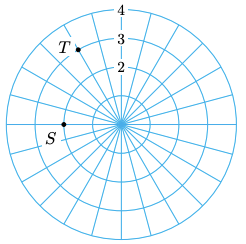
Give the polar coordinates of the points \(S\) and \(T\) shown below, with \(0 \leq \theta \leq 2\pi\).
- Answer
-
\(S(2, \pi),\, T\left(3, \dfrac{2\pi}{3}\right)\)
Each point has infinitely many polar coordinates because we can add multiples of \(2\pi\) to the value of \(\theta\). For example, the point with polar coordinates \(\left(1, \frac{\pi}{2}\right)\) also has polar coordinates \(\left(1, \frac{5\pi}{2}\right)\) and \(\left(1, \frac{-3\pi}{2}\right)\).
If we allow negative values of \(r\), there are even more ways to write the coordinates of a point. Each angle designates a line through the pole, and each line has both a positive and a negative direction.
On the line at \(\theta=\frac{\pi}{4}\), for instance, the positive direction lies in the first quadrant, so that the point \(\left(2, \frac{\pi}{4}\right)\) is designated by \(P\) in the figure below. To plot the point \(\left(-2, \frac{\pi}{4}\right)\), we move in the opposite direction from the pole, arriving at point \(Q\). Note that the point \(Q\) can also be designated by the coordinates \(\left(2, \frac{5\pi}{4}\right)\).

Give polar coordinates with negative \(r\)-values for the points in the previous exercise.
- Solution
-
The point \(S(2, \pi)\) is also \((-2, 2\pi)\) or \((-2,0)\). The point \(T\left(3, \frac{2\pi}{3}\right)\) can also be designated by \(\left(-3, \frac{2\pi}{3}+\pi\right)\), or \(\left(-3, \frac{5\pi}{3}\right)\).
Give polar coordinates with positive \(r\)-values and \(0 \leq \theta \leq 2\pi\) for each point given in polar coordinates.
- \(\left(-2.5, \dfrac{\pi}{6}\right)\)
- \((-0.7,5)\)
- Answers
-
- \(\left(2.5, \dfrac{7\pi}{6}\right)\)
- \((0.7,5-\pi)\)
Regions in the Plane
In Cartesian coordinates, we use equations and inequalities to describe regions in the plane. For example, the shaded region in Figure \(\PageIndex{10a}\) is the graph of \(y \leq x+2\). The pair of inequalities \(x \geq -2\) and \(1<y<3\) describes the region in Figure \(\PageIndex{10b}\). This region is particularly simple in that its boundaries are portions of the coordinate grid lines \(x=k\) and \(y=k\), where \(k\) is a constant.

In the polar plane, the coordinate grid lines are circles centered at the pole, with equations \(r = k\), and lines through the pole, with equations \(\theta = k\).
Sketch the region designated by each set of inequalities.
- \(1 \leq r < 3\)
- \(0 \leq r \leq 2, \frac{\pi}{6} < \theta < \frac{\pi}{3}\)
- Solutions
-
- The region consists of all points between 1 (inclusive) and 3 units from the pole. No restriction is given on \(\theta\), so the region is the annular ring shown in Figure \(\PageIndex{11}\).

Figure \(\PageIndex{11}\) - The region includes all points up to 2 units from the pole, but only between the lines \(\theta = \frac{\pi}{6}\) and \(\theta = \frac{\pi}{3}\). These curves bound the pie-shaped wedge (circular sector) shown in Figure \(\PageIndex{11b}\).
- The region consists of all points between 1 (inclusive) and 3 units from the pole. No restriction is given on \(\theta\), so the region is the annular ring shown in Figure \(\PageIndex{11}\).
Write inequalities to describe each region shown below.

- Answers
-
- \(r \geq 2, \frac{3\pi}{4}<\theta \leq \frac{5\pi}{4}\)
- \(2<r<3,0<\theta<\pi\)
Converting Between Polar and Cartesian Coordinates
Using Trigonometry, converting from polar coordinates to Cartesian is easy, or vice versa. Figure \(\PageIndex{13}\) shows how the two coordinates are related.

If we know the polar coordinates \((r, \theta)\), we can compute the Cartesian coordinates \((x, y)\) as the legs of a right triangle.\[\begin{array}{rclcrcl} \dfrac{x}{r} & = & \cos\left(\theta\right) & \implies & x & = & r\cos\left(\theta\right) \\[6pt] \dfrac{y}{r} & = & \sin\left(\theta\right) & \implies & y & = & r\sin\left(\theta\right) \\[6pt] \end{array}\nonumber\]
Find the Cartesian coordinates of the point with polar coordinates \(\left(\sqrt{2}, \frac{3\pi}{4}\right)\).
- Solution
-
The polar coordinates tell us that \(r=\sqrt{2}\) and \(\theta=\frac{3\pi}{4}\), as shown below. The \(x\)-coordinate of the point is\[\begin{array}{rcl} x & = & r\cos\left(\theta\right) \\[6pt] & = & \sqrt{2}\cos\left(\dfrac{3\pi}{4}\right) \\[6pt] & = & \sqrt{2} \cdot \dfrac{-1}{\sqrt{2}} \\[6pt] & = & -1 \\[6pt] \end{array}\nonumber\]

Figure \(\PageIndex{14}\) and its \(y\)-coordinate is\[\begin{array}{rcl} y & = & r\sin\left(\theta\right) \\[6pt] & = & \sqrt{2}\sin\left(\dfrac{3\pi}{4}\right) \\[6pt] & = & \sqrt{2} \cdot \dfrac{1}{\sqrt{2}} \\[6pt] & = & 1 \\[6pt] \end{array}\nonumber\]Thus, the Cartesian coordinates are \((-1, 1)\).
Find the Cartesian coordinates of the point with polar coordinates \(\left(4, \frac{5\pi}{3}\right)\).
- Answer
-
\((2,-2\sqrt{3})\)
If we know the Cartesian coordinates of a point, we can compute the polar coordinates as follows.\[\begin{array}{rrcl} & x^2+y^2 & = & r^2 \\[6pt] \implies & r & = & \sqrt{x^2+y^2} \\[6pt] & \tan\left(\theta\right) & = & \dfrac{y}{x} \\[6pt] \end{array}\nonumber\]As we are used to at this point, to find the angle \(\theta\), we first compute its reference angle, \(\widehat{\theta} = \tan^{-1}\left(\left|\frac{y}{x}\right|\right)\). We use this reference angle to help find the value of \(\theta\) by considering the given point's quadrant.
Find the polar coordinates of the point with Cartesian coordinates \(\left(-\dfrac{1}{2},-\dfrac{\sqrt{3}}{2}\right)\).
- Solution
-
We first compute the value of \(r\).\[r^2=x^2+y^2=\left(-\dfrac{1}{2}\right)^2+\left(-\dfrac{\sqrt{3}}{2}\right)^2=\dfrac{1}{4}+\dfrac{3}{4}=1.\nonumber\]Thus, \(r=\sqrt{1}=1\). To find \(\theta\), we compute\[\tan\left(\theta\right)=\dfrac{y}{x}=\dfrac{-\frac{\sqrt{3}}{2}}{-\frac{1}{2}}=\sqrt{3}.\nonumber\]Hence, \(\widehat{\theta} = \frac{\pi}{3}\). There are infinitely many values of \(\theta\) that satisfy this equation, but our point lies in the third quadrant, so we take \(\theta=\frac{4\pi}{3}\). Hence, the polar coordinates of the given point are \(\left(1,\frac{4 \pi}{3}\right)\).

Figure \(\PageIndex{15}\)
In Example \(\PageIndex{6}\), the angle \(\theta\) is not given by \(\tan^{-1}(\sqrt{3})=\frac{\pi}{3}\), because the given point lies in the third quadrant. Remember that there are always two angles between 0 and \(2\pi\) with a given tangent.
Find polar coordinates for the points with Cartesian coordinates \((2, -5)\). Give decimal approximations rounded to hundredths.
- Answer
-
(5.39, 5.09)
Equations in Polar Coordinates
Polar coordinates are useful for studying objects or phenomena with radial symmetry, such as circles, spheres, and cylinders, or the central forces (those that act equally in all directions), such as gravity and electric charge. The equations describing these objects are often simpler in polar coordinates than in Cartesian coordinates.
It is not hard to convert an equation from Cartesian to polar coordinates: we replace each \(x\) with \(r\cos\left(\theta\right)\) and each \(y\) with \(r\sin\left(\theta\right)\).
Convert the equation \(2x+3y=6\) to polar coordinates.
- Solution
-
Replacing \(x\) by \(r\cos\left(\theta\right)\) and \(y\) by \(r\sin\left(\theta\right)\), we get\[2r\cos\left(\theta\right)+3r\sin\left(\theta\right)=6.\nonumber\]If we solve for \(r\) in terms of \(\theta\), we find\[\begin{array}{rrcl} & r\left(2\cos\left(\theta\right)+3\sin\left(\theta\right)\right) & = & 6 \\[6pt] \implies & r & = & \dfrac{6}{2\cos\left(\theta\right)+3\sin\left(\theta\right)} \\[6pt] \end{array}\nonumber\]Neither of these equations is simpler than the Cartesian version; however, that should not surprise us because the original equation describes a line. Cartesian coordinates are better suited to rectilinear graphs.
Convert the equation \(x^2+y^2=4\) to polar coordinates.
- Answer
-
\(r=2\)
You may recognize the equation in Checkpoint \(\PageIndex{7}\) as a circle. Note also that its polar equation is more straightforward than the familiar Cartesian version.
Converting equations from polar to Cartesian form is more complex than the other direction (and is sometimes impossible). Here are some strategies to try:
- Expressions of the form \(r\cos\left(\theta\right)\) or \(r\sin\left(\theta\right)\) can be replaced by \(x\) and \(y\), respectively.
- \(r^2\) can be replaced by \(x^2+y^2\).
- \(\tan\left(\theta\right)\) can be replaced by \(\frac{y}{x}\).
Convert the equation \(r=3\cos\left(\theta\right)\) to Cartesian coordinates.
- Solution
-
We multiply both sides of the equation by \(r\) to obtain\[r^2=3r\cos\left(\theta\right).\nonumber\]Now we can replace the left side by \(x^2+y^2\) and the right side by \(3x\) to obtain\[x^2+y^2=3x.\nonumber\]This is the equation of a circle. By completing the square in each variable, we can write the equation in standard form,\[\left(x-\dfrac{3}{2}\right)^2+y^2=\dfrac{9}{4}.\nonumber\]The center of the circle is \(\left(\dfrac{3}{2}, 0\right)\), and its radius is \(\dfrac{3}{2}\).
Convert the equation \(r=\tan\left(\theta\right)\) to Cartesian coordinates.
- Answer
-
\(y^2=\dfrac{x^4}{1-x^2}\)
This page titled 9.1: Polar Coordinates was last modified on Mon, 17 Aug 2026 18:25:26 GMT and is shared under a CC BY-SA 12 license and was authored, remixed, and/or curated by Roy Simpson.
The book could not be loaded just now.