Opening the book…
Reading Questions
- What are the two components of an ordered pair in the polar coordinate system?
- What is the "pole" and what is the "polar axis"?
- If a point has polar coordinates \((r, \theta)\), what are the formulas to convert it to rectangular coordinates \((x, y)\)?
- If a point has rectangular coordinates \((x, y)\), how do you find its distance from the origin, \(r\)?
- Explain why a single point can be represented by infinitely many different polar coordinates.
- If a point has polar coordinates \((3, \frac{\pi}{4})\), give another representation for the same point where \(r\) is negative.
- What does the graph of the polar equation \(r=3\) look like?
- What does the graph of the polar equation \(\theta = \frac{\pi}{3}\) look like?
- What is the general strategy for converting a rectangular equation into a polar equation?
- What are some algebraic strategies you can use to convert a polar equation into a rectangular equation?
Skills Refresher
Review the following skills you will need for this section.
Recall the standard form for the equation of a circle of radius \(r\) centered at \((h, k)\):\[(x-h)^2+(y-k)^2=r^2.\nonumber \]For the following exercises, use completing the square to write each equation in standard form.
-
\(x^2+y^2-4 x+2 y-4=0\)
-
\(x^2+y^2=88+18 y\)
-
\(x^2+y^2+25=9-10 x-9 y\)
-
\(5 y^2=85-5 x^2-10 x\)
- Answers
-
-
\((x-2)^2+(y+1)^2=3^2\)
-
\(x^2+(y-9)^2=13^2\)
-
\((x-5)^2+(y-3)^2=(3 \sqrt{2})^2\)
-
\((x-1)^2+y^2=4^2\)
-
Homework
Vocabulary Check
-
The origin in the polar coordinate system is called the ___.
-
The positive \( x \)-axis in the polar coordinate system is called the ___.
Concept Check
-
Why is the Cartesian coordinate system sometimes called the rectangular system?
-
What do the graphs of the polar equations \(r=k\) and \(\theta=k\), where \(k\) is a constant, look like?
-
Fill in the blank: the point with polar coordinates \((-6, \theta)\) also has coordinates \((6, ?)\).
-
What does the region described by \(a \leq r \leq b\) look like? What does the region described by \(a \leq \theta \leq b\) look like?
-
Sketch a figure that explains how to convert between polar and Cartesian coordinates.
Basic Skills
For the following exercises, find exact values for the coordinates of the point.
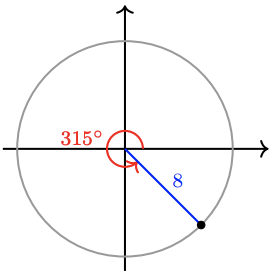


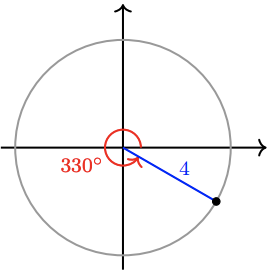


For the following exercises, find the coordinates of the point, rounded to hundredths.


For the following exercises, use the grid below to plot the points whose polar coordinates are given.

-
\(\left(2, \dfrac{2 \pi}{3}\right)\)
-
\(\left(3, \dfrac{5 \pi}{4}\right)\)
-
\(\left(3, \dfrac{3 \pi}{2}\right)\)
-
\((4, \pi)\)
-
\(\left(-4, \dfrac{\pi}{6}\right)\)
-
\(\left(-1, \dfrac{\pi}{2}\right)\)
-
\(\left(-1, \dfrac{7 \pi}{4}\right)\)
-
\(\left(-2, \dfrac{5 \pi}{3}\right)\)
For the following exercises, give polar coordinates for each point shown below, with \(r \geq 0\) and \(0 \leq \theta \leq 2 \pi\).

-
A
-
B
-
C
-
D
-
E
-
F
-
G
-
H
For the following exercises, convert the polar coordinates to Cartesian coordinates.
-
\(\left(6, \dfrac{2 \pi}{3}\right)\)
-
\(\left(5, \dfrac{7 \pi}{6}\right)\)
-
\(\left(-3, \dfrac{3 \pi}{4}\right)\)
-
\(\left(-4, \dfrac{5 \pi}{3}\right)\)
-
\((2.4,3.6)\)
-
\((1.7,5.2)\)
-
\((-2,1.5)\)
-
\((-3,4.5)\)
For the following exercises, convert the Cartesian coordinates to polar coordinates with \(r \geq 0\) and \(0 \leq \theta \leq 2 \pi\). Give exact values for \(r\) and \(\theta\).
-
\((7,7)\)
-
\((-7,-7)\)
-
\((\sqrt{6},-\sqrt{2})\)
-
\((-\sqrt{3}, 3)\)
-
\((-3,-2)\)
-
\((1,4)\)
-
\((-2,0)\)
-
\((0,-5)\)
For the following exercises, polar coordinates are given.
(a) Convert to polar coordinates with \(r \leq 0,0 \leq \theta<2 \pi\).
(b) Convert to polar coordinates with \(r \geq 0, \quad-2 \pi<\theta \leq 0\).
-
\(\left(2, \dfrac{5 \pi}{6}\right)\)
-
\(\left(1, \dfrac{4 \pi}{3}\right)\)
-
\((3, \pi)\)
-
\((4,0)\)
-
\((2.3,5.2)\)
-
\((1.2,1.2)\)
For the following exercises, sketch the region described by the inequalities.
-
\(r \leq 3\)
-
\(2 \leq r \leq 3\)
-
\(\dfrac{\pi}{6} \leq \theta \leq \dfrac{\pi}{3}\)
-
\(0 \leq \theta \leq \dfrac{\pi}{2}\)
-
\(r \geq 4, \dfrac{\pi}{2} \leq \theta \leq \dfrac{3 \pi}{4}\)
-
\(2 \leq r \leq 3, \dfrac{5 \pi}{3} \leq \theta \leq \dfrac{11 \pi}{6}\)
For the following exercises, write inequalities to describe the region.


For the following exercises, convert the equation into Cartesian coordinates.
-
\(r^2=2\)
-
\(r=2\)
-
\(r=4 \cos\left( \theta \right)\)
-
\(r=\sin\left( \theta \right)\)
-
\(r=\csc\left( \theta \right)\)
-
\(r=2 \sec\left( \theta \right)\)
-
\(\tan\left( \theta \right)=2\)
-
\(r^2=\tan\left( \theta \right)\)
-
\(r \sec\left( \theta \right)=3\)
-
\(\theta=\dfrac{\pi}{3}\)
-
\(r=\dfrac{2}{1+\sin\left( \theta \right)}\)
-
\(r=\dfrac{4}{4-\cos\left( \theta \right)}\)
-
\(2 r \cos\left( \theta \right)+r \sin\left( \theta \right)=1\)
-
\(\tan\left( \theta \right)=r \cos\left( \theta \right)-2\)
For the following exercises, convert the equation into polar coordinates.
-
\(x=2\)
-
\(y^2=2 x-x^2\)
-
\(2 x y=1\)
-
\(y=-x\)
-
\(y^2=4 x\)
-
\(x^2-y^2=1\)
-
\(x^2+y^2=4 \sqrt{x^2+y^2}\)
-
\(\left(x^2+y^2\right)^3=9 x^2 y^2\)
Synthesis Questions
-
Show that the graph of \(r=a \cos\left( \theta \right)+b \sin\left( \theta \right)\) is a circle. Find its center and radius.
Proofs
-
Use the Law of Cosines to prove the Distance Formula in polar coordinates:\[d=\sqrt{r_1^2+r_2^2-2 r_1 r_2 \cos \left(\theta_2-\theta_1\right)}\nonumber \]
This page titled 9.1.2: Homework was last modified on Mon, 07 Jul 2025 17:49:44 GMT and is shared under a not declared license and was authored, remixed, and/or curated by Roy Simpson.
The book could not be loaded just now.