Opening the book…
Reading Questions
- How are the Double-Angle Identities derived from the Sum and Difference Identities?
- What is the Double-Angle Identity for \(\sin(2\theta)\)?
- List the three different forms of the Double-Angle Identity for \(\cos(2\theta)\).
- If you are given the value of \(\cos(\theta)\) and need to find \(\cos(2\theta)\), which of the three forms of the cosine double-angle identity would be the most direct to use?
- Provide a numerical example that demonstrates that \(\sin(2\theta) \neq 2\sin(\theta)\).
- If you need to find the value of \(\sin(2\theta)\), what two pieces of information about \(\theta\) must you know?
- How can a Double-Angle Identity be used to help graph a function like \(f(x) = -8\cos^2(3x) + 4\)?
- When proving an identity, what should you look for if you see an expression like \(\cos(2x)\)?
Homework
Concept Check
-
Provide an example to show that doubling an angle does not double its sine or cosine.
Basic Skills
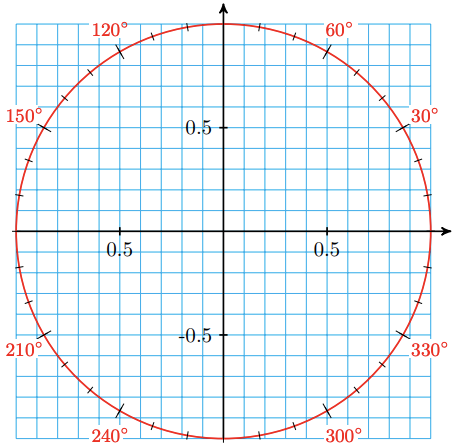
For the following exercises, use the unit circle to estimate trigonometric values. Then verify with your calculator.
-
Does \(\sin \left(2 \cdot 90^{\circ}\right) =2 \sin \left(90^{\circ}\right)\)?
-
Does \(\cos \left(2 \cdot 25^{\circ}\right)=2 \cos \left(25^{\circ}\right)\)?
-
Does \(\tan \left(2 \cdot 70^{\circ}\right)=2 \tan \left(70^{\circ}\right)\)?
-
Does \(\tan \left(2 \cdot 100^{\circ}\right)=2 \tan \left(100^{\circ}\right)\)?
For the following exercises, verify that each statement is true
-
\(\sin \left(90^{\circ}\right)=2 \sin \left(45^{\circ}\right) \cos \left(45^{\circ}\right)\)
-
\(\sin \left(60^{\circ}\right)=2 \sin \left(30^{\circ}\right) \cos \left(30^{\circ}\right)\)
-
\(\cos \left(60^{\circ}\right)=\cos^2 \left(30^{\circ}\right)-\sin^2 \left(30^{\circ}\right)\)
-
\(\tan \left(60^{\circ}\right)=\dfrac{2 \tan \left(30^{\circ}\right)}{1-\tan^2 \left(30^{\circ}\right)}\)
For the following exercises, determine if the statement is true or false. Explain your answer.
-
If \(\cos \left(\alpha\right)=0.32\), then \(\cos \left(2 \alpha\right)=0.64\).
-
If \(\sin\left( \phi\right)=r\), then \(\sin \left(2 \phi\right)=2 r\).
For the following exercises, use the Double Angle Identities to simplify the expression. Leave your answer in exact form.
-
\(2 \sin \left(34^{\circ}\right) \cos \left(34^{\circ}\right)\)
-
\(\cos^2\left( \dfrac{\pi}{10}\right)-\sin^2 \left(\dfrac{\pi}{10}\right)\)
-
\(1-2 \sin^2 \left(\dfrac{\pi}{16}\right)\)
-
\(2 \cos^2 \left(18^{\circ}\right)-1\)
-
\(\cos^2 \left(3 \theta\right)-\sin^2 \left(3 \theta\right)\)
-
\(2 \sin \left(2 \alpha\right) \cos \left(2 \alpha\right)\)
-
\(2 \sin \left(5 t\right) \cos \left(5 t\right)\)
-
\(\cos^2 \left(4 w\right)-\sin^2 \left(4 w\right)\)
-
\(\dfrac{2 \tan \left(64^{\circ}\right)}{1-\tan^2\left( 64^{\circ}\right)}\)
-
\(\dfrac{2 \tan \left(\frac{\pi}{5}\right)}{1-\tan^2 \left(\frac{\pi}{5}\right)}\)
-
\(2 \cos^2 \left(2 \beta\right)-1\)
-
\(1-2 \sin^2 \left(6 s\right)\)
-
\(\cos ^{2}\left(28^{\circ}\right)-\sin^{2}\left(28^{\circ}\right)\)
-
\(2\cos^{2} \left(37^{\circ} \right)-1\)
-
\(1-2\sin^{2}\left(17^{\circ}\right)\)
-
\(\cos^{2}\left(37^{\circ} \right)-\sin ^{2}\left(37^{\circ}\right)\)
-
\(\cos^{2} \left(9x\right)-\sin^{2} \left(9x\right)\)
-
\(\cos ^{2} \left(6x\right)-\sin ^{2} \left(6x\right)\)
-
\(4\sin \left(8x\right) \cos\left(8x\right)\)
-
\(6\sin \left(5x\right) \cos\left(5x\right)\)
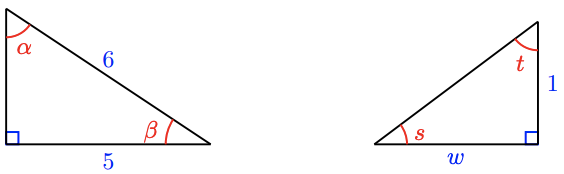
For the following exercises, use the figures to find the trigonometric ratios.
-
-
\(\sin \left(\alpha\right)\)
-
\(\cos \left(\alpha\right)\)
-
\(\tan \left(\alpha\right)\)
-
\(\sin \left(2\alpha\right)\)
-
\(\cos \left(2\alpha\right)\)
-
\(\tan \left(2\alpha\right)\)
-
-
-
\(\sin \left(\beta\right)\)
-
\(\cos \left(\beta\right)\)
-
\(\tan \left(\beta\right)\)
-
\(\sin \left(2\beta\right)\)
-
\(\cos \left(2\beta\right)\)
-
\(\tan \left(2\beta\right)\)
-
-
-
\(\sin \left(s\right)\)
-
\(\cos \left(s\right)\)
-
\(\tan \left(s\right)\)
-
\(\sin \left(2s\right)\)
-
\(\cos \left(2s\right)\)
-
\(\tan \left(2s\right)\)
-
-
-
\(\sin \left(t\right)\)
-
\(\cos \left(t\right)\)
-
\(\tan \left(t\right)\)
-
\(\sin \left(2t\right)\)
-
\(\cos \left(2t\right)\)
-
\(\tan \left(2t\right)\)
-
-
Suppose \(\cos \left(\theta\right)=\frac{12}{13}\) and \(\frac{3 \pi}{2}<\theta<2 \pi\). Compute exact values for the following.
-
\(\sin \left(\theta\right)\)
-
\(\sin \left(2 \theta\right)\)
-
\(\cos \left(2 \theta\right)\)
-
\(\tan \left(2 \theta\right)\)
-
Sketch the angles \(\theta\) and \(2 \theta\).
-
-
Suppose \(\sin \left(\phi\right)=\frac{5}{6}\) and \(\frac{\pi}{2}<\phi<\pi\). Compute exact values for the following.
-
\(\cos \left(\phi\right)\)
-
\(\sin \left(2 \phi\right)\)
-
\(\cos \left(2 \phi\right)\)
-
\(\tan \left(2 \phi\right)\)
-
Sketch the angles \(\phi\) and \(2 \phi\).
-
-
If \(\tan \left(u\right)=-4\) and \(270^{\circ}<u<360^{\circ}\), find exact values for the following.
-
\(\tan \left(2 u\right)\)
-
\(\cos \left(2 u\right)\)
-
\(\sin \left(2 u\right)\)
-
-
If \(\tan \left(v\right)=\frac{2}{3}\) and \(180^{\circ}<v<270^{\circ}\), find exact values for the following.
-
\(\tan \left(2v\right)\)
-
\(\cos \left(2v\right)\)
-
\(\sin \left(2v\right)\)
-
For the following exercises, use the given information about \(\theta\) to find the exact values of \(\sin(2\theta)\), \(\cos(2\theta)\), and \(\tan(2\theta)\).
-
\(\sin(\theta) = -\dfrac{7}{25}\) where \(\dfrac{3\pi}{2} < \theta < 2\pi\)
-
\(\cos(\theta) = \dfrac{28}{53}\) where \(0 < \theta < \dfrac{\pi}{2}\)
-
\(\tan(\theta) = \dfrac{12}{5}\) where \(\pi < \theta < \dfrac{3\pi}{2}\)
-
\(\csc(\theta) = 4\) where \(\dfrac{\pi}{2} < \theta < \pi\)
-
\(\cos(\theta) = \dfrac{3}{5}\) where \(0 < \theta < \dfrac{\pi}{2}\)
-
\(\sin(\theta) = -\dfrac{4}{5}\) where \(\pi < \theta < \dfrac{3\pi}{2}\)
-
\(\cos(\theta) = \dfrac{12}{13}\) where \(\dfrac{3\pi}{2} < \theta < 2\pi\)
-
\(\sin(\theta) = \dfrac{5}{13}\) where \(\dfrac{\pi}{2} < \theta < \pi\)
-
\(\sec(\theta) = \sqrt{5}\) where \(\dfrac{3\pi}{2} < \theta < 2\pi\)
-
\(\tan(\theta) = -2\) where \(\dfrac{\pi}{2} < \theta < \pi\)
-
Suppose \(\theta\) is a Quadrant I angle with \(\sin(\theta) = x\). Verify the following formulas
-
\(\cos(\theta) = \sqrt{1-x^2}\)
-
\(\sin(2\theta) = 2x\sqrt{1-x^2}\)
-
\(\cos(2\theta) = 1 - 2x^2\)
-
-
Suppose \(\theta\) is a Quadrant I angle with \(\tan(\theta) = x\). Verify the following formulas
-
\(\cos(\theta) = \dfrac{1}{\sqrt{x^2+1}}\)
-
\(\sin(\theta) = \dfrac{x}{\sqrt{x^2+1}}\)
-
\(\sin(2\theta) = \dfrac{2x}{x^2+1}\)
-
\(\cos(2\theta) = \dfrac{1-x^2}{x^2+1}\)
-
-
If \(\sin(\theta) = \dfrac{x}{2}\) for \(-\dfrac{\pi}{2} < \theta < \dfrac{\pi}{2}\), find an expression for \(\cos(2\theta)\) in terms of \(x\).
-
If \(\tan(\theta) = \dfrac{x}{7}\) for \(-\dfrac{\pi}{2} < \theta < \dfrac{\pi}{2}\), find an expression for \(\sin(2\theta)\) in terms of \(x\).
For the following exercises, graph one cycle of the given function by hand.
-
\( f(x) = 4\sin\left( 3x \right)\cos\left( 3x \right) \)
-
\( g(x) = \dfrac{2}{3}\cos^2\left( \frac{\pi}{3} x \right) - \dfrac{1}{2} \)
-
\( h(x) = -\dfrac{5}{7} \sin\left( \frac{1}{3}x \right) \cos\left( \frac{1}{3} x \right) \)
-
\( k(x) = \dfrac{3 \tan\left( \frac{1}{2}x \right)}{2 - 2\tan^2\left( \frac{1}{2}x \right)} \)
-
\( m(x) = 2\cos^2\left( 5x \right) - 2\sin^2\left( 5x \right) \)
Proofs
For the following exercises, prove the given identity for any right triangle \( \triangle ABC \), where \( C \) is a right angle.
-
\(\sin\left(A-B\right) = \cos\left(2B\right)\)
-
\(\cos\left(A-B\right) = \sin\left(2A\right)\)
-
\(\sin\left(2A\right) = \dfrac{2ab}{c^2}\)
-
\(\cos\left(2A\right) = \dfrac{b^2 - a^2}{c^2}\)
-
\(\tan\left(2A\right) = \dfrac{2ab}{b^2 - a^2}\)
-
Prove the Double-Angle Identity \(\sin \left(2 \theta\right)=2 \sin\left( \theta\right) \cos \left(\theta\right)\).
-
Prove the Double-Angle Identity \(\cos \left(2 \theta\right)=\cos^2 \left(\theta\right)-\sin^2 \left(\theta\right)\).
For the following exercises,
(a) Use graphs to decide if the equation is an identity.
(b) If the equation is not an identity, find a value of the variable that makes the equation false.
-
\(\cos \left(4 \theta\right)=4 \cos \left(\theta\right)\)
-
\(\cos \left(2 x\right)=\left(\cos \left(x\right)+\sin \left(x\right)\right)\left(\cos\left( x\right)-\sin \left(x\right)\right)\)
For the following exercises, prove the identity. Assume all quantities are defined.
-
\((\cos(\theta) + \sin(\theta))^2 = 1 + \sin(2\theta)\)
-
\((\cos(\theta) - \sin(\theta))^2 = 1 - \sin(2\theta)\)
-
\( \dfrac{\sin\left( 2\theta \right)}{\sin\left( \theta \right)} - \dfrac{\cos\left( 2\theta \right)}{\cos\left( \theta \right)} = \sec\left( \theta \right) \)
-
\( \dfrac{\sin\left( 3\theta \right)}{\sin\left( \theta \right)} - \dfrac{\cos\left( 3\theta \right)}{\cos\left( \theta \right)} = 2 \)
-
\(\tan(2\theta) = \dfrac{1}{1-\tan(\theta)} - \dfrac{1}{1+\tan(\theta)}\)
-
\(\csc(2\theta) = \dfrac{\cot(\theta) + \tan(\theta)}{2}\)
-
\(\left(\sin ^{2} x-1\right)^{2} =\cos \left(2x\right)+\sin ^{4} x\)
-
\(\sin \left(2x\right)=\dfrac{2\tan \left(x\right)}{1+\tan ^{2} \left(x\right)}\)
-
\(\tan \left(2x\right)=\dfrac{2\sin \left(x\right)\cos \left(x\right)}{2\cos ^{2} \left(x\right)-1}\)
-
\(\cot \left(x\right)-\tan \left(x\right)=2\cot \left(2x\right)\)
-
\(\dfrac{\sin \left(2\theta \right)}{1+\cos \left(2\theta \right)} =\tan \left(\theta \right)\)
-
\(\cos \left(2\alpha \right)=\dfrac{1-\tan ^{2} \left(\alpha \right)}{1+\tan ^{2} \left(\alpha \right)}\)
-
\(\dfrac{1+\cos \left(2t\right)}{\sin \left(2t\right)-\cos \left(t\right)} =\dfrac{2\cos \left(t\right)}{2\sin \left(t\right)-1}\)
-
\(\sin \left(3x\right)=3\sin \left(x\right)\cos ^{2} \left(x\right)-\sin ^{3} (x)\)
-
\(\cos \left(3x\right)=\cos ^{3} (x)-3\sin ^{2} (x)\cos \left(x\right)\)
-
\(8 \sin^{4}(\theta) = \cos(4\theta) - 4\cos(2\theta)+3\)
-
\(8 \cos^{4}(\theta) = \cos(4\theta) + 4\cos(2\theta)+3\)
-
\(\sin(3\theta) = 3\sin(\theta) - 4\sin^{3}(\theta)\)
-
\(\sin(4\theta) = 4\sin(\theta)\cos^{3}(\theta) - 4\sin^{3}(\theta)\cos(\theta)\)
-
\(\cos(4\theta) = 8\cos^{4}(\theta) - 8\cos^{2}(\theta) + 1\)
-
\(\cos(8\theta) = 128\cos^{8}(\theta)-256\cos^{6}(\theta)+160\cos^{4}(\theta)-32\cos^{2}(\theta)+1\)
-
\(\sec(2\theta) = \dfrac{\cos(\theta)}{\cos(\theta) + \sin(\theta)} + \dfrac{\sin(\theta)}{\cos(\theta)-\sin(\theta)}\)
-
\(\dfrac{1}{\cos(\theta) - \sin(\theta)} + \dfrac{1}{\cos(\theta) + \sin(\theta)} = \dfrac{2\cos(\theta)}{\cos(2\theta)}\)
-
\(\dfrac{1}{\cos(\theta) - \sin(\theta)} - \dfrac{1}{\cos(\theta) + \sin(\theta)} = \dfrac{2\sin(\theta)}{\cos(2\theta)}\)
-
\( \dfrac{\cos^2\left( \psi \right)}{\cos^2\left( \theta \right)} = \dfrac{1 + \cos\left( 2 \psi \right)}{1 + \cos\left( 2 \theta \right)} \)
Challenge Problems
-
Some trigonometry textbooks used to claim (incorrectly) that \(\sin\left(\theta\right) + \cos\left(\theta\right) = \sqrt{1 + \sin\left(2\theta\right)} \) was an identity. Give an example of a specific angle \(\theta \) that would make that equation false. Is \(\sin\left(\theta\right) + \cos\left(\theta\right) = \pm\sqrt{1 + \sin\left(2\theta\right)} \) an identity? Justify your answer.
-
In general, what is the largest value that \(\sin\left(\theta\right)\cos\left(\theta\right) \) can take? Justify your answer.
This page titled 6.3.2: Homework was last modified on Fri, 04 Jul 2025 21:03:21 GMT and is shared under a not declared license and was authored, remixed, and/or curated by Roy Simpson.
The book could not be loaded just now.