From LibreTexts, under not declared, as the source states it; its equations are written in TeX, which the PDF shows typeset. This page at LibreTexts.
4.3.2: Homework
Opening the book…
Reading Questions
What is the radius of a unit circle?
If the terminal side of an angle \(\theta\) intersects the unit circle at a point \(P(x, y)\), what do the x- and y-coordinates represent?
On a unit circle, what is the relationship between the radian measure of a central angle and the length of the arc it subtends?
When trigonometric functions are defined based on the arc length on a unit circle, what are they sometimes called?
To find the value of a trigonometric function for a real number \(t\), what do you do?
What calculator mode should be used when evaluating trigonometric functions for angles given in radians or for real numbers?
What is the domain of the sine function?
What is the domain of the tangent function?
What is the range of the cosine function?
What is the range of the secant function?
Is it possible for \(\sin(t)\) to equal 2? Why or why not?
Skills Refresher
Review the following skills you will need for this section.
Skills Refresher
For the following exercises, simplify.
\(\dfrac{2}{3} + \dfrac{1}{6}\)
\(\dfrac{2x}{3} + \dfrac{x}{6}\)
\(\dfrac{3}{4} - \dfrac{5}{8}\)
\(\dfrac{3n}{4} - \dfrac{5n}{8}\)
\(2 - \dfrac{3}{4}\)
\(2b - \dfrac{3b}{4}\)
\(1 + \dfrac{3}{8}\)
\(m + \dfrac{3m}{8}\)
\(\dfrac{5}{6} - \dfrac{7}{6}\)
\(\dfrac{5q}{6} - \dfrac{7q}{6}\)
\(\dfrac{2}{3} - \dfrac{5}{3}\)
\(\dfrac{2p}{3} - \dfrac{5p}{3}\)
Answers
a \(\dfrac{5}{6}\), b \(\dfrac{5x}{6}\)
a \(\dfrac{1}{8}\), b \(\dfrac{n}{8}\)
a \(\dfrac{5}{4}\), b \(\dfrac{5b}{4}\)
a \(\dfrac{11}{8}\), b \(\dfrac{11m}{8}\)
a \(\dfrac{-1}{6}\), b \(\dfrac{-q}{6}\)
a \(-1\), b \(-p\)
Homework
Vocabulary Check
A circle of radius 1 having center at the origin is called a(n) ___.
When considered as functions of arc length, we call the trigonometric functions ___ functions because they are defined by the coordinates of points on a unit circle.
Concept Check
Explain why \(\cos \theta \leq 1\) for any angle \(\theta\).
How many solutions are there to the equation \(\cos \left(\theta\right)=0.4\) between \(0^{\circ}\) and \(360^{\circ}\)?
On a unit circle, the ___ measure of the central angle and the ___ length it cuts off are the same value.
List the trigonometric functions having a domain of all real numbers.
List the trigonometric functions having a range of all real numbers.
Sketch a figure on a unit circle to illustrate each equation.
\(\sin \dfrac{3 \pi}{4}=0.7071\)
\(\cos 2.5=-0.8011\)
Write down the multiples of \(\frac{\pi}{12}\) from 0 to \(2 \pi\). Reduce each fraction.
Sketch arcs in standard position on a unit circle with the following lengths.\[s=\dfrac{\pi}{2}, \quad s=\dfrac{3 \pi}{4}, \quad s=\dfrac{\pi}{3}, \quad s=\dfrac{2 \pi}{3} \nonumber \]
True or False? For the following exercises, determine if the statement is true or false. If true, cite the definition or theorem stated in the text supporting your claim. If false, explain why it is false and, if possible, correct the statement.
Let \(P(x,y)\) be a point on the unit circle determined by an arc of length \(t\) from the point \((1,0)\) to \(P\). Then the coordinates of \(P\) are given by \[x=\sin \left(t\right), \quad y=\cos \left(t\right).\nonumber \]
If \(\beta \lt \alpha\), then \(\sin \left(\beta\right) \lt \sin \left(\alpha\right)\).
The circular functions are functions of real numbers. As such, we can set our calculator to either degree or radian mode to get approximations of these functions.
The domain of the tangent function includes all real numbers except for \( \frac{\pi}{2} \).
The range of the sine and cosine functions is -1 to 1, inclusive.
Basic Skills
For the following exercises, each point on the unit circle is the terminal point of a special angle in standard position. Give exact values for the radian measure, \(t\), of the angle, and the coordinates \((x, y)\) of the point.
\(a\)
\(b\)
\(c\)
\(d\)
\(t\)
\(x\)
\(y\)
\(a\)
\(b\)
\(c\)
\(d\)
\(t\)
\(x\)
\(y\)
\(a\)
\(b\)
\(c\)
\(d\)
\(t\)
\(x\)
\(y\)
\(a\)
\(b\)
\(c\)
\(d\)
\(t\)
\(x\)
\(y\)
Complete the table.
\(\theta\)
\( \sin\left( \theta \right) \)
\( \cos\left( \theta \right) \)
\( \tan\left( \theta \right) \)
\(\dfrac{2\pi}{3}\)
\(\dfrac{3\pi}{4}\)
\(\dfrac{5\pi}{6}\)
Complete the table.
\(\theta\)
\( \sin\left( \theta \right) \)
\( \cos\left( \theta \right) \)
\( \tan\left( \theta \right) \)
\(\dfrac{7\pi}{6}\)
\(\dfrac{5\pi}{4}\)
\(\dfrac{4\pi}{3}\)
Complete the table.
\(\theta\)
\( \sin\left( \theta \right) \)
\( \cos\left( \theta \right) \)
\( \tan\left( \theta \right) \)
\(\dfrac{5\pi}{3}\)
\(\dfrac{7\pi}{4}\)
\(\dfrac{11\pi}{6}\)
For the following exercises, evaluate each function.
\( \sin\left( 45^{ \circ } \right) \)
\( \cos\left( 150^{ \circ } \right) \)
\( \cot\left( 270^{ \circ } \right) \)
\( \tan\left( 240^{ \circ } \right) \)
\( \sec\left( 315^{ \circ } \right) \)
\( \csc\left( 210^{ \circ } \right) \)
\( \cos\left( \frac{\pi}{6} \right) \)
\( \sin\left( \frac{3 \pi}{2} \right) \)
\( \tan\left( \frac{2 \pi}{3} \right) \)
\( \sec\left( \frac{7 \pi}{6} \right) \)
\( \csc\left( \frac{5\pi}{4} \right) \)
\( \cot\left( \frac{4\pi}{3} \right) \)
For the following exercises, use the unit circle to find all values of \( \theta \) between \( 0 \) and \( 2\pi \) for which the given equation is true.
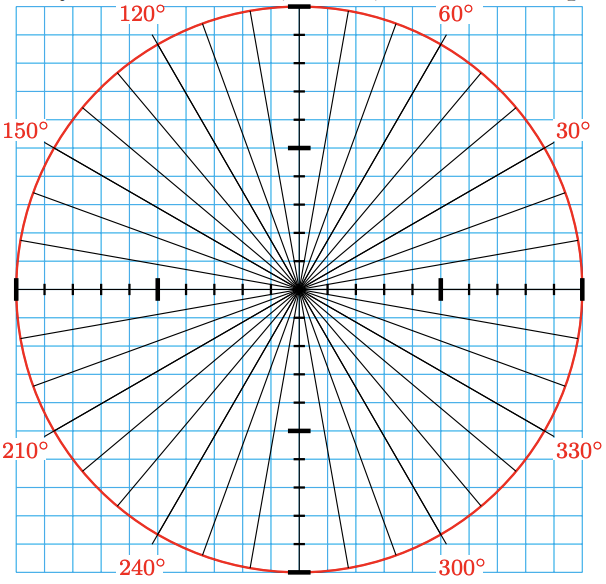
Estimate the \(x\)-coordinate of the points on the unit circle designated by each angle and complete the table. (Hint: Use symmetry in the second, third, and fourth quadrants.)
Angle
\(0^{\circ}\)
\(10^{\circ}\)
\(20^{\circ}\)
\(30^{\circ}\)
\(40^{\circ}\)
\(50^{\circ}\)
\(60^{\circ}\)
\(70^{\circ}\)
\(80^{\circ}\)
\(90^{\circ}\)
\(x\)-coordinate
Angle
\(100^{\circ}\)
\(110^{\circ}\)
\(120^{\circ}\)
\(130^{\circ}\)
\(140^{\circ}\)
\(150^{\circ}\)
\(160^{\circ}\)
\(170^{\circ}\)
\(180^{\circ}\)
\(x\)-coordinate
Angle
\(190^{\circ}\)
\(200^{\circ}\)
\(210^{\circ}\)
\(220^{\circ}\)
\(230^{\circ}\)
\(240^{\circ}\)
\(250^{\circ}\)
\(260^{\circ}\)
\(270^{\circ}\)
\(x\)-coordinate
Angle
\(280^{\circ}\)
\(290^{\circ}\)
\(300^{\circ}\)
\(310^{\circ}\)
\(320^{\circ}\)
\(330^{\circ}\)
\(340^{\circ}\)
\(350^{\circ}\)
\(360^{\circ}\)
\(x\)-coordinate
Estimate the \(y\)-coordinate of the points on the unit circle designated by each angle and complete the table. (Hint: Use symmetry in the second, third, and fourth quadrants.)
Angle
\(0^{\circ}\)
\(10^{\circ}\)
\(20^{\circ}\)
\(30^{\circ}\)
\(40^{\circ}\)
\(50^{\circ}\)
\(60^{\circ}\)
\(70^{\circ}\)
\(80^{\circ}\)
\(90^{\circ}\)
\(x\)-coordinate
Angle
\(100^{\circ}\)
\(110^{\circ}\)
\(120^{\circ}\)
\(130^{\circ}\)
\(140^{\circ}\)
\(150^{\circ}\)
\(160^{\circ}\)
\(170^{\circ}\)
\(180^{\circ}\)
\(x\)-coordinate
Angle
\(190^{\circ}\)
\(200^{\circ}\)
\(210^{\circ}\)
\(220^{\circ}\)
\(230^{\circ}\)
\(240^{\circ}\)
\(250^{\circ}\)
\(260^{\circ}\)
\(270^{\circ}\)
\(x\)-coordinate
Angle
\(280^{\circ}\)
\(290^{\circ}\)
\(300^{\circ}\)
\(310^{\circ}\)
\(320^{\circ}\)
\(330^{\circ}\)
\(340^{\circ}\)
\(350^{\circ}\)
\(360^{\circ}\)
\(x\)-coordinate
For the following exercises, use the unit circle to estimate the sine, cosine, and tangent of each arc of given length.
0.4
1.2
2
0.8
2.6
4
2.8
3.5
5
3
4.3
5.5
For the following exercises, use the unit circle to estimate two numbers with the given trigonometric value.
\(\cos t=0.3\)
\(\sin t=0.1\)
\(\sin t=-0.7\)
\(\cos t=-0.6\)
\(\tan t=\dfrac{-4}{9}\)
\(\tan t=\dfrac{8}{6}\)
Each of the following exercises describes an arc in standard position on the unit circle. In which quadrant does the terminal point of the arc lie?
\(\sin s>0, \quad \cos s<0\)
\(\sin s<0, \quad \cos s>0\)
\(\cos t<0, \quad \tan t<0\)
\(\cos t>0, \quad \tan t<0\)
\(\sin x<0, \quad \tan x>0\)
\(\sin x>0, \quad \tan x<0\)
For the following exercises, without a calculator, decide whether the quantity is positive or negative.
\(\cos 2.7\)
\(\sin 4.1\)
\(\tan 3.8\)
\(\tan 5.4\)
\(\sin 2.2\)
\(\cos 4.9\)
Starting at \((1,0)\), you walk \(s\) units around a unit circle. For the following exercises, sketch a unit circle showing your position. What are your coordinates?
\(s=2.5\)
\(s=4.3\)
\(s=8.5\)
\(s=11\)
Synthesis Questions
For the following exercises, place the trigonometric values in order from smallest to largest. Use the figure to help you, but try not to use a calculator!
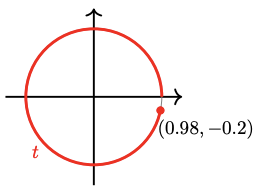
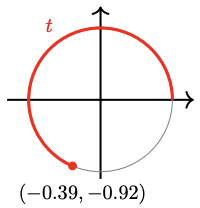
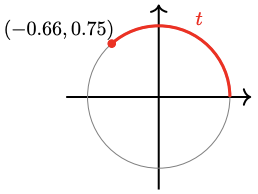
For the following exercises, the figure shows an arc of length \(t\), and the coordinates of its terminal point. Find the terminal point of each related arc given below, and give its sine, cosine, and tangent.
a \(2\pi - t\)
b \(\pi - t\)
c \(\pi + t\)
Use the figure to help you fill in the blanks.
As \(\theta\) increases from \(0^{\circ}\) to \(90^{\circ}, f(\theta)=\sin \theta\) _______ from _______ to _______.
As \(\theta\) increases from \(90^{\circ}\) to \(180^{\circ}, f(\theta)=\sin \theta\) _______ from _______ to _______.
As \(\theta\) increases from \(180^{\circ}\) to \(270^{\circ}, f(\theta)=\sin \theta\) _______ from _______ to _______.
As \(\theta\) increases from \(270^{\circ}\) to \(360^{\circ}, f(\theta)=\sin \theta\) _______ from _______ to _______.
Use the figure to help you fill in the blanks.
As \(\theta\) increases from \(0^{\circ}\) to \(90^{\circ}, f(\theta)=\cos \theta\) _______ from _______ to _______.
As \(\theta\) increases from \(90^{\circ}\) to \(180^{\circ}, f(\theta)=\cos \theta\) _______ from _______ to _______.
As \(\theta\) increases from \(180^{\circ}\) to \(270^{\circ}, f(\theta)=\cos \theta\) _______ from _______ to _______.
As \(\theta\) increases from \(270^{\circ}\) to \(360^{\circ}, f(\theta)=\cos \theta\) _______ from _______ to _______.
For the following exercises, use the grid provided below.
Draw two different angles \(\alpha\) and \(\beta\) in standard position whose sine is 0.6.
Use a protractor to measure \(\alpha\) and \(\beta\).
Find the reference angles for both \(\alpha\) and \(\beta\). Draw in the reference triangles.
Draw two different angles \(\theta\) and \(\phi\) in standard position whose sine is \(−0.8\).
Use a protractor to measure \(\theta\) and \(\phi\).
Find the reference angles for both \(\theta\) and \(\phi\). Draw in the reference triangles.
For the following exercises, use the grid provided below.
Draw two different angles \(\alpha\) and \(\beta\) in standard position whose cosine is 0.3.
Use a protractor to measure \(\alpha\) and \(\beta\).
Find the reference angles for both \(\alpha\) and \(\beta\). Draw in the reference triangles.
Draw two different angles \(\theta\) and \(\phi\) in standard position whose cosine is −0.4.
Use a protractor to measure \(\theta\) and \(\phi\).
Find the reference angles for both \(\theta\) and \(\phi\). Draw in the reference triangles.
For the following exercises, find all angles between \(0^{\circ}\) and \(360^{\circ}\) for which the statement is true.
\(\cos \theta = -1\)
\(\sin \theta = -1\)
\(\tan \theta = -1\)
Find two angles, \(0 \leq \theta \leq 360^{\circ}\), with \(\sin \theta = 0\).
Find two angles, \(0 \leq \theta \leq 360^{\circ}\), with \(\cos \theta = 0\).
For the following exercises, find two points on the unit circle with the given coordinate. Sketch the approximate location of the points on the circle. (Hint: what is the equation for the unit circle?)
\(x=0.2\)
\(x=-0.6\)
\(y=-0.35\)
\(y=0.7\)
\(x=\dfrac{-\sqrt{3}}{2}\)
\(y=\dfrac{1}{\sqrt{2}}\)
For the following exercises, find the angle in radians between 0 and \(2 \pi\) determined by the terminal point on the unit circle. Round your answer to hundredths.
(−0.1782, 0.9840)
(−0.8968, −0.4425)
(0.8855, −0.4646)
(0.9801, 0.1987)
(−0.7659, −0.6430)
(0.9602, −0.2794)
Sketch a unit circle and the line \(y=x\). Find the coordinates of the two points where the line and the circle intersect.
State your answers to part (a) using trigonometric functions.
Sketch a unit circle and the line \(y=-x\). Find the coordinates of the two points where the line and the circle intersect.
State your answers to part (a) using trigonometric functions.
Sketch a line that passes through the origin and the point (8,3). What is the slope of the line?
What is the angle of inclination of the line in radians, measured from the positive \(x\)-axis?
Sketch a line that passes through the origin and the point (3,8). What is the slope of the line?
What is the angle of inclination of the line in radians, measured from the positive \(x\)-axis?
For the following exercises, find an equation for the line with the given angle of inclination passing through the given point.
\(\alpha=\dfrac{\pi}{3},(4,2)\)
\(\alpha=\dfrac{5 \pi}{6},(-6,3)\)
\(\alpha=2.4,(5,-8)\)
\(\alpha=0.6,(-2,-3)\)
If \(\sec(\theta) = \dfrac{x}{4}\) for \(0 < \theta < \dfrac{\pi}{2}\), find an expression for \(\ln|\sec(\theta) + \tan(\theta)|\) in terms of \(x\).
Applications
The sunrise time in Wellington, New Zealand, on the nth day of the year can be modeled by\[S=1.93 \sin (0.016 n-1.13)+6.14 \nonumber \]where \(S\) is given in hours after midnight. Find the sunrise time on January 1 (day \(n=1\)), April 1 (day \(n=91\)), July 1 (day \(n=182\)), and on October 1 (day \(n=274\)).
The variable star RT Cygni reached its maximum magnitude on May 22, 2004, and \(t\) days later its magnitude is given by\[M=9.55-2.25 \cos (0.033 t) \nonumber \]Find the magnitude of RT Cygni on days \(t=0\), \(t=48\), \(t=95\), \(t=142\), and \(t=190\). (Note that smaller values of \(M\) denote brighter magnitudes.)
City Park features a circular jogging track with a radius of 1 mile centered on the open-air bandstand. You start jogging on the track 1 mile due east of the bandstand and proceed counterclockwise. What are your coordinates relative to the bandstand when you jogged five miles?
Silver Reservoir is a circular man-made lake with a radius of 1 kilometer. If you start at the easternmost point on the reservoir and walk counterclockwise for 4 kilometers, how far south of your initial position are you?
Use the results of Problem 110 for Problems 111 - 113.
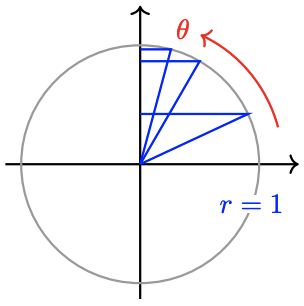
Use similar triangles to show that the coordinates of a point \(P\) determined by angle \(\theta\) on a circle of radius \(r\) are \(x = r \cos \theta, y = r \sin \theta\). (See the figure below.)
The Astrodome in Houston has a diameter of 710 feet. If you start at the easternmost point and walk counterclockwise around its perimeter for 250 feet, how far north of your starting point are you?
The Barringer meteor crater near Winslow, Arizona, is 1182 meters in diameter. You start at the easternmost point on the crater's rim and walk counterclockwise around the edge. After walking for 1 kilometer, what is your position relative to your starting point?
One of the most intriguing features of Stonehenge is the position of the four Station Stones.
They form the corners of a rectangle inscribed in the Aubrey Circle on the perimeter of the henge, which has a diameter of 288 feet. A line from the center of the circle and perpendicular to the long edge of the rectangle points through the Slaughter Stones at the entrance of the henge and out to the Heel Stone. If you stood in the circle's center on the summer solstice, you would see the sun rise directly over the Heel Stone.
The sun rises \(48.6^{\circ}\) east of north on the summer solstice at Stonehenge. If the positive \(y\)-axis points north, find the coordinates of the henge entrance relative to its center.
The northernmost station stone is located \(66.6^{\circ}\) of arc counterclockwise from the entrance. Find its coordinates relative to the center of the henge.
Challenge Problems
Use similar triangles to show that the coordinates of point \(P\) on the unit circle shown below are \((\cos t, \sin t)\).
Use similar triangles to show that \(S T=\tan t\).
This page titled 4.3.2: Homework was last modified on Tue, 01 Jul 2025 23:54:25 GMT and is shared under a not declared license and was authored, remixed, and/or curated by Roy Simpson.