Opening the book…
- Note to the Instructor (click to expand)
- If you made it to (and through) this section, congratulate yourself and your students. You have performed a substantial accomplishment.
- (click to expand)
-
- Arithmetic
The following is a list of learning objectives for this section.
- Learning Objectives (click to expand)
-
- Write complex numbers in polar form.
- Convert a complex number from polar to rectangular form.
- Find products of complex numbers in polar form.
- Find quotients of complex numbers in polar form.
- Find powers of complex numbers in polar form.
- Find roots of complex numbers in polar form.
"God made the integers; all else is the work of man."
This rather famous quote by nineteenth-century German mathematician Leopold Kronecker sets the stage for this section on the polar form of a complex number. Complex numbers were invented by people and represent over a thousand years of continuous investigation and struggle by mathematicians such as Pythagoras, Descartes, De Moivre, Euler, Gauss, and others. Complex numbers answered questions that for centuries had puzzled the greatest minds in science.
Writing Complex Numbers in Polar Form
Given a complex number expressed as \(z = x + y \, i\), we can use the material from the previous section to visualize \(z\) as the point \(\left( x,y \right)\) on the Cartesian plane.1 We then observe that we can rewrite both \(x\) and \(y\) in trigonometric form:\[\begin{array}{rcl} x & = & r \cos\left( \theta \right) \\ y & = & r \sin\left( \theta \right) \\ r & = & \sqrt{x^2+y^2} \end{array} \nonumber \]where \(\theta\) is the angle in standard position with terminal side being the line segment connecting the origin to the point \(\left( x,y \right)\). We review these relationships in Figure \(\PageIndex{1}\).
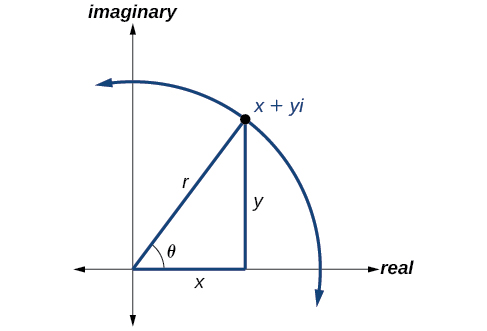
Thus, we can rewrite the complex number, \(z = x + y \, i\), in the form\[z = r \cos\left( \theta \right) + \left( r \sin\left( \theta \right) \right) i = r \left( \cos\left( \theta \right) + i \, \sin\left( \theta \right) \right). \nonumber \]This form is known as the polar form of the complex number.
The notation \(z = r \, \mathrm{cis}\left( \theta \right)\) is read as "cosine plus i sine of theta."
As we did in the previous section, we use the term modulus to represent the "size" of a complex number, or the distance from the origin to the point \(\left(x,y\right)\) on the complex plane. The modulus, therefore, is the same as \(r\), the radius in polar form.
Express the complex number \(4i\) in polar form.
- Solution
-
On the complex plane, the number \(z=4i\) is the same as \(z=0+4i\). To write this in polar form, we must first calculate \(r\).\[\begin{array}{rcl} r & = & \sqrt{x^2+y^2} \\ & = & \sqrt{0^2+4^2} \\ & = & \sqrt{16} \\ & = & 4 \end{array} \nonumber \]Next, we look at \(x\). If \(x=r \cos\left( \theta \right)\) and \(x=0\), then \(\theta=\frac{\pi}{2}\). Therefore, in polar form, the complex number \(z=0+4i\) can be written as\[z = 4\left(\cos\left(\dfrac{\pi}{2}\right)+i \, \sin\left(\dfrac{\pi}{2}\right)\right) = 4 \, \mathrm{cis}\left( \dfrac{\pi}{2}\right). \nonumber \]See Figure \(\PageIndex{2}\).
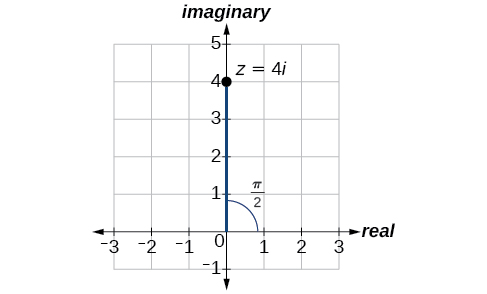
Figure \(\PageIndex{2}\)
Express \(z=3i\) as \(r \, \mathrm{cis}\left( \theta \right)\) in polar form.
- Answer
-
\(z=3\left(\cos\left(\frac{\pi}{2}\right)+i \, \sin\left(\frac{\pi}{2}\right)\right)\) or \(z = 3 \, \mathrm{cis}\left( \frac{\pi}{2} \right)\)
Find the polar form of \(-4+4i\).
- Solution
-
We begin by finding the value of \(r\).\[\begin{array}{rcl}
r & = & \sqrt{x^2+y^2} \\[6pt] & = & \sqrt{(-4)^2+4^2} \\[6pt] & = & \sqrt{32} \\[6pt] & = & 4\sqrt{2} \\[6pt] \end{array} \nonumber \]We now find the angle \(\theta\).\[\begin{array}{rrcl}
& \cos\left( \theta \right) & = & \dfrac{x}{r} \\[6pt] \implies & \cos\left( \theta \right) & = & -\dfrac{4}{4\sqrt{2}} \\[6pt] \implies & \cos\left( \theta \right) & = & -\dfrac{1}{\sqrt{2}} \\[6pt] \implies & \widehat{\theta} & = & \cos^{-1} \left(\dfrac{1}{\sqrt{2}}\right) \\[6pt] \implies & \widehat{\theta} & = & \dfrac{\pi}{4} \\[6pt] \end{array} \nonumber \]Using the fact that \(z = -4 + 4i\) is in the second quadrant, we get \(\theta = \frac{3\pi}{4}\). Thus, the polar form is\[z = 4\sqrt{2} \, \mathrm{cis} \left(\dfrac{3\pi}{4}\right). \nonumber \]
It's very tempting to evaluate the trigonometric functions at \(\frac{3\pi}{4}\) in Example \(\PageIndex{2}\). I would not blame you for wanting to do that because that's what we have been doing this entire course; however, in doing so, you would be reverting back to the standard (rectangular) form of the complex number (thereby undoing all of your work to get the number in polar form).
Write \(z=\sqrt{3}+i\) in polar form.
- Answer
-
\(z=2\left(\cos\left(\frac{\pi}{6}\right)+ i \, \sin\left(\frac{\pi}{6}\right)\right) = 2 \mathrm{cis}\left( \frac{\pi}{6} \right)\)
Converting a Complex Number from Polar to Rectangular Form
Converting a complex number from polar form to rectangular form is a matter of evaluating what is given and using the distributive property. In other words, given\[z = r\left(\cos\left( \theta \right)+i \, \sin\left( \theta \right)\right), \nonumber \]we first evaluate the trigonometric functions \(\cos\left( \theta \right)\) and \(\sin\left( \theta \right)\), then multiply through by \(r\).
Convert the polar form of the given complex number to rectangular form:\[z = 12\left(\cos\left(\dfrac{\pi}{6}\right)+i \, \sin\left(\dfrac{\pi}{6}\right)\right)\nonumber \]
- Solution
-
We begin by evaluating the trigonometric expressions.\[\begin{array}{rclcrcl}
\cos\left(\dfrac{\pi}{6}\right) & = & \dfrac{\sqrt{3}}{2} & \text{ and } & \sin(\dfrac{\pi}{6}) & = & \dfrac{1}{2}\\ \end{array} \nonumber \]After substitution, the complex number is\[z = 12\left(\dfrac{\sqrt{3}}{2}+\dfrac{1}{2} \, i\right) = 6\sqrt{3} + 6 i \nonumber \]Hence, the rectangular form of the given point in polar form is \(6\sqrt{3}+6i\).
Convert the complex number to rectangular form:\[z = 4\left(\cos \left(\dfrac{11\pi}{6}\right) + i \, \sin \left(\dfrac{11\pi}{6}\right)\right) \nonumber \]
- Answer
-
\(z=2\sqrt{3}-2i\)
Finding Products of Complex Numbers in Polar Form
Now that we can convert complex numbers to polar form we will learn how to perform operations on complex numbers in polar form. For the rest of this section, we will work with formulas developed by French mathematician Abraham de Moivre (1667-1754). These formulas have made working with products, quotients, powers, and roots of complex numbers much simpler than they appear. The rules are based on multiplying the moduli and adding the arguments.
Notice that the product calls for multiplying the moduli and adding the angles. The proof of this theorem is left as a homework exercise.
Find the product of \(z_1z_2\), given \(z_1 = 4 \left(\cos\left(80^{\circ}\right) + i \, \sin\left(80^{\circ}\right)\right)\) and \(z_2 = 2 \, \mathrm{cis}\left(145^{\circ}\right)\).
- Solution
-
Follow the formula:
\[\begin{array}{rcl} z_1 z_2 & = & 4 \cdot 2 \left[ \cos\left(80^{\circ} +145^{\circ}\right) + i \, \sin\left(80^{\circ} +145^{\circ} \right)\right] \\[6pt] & = & 8 \left[\cos\left(225^{\circ}\right) + i \, \sin\left(225^{\circ}\right) \right] \\[6pt] & = & 8 \left[-\dfrac{\sqrt{2}}{2} + i \, \left(-\dfrac{\sqrt{2}}{2}\right) \right] \\[6pt] & = & -4\sqrt{2} - 4i\sqrt{2} \\[6pt] \end{array} \nonumber \]
Let \(z_1 = -\sqrt{3} + i\) and \(z_2 = 3 + 3 i\).
- Find the product of \(z_1\) and \(z_2\) in rectangular form (without converting to polar form).
- Without converting to polar form, determine the angle \(z_1 z_2\) makes with the positive \(x\)-axis.
- Rewrite \(z_1\) and \(z_2\) in polar form.
- Find the product of \(z_1\) and \(z_2\) in polar form.
- Using your answer from part (d), determine the angle \(z_1 z_2\) makes with the positive \(x\)-axis.
- Answers
-
- \(z_1 z_2 = (-3 -3\sqrt{3}) + (3 - 3\sqrt{3}) i\)
- \(195^{ \circ }\)
- \(z_1 = 2 \left( \cos\left( 150^{ \circ } \right) + i \, \sin\left( 150^{ \circ } \right) \right)\) and \(z_2 = 3\left( \cos\left( 45^{ \circ } \right) + i \, \sin\left( 45^{ \circ } \right) \right)\)
- \(z_1 z_2 = 6 \left( \cos\left( 195^{ \circ } \right) + i \, \sin\left( 195^{ \circ } \right) \right)\)
- \(195^{ \circ }\)
Finding Quotients of Complex Numbers in Polar Form
The quotient of two complex numbers in polar form follows the same patterns set for products.
The proof of this theorem is left as a homework exercise.
Find the quotient of \(z_1 = 2\left(\cos(213^{\circ} )+i \, \sin(213^{\circ} )\right)\) and \(z_2=4\left(\cos(33^{\circ} )+i \, \sin(33^{\circ} )\right)\).
- Solution
-
Using the formula, we have\[\begin{array}{rcl}
\dfrac{z_1}{z_2} & = & \dfrac{2}{4}\left[\cos(213^{\circ} -33^{\circ} )+i \, \sin(213^{\circ} -33^{\circ} )\right] \\[6pt] & = & \dfrac{1}{2}\left[\cos(180^{\circ} )+i \, \sin(180^{\circ} )\right] \\[6pt] & = & \dfrac{1}{2}[-1+0i] \\[6pt] & = & -\dfrac{1}{2}+0i \\[6pt] & = & -\dfrac{1}{2} \\[6pt] \end{array} \nonumber \]
Find the product and the quotient of \(z_1=2\sqrt{3}\left(\cos(150^{\circ} )+i \, \sin(150^{\circ} )\right)\) and \(z_2=2\left(\cos(30^{\circ} )+i \, \sin(30^{\circ} )\right)\).
- Answer
-
\(z_1z_2=-4\sqrt{3}\); \(\frac{z_1}{z_2}=-\frac{\sqrt{3}}{2}+\frac{3}{2}i\)
Finding Powers of Complex Numbers in Polar Form
Finding powers of complex numbers is greatly simplified when they are written in polar form. For example, let \(z = 1 + i\). This is a fairly innocuous complex number; however, let's try to compute \(z^5 = \left( 1 + i \right)^5\).\[\begin{array}{rcl}
z^5 & = & \left( 1 + i \right)^5 \\[6pt] & = & \left( 1 + i \right)^2 \left( 1 + i \right)^2 \left( 1 + i \right) \\[6pt] & = & \left( 1 + 2i + i^2 \right) \left( 1 + 2i + i^2 \right) \left( 1 + i \right) \\[6pt] & = & \left( 1 + 2i - 1 \right) \left( 1 + 2i - 1 \right) \left( 1 + i \right) \\[6pt] & = & \left( 2i \right) \left( 2i \right) \left( 1 + i \right) \\[6pt] & = & 4i^2 \left( 1 + i \right) \\[6pt] & = & -4 \left( 1 + i \right) \\[6pt] & = & -4 - 4i \\[6pt] \end{array} \nonumber \]This is only the fifth power of a somewhat simple complex number. Imagine working with the tenth power of something like \(z = -\sqrt{3} + i\). If our complex number is written in polar form, however, something fantastic happens.
(Note: The following derivation of why De Moivre's Theorem works requires a proof method called Mathematical Induction. If you have already taken College Algebra, then you have worked with, and performed, proofs using Mathematical Induction; however, since College Algebra is not a prerequisite for this course, you might not have seen it. As such, I provide the proof only for those who are interested.)
De Moivre's Theorem states that, for a positive integer \(n\), \(z^n\) is found by raising the modulus to the \(n^{th}\) power and multiplying the argument by \(n\). It is the standard method used in modern Mathematics.
Evaluate the expression \({(1+i)}^5\) using De Moivre's Theorem.
- Solution
-
Since De Moivre's Theorem applies to complex numbers written in polar form, we must first write \((1+i)\) in polar form. Let us find \(r\).\[\begin{array}{rcl}
r & = & \sqrt{x^2+y^2} \\[6pt] & = & \sqrt{{(1)}^2+{(1)}^2} \\[6pt] & = & \sqrt{2} \\[6pt] \end{array} \nonumber \]Then we find \(\theta\). Using the formula \(\tan \theta=\frac{y}{x}\) gives\[\begin{array}{rrcl}
& \tan \left(\theta\right) & = & \dfrac{1}{1} \\[6pt] \implies & \tan \left(\theta\right) & = & 1 \\[6pt] \implies & \widehat{\theta} & = & \dfrac{\pi}{4} \\[6pt] \end{array} \nonumber \]Since \((1 + i)\) is in the first quadrant, this means \(\theta = \frac{\pi}{4}\).Now we use De Moivre's Theorem to evaluate the expression.\[\begin{array}{rcl}
(1+i)^5 & = & (\sqrt{2})^5 \left[ \cos\left(5 \cdot \dfrac{\pi}{4}\right) + i \, \sin\left(5 \cdot \dfrac{\pi}{4}\right) \right] \\[6pt] & = & 4\sqrt{2}\left[ \cos\left(\dfrac{5\pi}{4}\right)+i \, \sin\left(\dfrac{5\pi}{4}\right) \right] \\[6pt] & = & 4\sqrt{2}\left[ -\dfrac{\sqrt{2}}{2} + i \, \left(-\dfrac{\sqrt{2}}{2}\right) \right] \\[6pt] & = & -4-4i \\[6pt] \end{array} \nonumber \]
Compute \(\left( -\sqrt{3} + i \right)^{10}\).
- Answer
-
\(2^{10} \, \mathrm{cis}\left( \frac{25 \pi}{3} \right) = 1024 \, \mathrm{cis}\left( \frac{\pi}{3} \right) = 1024 \left( \frac{1}{2} + \frac{\sqrt{3}}{2} \, i \right) = 512 + 512 \, i \sqrt{3}\)
Finding Roots of Complex Numbers in Polar Form
DeMoivre's Theorem also works for fractional values of \(n\), so we can compute roots of complex numbers. For example, by applying the theorem with \(n=\frac{1}{2}\), we see that one of the square roots of \(z=r(\cos\left( \theta \right)+i \sin\left( \theta \right))\) is\[z^{1 / 2} = r^{1 / 2}\left(\cos \left(\dfrac{\theta}{2}\right)+i \, \sin \left(\dfrac{\theta}{2}\right)\right). \nonumber \]Now, every number, whether real or complex, has two square roots. To find the other root, remember that we can add a multiple of \(2 \pi\) to the argument of \(z\), that is, we can also write the polar form of \(z\) as\[z=r(\cos (\theta+2 \pi)+i \, \sin (\theta+2 \pi)).\nonumber\]
The second square root of \(z\) is thus\[r^{1 / 2}\left(\cos \left(\dfrac{\theta}{2}+\pi\right)+i \, \sin \left(\dfrac{\theta}{2}+\pi\right)\right). \nonumber \]As an example, consider \(w=-8+8 i \sqrt{3}\), whose polar form is \(16\left(\cos \left(\frac{2 \pi}{3}\right)+i \,\sin\left( \frac{2 \pi}{3}\right)\right)\), or by adding \(2 \pi\) to the argument, \(16\left(\cos \left(\frac{8 \pi}{3}\right)+i \, \sin \left(\frac{8 \pi}{3}\right)\right)\). The two square roots of \(w\) are\[\begin{array}{rclcrcl}
z_1 & = & 16^{1 / 2}\left(\cos \left(\dfrac{\pi}{3}\right) + i \, \sin \left(\dfrac{\pi}{3}\right)\right) & \quad & z_2 & = & 16^{1 / 2}\left(\cos\left( \dfrac{4 \pi}{3}\right) + i \, \sin \left(\dfrac{4 \pi}{3}\right)\right) \\[6pt] & = & 4\left(\dfrac{1}{2}+i \, \dfrac{\sqrt{3}}{2}\right) & \quad & & = & 4\left(\dfrac{-1}{2}+i \dfrac{-\sqrt{3}}{2}\right) \\[6pt] & = & 2+2 i \sqrt{3} & \quad & & = & -2-2 i \sqrt{3} \\[6pt] \end{array} \nonumber \]You can verify that both of these numbers are square roots of \(w=-8+8 i \sqrt{3}\), for instance,\[\begin{array}{rcl}
(2+2 i \sqrt{3})^2 & = & 4+2(2)(2 i \sqrt{3})+12 i^2 \\[6pt] & = & -8+8 i \sqrt{3} \\[6pt] \end{array} \nonumber \]The graphs of \(w\) and its two square roots are shown below.

It is not hard to show that every number has three complex cube roots, four complex fourth roots, and so on.
In general, to find the \(n^{th}\) root of a complex number in polar form, we use the \(n^{th}\) Root Theorem, or we can use De Moivre's Theorem as we did in our work above. The following theorem is presented without proof.
Find the cube roots of \(z = 8\left(\cos\left(\frac{2\pi}{3}\right)+i \, \sin\left(\frac{2\pi}{3}\right)\right)\).
- Solution
-
We have\[\begin{array}{rcl}
z^{\frac{1}{3}} & = & 8^{\frac{1}{3}}\left[ \cos\left(\dfrac{\dfrac{2\pi}{3}}{3}+\dfrac{2k\pi}{3}\right)+i \, \sin\left(\dfrac{\dfrac{2\pi}{3}}{3}+\dfrac{2k\pi}{3}\right) \right] \\[6pt] & = & 2\left[ \cos\left(\dfrac{2\pi}{9}+\dfrac{2k\pi}{3}\right)+i \, \sin\left(\dfrac{2\pi}{9}+\dfrac{2k\pi}{3}\right) \right] \\[6pt] \end{array} \nonumber \]There will be three roots - one for each of \(k=0\) , \(1\), and \(2\).When \(k=0\), we have\[z^{\frac{1}{3}} = 2\left(\cos\left(\dfrac{2\pi}{9}\right)+i \, \sin\left(\dfrac{2\pi}{9}\right)\right).\nonumber \]When \(k=1\), we have\[\begin{array}{rclcl}
z^{\frac{1}{3}} & = & 2\left[ \cos\left(\dfrac{2\pi}{9}+\dfrac{6\pi}{9}\right)+i \, \sin\left(\dfrac{2\pi}{9}+\dfrac{6\pi}{9}\right) \right] & \quad & \left(\text{adding }\dfrac{2(1)\pi}{3} \text{ to each angle}\right) \\[6pt] & = & 2\left(\cos\left(\dfrac{8\pi}{9}\right)+i \, \sin\left(\dfrac{8\pi}{9}\right)\right) & & \\[6pt] \end{array} \nonumber \]When \(k=2\), we have\[\begin{array}{rclcl}
z^{\frac{1}{3}} & = & 2\left[ \cos\left(\dfrac{2\pi}{9}+\dfrac{12\pi}{9}\right)+i \, \sin\left(\dfrac{2\pi}{9}+\dfrac{12\pi}{9}\right) \right] & \quad & \left(\text{adding }\dfrac{2(2)\pi}{3} \text{ to each angle}\right) \\[6pt] & = & 2\left(\cos\left(\dfrac{14\pi}{9}\right)+i \, \sin\left(\dfrac{14\pi}{9}\right)\right) & & \\[6pt] \end{array} \nonumber \]Remember to find the common denominator to simplify fractions in situations like this one. For \(k=1\), the angle simplification is\[\begin{array}{rcl}
\dfrac{\dfrac{2\pi}{3}}{3}+\dfrac{2(1)\pi}{3} & = & \dfrac{2\pi}{3}(\dfrac{1}{3})+\dfrac{2(1)\pi}{3}\left(\dfrac{3}{3}\right) \\[6pt] & = & \dfrac{2\pi}{9}+\dfrac{6\pi}{9} \\[6pt] & = & \dfrac{8\pi}{9} \\[6pt] \end{array} \nonumber \]
Find the four fourth roots of \(16(\cos(120^{\circ} )+i \, \sin(120^{\circ} ))\).
- Answer
-
\(z_0 = 2(\cos(30^{\circ} )+i \, \sin(30^{\circ} ))\)
\(z_1=2(\cos(120^{\circ} )+i \, \sin(120^{\circ} ))\)
\(z_2=2(\cos(210^{\circ} )+i \, \sin(210^{\circ} ))\)
\(z_3=2(\cos(300^{\circ} )+i \, \sin(300^{\circ} ))\)
This page titled 9.4: Polar Form of Complex Numbers was last modified on Fri, 02 Oct 2026 22:30:54 GMT and is shared under a CC BY-SA 4.0 license and was authored, remixed, and/or curated by OpenStax via source content that was edited to the style and standards of the LibreTexts platform.
The book could not be loaded just now.