Opening the book…
Reading Questions
- What graphical test is used to determine if a function is one-to-one?
- Why is it necessary to restrict the domain of the sine function before we can define its inverse function?
- What is the restricted domain of the cosine function that is used to define the inverse cosine function?
- What is the domain of the function \(y = \arcsin(x)\)?
- What is the range of the function \(y = \arccos(x)\)?
- What is the range of the function \(y = \arctan(x)\)?
- The expression \(\sin^{-1}(0.5)\) represents an angle. In which quadrant does this angle lie?
- The expression \(\cos^{-1}(-0.5)\) represents an angle. In which quadrant does this angle lie?
- Is the statement \(\sin^{-1}(\sin(3\pi)) = 3\pi\) true or false? Explain your reasoning.
- Is the statement \(\sin(\sin^{-1}(0.5)) = 0.5\) true or false? Explain your reasoning.
- What is the key difference between the meaning of \(\sin^{-1}(x)\) and \((\sin(x))^{-1}\)?
- When simplifying an expression like \(\cos(\arctan(x))\), what is a helpful first step?
Skills Refresher
Review the following skills you will need for this section.
For the following exercises, find the inverse of the function, if it exists.
-
\( f(x) = 2x^2 - 16x + 1 \)
-
\( g(x) = (x - 2)^3 \)
-
\( f(x) = \dfrac{3x - 1}{5x - 1} \)
For the following exercises,
(a) Find a formula for the inverse function.
(b) State the domain and range of the inverse function.
(c) Graph the function and its inverse on the same grid.
-
\(f(x) = \frac{1}{2}x - 4\)
-
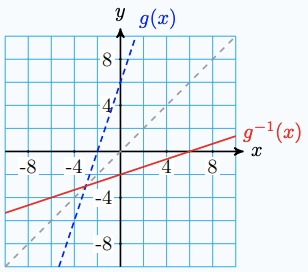
\(g(x) = 3x + 6\)
-
\(F(x) = 2 + \frac{1}{x}\)
-
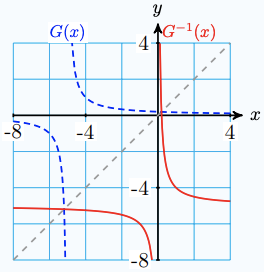
\(G(x) = \frac{1}{x+5}\)
-
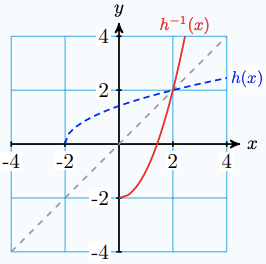
\(h(x) = \sqrt{x+2}\)
-
\(H(x) = 3 + \sqrt[3]{x}\)
For the following exercises, which functions have an inverse function? Explain your answer.
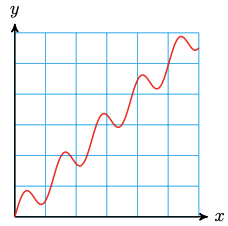


For the following exercises, use technology to graph the function and decide if it has an inverse function.
-
\(f(x)=\sin \left(2 x\right)-\cos \left(x\right)\)
-
\(g(x)=4 e^{-(x / 4)^2}\)
-
\(G(x)=\sqrt{25-x^2}\)
-
\(F(x)=\ln \left(x^3+8\right)\)
- Answers
-
-
No inverse exists for this function.
-
\( g^{-1}(x) = \sqrt[3]{x} + 2 \)
-
\( \dfrac{x - 1}{5x - 3} \)
-
-
\(f^{-1}(x)=2 x+8\)
-
Dom: \((-\infty, \infty)\) Rge: \((-\infty, \infty)\)
-

-
-
-
\(g^{-1}(x)=\dfrac{1}{3} x-2\)
-
Dom: \((-\infty, \infty)\) Rge: \((-\infty, \infty)\)
-
-
-
-
\(F^{-1}(x) = \dfrac{1}{x-2}\)
-
Dom: \(x \neq 0\) Rge: \(y \neq 2\)
-

-
-
-
\(G^{-1}(x)=\dfrac{1}{x}-5\)
-
Dom: \(x \neq -5\) Rge: \(y \neq 0\)
-
-
-
-
\(h^{-1}(x)=x^2-2\)
-
Dom: \(x \geq 0\) Rge: \(y \geq -2\)
-
-
-
-
\(H^{-1}(x) = (x-3)^3\)
-
Dom: \((-\infty, \infty)\) Rge: \((-\infty, \infty)\)
-

-
-
No. This graph does not pass the Horizontal Line Test.
-
Yes. This graph passes the Horizontal Line Test.
-
Yes. This graph passes the Horizontal Line Test.
-
No. This graph does not pass the Horizontal Line Test.
-
No.
-
No.
-
No.
-
Yes.
-
Homework
Concept Check
-
The following is a table of values defining a function \(f\). Make a table of values for \(f^{-1}\).
\(x\) -3 -2 0 1 4 \(f(x)\) 6 3 1 0 -1 -
What does it mean for a function to be one-to-one? Give an example.
-
Why do we restrict the domains of the trigonometric functions when we define their inverse functions?
-
Which of the following expressions is undefined? Why?
-
\(\cos ^{-1}(0)\)
-
\(\arctan (-2)\)
-
\(\arcsin (-2)\)
-
-
Use your calculator to evaluate \(\sin \left(118^{\circ}\right)\), then evaluate \(\sin ^{-1}\) of your answer. Explain the result.
-
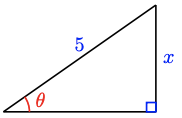
-
Write \(x\) as a function of \(\theta\).
-
Write \(\theta\) as a function of \(x\).
-
-

-
Write \(x\) as a function of \(\theta\).
-
Write \(\theta\) as a function of \(x\).
-
Basic Skills
For the following exercises,
(a) Evaluate each pair of angles to the nearest \(0.1\) radian, and show that they are supplements.
(b) Sketch both angles.
(c) Find the sine of each angle.
-
\(\theta=\cos ^{-1}\left(\frac{3}{4}\right), \phi=\cos ^{-1}\left(-\frac{3}{4}\right)\)
-
\(\theta=\cos ^{-1}\left(\frac{1}{5}\right), \phi=\cos ^{-1}\left(-\frac{1}{5}\right)\)
-
\(\theta=\cos ^{-1}(0.1525), \quad \phi=\cos ^{-1}(-0.1525)\)
-
\(\theta=\cos ^{-1}(0.6825), \quad \phi=\cos ^{-1}(-0.6825)\)
For the following exercises, use a calculator to evaluate. Round your answers to the nearest tenth of a radian.
-
\(\sin ^{-1}(0.2838)\)
-
\(\tan ^{-1}(4.8972)\)
-
\(\cos ^{-1}(0.6894)\)
-
\(\arccos (-0.8134)\)
-
\(\arctan (-1.2765)\)
-
\(\arcsin (-07493)\)
For the following exercises, give exact values.
-
\(\cos ^{-1} \left(-\frac{1}{\sqrt{2}}\right)\)
-
\(\tan ^{-1}(-1)\)
-
\(\sin ^{-1} \left(-\frac{1}{2}\right)\)
-
\(\arccos \left(\frac{\sqrt{3}}{2}\right)\)
-
\(\arctan \left(\frac{1}{\sqrt{3}}\right)\)
-
\(\arcsin (-1)\)
-
\(\arccos \left( -1 \right)\)
-
\(\arctan \left( \sqrt{3} \right)\)
-
\(\arcsin \left( -\frac{\sqrt{3}}{2} \right)\)
-
\(\arccos \left( -\frac{\sqrt{3}}{2} \right)\)
-
\(\arctan \left( -\sqrt{3} \right)\)
-
\(\arcsin \left( -\frac{\sqrt{2}}{2} \right)\)
-
\(\arccos \left( 0 \right)\)
-
\(\arctan \left( 0 \right)\)
-
\(\arcsin \left( 0 \right)\)
-
\(\arccos \left( \frac{1}{2} \right)\)
-
\(\arctan \left( -\frac{\sqrt{3}}{3} \right)\)
-
\(\arcsin \left( \frac{1}{2} \right)\)
-
\(\arccos \left( \frac{\sqrt{2}}{2} \right)\)
-
\(\arctan \left( 1 \right)\)
-
\(\arcsin \left( \frac{\sqrt{2}}{2} \right)\)
-
\(\arcsin \left( \frac{\sqrt{3}}{2} \right)\)
-
\(\arcsin \left( 1 \right)\)
-
\(\arccos \left( 1 \right)\)
For the following exercises, without using a calculator, find the exact value or state that it is undefined.
-
\(\sin\left(\arcsin\left(\dfrac{1}{2}\right)\right)\)
-
\(\sin\left(\arcsin\left(-\dfrac{\sqrt{2}}{2}\right)\right)\)
-
\(\sin\left(\arcsin\left(\dfrac{3}{5}\right)\right)\)
-
\(\sin\left(\arcsin\left(-0.42\right)\right)\)
-
\(\sin\left(\arcsin\left(\dfrac{5}{4}\right)\right)\)
-
\(\cos\left(\arccos\left(\dfrac{\sqrt{2}}{2}\right)\right)\)
-
\(\cos\left(\arccos\left(-\dfrac{1}{2}\right)\right)\)
-
\(\cos\left(\arccos\left(\dfrac{5}{13}\right)\right)\)
-
\(\cos\left(\arccos\left(-0.998\right)\right)\)
-
\(\cos\left(\arccos\left(\pi \right)\right)\)
-
\(\tan\left(\arctan\left(-1\right)\right)\)
-
\(\tan\left(\arctan\left(\sqrt{3}\right)\right)\)
-
\(\tan\left(\arctan\left(\dfrac{5}{12}\right)\right)\)
-
\(\tan\left(\arctan\left(0.965\right)\right)\)
-
\(\tan\left(\arctan\left( 3\pi \right)\right)\)
For the following exercises, find the exact value without using a calculator.
-
\(\tan \left(\sin ^{-1}\left(\frac{2}{3}\right)\right)\)
-
\(\tan \left(\cos ^{-1}\left(\frac{3}{4}\right)\right)\)
-
\(\cos \left[\tan ^{-1}(-2)\right]\)
-
\(\sin \left[\tan ^{-1}\left(-\frac{3}{\sqrt{5}}\right)\right]\)
-
\(\sin \left[\cos ^{-1}\left(-\frac{2 \sqrt{6}}{7}\right)\right]\)
-
\(\cos \left[\sin ^{-1}\left(-\frac{2}{7}\right)\right]\)
-
\(\sin\left(\arccos\left(-\dfrac{1}{2}\right)\right)\)
-
\(\sin\left(\arccos\left(\dfrac{3}{5}\right)\right)\)
-
\(\sin\left(\arctan\left(-2\right)\right)\)
-
\(\cos\left(\arcsin\left(-\dfrac{5}{13}\right)\right)\)
-
\(\cos\left(\arctan\left(\sqrt{7} \right)\right)\)
-
\(\tan\left(\arcsin\left(-\dfrac{2\sqrt{5}}{5}\right)\right)\)
-
\(\tan\left(\arccos\left(-\dfrac{1}{2}\right)\right)\)
-
\(\cot\left(\arcsin\left(\dfrac{12}{13}\right)\right)\)
-
\(\cot\left(\arccos\left(\dfrac{\sqrt{3}}{2}\right)\right)\)
-
\(\cot\left(\arctan \left( 0.25 \right)\right)\)
-
\(\sec\left(\arccos\left(\dfrac{\sqrt{3}}{2}\right)\right)\)
-
\(\sec\left(\arcsin\left(-\dfrac{12}{13}\right)\right)\)
-
\(\sec\left(\arctan\left(10\right)\right)\)
-
\(\csc\left(\arcsin\left(\dfrac{3}{5}\right)\right)\)
-
\(\csc\left(\arctan\left(-\dfrac{2}{3}\right)\right)\)
For the following exercises, simplify the expression and state the domain on which the equivalence is valid.
-
\(\tan \left(\cos ^{-1} (x)\right)\)
-
\(\cos \left(\sin ^{-1} (h)\right)\)
-
\(\sin \left( \arccos \left( x \right) \right)\)
-
\(\cos \left( \arctan \left( x \right) \right)\)
-
\(\tan \left( \arcsin \left( x \right) \right)\)
-
\(\sec \left( \arctan \left( x \right) \right)\)
-
\(\csc \left( \arccos \left( x \right) \right)\)
-
\(\sin \left(\tan ^{-1} (2 t)\right)\)
-
\(\tan \left(\sin ^{-1} (3 b)\right)\)
For the following exercises, find the exact value or state that it is undefined.
-
\(\arcsin\left(\sin\left(\dfrac{\pi}{6}\right) \right)\)
-
\(\arcsin\left(\sin\left(-\dfrac{\pi}{3}\right) \right)\)
-
\(\arcsin\left(\sin\left(\dfrac{3\pi}{4}\right) \right)\)
-
\(\arcsin\left(\sin\left(\dfrac{11\pi}{6}\right) \right)\)
-
\(\arcsin\left(\sin\left(\dfrac{4\pi}{3}\right) \right)\)
-
\(\arccos\left(\cos\left(\dfrac{\pi}{4}\right) \right)\)
-
\(\arccos\left(\cos\left(\dfrac{2\pi}{3}\right) \right)\)
-
\(\arccos\left(\cos\left(\dfrac{3\pi}{2}\right) \right)\)
-
\(\arccos\left(\cos\left(-\dfrac{\pi}{6}\right) \right)\)
-
\(\arccos\left(\cos\left(\dfrac{5\pi}{4}\right) \right)\)
-
\(\arctan\left(\tan\left(\dfrac{\pi}{3}\right) \right)\)
-
\(\arctan\left(\tan\left(-\dfrac{\pi}{4}\right) \right)\)
-
\(\arctan\left(\tan\left(\pi\right) \right)\)
-
\(\arctan\left(\tan\left(\dfrac{\pi}{2}\right) \right)\)
-
\(\arctan\left(\tan\left(\dfrac{2\pi}{3}\right) \right)\)
For the following exercises, complete the table of values and sketch the function.
-
\(x\) -1 \(-\frac{\sqrt{3}}{2}\) \(-\frac{\sqrt{2}}{2}\) \(-\frac{1}{2}\) 0 \(\frac{1}{2}\) \(\frac{\sqrt{2}}{2}\) \(\frac{\sqrt{3}}{2}\) 1 \(\cos ^{-1} x\) 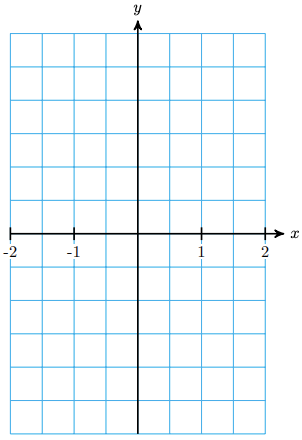
-
\(x\) -1 \(-\frac{\sqrt{3}}{2}\) \(-\frac{\sqrt{2}}{2}\) \(-\frac{1}{2}\) 0 \(\frac{1}{2}\) \(\frac{\sqrt{2}}{2}\) \(\frac{\sqrt{3}}{2}\) 1 \(\sin ^{-1} x\) 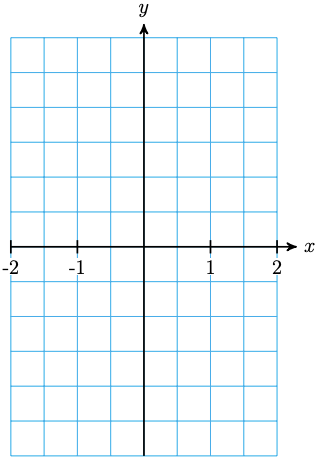
-
\(x\) \(-\sqrt{3}\) -1 \(-\frac{1}{\sqrt{3}}\) 0 \(\frac{1}{\sqrt{3}}\) 1 \(\sqrt{3}\) \(\tan ^{-1} x\) 
-
Use a graphing calculator to answer each of the following questions. Then explain the results.
-
Does \(\cos ^{-1} (x)=\frac{1}{\cos (x)}\)?
-
Does \(\sin ^{-1} (x)=\frac{1}{\sin (x)}\)?
-
Does \(\tan ^{-1} (x)=\frac{1}{\tan (x)}\)?
-
-
-
Sketch a graph of \(y=\cos ^{-1} (x)\), and label the scales on the axes.
-
Use transformations to sketch graphs of \(y=2 \cos ^{-1} (x)\) and \(y=\cos ^{-1}(2 x)\).
-
Does \(2 \cos ^{-1} (x)=\cos ^{-1}(2 x)\)?
-
-
-
Sketch a graph of \(y=\sin ^{-1} (x)\), and label the scales on the axes.
-
Use transformations to sketch graphs of \(y=\frac{1}{2} \sin ^{-1} (x)\) and \(y=\cos ^{-1}\left(\frac{1}{2} x\right)\).
-
Does \(\frac{1}{2} \sin ^{-1} (x)=\cos ^{-1}\left(\frac{1}{2} x\right)\)?
-
-
-
Sketch a graph of \(y=\tan ^{-1} (x)\), and label the scales on the axes.
-
Use your calculator to graph \(y=\frac{\sin ^{-1} (x)}{\cos ^{-1} (x)}\) on a suitable domain.
-
Does \(\tan ^{-1} (x)=\frac{\sin ^{-1} (x)}{\cos ^{-1} (x)}\)?
-
-
-
Use your calculator to sketch \(y=\sqrt[3]{x}\) and \(\tan ^{-1} (x)\) on \([-10,10]\).
-
Describe the similarities and differences in the two graphs.
-
For the following exercises, find the exact value for the expression.
-
\(\sin\left(\arcsin\left( \dfrac{5}{13} \right) + \dfrac{\pi}{4}\right)\)
-
\(\tan\left( \arctan(3) + \arccos\left(-\dfrac{3}{5}\right) \right)\)
-
\(\sin\left(2\arcsin\left(-\dfrac{4}{5}\right)\right)\)
-
\(\sin\left(2\arctan\left(2\right)\right)\)
-
\(\cos\left(2 \arcsin\left(\dfrac{3}{5}\right)\right)\)
-
\(\sin\left( \dfrac{\arctan(2)}{2} \right)\)
-
\(\sin \left(2 \tan ^{-1} (4)\right)\)
-
\(\cos \left(2 \sin ^{-1}\left(\frac{5}{13}\right)\right)\)
-
\(\tan \left(2 \cos ^{-1}\left(\frac{3}{4}\right)\right)\)
-
\(\sin \left(2 \cos ^{-1}\left(-\frac{4}{5}\right)\right)\)
-
\(\tan \left(2 \sin ^{-1}\left(\frac{1}{3}\right)\right)\)
-
\(\cos \left(2 \tan ^{-1}\left(\frac{3}{2}\right)\right)\)
-
Let \(\alpha = \cos ^{-1} \left(-\frac{4}{5}\right), \beta = \sin ^{-1} \left(\frac{5}{13}\right)\). Find exact values for the following.
-
\(\cos (\alpha + \beta )\)
-
\(\sin (\alpha + \beta )\)
-
\(\cos (\alpha - \beta )\)
-
\(\sin (\alpha - \beta )\)
-
-
Let \(\alpha = \sin ^{-1} \left(-\frac{15}{17}\right), \beta = \tan ^{-1} \left(\frac{4}{3}\right)\). Find exact values for the following.
-
\(\cos (\alpha + \beta )\)
-
\(\sin (\alpha + \beta )\)
-
\(\cos (\alpha - \beta )\)
-
\(\sin (\alpha - \beta )\)
-
-
Find an exact value for \(\sin \left(\tan ^{-1}\left(\frac{3}{4}\right)+\sin ^{-1}\left(-\frac{4}{5}\right)\right)\).
-
Find an exact value for \(\cos \left(\tan ^{-1}\left(\frac{5}{12}\right)+\sin ^{-1}\left(-\frac{3}{5}\right)\right)\).
For the following exercises, rewrite the expression as an algebraic expression without trigonometric functions.
-
\(\sin \left(2 \tan ^{-1} (x)\right)\)
-
\(\cos \left(2 \sin ^{-1} (x)\right)\)
-
\(\sin \left(2 \cos ^{-1} (w)\right)\)
-
\(\cos \left(2 \tan ^{-1} (w)\right)\)
-
\(\sin(\arccos(2x))\)
-
\(\sin\left(\arccos\left(\dfrac{x}{5}\right)\right)\)
-
\(\cos\left(\arcsin\left(\dfrac{x}{2}\right)\right)\)
-
\(\cos\left(\arctan\left(3x\right)\right)\)
-
\(\sin(2\arcsin(7x))\)
-
\(\sin\left(2 \arcsin\left( \dfrac{x\sqrt{3}}{3} \right) \right)\)
-
\(\cos(2 \arcsin(4x))\)
-
\(\sec(\arctan(2x))\tan(\arctan(2x))\)
-
\(\sin \left( \arcsin(x) + \arccos(x) \right)\)
-
\(\cos \left( \arcsin(x) + \arctan(x) \right)\)
-
\(\tan \left( 2\arcsin(x) \right)\)
-
\(\sin \left( \dfrac{1}{2}\arctan(x) \right)\)
-
If \(x=5 \sin (\theta), 0^{\circ}<\theta<90^{\circ}\), express \(\sin (2 \theta)\) and \(\cos (2 \theta)\) in terms of \(x\).
-
If \(x-1=2 \cos (\theta), 0^{\circ}<\theta<90^{\circ}\), express \(\sin (2 \theta)\) and \(\cos (2 \theta)\) in terms of \(x\).
-
If \(x=3 \tan (\theta)\), write \(\theta+\frac{1}{4} \sin (2 \theta)\) in terms of \(x\).
-
If \(x=5 \cos (\theta)\), write \(\frac{\theta}{2}-\cos (2 \theta)\) in terms of \(x\).
-
If \(\sin(\theta) = \dfrac{x}{2}\) for \(-\dfrac{\pi}{2} < \theta < \dfrac{\pi}{2}\), find an expression for \(\theta + \sin(2\theta)\) in terms of \(x\).
-
If \(\tan(\theta) = \dfrac{x}{7}\) for \(-\dfrac{\pi}{2} < \theta < \dfrac{\pi}{2}\), find an expression for \(\dfrac{1}{2}\theta - \dfrac{1}{2}\sin(2\theta)\) in terms of \(x\).
-
If \(\sec(\theta) = \dfrac{x}{4}\) for \(0 < \theta < \dfrac{\pi}{2}\), find an expression for \(4\tan(\theta) - 4\theta\) in terms of \(x\).
-
-
For what values of \(x\) is the function \(f(x)=\sin (\arcsin (x))\) defined?
-
Is \(\sin (\arcsin (x))=x\) for all \(x\) where it is defined? If not, for what values of \(x\) is the equation false?
-
For what values of \(x\) is the function \(g(x)=\arcsin (\sin (x))\) defined?
-
Is \(\arcsin (\sin (x))=x\) for all \(x\) where it is defined? If not, for what values of \(x\) is the equation false?
-
-
-
For what values of \(x\) is the function \(f(x)=\cos (\arccos (x))\) defined?
-
Is \(\cos (\arccos (x))=x\) for all \(x\) where it is defined? If not, for what values of \(x\) is the equation false?
-
For what values of \(x\) is the function \(g(x)=\arccos (\cos (x))\) defined?
-
Is \(\arccos (\cos (x))=x\) for all \(x\) where it is defined? If not, for what values of \(x\) is the equation false?
-
Synthesis Questions
For the following exercises, state the domain of the function.
-
\(f(x) = \arcsin(5x)\)
-
\(f(x) = \arccos\left(\dfrac{3x-1}{2} \right)\)
-
\(f(x) = \arcsin\left(2x^2\right)\)
-
\(f(x) = \arccos\left(\dfrac{1}{x^2-4}\right)\)
-
\(f(x) = \arctan(4x)\)
Applications
For the following exercises, sketch a figure to help you model each problem.
-
Ivan is watching the launch of a satellite at Cape Canaveral. The viewing area is 500 yards from the launch site. The angle of elevation, \(\theta\), of Ivan's line of sight increases as the booster rocket rises.
-
Write a formula for the height, \(h\), of the rocket as a function of \(\theta\).
-
Write a formula for \(\theta\) as a function of \(h\).
-
Evaluate the formula in part (b) for \(h=1000\), and interpret the result.
-
-
Camille's house lies under the flight path from the city airport, and commercial airliners pass overhead at an altitude of 15,000 feet. As Camille watches an airplane recede, its angle of elevation, \(\theta\), decreases.
-
Write a formula for the horizontal distance, \(d\), to the airplane as a function of \(\theta\).
-
Write a formula for \(\theta\) as a function of \(d\).
-
Evaluate the formula in part (b) for \(d=20,000\), and interpret the result.
-
-
While driving along the interstate, you approach an enormous 50-foot-wide billboard that sits just beside the road. Your viewing angle, \(\theta\), increases as you get closer to the billboard.
-
Write a formula for your distance, \(d\), from the billboard as a function of \(\theta\).
-
Write a formula for \(\theta\) as a function of \(d\).
-
Evaluate the formula in part (b) for \(d=200\), and interpret the result.
-
-
Sang is walking along the bank of a straight river toward a 20-meter-long bridge over the river. Let \(\theta\) be the angle subtended horizontally by Sang's view of the bridge.
-
Write a formula for Sang's distance from the bridge, \(d\), as a function of \(\theta\).
-
Write a formula for \(\theta\) as a function of \(d\).
-
Evaluate the formula in part (b) for \(d=500\), and interpret the result.
-
-
Wyatt is viewing a 4-meter tall painting whose base is 1 meter above his eye level.
-
Write a formula for \(\alpha\), the angle subtended from Wyatt's eye level to the bottom of the painting, when he stands \(x\) meters from the wall.
-
Write a formula for \(\beta\), the angle subtended by the painting, in terms of \(x\).
-
Evaluate the formula in part (b) for \(x=5\), and interpret the result.
-
-
A 5-foot-tall mirror is positioned so that its bottom is 1.5 feet below Kim's eye level.
-
Write a formula for \(\alpha\), the angle subtended by the section of the mirror below Kim's eye level, when she stands \(x\) feet from the mirror.
-
Write a formula for \(\theta\), the angle subtended by the entire mirror, in terms of \(x\).
-
Evaluate the formula in part (b) for \(x = 10\), and interpret the result.
-
Challenge Problems
-
Use your calculator to graph \(y=\sin ^{-1} (x)+\cos ^{-1} (x)\).
-
State the domain and range of the graph.
-
Explain why the graph looks as it does.
-
-
Use your calculator to graph \(y=\tan ^{-1} (x)+\tan ^{-1}\left(\frac{1}{x}\right)\).
-
State the domain and range of the graph.
-
Explain why the graph looks as it does.
-
-
Show that \(\arcsin(x) + \arccos(x) = \dfrac{\pi}{2}\) for \(-1 \leq x \leq 1\).
-
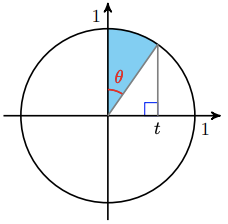
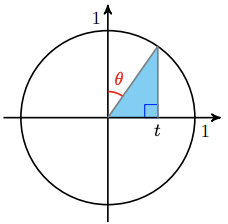
Use the figure of a unit circle to answer the following.
-
Write an expression for the area of the shaded sector in terms of \(\theta\).
-
How are \(\theta\) and \(t\) related in the figure? (Hint: Write an expression for \(\sin (\theta)\).)
-
Combine your answers to (a) and (b) to write an expression for the area of the sector in terms of \(t\).
-
-
Use the figure of a unit circle to answer the following.
-
Write an expression for the height of the shaded triangle in terms of \(t\). (Hint: Use the Pythagorean Theorem.)
-
Write an expression for the area of the triangle in terms of \(t\).
-
Combine your answers to (b) and to the previous problem to write an expression for the area bounded above by the upper semicircle, below by the \(x\)-axis, on the left by the \(y\)-axis, and on the right by \(x=t\), when \(0 \leq t \leq 1\).
-
-
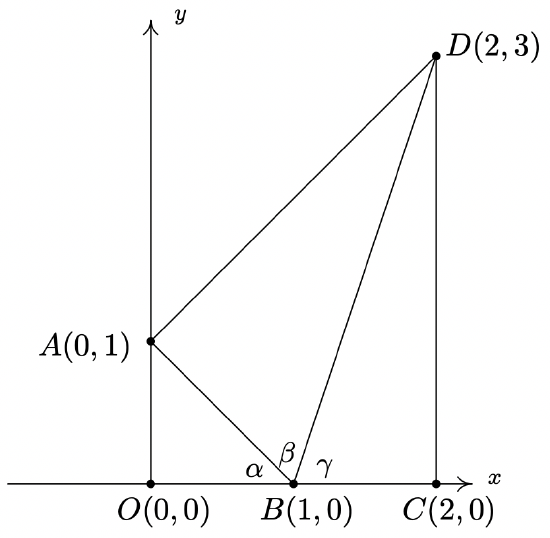
Use the following picture and the series of exercises on the next page to show that \[\arctan(1) + \arctan(2) + \arctan(3) = \pi\nonumber\]
-
Clearly \(\triangle AOB\) and \(\triangle BCD\) are right triangles because the line through \(O\) and \(A\) and the line through \(C\) and \(D\) are perpendicular to the \(x\)-axis. Use the distance formula to show that \(\triangle BAD\) is also a right triangle (with \(\angle BAD\) being the right angle) by showing that the sides of the triangle satisfy the Pythagorean Theorem.
-
Use \(\triangle AOB\) to show that \(\alpha = \arctan(1)\)
-
Use \(\triangle BAD\) to show that \(\beta = \arctan(2)\)
-
Use \(\triangle BCD\) to show that \(\gamma = \arctan(3)\)
-
Use the fact that \(O\), \(B\) and \(C\) all lie on the \(x\)-axis to conclude that \(\alpha + \beta + \gamma = \pi\). Thus \(\arctan(1) + \arctan(2) + \arctan(3) = \pi\).
-
This page titled 7.1.2: Homework was last modified on Sat, 05 Jul 2025 03:17:40 GMT and is shared under a not declared license and was authored, remixed, and/or curated by Roy Simpson.
The book could not be loaded just now.