From LibreTexts, under CC BY-SA 12, as the source states it; its equations are written in TeX, which the PDF shows typeset. This page at LibreTexts.
3.3: Solving Right Triangles
Opening the book…
Section Preview
Note to the Instructor (click to expand)
This section focuses on solving right triangles. As such, all angles will be acute. In addition, applications and concept exercises require the student to find missing angles and/or sides within a right triangle; however, more robust applications involving angles of elevation or depression, navigation, and problems involving more than a single right triangle in a three-dimensional environment are reserved for the next section.
Operational Prerequisites (i.e., "Completing the Homework"): The following prerequisite topics (which have not already been listed as prerequisites in previous sections of this text) are needed to complete the homework.
The following is a list of learning objectives for this section.
Learning Objectives (click to expand)
Solve a right triangle for a missing side.
Solve a right triangle for a missing angle.
Solve an application using Right Triangle Trigonometry.
Use Right Triangle Trigonometry in a robust geometry problem.
With the Pythagorean Theorem, we can find one side of a right triangle if we know the other two sides. For example, the missing side in Figure \(\PageIndex{1}\) can be found as follows:\[\begin{array}{rrcl} & b^2+5^2 & = & 12^2 \\[6pt] \implies & b^2+25 & = & 144 \\[6pt] \implies & b^2 & = & 119 \\[6pt] \implies & b & = & \sqrt{119} \\[6pt] \end{array}\nonumber\]
Figure \(\PageIndex{1}\)
However, is there a way to find the length of side \(b\) in Figure \(\PageIndex{2}\), given that we only know the length of one side of the right triangle and one of the non-right angles?
Figure \(\PageIndex{2}\)
Using a Trigonometric Function to Find an Unknown Side
When finding the length of a side of a right triangle, we must be given at least two pieces of information. If we are given two side lengths (as in Figure \(\PageIndex{1}\)), we use the Pythagorean Theorem. If, on the other hand, we are given an angle and a side length, we determine the trigonometric function relating the missing side and the provided information.
Example \(\PageIndex{1}\)
Find the side length opposite the \(50^{\circ}\) angle in Figure \(\PageIndex{3}\).
Figure \(\PageIndex{3}\)
Solution
In this triangle, the trigonometric function that relates the missing side to the given information is the sine:\[\sin\left(50^{\circ}\right)=\dfrac{\text{opposite}}{\text{hypotenuse}}\nonumber\]We use a calculator to find an approximate value for the sine of \(50^{\circ}\), filling in the lengths of the hypotenuse and the opposite side to get\[0.7660 \approx \dfrac{x}{18}.\nonumber\]We solve for \(x\) to find\[x \approx 18(0.7660) = 13.788.\nonumber\]To two decimal places, the length of the opposite side is approximately \(13.79\) centimeters.
Caution: Save Rounding for Display Purposes Only
In the previous example, even though we showed only four decimal places in \(\sin\left(50^{\circ}\right)\), you should not round off intermediate steps in a calculation—the answer loses accuracy with each rounding. The following keystrokes can be used to avoid entering an extended approximation for \(\sin\left(50^{\circ}\right)\):\[18 \quad \times \quad \mathrm{SIN} \quad 50 \quad \mathrm{ENTER}\nonumber\]The calculator returns \(13.78879998\).
As an additional warning, recall that most scientific and graphing calculators return \(\mathrm{SIN(}\) when you press the \(\mathrm{SIN}\) key. If you intend to perform the multiplication in the opposite order (i.e., you intend to compute \(\sin\left(50^{\circ}\right) \times 18\)), you must close the parentheses on the argument of the sine. That is, you would use the following keystrokes in your calculator:\[\mathrm{SIN} \quad 50 \quad \mathrm{)} \quad \times \quad 18.\nonumber\]Without the closing parenthesis, the calculator computes \(\sin\left(50 \times 18^{\circ}\right)\), which is not equivalent to \(\sin\left(50^{\circ}\right) \times 18\).
Checkpoint \(\PageIndex{1}\)
Use the tangent ratio to find \(x\) in Figure \(\PageIndex{4}\).
Figure \(\PageIndex{4}\)
Use the sine ratio to find the hypotenuse, \(c\), of the triangle.
Use the Pythagorean Theorem to find the hypotenuse of the triangle. Is the answer the same with both methods? Explain why the calculations might give (slightly) different answers.
Answers
\(x \approx 23\) ft
\(c \approx 55\) ft
The answers agree when rounded to units. Rounding during calculation can cause the results to differ.
Solving Triangles
A triangle has six parts: three sides and three angles. In a right triangle, we know that one of the angles is \(90^{\circ}\). If given enough information, we can find the measures of the remaining angles within the right triangle and the lengths of the sides. This is called solving the triangle.
Definition: Solving a Triangle
Solving a triangle means finding all the missing side lengths and angle measures, given some initial information about the triangle.
Example \(\PageIndex{2}\)
In the right triangle \(\triangle ABC\), \(\angle A = 37^{\circ}\) and (non-hypotenuse) side \(b = 11\). Solve the triangle.
Solution
Since \(\angle A = 37^{\circ}\), side \(a\) is not the hypotenuse of the right triangle. Moreover, we were told that side \(b\) is not the hypotenuse. Thus, \(c\) must be the hypotenuse and \(\angle C = 90^{\circ}\). Creating a rough sketch of \(\triangle ABC\), we get
Figure \(\PageIndex{5}\)
Using the Triangle Sum, we quickly compute \(\angle B = 90^{\circ}-37^{\circ}=53^{\circ}\). We now concentrate on finding the missing sides by using the trigonometric functions and the given information. The tangent relates \(37^{\circ}\) to sides \(a\) and \(b\). Therefore,\[\tan\left(37^{\circ}\right) = \dfrac{a}{11} \implies a = 11\tan\left(37^{\circ}\right) \approx 8.2891.\nonumber\]Finally, we use the cosine to relate \(37^{\circ}\) to the given side \(b\) and the hypotenuse \(c\).\[\cos\left(37^{\circ}\right) = \dfrac{11}{c} \implies c = \dfrac{11}{\cos\left(37^{\circ}\right)} \approx 13.7735.\nonumber\]
Traditional Notation: The Right Angle of \(\triangle ABC\)
Given the right triangle \(\triangle ABC\), we adopt the convention used throughout most math textbooks that \(\angle C\) is the \(90^{\circ}\) angle and side \(c\) is the hypotenuse.
Checkpoint \(\PageIndex{2}\)
Sketch a right triangle with one angle of \(37^{\circ}\) and the side adjacent to that angle of length 5 centimeters. Without doing the calculations, list the steps used to solve the triangle.
Answer
Use \(\tan\left(37^{\circ}\right)\) to find the opposite side. Use \(\cos\left(37^{\circ}\right)\) to find the hypotenuse. Subtract \(37^{\circ}\) from \(90^{\circ}\) to find the third angle.
In Example \(\PageIndex{2}\) and Checkpoint \(\PageIndex{2}\), we were given an angle and a side. Using those two pieces of information (along with the fact that one of the other angles in the right triangle is \(90^{\circ}\)), we were able to solve the triangles completely. What if we were not given any angles (other than the right angle) but two side lengths instead?
Example \(\PageIndex{3}\)
Solve \(\triangle ABC\) given that \(a = 3\) and \(c = 5\).
Solution
It's always best to start by drawing a triangle.
Figure \(\PageIndex{6}\)
We can use the Pythagorean Theorem to compute the length of side \(b\), or we could recognize that this is a Pythagorean Triple. No matter how we compute it, \(b = 4\). Now, we need to find the missing angles. Luckily, we were given that this is a right triangle, so once we find either \(\angle A\) or \(\angle B\), we can use the Triangle Sum to find the other angle. Let's go ahead and find \(\angle A\). Since \(\sin\left(\angle A\right) = \frac{a}{c} = \frac{3}{5}\), we use a calculator to compute \(\angle A = \sin^{-1}\left(\frac{3}{5}\right) \approx 36.8699^{\circ}\). Thus,\[\angle B = 180^{\circ}-\angle C-\angle A \approx 180^{\circ}-90^{\circ}-36.8699^{\circ} \approx 53.1301^{\circ}.\nonumber\]It's often best to organize all of this information in a table like so:\[\begin{array}{rclcrcl} \angle A & \approx & 36.8699^{\circ} & \quad & a & = & 3 \\[6pt] \angle B & \approx & 53.1301^{\circ} & \quad & b & = & 4 \\[6pt] \angle C & = & 90^{\circ} & \quad & c & = & 5 \\[6pt] \end{array}\nonumber\]
Checkpoint \(\PageIndex{3}\)
Solve the right triangle \(\triangle ABC\) given \(b = 1.12\) and \(c = 3.25\). Round your displayed answers to the nearest hundredth.
Answer
\[\begin{array}{rclcrcl} \angle A & \approx & 69.84^{\circ} & \quad & a & \approx & 3.05 \\[6pt] \angle B & \approx & 20.16^{\circ} & \quad & b & = & 1.12 \\[6pt] \angle C & = & 90^{\circ} & \quad & c & = & 3.25 \\[6pt] \end{array}\nonumber\]
The power of Trigonometry comes from its usefulness in helping us solve physical applications.
Example \(\PageIndex{4}\)
A 10-foot ladder is leaning against a wall. If the ladder's base is too far from the wall, the base can slide out. If the ladder base is too close to the wall, there’s a risk that the ladder could tip over backward. The leaning ladder should make a \(75^{\circ}\) angle with the ground for safety reasons.
Figure \(\PageIndex{7}\)
How far should the base of the ladder be from the wall?
How far up the wall will the top of the ladder reach?
Solutions
The distance between the ladder's base and the wall is the side adjacent to the \(75^{\circ}\) angle. We can find the side adjacent to the \(75^{\circ}\) angle using the cosine ratio.\[\begin{array}{rrcl} & \cos\left(75^{\circ}\right) & = & \dfrac{\text{adjacent}}{\text{hypotenuse}} \\[6pt] \implies & 0.2588 & \approx & \dfrac{b}{10} \\[6pt] \implies & 10(0.2588) & \approx & b \\[6pt] \implies & b & \approx & 2.588 \\[6pt] \end{array}\nonumber\]The ladder's base should be about 2.6 feet from the wall.
We could use the Pythagorean Theorem to find how far up the wall the ladder will reach. However, using the given information rather than the calculated values to find the other unknown parts is better. We will use the sine ratio.\[\begin{array}{rrcl} & \sin\left(75^{\circ}\right) & = & \dfrac{\text{opposite}}{\text{hypotenuse}} \\[6pt] \implies & 0.9659 & \approx & \dfrac{a}{10} \\[6pt] \implies & 10(0.9659) & \approx & a \\[6pt] \implies & a & \approx & 9.659 \\[6pt] \end{array}\nonumber\]The ladder will reach about 9.7 feet.
Checkpoint \(\PageIndex{4}\)
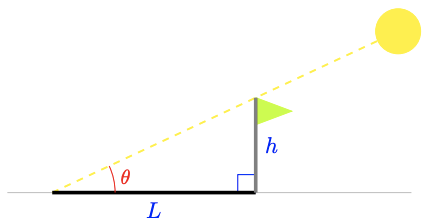
The length, \(L\), of the shadow cast by a flagpole on a sunny day depends on the height, \(h\), of the flagpole and the angle, \(\theta\), that the sun's rays make with the ground (see Figure \(\PageIndex{8}\)).
Figure \(\PageIndex{8}\)
Write an expression for the length, \(L\), of the shadow cast by a flagpole of height \(h\) when the sun makes an angle of \(\theta\) from the ground.
Find the length (to the nearest 0.01 meter) of the shadow cast by a 3-meter flagpole when the sun makes an angle of \(20^{\circ}\) from the ground.
Answers
\(L=h\cot\left(\theta\right)\)
The shadow is about 8.24 meters long.
Interactive Element: Sun Angle and Shadow Length
The following Interactive Element might help you visualize how a flagpole's shadow length depends on the sun's angle, \(\theta\), above the ground.
Interact: Drag the bright point at the tip of the shadow left and right along the ground.
Observation: The lower the sun sits (smaller \(\theta\)), the longer the shadow — and near a low sun a tiny drop in angle stretches the shadow dramatically, matching \(L=h\cot\left(\theta\right)\).
Introducing Right Triangles to Non-Right Triangles
While the trigonometric functions are defined in terms of ratios of sides of a right triangle, they are useful on many occasions when a non-right triangle is involved.
Example \(\PageIndex{5}\)
The vertex angle of an isosceles triangle is \(34^{\circ}\), and the equal sides are 16 meters long. Find the altitude of the triangle.
Solution
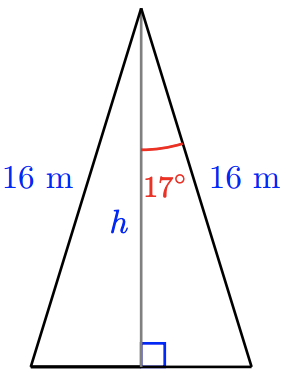
The triangle described is not a right triangle. However, the altitude of an isosceles triangle bisects the vertex angle. It divides the triangle into two congruent right triangles, as shown in Figure \(\PageIndex{9}\). The 16-meter side becomes the hypotenuse of the right triangle. The altitude, \(h\), of the original triangle is the side adjacent to the \(17^{\circ}\) angle.
Figure \(\PageIndex{9}\)
Which of the three trigonometric ratios is helpful in this problem? The cosine is the ratio that relates the hypotenuse and the adjacent side. Therefore, we will begin with the equation:\[\cos\left(17^{\circ}\right)=\dfrac{\text{adjacent}}{\text{hypotenuse}}\nonumber\]We use a calculator to find \(\cos\left(17^{\circ}\right)\) and fill in the lengths of the sides to get\[0.9563 \approx \dfrac{h}{16}.\nonumber\]Solving for \(h\) gives\[h \approx 16(0.9563) = 15.3008.\nonumber\]The altitude of the triangle is about \(15.3\) meters long.
Checkpoint \(\PageIndex{5}\)
Another isosceles triangle has base angles of \(72^{\circ}\) and equal sides of length \(6.8\) centimeters. Find the size of the base.
Answer
4 cm
Thought-Provoking Right Triangle Geometry
Part of your excursion into Trigonometry (and higher-level mathematics) is to think critically and problem-solve. One way to engage your imagination and thinking skills is through abstract geometry problems that are often fun!
Example \(\PageIndex{6}\)
Figure \(\PageIndex{10}\) shows a circle of radius \(r\) and a right triangle with side \(a\) along the radius of the circle and side \(b\) tangent to the circle.
Figure \(\PageIndex{10}\)
If \(\angle B = 50^{\circ}\) and \(b = 10\) inches, find the radius of the circle and the partial length of the hypotenuse, \(x\), that sits outside the circle. Round your answers to the nearest tenth.
Solution
Throughout Trigonometry, you will be faced with thought-provoking questions. The beautiful thing about right triangle trigonometry is that you typically need to find a trigonometric function that relates the given information to the missing information. In this case, we are given \(\angle B\) and side \(b\). We are initially asked for the radius of the circle, which is the same as the side length \(a\) of the right triangle. The trigonometric function relating \(\angle B\) to sides \(a\) and \(b\) is the tangent:\[\tan\left(\angle B\right) = \dfrac{b}{a} = \dfrac{b}{r}.\nonumber\]Therefore,\[\tan\left(50^{\circ}\right) = \dfrac{10}{r} \implies r = \dfrac{10}{\tan\left(50^{\circ}\right)}.\nonumber\]Hence, the radius of the circle is \(\frac{10}{\tan\left(50^{\circ}\right)} \approx 8.4\) inches.
Now we need to find the length \(x\). Again, we want to find a trigonometric function that relates the information to what we seek. Unfortunately, we are looking for only part of the hypotenuse of the right triangle; however, the entire hypotenuse is \(x+r\), and we just found \(r\). The sine is the trigonometric function that relates \(\angle B\) to side \(b\) and the hypotenuse:\[\sin\left(\angle B\right) = \dfrac{b}{x+r} \implies x+r = \dfrac{b}{\sin\left(\angle B\right)} \implies x = \dfrac{b}{\sin\left(\angle B\right)}-r.\nonumber\]Substituting the given values for \(\angle B\) and side \(b\), along with the exact value for \(r\), we get\[x = \dfrac{10}{\sin\left(50^{\circ}\right)}-\dfrac{10}{\tan\left(50^{\circ}\right)} \approx 4.66\text{ inches}.\nonumber\]
We continually harp on this but notice that we used the exact value of \(r\) when doing our final computation in Example \(\PageIndex{6}\). This is because we always want to avoid using rounded values for subsequent computations.
Checkpoint \(\PageIndex{6}\)
Let \(r = 5\) and \(\angle A = 24^{\circ}\) in Figure \(\PageIndex{10}\) (Example \(\PageIndex{6}\)), find \(x\). Round your answer to the nearest tenth.
Answer
\(x \approx 7.3\)
Example \(\PageIndex{7}\)
In Figure \(\PageIndex{11}\), \(x = 5\), \(\angle A = 25^{\circ}\), and \(\angle BDC = 48^{\circ}\). Find \(y\).
Figure \(\PageIndex{11}\)
Solution
It is helpful to redraw only \(\triangle BCD\) and then \(\triangle ABC\), noticing that they share the common side \(h\). For \(\triangle BCD\), we only have one piece of given information, \(\angle BDC\); however, we need to find \(y\), and it will be useful to work with \(h\) since both triangles share that side (I call this the "link" between the triangles). The trigonometric function relating these is the tangent:\[\tan\left(\angle BDC\right) = \dfrac{h}{y} \implies y\tan\left(\angle BDC\right) = h.\nonumber\]Hence,\[h = y\tan\left(48^{\circ}\right).\nonumber\]Moving to \(\triangle ABC\), since we were given \(x\) and \(\angle A\), it seems best to use the tangent again to get \(h\) involved. Therefore,\[\tan\left(\angle A\right) = \dfrac{h}{x+y} \implies (x+y)\tan\left(\angle A\right) = h.\nonumber\]That is,\[h = (5+y)\tan\left(25^{\circ}\right).\nonumber\]We now equate these two versions of \(h\) to each other (since they both equal \(h\), they are both equal to each other).\[\begin{array}{rcl} y\tan\left(48^{\circ}\right) = (5+y)\tan\left(25^{\circ}\right) & \implies & y\tan\left(48^{\circ}\right) = 5\tan\left(25^{\circ}\right)+y\tan\left(25^{\circ}\right) \\[6pt] & \implies & y\tan\left(48^{\circ}\right)-y\tan\left(25^{\circ}\right) = 5\tan\left(25^{\circ}\right) \\[6pt] & \implies & y\left(\tan\left(48^{\circ}\right)-\tan\left(25^{\circ}\right)\right) = 5\tan\left(25^{\circ}\right) \\[6pt] & \implies & y = \dfrac{5\tan\left(25^{\circ}\right)}{\tan\left(48^{\circ}\right)-\tan\left(25^{\circ}\right)} \\[6pt] & \implies & y \approx 3.62 \\[6pt] \end{array}\nonumber\]
Checkpoint \(\PageIndex{7}\)
Let \(\angle A = 24^{\circ}\), \(y = 12\), and \(\angle BDC = 62^{\circ}\) in Figure \(\PageIndex{11}\) (Example \(\PageIndex{7}\)). Find \(x\). Round your answer to the nearest tenth.
Answer
\(x \approx 38.7\)
Success in College: Learning From Tests (Part 1)
A student scored 75% on their last math test. They tried to redo the questions and problems that they missed. Now they need to know if their new answers are correct. For your current math class, how could they find this out?
Look over your last math test. Did you miss any points because you did not show enough work? If so, explain why you didn’t show the work on the test.
Success in Mathematics: Math Anxiety (Part 1)
The following is an excerpt of an article written at MathAcademy.com.
A famous stage actress was once asked if she had ever suffered from stage fright and, if so, how she had gotten over it. She laughed at the interviewer's naive assumption that she must not feel that kind of anxiety since she was an accomplished actress. She assured him that she had always had stage fright and had never gotten over it. Instead, despite it, she had learned to walk on stage and perform.
Like stage fright, math anxiety can be a disabling condition, causing humiliation, resentment, and even panic.
Even though we all suffer from math anxiety to some degree – just as anyone feels at least a little nervous when speaking to an audience – for some of us, it is a severe problem. This burden interferes with our lives, preventing us from achieving our goals. The first step, without which no further progress is possible, is to recognize that math anxiety is an emotional response. (In fact, severe math anxiety is a learned emotional response.) As with any strong emotional reaction, there are constructive and unconstructive ways to manage math anxiety. Unconstructive (and damaging) ways include rationalization, suppression, and denial.
By "rationalization," we mean finding reasons why it is okay and perhaps even inevitable – and therefore justified – for you to have this reaction. The myths of "men are better at math than women" or "math is for logical people and not creative people" are examples of rationalizations. While they may make you feel better (or at least less bad) about having math anxiety, they will do nothing to lessen it or to help you get it under control. Therefore, rationalization is unconstructive.
"Suppression" means being aware of the anxiety – but trying very hard not to feel it. I have found that students very commonly attempt this, and some severe self-criticism accompanies it. Students feel that they shouldn't feel this anxiety, that it's a weakness they should overcome by brute force if necessary. When this effort doesn't succeed (as invariably it doesn't), the self-criticism becomes ever harsher, leading to a deep sense of frustration and often a severe loss of self-esteem – mainly if the stakes for a student are high, as when their career or personal goals are riding on a successful outcome in a math class, or when parental disapproval is a factor. Consequently, suppression of math anxiety is not only unconstructive but can be damaging.
Finally, there is denial. People using this approach probably aren't likely to see this essay, much less read it, for they carefully construct their lives to avoid all mathematics as much as possible. They choose college majors and careers that don't require math and let the bank or their spouse balance the checkbook. This approach has the advantage that feelings of frustration and anxiety about math are mostly avoided. However, their lives are drastically constrained, for, in our society, fewer than 25% of all careers are, so to speak, "math-free." Thus, their choices of personal and professional goals are severely limited. (Incidentally, most math-free jobs are low-status and low-pay.)
People in denial about mathematics miss out on something else, too, for the student of mathematics learns to see aspects of the structure and beauty of our world that can be seen in no other way and to which the "innumerate" necessarily remain forever blind. It would be a lot like never hearing music or never seeing colors. (I understand that some people have these disabilities but didn't choose to have them.)
Okay, so what is the constructive way to manage math anxiety? I call it "taking possession." It involves identifying the sources of math anxiety in one's life, accepting those feelings without self-criticism, and then learning strategies for disarming math anxiety's influence on one's future study of mathematics.
Begin by understanding that your feelings of math anxiety are not uncommon and do not indicate that there is anything wrong with you or inferior about your ability to learn math. For some, this can be hard to accept, but it is worth trying to accept – since, after all, it happens to be true. This can be made more accessible by exploring your own "math history." Think back across your career as a math student, and identify those experiences which have contributed most to your feelings of frustration about math. For some, this will be a memory of a humiliating experience in school, such as being made to stand at the blackboard and embarrassed in front of one's peers. For others, it may involve interaction with a parent. Whatever the principle episodes are, recall them as vividly as you can. Then, write them down. This is important. After you have written the episode on a sheet(s) of paper, write down your reaction to the episode, both at the time and how it makes you feel to recall it now.
After completing this exercise, take a fresh sheet of paper and try to sum up in a few words what your feelings about math are at this point in your life, together with the reason or reasons you wish to succeed at math. This, too, is important. Not until after we lay out for ourselves consciously and deliberately what our feelings and desires are towards mathematics will it become possible to take possession of our feelings of math anxiety and become free to implement strategies for coping with those feelings.
At this point, sharing your memories, feelings, and goals with others can be enormously helpful. In a math class I teach for art majors, I hand out a questionnaire early in the semester asking students to do precisely what is described above. After spending about twenty minutes writing down their recollections and goals, I lead them in a classroom discussion on math anxiety. This process of dialogue and sharing – though it may seem just a bit on the goopy side – invariably brings out of each student their barriers to math, often helping them become completely conscious of these barriers for the first time. Just as important, it helps all my students understand that the negative experiences they have had, and their reactions to them, are shared one way or another by almost everyone else in the room.
If you do not have the opportunity to engage in a group discussion in a classroom setting, find friends or relatives you trust to respect your feelings and induce them to talk about their own math anxiety experiences and listen to yours.
Here are some questions about this topic that may help you succeed in this class (and possibly many other classes as well):
Are there counselors at your school that are available to help students who are struggling with math anxiety? If so, where are they located, and how to make an appointment to see one?
Estimate the percent of students in your class you think are negatively affected by math anxiety.
If you are unsure about the answers to either of these questions, feel free to ask your instructor - that's what they are there for!