Opening the book…
- Theory of nonhomogeneous linear second-order differential equations.
- Verify that a function \( y_p \) is a particular solution of nonhomogeneous linear second-order differential equations and write the general solution in the form \( y\)=\( y_c \) +\( y_p \) , where \( y_c \)=\( c_1 \) \( y_1 \)+\( c_2 \)\( y_2 \) and \( c_1\), \( c_2 \) are arbitrary constants.
We’ll now consider the nonhomogeneous linear second order equation
\[\label{eq:5.3.1} y''+p(x)y'+q(x)y=f(x),\]
where the forcing function \(f\) isn’t identically zero. The next theorem, an extension of Theorem 5.1.1, gives sufficient conditions for existence and uniqueness of solutions of initial value problems for Equation \ref{eq:5.3.1}. We omit the proof, which is beyond the scope of this book.
Suppose \(p,\) \(,q\) and \(f\) are continuous on an open interval \((a,b),\) let \(x_0\) be any point in \((a,b),\) and let \(k_0\) and \(k_1\) be arbitrary real numbers\(.\) Then the initial value problem
\[y''+p(x)y'+q(x)y=f(x), \quad y(x_0)=k_0,\quad y'(x_0)=k_1\nonumber \]
has a unique solution on \((a,b).\)
To find the general solution of Equation \ref{eq:5.3.1} on an interval \((a,b)\) where \(p\), \(q\), and \(f\) are continuous, it is necessary to find the general solution of the associated homogeneous equation
\[\label{eq:5.3.2} y''+p(x)y'+q(x)y=0\]
on \((a,b)\). We call Equation \ref{eq:5.3.2} the complementary equation for Equation \ref{eq:5.3.1}.
The next theorem shows how to find the general solution of Equation \ref{eq:5.3.1} if we know one solution \(y_p\) of Equation \ref{eq:5.3.1} and a fundamental set of solutions of Equation \ref{eq:5.3.2}. We call \(y_p\) a particular solution of Equation \ref{eq:5.3.1} ; it can be any solution that we can find, one way or another.
Suppose \(p,\) \(q,\) and \(f\) are continuous on \((a,b).\) Let \(y_p\) be a particular solution of
\[\label{eq:5.3.3} y''+p(x)y'+q(x)y=f(x)\]
on \((a,b)\), and let \(\{y_1,y_2\}\) be a fundamental set of solutions of the complementary equation
\[\label{eq:5.3.4} y''+p(x)y'+q(x)y=0\]
on \((a,b)\). Then \(y\) is a solution of \(\eqref{eq:5.3.3}\) on \((a,b)\) if and only if
\[\label{eq:5.3.5} y=y_p+c_1y_1+c_2y_2,\]
where \(c_1\) and \(c_2\) are constants.
- Proof
-
We first show that \(y\) in Equation \ref{eq:5.3.5} is a solution of Equation \ref{eq:5.3.3} for any choice of the constants \(c_1\) and \(c_2\). Differentiating Equation \ref{eq:5.3.5} twice yields
\[y'=y_p'+c_1y_1'+c_2y_2' \quad \text{and} \quad y''=y_p''+ c_1y_1''+c_2y_2'', \nonumber\]
so
\[\begin{align*} y''+p(x)y'+q(x)y&=(y_p''+c_1y_1''+c_2y_2'') +p(x)(y_p'+c_1y_1'+c_2y_2') +q(x)(y_p+c_1y_1+c_2y_2)\\ &=(y_p''+p(x)y_p'+q(x)y_p)+c_1(y_1''+p(x)y_1'+q(x)y_1) +c_2(y_2''+p(x)y_2'+q(x)y_2)\\ &= f+c_1\cdot0+c_2\cdot0=f,\end{align*}\]
since \(y_p\) satisfies Equation \ref{eq:5.3.3} and \(y_1\) and \(y_2\) satisfy Equation \ref{eq:5.3.4}.
Now we’ll show that every solution of Equation \ref{eq:5.3.3} has the form Equation \ref{eq:5.3.5} for some choice of the constants \(c_1\) and \(c_2\). Suppose \(y\) is a solution of Equation \ref{eq:5.3.3}. We’ll show that \(y-y_p\) is a solution of Equation \ref{eq:5.3.4}, and therefore of the form \(y-y_p=c_1y_1+c_2y_2\), which implies Equation \ref{eq:5.3.5}. To see this, we compute
\[\begin{align*} (y-y_p)''+p(x)(y-y_p)'+q(x)(y-y_p)&=(y''-y_p'')+p(x)(y'-y_p') +q(x)(y-y_p)\\ &=(y''+p(x)y'+q(x)y) -(y_p''+p(x)y_p'+q(x)y_p)\\ &=f(x)-f(x)=0,\end{align*}\]
since \(y\) and \(y_p\) both satisfy Equation \ref{eq:5.3.3}.
We say that Equation \ref{eq:5.3.5} is the general solution of \(\eqref{eq:5.3.3}\) on \((a,b)\).
If \(P_0\), \(P_1\), and \(F\) are continuous and \(P_0\) has no zeros on \((a,b)\), then Theorem 4.2.2 implies that the general solution of
\[\label{eq:5.3.6} P_0(x)y''+P_1(x)y'+P_2(x)y=F(x)\]
on \((a,b)\) is \(y=y_p+c_1y_1+c_2y_2\), where \(y_p\) is a particular solution of Equation \ref{eq:5.3.6} on \((a,b)\) and \(\{y_1,y_2\}\) is a fundamental set of solutions of
\[P_0(x)y''+P_1(x)y'+P_2(x)y=0\nonumber\]
on \((a,b)\). To see this, we rewrite Equation \ref{eq:5.3.6} as
\[y''+{P_1(x)\over P_0(x)}y'+{P_2(x)\over P_0(x)}y={F(x)\over P_0(x)}\nonumber\]
and apply Theorem 4.2.2 with \(p=P_1/P_0\), \(q=P_2/P_0\), and \(f=F/P_0\).
To avoid awkward wording in examples and exercises, we will not specify the interval \((a,b)\) when we ask for the general solution of a specific linear second order equation, or for a fundamental set of solutions of a homogeneous linear second order equation. Let’s agree that this always means that we want the general solution (or a fundamental set of solutions, as the case may be) on every open interval on which \(p\), \(q\), and \(f\) are continuous if the equation is of the form Equation \ref{eq:5.3.3}, or on which \(P_0\), \(P_1\), \(P_2\), and \(F\) are continuous and \(P_0\) has no zeros, if the equation is of the form Equation \ref{eq:5.3.6}. We leave it to you to identify these intervals in specific examples and exercises.
For completeness, we point out that if \(P_0\), \(P_1\), \(P_2\), and \(F\) are all continuous on an open interval \((a,b)\), but \(P_0\) does have a zero in \((a,b)\), then Equation \ref{eq:5.3.6} may fail to have a general solution on \((a,b)\) in the sense just defined. Exercises 5.1.42-5.1.44 illustrate this point for a homogeneous equation.
In this section we to limit ourselves to applications of Theorem 4.2.2 where we can guess at the form of the particular solution.
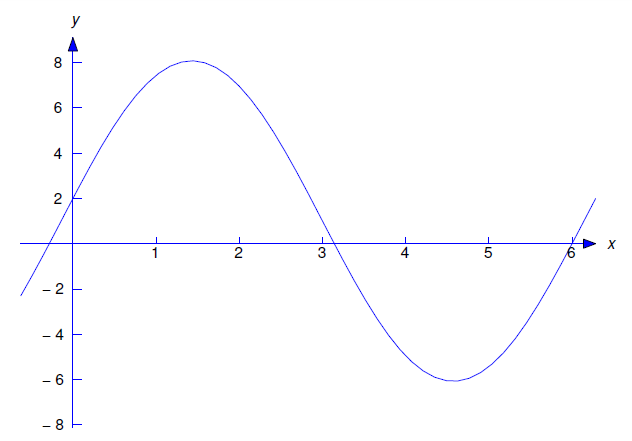
For the differential equation \[ y''+y=1,\nonumber\] the general solution is given by the two-parameter family \[ \label{eq:5.3.7}y(x)=1+c_1\cos x + c_2\sin x.\]
Use the initial conditions \( y(0)=2,\quad y'(0)=7\) to find the particular solution.
Solution
Using the initial condition \(y(0)=2\), we have \[2=1+c_1\cos (0) + c_2\sin (0),\nonumber\] which yields \[2=1+c_1, \quad\quad \text{so}\quad c_1=1.\nonumber\]
Differentiating the general solution \ref{eq:5.3.7} yields \[y(x)'=-c_1\sin x+c_2\cos x.\nonumber\]
Imposing the initial condition \(y'(0)=7\), we obtain \[7=-c_1\sin (0)+c_2\cos (0),\nonumber\] which yields \[c_2=7. \nonumber\] Therefore, the particular solution is given by
\[y(x)=1+\cos x+7\sin x.\nonumber\]
Figure 4.2.1 is a graph of this function.
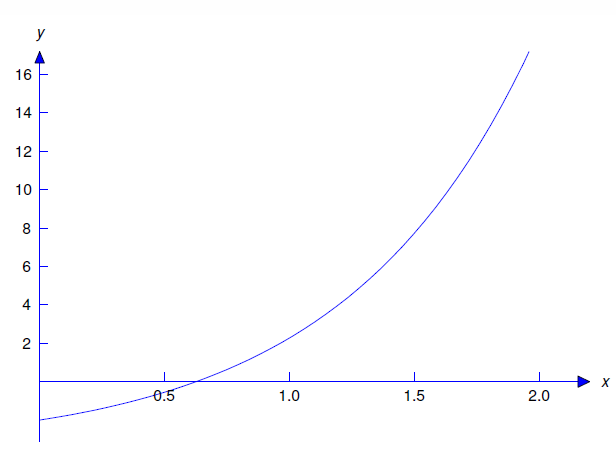
For the differential equation \[ y''-2y'+y=-3-x+x^2\nonumber\] the general solution is given by the two-parameter family \[ \label{eq:4.2.8}y(x)=1+3x+x^2+e^x(c_1+c_2x) \]
Use the initial conditions \( y(0)=-2,\quad y'(0)=1\nonumber\) to find the particular solution.
Solution
Using the initial condition \(y(0)=-2\), we have \[-2=1+3(0)+(0)^2+e^0(c_1+c_2(0)) ,\nonumber\] which yields \[-2=1+c_1, \quad\quad \text{so}\quad c_1=-3.\nonumber\]
Differentiating the general solution \ref{eq:4.2.8} yields \[y(x)'=3+2x+e^x(c_1+c_2x)+c_2e^x.\nonumber\]
Imposing the initial condition \(y'(0)=1\), we obtain \[7=3+2(0)+e^0(c_1+c_2(0))+c_2e^0,\nonumber\] which yields \[1=3+c_1+c_2,\quad \quad \text{so}\quad c_2=1. \nonumber\] Therefore, the particular solution is given by
\[y(x)=1+3x+x^2-e^x(3-x). \nonumber\]
Figure 4.2.2 is a graph of this solution.
The Principle of Superposition
The next theorem enables us to break a nonhomogeous equation into simpler parts, find a particular solution for each part, and then combine their solutions to obtain a particular solution of the original problem.
Suppose \(y_{p_1}\) is a particular solution of
\[y''+p(x)y'+q(x)y=f_1(x) \nonumber\]
on \((a,b)\) and \(y_{p_2}\) is a particular solution of
\[y''+p(x)y'+q(x)y=f_2(x) \nonumber\]
on \((a,b)\). Then
\[y_p=y_{p_1}+y_{p_2} \nonumber\]
is a particular solution of
\[y''+p(x)y'+q(x)y=f_1(x)+f_2(x) \nonumber\]
on \((a,b)\).
- Proof
-
If \(y_p=y_{p_1}+y_{p_2}\) then
\[\begin{align*} y_p''+p(x)y_p'+q(x)y_p&=(y_{p_1}+y_{p_2})''+p(x)(y_{p_1}+y_{p_2})' +q(x)(y_{p_1}+y_{p_2})\\ &=\left(y_{p_1}''+p(x)y_{p_1}'+q(x)y_{p_1}\right) +\left(y_{p_2}''+p(x)y_{p_2}'+q(x)y_{p_2}\right)\\ &=f_1(x)+f_2(x). \end{align*}\]
It’s easy to generalize Theorem 4.2.3 to the equation
\[\label{eq:5.3.14} y''+p(x)y'+q(x)y=f(x)\]
where
\[f=f_1+f_2+\cdots+f_k; \nonumber\]
thus, if \(y_{p_i}\) is a particular solution of
\[y''+p(x)y'+q(x)y=f_i(x) \nonumber\]
on \((a,b)\) for \(i=1\), \(2\), …, \(k\), then \(y_{p_1}+y_{p_2}+\cdots+y_{p_k}\) is a particular solution of Equation \ref{eq:5.3.14} on \((a,b)\). Moreover, by a proof similar to the proof of Theorem 4.2.3 we can formulate the principle of superposition in terms of a linear equation written in the form
\[P_0(x)y''+P_1(x)y'+P_2(x)y=F(x) \nonumber\]
(Exercise 5.3.39); that is, if \(y_{p_1}\) is a particular solution of
\[P_0(x)y''+P_1(x)y'+P_2(x)y=F_1(x) \nonumber\]
on \((a,b)\) and \(y_{p_2}\) is a particular solution of
\[P_0(x)y''+P_1(x)y'+P_2(x)y=F_2(x) \nonumber\]
on \((a,b)\), then \(y_{p_1}+y_{p_2}\) is a solution of
\[P_0(x)y''+P_1(x)y'+P_2(x)y=F_1(x)+F_2(x) \nonumber\]
on \((a,b)\).
The function \(y_{p_1}=x^4/15\) is a particular solution of
\[\label{eq:5.3.15} x^2y''+4xy'+2y=2x^4\]
on \((-\infty,\infty)\) and \(y_{p_2}=x^2/3\) is a particular solution of\[\label{eq:5.3.16} x^2y''+4xy'+2y=4x^2\]
on \((-\infty,\infty)\). Use the principle of superposition to find a particular solution of\[\label{eq:5.3.17} x^2y''+4xy'+2y=2x^4+4x^2\]
on \((-\infty,\infty)\).
Solution
The right side \(F(x)=2x^4+4x^2\) in Equation \ref{eq:5.3.17} is the sum of the right sides
\[F_1(x)=2x^4\quad \text{and} \quad F_2(x)=4x^2. \nonumber\]
in Equation \ref{eq:5.3.15} and Equation \ref{eq:5.3.16}. Therefore the principle of superposition implies that\[y_p=y_{p_1}+y_{p_2}={x^4\over15}+{x^2\over3} \nonumber\]
is a particular solution of Equation \ref{eq:5.3.17}.
This page titled 4.2: Nonhomogeneous Linear Second Order Equations was last modified on Sat, 03 May 2025 12:56:49 GMT and is shared under a CC BY-NC-SA 3.0 license and was authored, remixed, and/or curated by William F. Trench via source content that was edited to the style and standards of the LibreTexts platform.
The book could not be loaded just now.