Opening the book…
Infinite Limits
[T] In exercises 1 - 2, set up a table of values to find the indicated limit. Round to eight significant digits.
1) \(\displaystyle \lim_{z \to 0}\frac{z−1}{z^2(z+3)}\)
| \(z\) | \(\frac{z−1}{z^2(z+3)}\) | \(z\) | \(\frac{z−1}{z^2(z+3)}\) |
|---|---|---|---|
| -0.1 | a. | 0.1 | e. |
| -0.01 | b. | 0.01 | f. |
| -0.001 | c. | 0.001 | g. |
| -0.0001 | d. | 0.0001 | h. |
- Answer:
- a. −37.931034; b. −3377.9264; c. −333,777.93; d. −33,337,778; e. −29.032258; f. −3289.0365; g. −332,889.04; h. −33,328,889
\( \displaystyle \lim_{x \to 0}\frac{z−1}{z^2(z+3)}=−∞\)
2) \(\displaystyle \lim_{t \to 0^+}\frac{\cos t}{t}\)
| \(t\) | \(\frac{\cos t}{t}\) |
|---|---|
| 0.1 | a. |
| 0.01 | b. |
| 0.001 | c. |
| 0.0001 | d. |
[T] In exercises 3 - 4, set up a table of values and round to eight significant digits. Based on the table of values, make a guess about what the limit is. Then, use a calculator to graph the function and determine the limit. Was the conjecture correct? If not, why does the method of tables fail?
3) \(\displaystyle \lim_{α \to 0^+} \frac{1}{α}\cos\left(\frac{π}{α}\right)\)
| \(a\) | \(\frac{1}{α}\cos\left(\frac{π}{α}\right)\) |
|---|---|
| 0.1 | a. |
| 0.01 | b. |
| 0.001 | c. |
| 0.0001 | d. |
- Answer:
-
a. 10.00000; b. 100.00000; c. 1000.0000; d. 10,000.000;
Guess: \(\displaystyle \lim_{α→0^+}\frac{1}{α}\cos\left(\frac{π}{α}\right)=∞\);
Actual: DNE, since the graph shows the function oscillates wildly between values approaching positive infinity and values approaching negative infinity, as the value of \(α\) approaches \(0\) from the positive side.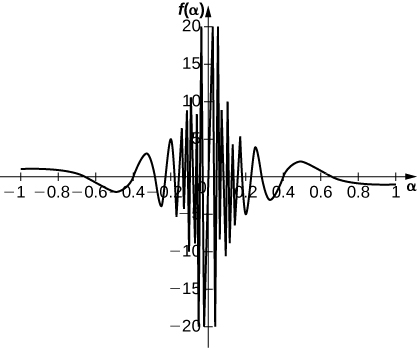
4) \(\displaystyle \lim_{θ \to 0}\sin\left(\frac{π}{θ}\right)\)
| \(θ\) | \(\sin\left(\frac{π}{θ}\right)\) | \(θ\) | \(\sin\left(\frac{π}{θ}\right)\) |
|---|---|---|---|
| -0.1 | a. | 0.1 | e. |
| -0.01 | b. | 0.01 | f. |
| -0.001 | c. | 0.001 | g. |
| -0.0001 | d. | 0.0001 | h. |
In exercises 5 - 8, consider the graph of the function \(y=f(x)\) shown here. Which of the statements about \(y=f(x)\) are true and which are false? Explain why a statement is false.
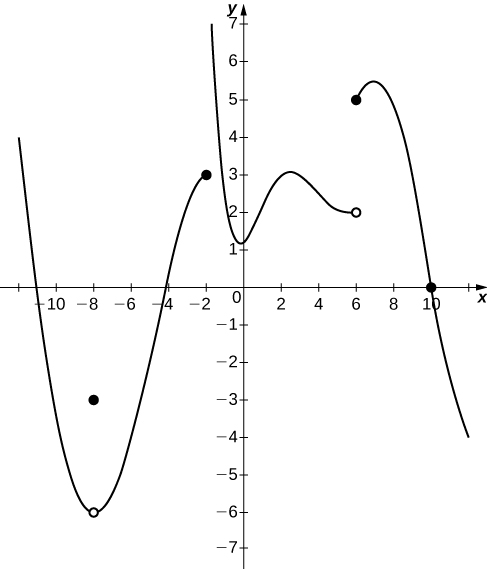
5) \(\displaystyle \lim_{x→−2^+}f(x)=3\)
- Answer:
- False; \(\displaystyle \lim_{x→−2^+}f(x)=+∞\)
6) \(\displaystyle \lim_{x→−8}f(x)=f(−8)\)
7) \(\displaystyle \lim_{x→6}f(x)=5\)
- Answer:
- False; \(\displaystyle \lim_{x→6}f(x)\) DNE since \(\displaystyle \lim_{x→6^−}f(x)=2\) and \(\displaystyle \lim_{x→6^+}f(x)=5\).
8) \(\displaystyle \lim_{x→10}f(x)=0\)
In each exercise, sketch the graph of a function with the given properties.
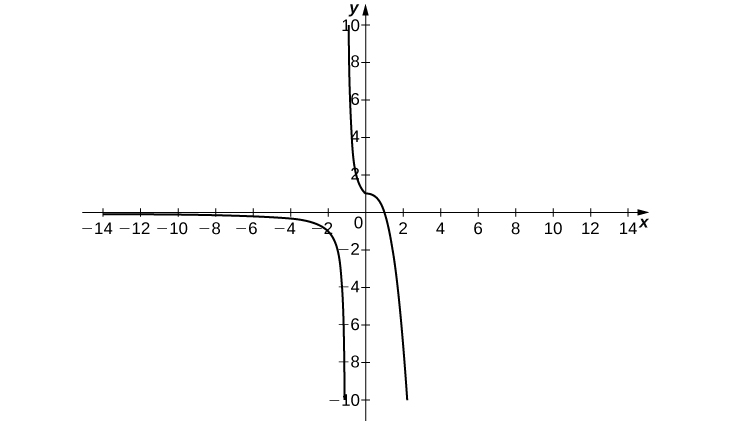
9) \(\displaystyle \lim_{x→−∞}f(x)=0, \quad \lim_{x→−1^−}f(x)=−∞, \quad \lim_{x→−1^+}f(x)=∞,\quad \lim_{x→0}f(x)=f(0), \quad f(0)=1, \quad \lim_{x→∞}f(x)=−∞\)
- Answer:
-
Answers may vary
10) \(\displaystyle \lim_{x→2}f(x)=1, \quad \lim_{x→4^−}f(x)=3, \quad \lim_{x→4^+}f(x)=6, \quad x=4\) is not defined.
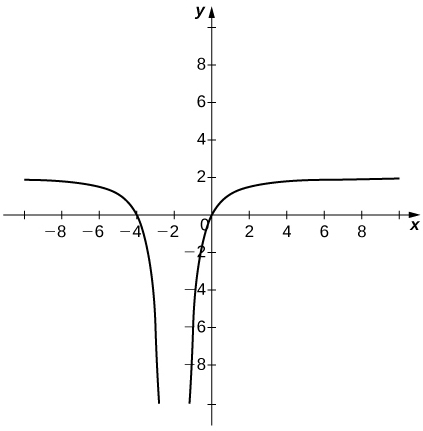
11) \(\displaystyle \lim_{x→−∞}f(x)=2,\quad \lim_{x→−2}f(x)=−∞,\quad \lim_{x→∞}f(x)=2,\quad f(0)=0\)
- Answer:
-
Answer may vary
12) \(\displaystyle \lim_{x→−∞}f(x)=2, \quad \lim_{x→3^−}f(x)=−∞, \quad \lim_{x→3^+}f(x)=∞, \quad \lim_{x→∞}f(x)=2, \quad f(0)=-\frac{1}{3}\)
13) \(\displaystyle \lim_{x→−∞}f(x)=0,\quad \lim_{x→−1^−}f(x)=∞,\quad \lim_{x→−1^+}f(x)=−∞, \quad f(0)=−1, \quad \lim_{x→1^−}f(x)=−∞, \quad \lim_{x→1^+}f(x)=∞, \quad \lim_{x→∞}f(x)=0\)
Contributors and Attributions
Gilbert Strang (MIT) and Edwin “Jed” Herman (Harvey Mudd) with many contributing authors. This content by OpenStax is licensed with a CC-BY-SA-NC 4.0 license. Download for free at http://cnx.org.
This page titled 2.4E: Exercises for Section 2.3 was last modified on Wed, 24 May 2023 20:08:10 GMT and is shared under a CC BY-NC-SA 4.0 license and was authored, remixed, and/or curated by Chau D Tran via source content that was edited to the style and standards of the LibreTexts platform.
The book could not be loaded just now.